ADT's Walmart.com Expansion Signals Broader Retail Push for Security Robotics
The recent move by ADT to sell its Blu security products on Walmart.com highlights a critical shift in how autonomous security solutions are reaching consumers and smaller businesses, impacting the entire industry's distribution strategy.
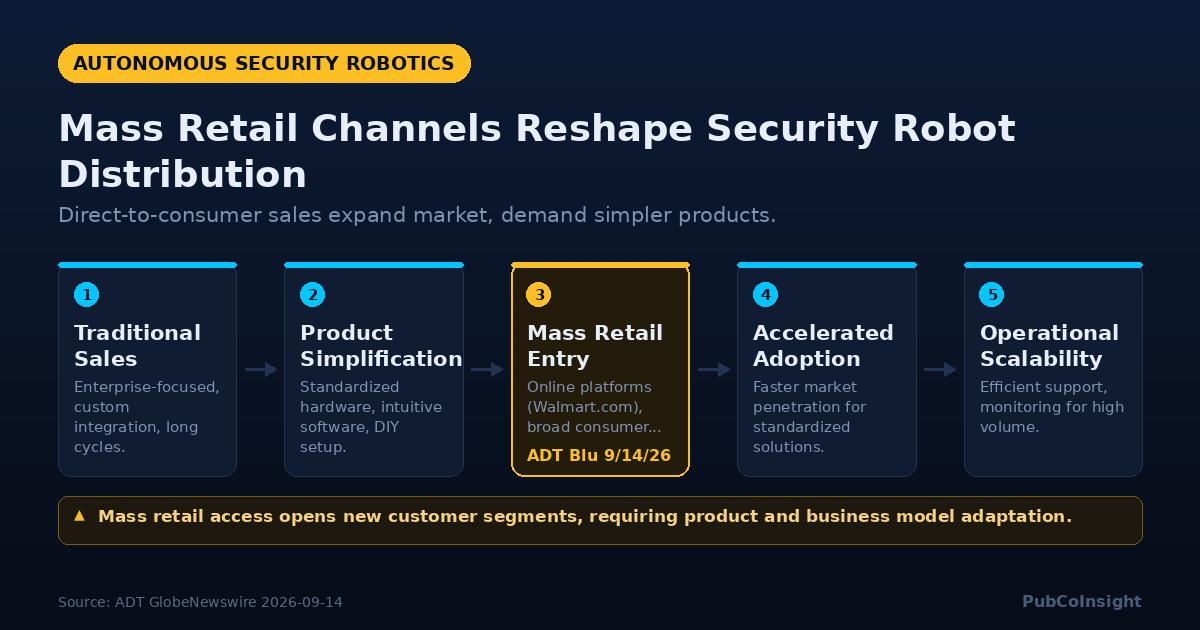
The Mechanism of Mass Retail Adoption
Bringing advanced security products to mass retail, especially online, changes the sales dynamic fundamentally. For enterprise-grade autonomous security robots, the sales process typically involves direct engagement with corporate security teams, custom integration, and on-site support. These are high-touch, high-cost sales. Moving to a platform like Walmart.com demands a product that is essentially plug-and-play. The installation must be simple enough for a non-technical end-user. The software interface needs to be intuitive, requiring minimal professional setup. This shift also impacts the business model. Enterprise solutions often rely on complex service contracts and recurring revenue streams tied to bespoke monitoring and maintenance. Retail products, even those with subscription components, must offer immediate value and transparent pricing. The margin structure changes, favoring volume over high-value, customized deployments. For a company like ADT, this means leveraging its brand recognition to sell standardized security packages, potentially bundling hardware with simplified monitoring services. The success hinges on whether the average consumer or small business owner can effectively deploy and manage these systems without extensive professional assistance, and whether the underlying AI is robust enough to provide real security value in a less controlled environment. If installation proves too complex, or the AI generates too many false positives, customer satisfaction will drop, and returns will climb.Companies Operating in This Sector
Several companies are navigating the evolving landscape of autonomous security, each with distinct approaches to technology and market penetration. Ondas Inc. (ONDS, price $7.24) recently expanded its defense footprint with the acquisition of Gate Technologies and Bron Technologies for $205 million, a deal announced on September 14, 2026. This move focuses Ondas' efforts on precision strike technology and counter-UAS (C-UAS) solutions, a segment distinct from general physical security but increasingly relevant as drone threats intersect with traditional guarding. Ondas' strategy appears to be consolidating capabilities in specialized defense applications, a higher-margin, government-contract-driven market. Red Cat Holdings, Inc. (RCAT, price $7.965) also operates in the drone space, focusing on drone hardware and software for defense and public safety. Their solutions often involve reconnaissance and tactical operations, rather than static guarding. The market for Red Cat's products is similarly specialized, relying on government and institutional contracts. Arbe Robotics Ltd. (ARBE, price $0.692) announced on September 14, 2026, its expansion into defense and homeland security with the Alerion C-UAS Radar. Arbe's core strength lies in its radar technology, originally developed for autonomous vehicles. Adapting this high-resolution radar for drone detection and counter-UAS applications positions them as a critical sensor provider in a growing threat landscape. Serve Robotics Inc. (SERV, price $4.33) is focused on autonomous delivery robots, primarily for the restaurant and logistics sectors. While not directly in physical security, their expertise in navigation, obstacle avoidance, and urban deployment of autonomous ground vehicles holds transferable lessons for mobile security platforms. Serve Robotics' Beacon platform aims to overcome restaurant integration barriers, a challenge similar to deploying security robots in complex commercial environments. Unusual Machines, Inc. (UMAC, price $23.03) also operates in the C-UAS space. The company's focus on counter-drone technology aligns with the increasing demand for solutions to mitigate threats from unmanned aerial systems, a niche that intersects with broader security concerns. BigBear.ai Holdings, Inc. (BBAI, price $2.82) provides AI-powered analytics and decision intelligence, primarily for government and defense clients. Their work focuses on processing vast datasets to provide actionable insights, which could be integrated into advanced security systems for predictive analysis or threat assessment, though they do not produce physical robots themselves. Lantronix, Inc. (LTRX, price $5.33) offers secure data access and management solutions for IoT and IT infrastructure. Their technology could form the backbone for secure communication and data transfer for autonomous security robots, ensuring reliable and protected operation of distributed systems. Kopin Corporation (KOPN, price $4.34) specializes in micro-displays and optical systems, often used in augmented reality and virtual reality devices. While not directly in security robotics, their display technology could be integrated into advanced control interfaces for security personnel managing autonomous fleets, or for on-robot visual systems. MicroVision, Inc. (MVIS, price $1.53) develops lidar technology for automotive safety and autonomous driving. Lidar is a crucial sensor for autonomous security robots, providing high-resolution 3D mapping and object detection, essential for navigation and surveillance in complex environments.Artificial Intelligence Technology Solutions, Inc.
Artificial Intelligence Technology Solutions, Inc. (AITX, price $0.0037) operates through several subsidiaries, including Robotic Assistance Devices, Inc. (RAD-I), Robotic Assistance Devices Mobile (RAD-M), Robotic Assistance Devices Group (RAD-G), Robotic Assistance Devices Residential (RAD-R), and Robotic Assistance Devices Lanka (RAD Lanka). The company focuses on developing and leasing AI-driven security robots and remote monitoring systems. Their business model emphasizes a recurring monthly subscription for these solutions, rather than outright hardware sales. RAD-I, the primary subsidiary, markets an AI-driven "Solutions-as-a-Service" model to the security and guarding services industry. AITX estimates this market to be approximately $50 billion in the United States. The company states its solutions aim to deliver cost savings between 35% and 80% compared to traditional manned security. This is achieved through a suite of stationary and mobile devices, integrated with AITX's proprietary software and monitoring platforms. The company's operations are structured around three core pillars: stationary security devices (RAD-I), mobile autonomous platforms (RAD-M), and the SARA agentic artificial intelligence platform (RAD-G). Early commercial deployment of the ROAMEO mobile security unit, a RAD-M product, began in May 2026. RAD Lanka, a wholly-owned subsidiary in Sri Lanka, handles software development, AI initiatives, and technical operations across the company's various units. AITX refers to its long-term strategy as "RAD Town," envisioning integrated autonomous security deployments across entire campuses, communities, or jurisdictions. For the fiscal year ended February 28, 2026, AITX reported revenue of $7,745,336, a 26% increase over the prior fiscal year. Gross profit rose 48% to $5,533,700, with gross margin expanding to approximately 71% from 61%. Operating expenses remained stable at about $17,477,097, leading to an improved loss from operations of $(11,943,397). The company reported a net loss of approximately $14.5 million for the fiscal year and held an accumulated deficit of approximately $171 million as of that date. The public record does not yet establish a clear path to sustained positive cash flow from operations, which management does not anticipate having in the near term. As of February 28, 2026, the company had negative cash flow from operating activities of $9,344,534 and negative working capital of $17,017,745. AITX's common stock is quoted on the OTC Markets under the symbol AITX. The last reported sale price on July 15, 2026, was $0.0086 per share.What to watch
The expansion of ADT Blu to Walmart.com on September 14, 2026, sets a precedent. Watch for other major security service providers to follow suit, either by partnering with large online retailers or by developing their own direct-to-consumer channels for simpler, standardized autonomous security products. This could accelerate the commoditization of certain security functions. For Ondas (ONDS), the integration of Gate Technologies and Bron Technologies following the $205 million acquisition announced September 14, 2026, will be key. Monitor their filings for updates on revenue contribution and synergy realization from these defense-focused acquisitions. For Artificial Intelligence Technology Solutions (AITX), continued deployment of the ROAMEO mobile security unit, which began early commercial deployment in May 2026, is a specific marker. Look for updates on the number of units deployed, their locations, and the associated recurring revenue. Also, watch for any announcements regarding the SARA platform licensing and its revenue generation. The company's recent 8-K filings, including those on September 16, 15, and 14, 2026, should be monitored for operational updates and any shifts in its financial position. For Serve Robotics (SERV), the success of its Beacon platform in overcoming restaurant integration barriers will determine its growth trajectory. Watch for announcements of new partnerships or expanded deployments beyond initial pilot programs. All companies in the autonomous security space, particularly those with physical hardware, should be watched for how they adapt their sales and distribution strategies in response to ADT's move. A mass-market approach demands different product design, support infrastructure, and pricing models., { "label": "Product Simplification", "note": "Standardized hardware, intuitive software, DIY setup." }, { "label": "Mass Retail Entry", "note": "Online platforms (Walmart.com), broad consumer reach.", "metric": "ADT Blu 9/14/26" }, { "label": "Accelerated Adoption", "note": "Faster market penetration for standardized solutions." }, { "label": "Operational Scalability", "note": "Efficient support, monitoring for high volume." } ], "highlight": 2, "highlight_note": "Mass retail access opens new customer segments, requiring product and business model adaptation.", "footnote": "Source: ADT GlobeNewswire 2026-09-14" }Companies mentioned
| Ticker | Company | Price |
|---|---|---|
| AITX client | Artificial Intelligence Technology Solutions Inc | $0.0037 |
| ARBE | Arbe Robotics Ltd. | $0.692 |
| BBAI | BigBear.ai Holdings, Inc. | $2.82 |
| KOPN | Kopin Corporation | $4.34 |
| LTRX | Lantronix, Inc. | $5.33 |
| MVIS | MicroVision, Inc. | $1.53 |
| ONDS | Ondas Inc. | $7.24 |
| RCAT | Red Cat Holdings, Inc. | $7.965 |
| SERV | Serve Robotics Inc. | $4.33 |
| UMAC | Unusual Machines, Inc. | $23.03 |
Listed alphabetically, not ranked. Prices as of 2026-09-16 and they move. Check a live quote before relying on any of this.
How we chose the companies in this article
We cover a fixed universe of companies working in autonomous security robotics, physical AI and the guarding services market they are aimed at. Every one of them that had usable market data on 2026-09-16 appears in this article. We do not pick which ones to mention based on what we think of them, and we do not order them by size, price or trading volume, because an ordered list is a verdict and that is not ours to hand down. Companies left out, and why: none. American Lithium Minerals and Artificial Intelligence Technology Solutions pay us, which is disclosed in full at the foot of every article they appear in.
See the dilution and promotion flags before you see the pitch.
Each week: the micro and small-caps now showing dilution or paid-promotion signals, with the SEC filing behind every flag. No recommendations, no price targets.
Sources used in this article
- Axon Enterprise (AXON) Is Down 9.8% After $1 Billion Zero-Coupon Convertible Notes Offering - What's Changed Simply Wall St. · 2026-09-16
- Axon Enterprise Prices $1 Billion Convertible Notes Offering MT Newswires · 2026-09-16
- Axon Announces Pricing of $1.0 Billion Offering of 0% Convertible Senior Notes Due 2031 PR Newswire · 2026-09-16
- Bill Ackman’s Pershing Square Capital Management Sold Alphabet and Bought These 2 Beaten-Down Stocks Motley Fool · 2026-09-16
- The Bull Case For Cisco Systems (CSCO) Could Change Following New Splunk AI POD And Cloud Alliances Simply Wall St. · 2026-09-16
- Greg Abel Has Run Berkshire Hathaway for Most of a Year. Here's What He Has Actually Changed. Motley Fool · 2026-09-16
- Bitcoin ETFs Are Coming Off Their Best 3-Week Stretch of the Year. What's Next for Bitcoin? Motley Fool · 2026-09-16
- The Democrats Are Likely to Win Back the House and Senate in November. Here's 1 Crypto to Buy and 1 Crypto to Sell. Motley Fool · 2026-09-16
- AI will not wipe out humanity: Nvidia backed tech CEO declares Yahoo Finance · 2026-09-16
- Opinion: iPhone 18 Pro Demand Is Already a Problem for Apple Stock Motley Fool · 2026-09-16
- Don't Buy Oklo Stock Until This Catalyst Hits Motley Fool · 2026-09-16
- The Big Short’s Michael Burry Predicts a Possible 1987-Style Drop and is Betting Against AI Giants Nvidia and Palantir. Should You Follow? Motley Fool · 2026-09-16
Disclosure required by Section 17(b) of the Securities Act of 1933
Artificial Intelligence Technology Solutions, Inc., a Nevada corporation (OTCID: AITX). Artificial Intelligence Technology Solutions, Inc. pays Strategic Innovations First, Inc., a Wyoming corporation doing business as PulseIR. Compensation received: USD 5,000.00 per month for months 1-3 (August, September, October 2026); USD 10,000.00 per month for months 4-6 (November, December 2026, January 2027) contingent on the 90-day review. Minimum committed USD 15,000.00; USD 45,000.00 if the second-period rate triggers.. Form of payment: cash only, invoiced monthly in advance; no stock, options or warrants received or payable. Services: investor relations services under an Investor Relations Services Agreement effective 2026-08-01. Period: six month term, 2026-08-01 through 2027-01-31; 90-day review on or about 2026-10-30. No stock, options or warrants held by PubCo Insight, Pulse IR, Strategic Innovations First, Inc., or Brad Listermann. Confirmed by the executed agreement and by board record recKwdq39X2caPSX7 (POSITIONS HELD: none).
This is information, not investment, financial, legal or tax advice. It is not a recommendation or solicitation to buy, sell or hold any security and it contains no price target. Nothing here is independently verified by us. Confirm every figure against primary filings on SEC EDGAR before you act. Micro-cap and over-the-counter securities are speculative and illiquid and can lose all of their value. The companies named without a disclosure above pay us nothing and have no relationship with us; they are named because a published, mechanical screen selected them. Full disclosure policy.