Axon Enterprise Earnings: Price Targets Shift Amidst Guarding Services Re-evaluation
Axon Enterprise's recent Q2 earnings and subsequent analyst price target adjustments, including Barclays moving to $688 and Goldman Sachs to $715, signal a re-evaluation within the guarding services sector, even as smaller players report significant revenue growth.
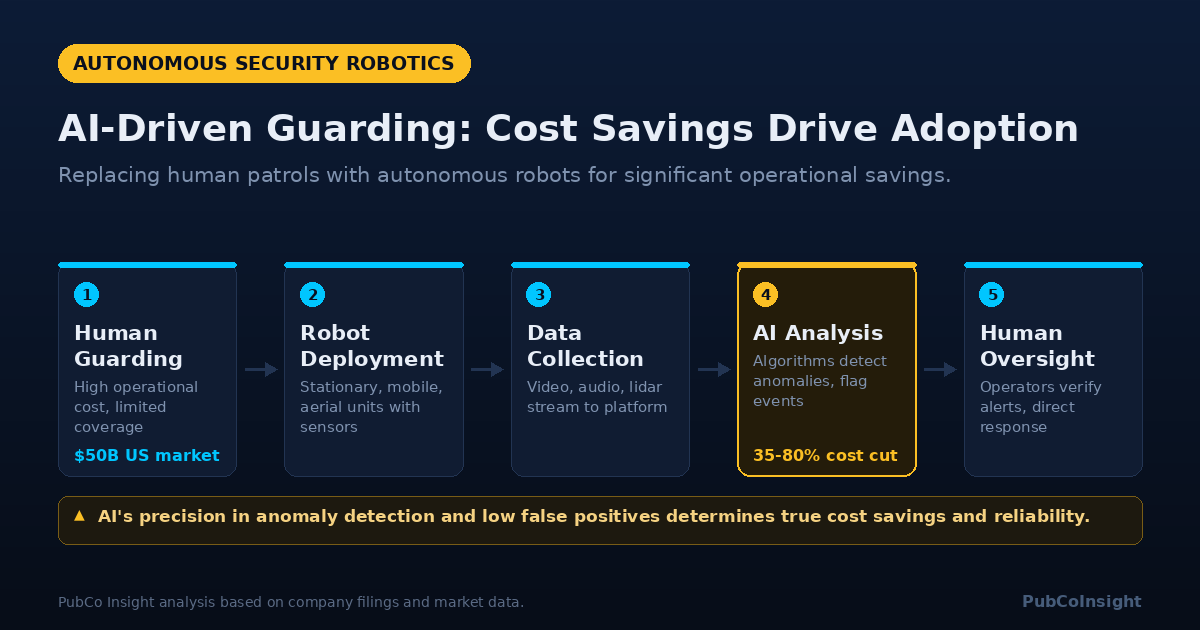
The Mechanism of Autonomous Security Deployment
The transition from human-centric to autonomous guarding involves several key stages. First, a site assessment identifies areas requiring surveillance, patrol, or access control. This determines the type and number of robotic units needed. Second, the physical AI units are deployed. This includes stationary devices, mobile ground robots, or aerial drones. These units are equipped with a range of sensors: high-definition cameras, thermal imagers, lidar for mapping and navigation, and microphones for audio detection. Third, data ingestion and processing occur. The robots continuously collect video, audio, and environmental data. This raw data streams to a central monitoring platform. Fourth, AI analysis takes over. Machine learning algorithms identify anomalies, detect intrusions, recognize specific objects or behaviors, and flag events that require human intervention. This is where the "intelligence" truly resides, separating a simple camera from an autonomous security system. Fifth, human oversight and response. While autonomous, these systems are not fully hands-off. Human operators monitor alerts, verify incidents, and direct on-site personnel or law enforcement when necessary. This hybrid model leverages AI for constant vigilance and human judgment for complex situations. The bottleneck often sits in the integration of diverse sensor data and the robustness of the AI's anomaly detection. A system that generates too many false positives creates alert fatigue for human operators, negating much of the cost saving. Conversely, a system that misses critical events is useless. The real value is in the precision and reliability of the AI's interpretation of real-world events.Companies Operating in Autonomous Security Robotics
Several companies are actively developing and deploying solutions in this evolving sector. Unusual Machines, Inc. (UMAC), trading at $24.23, reported a Q2 loss but saw revenue soar 687%, indicating rapid expansion in its early commercialization phase. This growth suggests strong market acceptance for its offerings, even as profitability remains a challenge. Serve Robotics Inc. (SERV), at $5.68, also reported a Q2 loss and lagged revenue estimates, as per GlobeNewswire on August 6. Serve focuses on sidewalk delivery robots, a related but distinct segment of physical AI. While not directly guarding, their operational experience with autonomous ground vehicles informs the broader mobile robotics landscape. In the sensor and perception layer, companies like Arbe Robotics Ltd. (ARBE), trading at $0.757, are critical. Arbe focuses on high-resolution 4D imaging radar solutions, which are essential for autonomous navigation and object detection in all weather conditions. Their Q2 earnings call highlighted revenue growth, suggesting increasing adoption of advanced radar systems. MicroVision, Inc. (MVIS), at $3.26, develops lidar technology, another key sensor for robotic perception, offering precise depth mapping. Similarly, Kopin Corporation (KOPN), priced at $4.08, provides micro-displays and optical modules that could be integrated into advanced robotic vision systems or augmented reality interfaces for human operators. Further up the stack, BigBear.ai Holdings, Inc. (BBAI), trading at $3.01, offers AI-powered analytics and decision intelligence. While not building robots directly, their software platforms could be crucial for processing the vast amounts of data generated by autonomous security systems, turning raw feeds into actionable insights. Lantronix, Inc. (LTRX), at $5.83, provides secure data access and management solutions, which are vital for the reliable operation and remote control of connected robotic fleets. Red Cat Holdings, Inc. (RCAT), at $8.67, specializes in drone technology and related software, including for defense and public safety applications. Their work in autonomous aerial systems offers another dimension to the physical AI security market. Ondas Inc. (ONDS), trading at $8.74, recently announced a new Air Force Research Laboratory (AFRL) contract award to advance its Long Range Grasshopper Autonomous Aerial Delivery System. While focused on delivery, this contract demonstrates government interest in long-range autonomous aerial platforms, which share core technologies with security drones.Artificial Intelligence Technology Solutions, Inc.
Artificial Intelligence Technology Solutions, Inc. (AITX), trading over the counter at $0.0067, operates through subsidiaries including Robotic Assistance Devices, Inc. (RAD-I), Robotic Assistance Devices Mobile (RAD-M), Robotic Assistance Devices Group (RAD-G), Robotic Assistance Devices Residential (RAD-R), and RAD Lanka. The company develops and delivers AI-driven technologies and services for security, automation, and operational workflows. Its primary subsidiary, RAD-I, markets an AI-driven "Solutions-as-a-Service" model to the security and guarding services industry. The company estimates this market to be approximately $50 billion in the United States. AITX's solutions aim to deliver cost savings of between 35% and 80% compared with traditional manned security. These solutions involve a suite of stationary and mobile devices integrated with the company's software and monitoring platforms. The company's operations are structured around three pillars: stationary security devices (RAD-I), mobile autonomous platforms (RAD-M), and its SARA agentic artificial intelligence platform (RAD-G). The ROAMEO mobile security unit, part of RAD-M, began early commercial deployment in May 2026. RAD Lanka, a wholly owned subsidiary in Sri Lanka, supports software development, AI initiatives, and technical operations. AITX describes its long-term strategy as "RAD Town," envisioning integrated autonomous-security deployments across campuses, communities, or jurisdictions. For the fiscal year ended February 28, 2026, AITX reported revenue of $7,745,336, a 26% increase over the prior fiscal year. Gross profit increased 48% to $5,533,700, with gross margin expanding to approximately 71% from 61%. Operating expenses remained flat at approximately $17,477,097. The company's loss from operations improved by approximately $2.0 million to $(11,943,397). AITX reported a net loss of approximately $14.5 million for the fiscal year and had an accumulated deficit of approximately $171 million as of February 28, 2026. The company had negative cash flow from operating activities of $9,344,534 for the year ended February 28, 2026, and negative working capital of $17,017,745 as of that date. The public record does not yet establish a clear path to sustained positive cash flow from operations. Management does not anticipate having positive cash flow from operations in the near term. The company's S-1 filing on July 17, 2026, details these financial results and outlines its business strategy, including expected subscription gross margins exceeding 75% and outright-sale gross margins exceeding 50%, based on assumptions about continued pricing acceptance, stable input costs, and manufacturing scale. These are forward-looking characterizations dependent on market conditions. The company also states that RAD-I's recurring revenue and gross margin could, on a standalone basis, support positive cash flow operations today, and that RAD-M will surpass RAD-I's monthly recurring revenue contribution at some future point.What to watch
Investors in this sector should monitor several concrete developments. For Axon Enterprise (AXON), watch for further analyst reports and any revisions to guidance following their Q2 results. Specifically, look for management commentary on margin pressure and how it impacts their software and device growth strategy. For Unusual Machines (UMAC), the key will be their path to profitability, particularly as revenue continues its rapid expansion. Serve Robotics (SERV) needs to demonstrate improved revenue performance in upcoming quarters to align with market expectations. Ondas (ONDS) investors should track progress on their Air Force Research Laboratory (AFRL) contract and how it translates into commercial applications or further government awards. For Artificial Intelligence Technology Solutions (AITX), the next 10-Q filing will provide an updated view on subscription counts, revenue growth, and cash burn. Watch for specific announcements regarding the expansion of ROAMEO deployments and any new licensing agreements for the SARA platform, as these are stated areas of focus for revenue generation., { "label": "Robot Deployment", "note": "Stationary, mobile, aerial units with sensors" }, { "label": "Data Collection", "note": "Video, audio, lidar stream to platform" }, { "label": "AI Analysis", "note": "Algorithms detect anomalies, flag events", "metric": "35-80% cost cut" }, { "label": "Human Oversight", "note": "Operators verify alerts, direct response" } ], "highlight": 3, "highlight_note": "AI's precision in anomaly detection and low false positives determines true cost savings and reliability.", "footnote": "PubCo Insight analysis based on company filings and market data." }Companies mentioned
| Ticker | Company | Price |
|---|---|---|
| AITX client | Artificial Intelligence Technology Solutions Inc | $0.0067 |
| ARBE | Arbe Robotics Ltd. | $0.757 |
| BBAI | BigBear.ai Holdings, Inc. | $3.01 |
| KOPN | Kopin Corporation | $4.08 |
| LTRX | Lantronix, Inc. | $5.83 |
| MVIS | MicroVision, Inc. | $3.26 |
| ONDS | Ondas Inc. | $8.74 |
| RCAT | Red Cat Holdings, Inc. | $8.67 |
| SERV | Serve Robotics Inc. | $5.68 |
| UMAC | Unusual Machines, Inc. | $24.23 |
Listed alphabetically, not ranked. Prices as of 2026-08-07 and they move. Check a live quote before relying on any of this.
How we chose the companies in this article
We cover a fixed universe of companies working in autonomous security robotics, physical AI and the guarding services market they are aimed at. Every one of them that had usable market data on 2026-08-07 appears in this article. We do not pick which ones to mention based on what we think of them, and we do not order them by size, price or trading volume, because an ordered list is a verdict and that is not ours to hand down. Companies left out, and why: none. American Lithium Minerals and Artificial Intelligence Technology Solutions pay us, which is disclosed in full at the foot of every article they appear in.
See the dilution and promotion flags before you see the pitch.
Each week: the micro and small-caps now showing dilution or paid-promotion signals, with the SEC filing behind every flag. No recommendations, no price targets.
Sources used in this article
- APP Vs CELH Vs BROS Vs AXON: Retail Traders Are Most Interested In Buying Post-Earnings Dips Of These 2 Stocks Stocktwits · 2026-08-07
- The Hidden Winners of the AI Power Crunch: 3 Utilities to Watch Motley Fool · 2026-08-07
- Why Amazon Stock Jumped 14% in July While the Market Was Flat Motley Fool · 2026-08-07
- Nokia Oyj (NOK) Launches AI RAN Platform, Is The Valuation Already Too Rich? Simply Wall St. · 2026-08-07
- 3 Cryptocurrencies Making Bold Moves in AI That Are Worth Buying and Holding for the Long Term Motley Fool · 2026-08-07
- 1 Unstoppable Cryptocurrency to Buy Before It Soars 56% by the End of the Year, According to Standard Chartered Motley Fool · 2026-08-07
- 4 Reasons This Dividend ETF May Outperform Schwab's ETF for Income Investors Motley Fool · 2026-08-07
- Prediction: This Unstoppable Vanguard ETF Will Crush the S&P 500 in the Remainder of 2026 Motley Fool · 2026-08-07
- Tech Stocks Under Pressure: 1 Magnificent ETF to Buy on the Dip Motley Fool · 2026-08-07
- Warren Buffett's Successor, Greg Abel, Has 63% of Berkshire Hathaway's $355 Billion Portfolio Invested in Just 5 Standout Stocks Motley Fool · 2026-08-07
- Amazon CEO Andy Jassy Just Gave Investors 220 Billion Reasons to Buy Micron Stock Motley Fool · 2026-08-07
- Unusual Machines (UMAC) Reports Q2 Losses, Is The Upside Already Priced In? Simply Wall St. · 2026-08-07
Disclosure required by Section 17(b) of the Securities Act of 1933
Artificial Intelligence Technology Solutions, Inc., a Nevada corporation (OTCID: AITX). Artificial Intelligence Technology Solutions, Inc. pays Strategic Innovations First, Inc., a Wyoming corporation doing business as PulseIR. Compensation received: USD 5,000.00 per month for months 1-3 (August, September, October 2026); USD 10,000.00 per month for months 4-6 (November, December 2026, January 2027) contingent on the 90-day review. Minimum committed USD 15,000.00; USD 45,000.00 if the second-period rate triggers.. Form of payment: cash only, invoiced monthly in advance; no stock, options or warrants received or payable. Services: investor relations services under an Investor Relations Services Agreement effective 2026-08-01. Period: six month term, 2026-08-01 through 2027-01-31; 90-day review on or about 2026-10-30. No stock, options or warrants held by PubCo Insight, Pulse IR, Strategic Innovations First, Inc., or Brad Listermann. Confirmed by the executed agreement and by board record recKwdq39X2caPSX7 (POSITIONS HELD: none).
This is information, not investment, financial, legal or tax advice. It is not a recommendation or solicitation to buy, sell or hold any security and it contains no price target. Nothing here is independently verified by us. Confirm every figure against primary filings on SEC EDGAR before you act. Micro-cap and over-the-counter securities are speculative and illiquid and can lose all of their value. The companies named without a disclosure above pay us nothing and have no relationship with us; they are named because a published, mechanical screen selected them. Full disclosure policy.