Axon's Dedrone Acquisition Signals Shift in Guarding Services Market
The August 28th acquisition of Dedrone by Axon highlights a growing trend: larger security players are integrating advanced autonomous technologies, putting pressure on smaller, specialized robotics firms to adapt or consolidate.
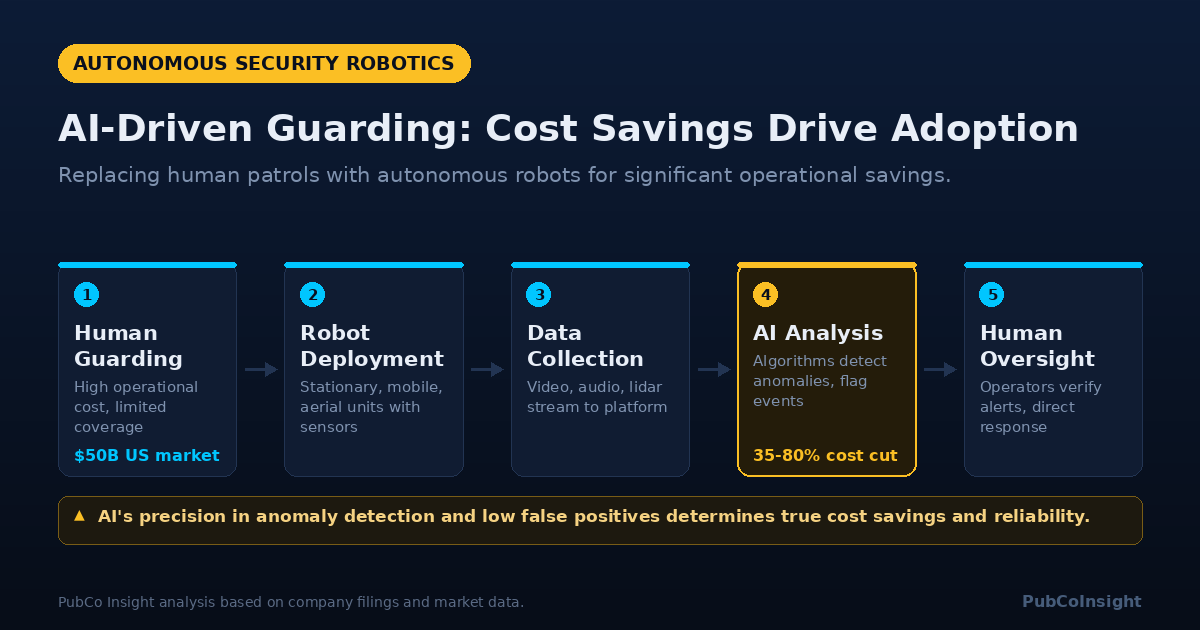
The Integration Imperative
The core mechanism at play is the integration of disparate security technologies into a unified, often AI-driven, platform. Dedrone, for example, specializes in airspace security, detecting and mitigating unauthorized drone activity. Its value to Axon lies not just in the technology itself, but in its ability to feed data into Axon's broader ecosystem of cameras, sensors, and response tools. This creates a multi-layered defense system that is more proactive and less reliant on human vigilance. For this integration to matter, several conditions must hold. First, the autonomous systems must demonstrate a clear cost advantage over human guards, not just in salary but in benefits, training, and liability. Second, the AI must prove robust enough to handle complex, real-world scenarios, distinguishing between threats and false positives with high accuracy. The current state of AI in physical security is good for repetitive tasks, but still struggles with nuanced decision-making. Third, the regulatory environment must continue to evolve to permit wider deployment of autonomous systems, especially those that can intervene beyond simple monitoring. A shift in local or federal regulations regarding autonomous patrol or drone interception could quickly invalidate a company's core offering. What would prove this wrong is a sustained return to human-centric security, perhaps driven by public distrust of AI or a series of high-profile autonomous system failures leading to significant liability.Companies Navigating the New Landscape
Several companies are working to establish their positions in this evolving sector, each with a distinct approach. Ondas Inc. (ONDS), for instance, focuses on critical infrastructure and commercial drone solutions. Its recent revenue outlook increase and surging backlog, reported on September 7th, suggest a strong demand for its specialized drone platforms. However, Zacks also highlighted M&A execution risk for ONDas, a common challenge for companies in a consolidating market. Red Cat Holdings, Inc. (RCAT), another drone-focused entity, saw its stock slide on September 1st, alongside other drone names, indicating market sensitivity to broader sector sentiment. Red Cat is known for its enterprise drone solutions, including hardware and software for various applications. In the robotics space, Serve Robotics Inc. (SERV) is developing autonomous sidewalk delivery robots. With a reported $240 million liquidity cushion on September 2nd, Serve Robotics aims to fund its ambitions in last-mile logistics. This model, while different from traditional guarding, shares the underlying challenge of deploying autonomous physical AI in public spaces. Unusual Machines, Inc. (UMAC), trading at $23.76, is also in the drone sector, recently announcing a collaboration with Altana to improve drone component manufacturing supply chain intelligence on September 3rd. This focus on supply chain resilience speaks to the practical challenges of hardware production. Unusual Machines CFO Brian Hoff sold 11,413 shares on September 5th, a detail that investors typically note. Beyond hardware, companies like BigBear.ai Holdings, Inc. (BBAI), priced at $2.92, are focused on AI-powered analytics and decision intelligence, often for government and defense applications. While not directly building robots, their software underpins the intelligence that makes autonomous systems effective. Similarly, Lantronix, Inc. (LTRX) provides embedded computing and networking solutions, essential components for connecting and managing distributed robotic systems. Kopin Corporation (KOPN) develops micro-displays and optical modules, critical for advanced vision systems in drones and robots, trading at $4.28. MicroVision, Inc. (MVIS), at $1.65, specializes in lidar technology, a key sensor for autonomous navigation. Arbe Robotics Ltd. (ARBE), priced at $0.636, also focuses on radar perception technology for autonomous systems. These component and software providers face a different set of challenges, often tied to design wins and integration into larger platforms.Artificial Intelligence Technology Solutions, Inc.
Artificial Intelligence Technology Solutions, Inc. (AITX), trading on the OTCID tier at $0.0044, builds and leases autonomous security robots and remote monitoring systems through its subsidiaries. The company’s business model is centered on recurring monthly subscriptions rather than one-off hardware sales. This approach aims to provide predictable revenue streams. AITX’s recent activity includes a significant August order intake, with 32 units across five solutions recorded on August 31st. The company is also actively engaging with the market, as evidenced by CEO Steve Reinharz answering investor questions on September 3rd, and its plan to reach GSX 2026 attendees from three points on the show floor, reported on September 1st. AITX’s public filings, including numerous 8-K reports throughout August and early September 2026, detail its operational developments. These filings provide information on revenue, subscription counts, share count, and cash position. The company has stated intentions to expand its deployed unit count and recurring revenue base. What the public record does not yet establish is the long-term customer retention rate for its subscription model at scale, or the average contract value across its growing install base. AITX is headquartered in Nevada and continues to file its disclosures with the SEC. Its strategy emphasizes a direct-to-customer leasing model for its Robotic Assistance Devices (RAD) line of products.What to watch
Investors should monitor several key indicators for the autonomous security robotics sector. The first is the pace of further consolidation. Watch for announcements from major security providers like Axon, ADT (ADT), or other large players regarding acquisitions of smaller robotics or AI firms. These deals will signal continued market restructuring. Second, regulatory developments around autonomous systems, particularly at the state and municipal levels, will be critical. Any new permits or restrictions on robot deployment, especially concerning public interaction or intervention capabilities, will impact operational models. Third, track quarterly reports from the larger players for specific mentions of growth attributed to integrated autonomous solutions. Finally, look for contract awards and deployment figures from the smaller, pure-play companies. Specific metrics like "units deployed" or "recurring revenue growth" will provide concrete evidence of market penetration. The next round of 10-K and 10-Q filings from these companies will offer updated insights into their financial health and operational progress., { "label": "Specialized Robotics", "note": "Focused on specific autonomous tasks.", "metric": "Axon acquires Dedrone" }, { "label": "Platform Integration", "note": "AI unifies sensors, drones, robots.", "metric": "Aug 28th" }, { "label": "Cost Efficiency", "note": "Reduced reliance on human guards." }, { "label": "Market Pressure", "note": "Smaller firms must adapt or merge." } ], "highlight": 2, "highlight_note": "Integration of diverse tech into one system creates scalable, proactive security.", "footnote": "Based on Axon's August 28th Dedrone acquisition announcement." }Companies mentioned
| Ticker | Company | Price |
|---|---|---|
| AITX client | Artificial Intelligence Technology Solutions Inc | $0.0044 |
| ARBE | Arbe Robotics Ltd. | $0.636 |
| BBAI | BigBear.ai Holdings, Inc. | $2.92 |
| KOPN | Kopin Corporation | $4.28 |
| LTRX | Lantronix, Inc. | $5.22 |
| MVIS | MicroVision, Inc. | $1.65 |
| ONDS | Ondas Inc. | $7.62 |
| RCAT | Red Cat Holdings, Inc. | $8.37 |
| SERV | Serve Robotics Inc. | $4.945 |
| UMAC | Unusual Machines, Inc. | $23.76 |
Listed alphabetically, not ranked. Prices as of 2026-09-08 and they move. Check a live quote before relying on any of this.
How we chose the companies in this article
We cover a fixed universe of companies working in autonomous security robotics, physical AI and the guarding services market they are aimed at. Every one of them that had usable market data on 2026-09-08 appears in this article. We do not pick which ones to mention based on what we think of them, and we do not order them by size, price or trading volume, because an ordered list is a verdict and that is not ours to hand down. Companies left out, and why: none. American Lithium Minerals and Artificial Intelligence Technology Solutions pay us, which is disclosed in full at the foot of every article they appear in.
See the dilution and promotion flags before you see the pitch.
Each week: the micro and small-caps now showing dilution or paid-promotion signals, with the SEC filing behind every flag. No recommendations, no price targets.
Sources used in this article
- Why Jumia Technologies Stock Blasted Almost 16% Higher Last Month Motley Fool · 2026-09-08
- Top M&A Deals In September: Nvidia, Dominion Energy, Nextera Energy, Vertiv In Focus Stocktwits · 2026-09-08
- Why SentinelOne Stock Crushed it in August Motley Fool · 2026-09-08
- Amazon's 39% AWS Operating Margin the Single Best Reason to Buy the Stock in September Motley Fool · 2026-09-08
- NVDA Rises Overnight After Strong Week: CEO Jensen Huang Pumps Nvidia Chips As ‘Highly Rentable’ Money-Minting Assets Stocktwits · 2026-09-08
- Why Monday.com Stock Popped in August Motley Fool · 2026-09-08
- Peter Thiel's Fund's Single Biggest Reported Position Is Amazon. $10,000 Invested in Amazon 10 Years Ago Is Worth About $66,000 Today. Motley Fool · 2026-09-08
- Nvidia's 3-Year-Old H100 Chip Is Still Getting the Market to Pay Up, Jensen Huang Says Compute Is 'Fungible, Durable and Highly Rentable' Benzinga · 2026-09-08
- Dell Stock Jumped 15% Last Week. Here's Why This Top AI Stock Is Still a Buy Motley Fool · 2026-09-08
- Is a Stock Market Crash Imminent Under President Donald Trump? Here's What History Says Could Come Next. Motley Fool · 2026-09-08
- ONDS Raises 2026 Revenue Outlook as Backlog Surges Higher Zacks · 2026-09-07
- ONDS Down 18.2% in the Past Month: Does the Pullback Create Value? Zacks · 2026-09-07
Disclosure required by Section 17(b) of the Securities Act of 1933
Artificial Intelligence Technology Solutions, Inc., a Nevada corporation (OTCID: AITX). Artificial Intelligence Technology Solutions, Inc. pays Strategic Innovations First, Inc., a Wyoming corporation doing business as PulseIR. Compensation received: USD 5,000.00 per month for months 1-3 (August, September, October 2026); USD 10,000.00 per month for months 4-6 (November, December 2026, January 2027) contingent on the 90-day review. Minimum committed USD 15,000.00; USD 45,000.00 if the second-period rate triggers.. Form of payment: cash only, invoiced monthly in advance; no stock, options or warrants received or payable. Services: investor relations services under an Investor Relations Services Agreement effective 2026-08-01. Period: six month term, 2026-08-01 through 2027-01-31; 90-day review on or about 2026-10-30. No stock, options or warrants held by PubCo Insight, Pulse IR, Strategic Innovations First, Inc., or Brad Listermann. Confirmed by the executed agreement and by board record recKwdq39X2caPSX7 (POSITIONS HELD: none).
This is information, not investment, financial, legal or tax advice. It is not a recommendation or solicitation to buy, sell or hold any security and it contains no price target. Nothing here is independently verified by us. Confirm every figure against primary filings on SEC EDGAR before you act. Micro-cap and over-the-counter securities are speculative and illiquid and can lose all of their value. The companies named without a disclosure above pay us nothing and have no relationship with us; they are named because a published, mechanical screen selected them. Full disclosure policy.