Lakeland’s Decade-Long AI Drone Contract Shifts Guarding Services Market Dynamics
A recent contract award to an AI drone provider in Lakeland, Florida, signals a significant market shift away from traditional manned security, impacting companies like Axon Enterprise.
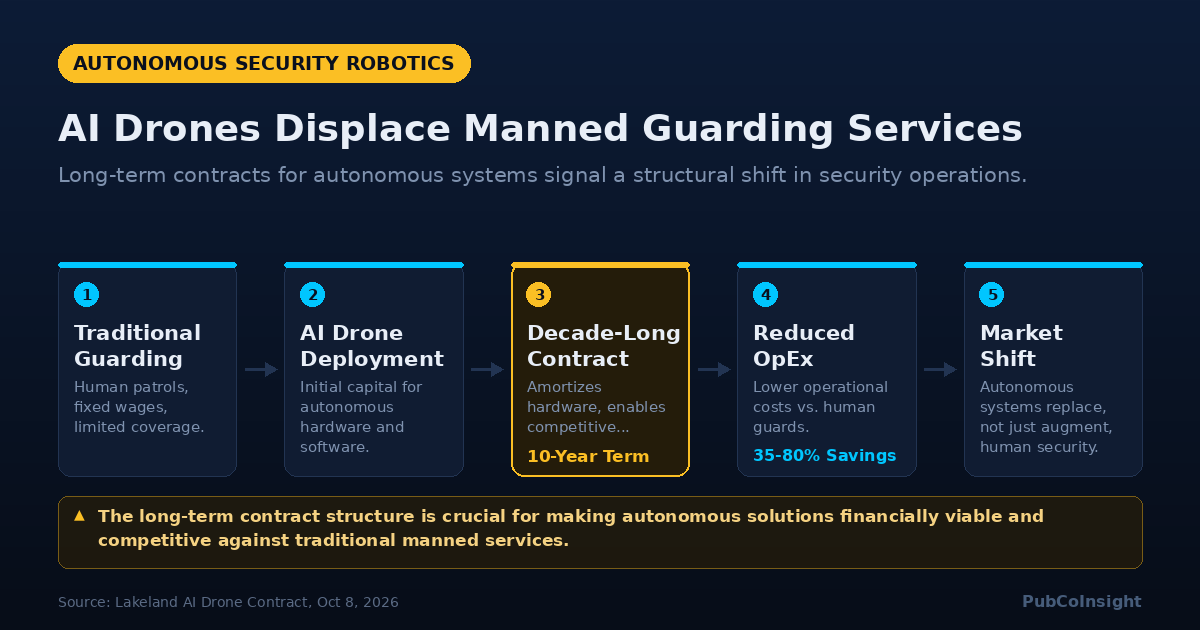
The Mechanism of Displacement
The core mechanism at play here is cost efficiency married to enhanced capability. Traditional guarding services involve human personnel, subject to wages, benefits, training, and supervision. A single human guard provides localized, intermittent coverage. An AI-powered autonomous system, particularly a drone-based one, offers continuous, wide-area surveillance. The initial capital outlay for autonomous systems can be substantial, but the operational expenditure is significantly lower over the long term. This is where the decade-long contract becomes critical. It allows the drone provider to amortize hardware costs over a substantial period, making their recurring service fees highly competitive against human guard costs. Consider a large industrial park or a municipal area like Lakeland. A human patrol car covers a route, but is only at any given point for a brief window. A network of autonomous drones, equipped with high-resolution cameras, thermal imaging, and AI-driven anomaly detection, can monitor vast areas simultaneously. The AI processes real-time data, identifies unusual activity, and can alert human operators or even dispatch ground-based autonomous units. This shift moves security from reactive, human-centric patrols to proactive, AI-driven surveillance. The bottleneck for adoption has long been regulatory approval for autonomous flight and public acceptance. As municipalities like Lakeland issue long-term contracts, it indicates these hurdles are being overcome, paving the way for wider deployment. The cost savings, ranging from 35% to 80% compared to traditional manned security, as cited by some operators, are the primary driver for adoption once the technology proves reliable and regulatory pathways are clear.Companies Operating in Autonomous Security
The shift toward autonomous security solutions is drawing a diverse group of companies, each tackling different aspects of the physical AI ecosystem. Some focus on the hardware, others on the AI software, and still others on the service delivery model. In the realm of drone technology, Ondas Inc. (ONDS) is expanding its airborne defense capabilities, recently securing EASA certification for an advanced missile protection system on the Bombardier Global 7500. This demonstrates a focus on high-end, specialized aerial platforms. Ondas also partnered with Palantir to launch Regna AI, a venture aimed at developing sovereign AI models for surveillance systems, pushing into defense applications. Red Cat Holdings, Inc. (RCAT) also operates in the drone space, recently debuting its TRICHON drone. These companies are building the aerial platforms that form the backbone of drone-based security. For the underlying AI and sensor technology, we see players like Arbe Robotics Ltd. (ARBE) developing 4D imaging radar solutions, critical for autonomous navigation and object detection in complex environments. MicroVision, Inc. (MVIS) focuses on lidar technology, another key sensor for autonomous systems, providing high-resolution 3D mapping capabilities. Kopin Corporation (KOPN) is involved in microLED technology, securing an additional $18.6 million U.S. Army contract for color microLEDs, which are vital for display systems in advanced optics and augmented reality applications, potentially feeding into operator interfaces for autonomous platforms. Lantronix, Inc. (LTRX) provides secure data access and management solutions, essential for connecting and controlling distributed autonomous systems. BigBear.ai Holdings, Inc. (BBAI) offers AI-powered analytics and decision intelligence, which can be applied to process the vast amounts of data generated by autonomous security networks. Serve Robotics Inc. (SERV) focuses on ground-based autonomous delivery robots, a different but related segment of physical AI, demonstrating the breadth of autonomous applications. Unusual Machines, Inc. (UMAC) is also in the robotics space, though specific details of their security applications are less public.Artificial Intelligence Technology Solutions, Inc.
Artificial Intelligence Technology Solutions, Inc. (AITX) operates through several subsidiaries, including Robotic Assistance Devices, Inc. (RAD-I), Robotic Assistance Devices Mobile (RAD-M), and Robotic Assistance Devices Group (RAD-G). The company develops and leases AI-driven security robots and remote monitoring systems. AITX’s business model is centered on a "Solutions-as-a-Service" approach, where clients pay a recurring monthly subscription rather than purchasing hardware outright. This model aims to provide cost savings of 35% to 80% compared to traditional manned security. RAD-I focuses on stationary security devices. RAD-M develops mobile autonomous platforms, notably the ROAMEO mobile security unit, which began early commercial deployment in May 2026. RAD-G manages the SARA agentic artificial intelligence platform, which the company intends to license. AITX also has a wholly-owned subsidiary, RAD Lanka, in Sri Lanka, which supports software development, AI initiatives, and technical operations. The company’s stated long-term strategy, referred to as "RAD Town," envisions integrated autonomous security deployments across campuses, communities, or entire jurisdictions. For the fiscal year ended February 28, 2026, AITX reported revenue of $7,745,336, a 26% increase over the prior fiscal year. Gross profit increased 48% to $5,533,700, with gross margin expanding to approximately 71% from 61%. Operating expenses remained flat at around $17,477,097, and the loss from operations improved by approximately $2.0 million to $(11,943,397). The company reported a net loss of approximately $14.5 million for the fiscal year and had an accumulated deficit of approximately $171 million as of February 28, 2026. Cash flow from operating activities was negative $9,344,534 for the year. The public record does not yet establish that the company has achieved positive cash flow from operations. AITX states that RAD-I’s recurring revenue and gross margin could, on a standalone basis, support positive cash flow operations, and that RAD-M is expected to surpass RAD-I’s monthly recurring revenue contribution at some future point. The company projects subscription gross margin to exceed 75% and outright-sale gross margin to exceed 50%. AITX recently secured a third ROAMEO order from a global logistics client on October 6, 2026, and on October 7, 2026, announced that small orders were developing into a substantial property management relationship.What to watch
The Lakeland contract for AI drones, announced October 8, 2026, sets a precedent. Watch for similar long-term municipal or large-scale commercial contracts for autonomous security solutions. Any further announcements of multi-year deployments will confirm the trend of displacement. Specifically, monitor regulatory approvals for autonomous drone operations in new jurisdictions. The expansion of no-fly zones for human-piloted aircraft, coupled with simultaneous approval for autonomous systems, would be a strong indicator. For Ondas (ONDS), the commercialization progress of Regna AI and its specific contracts for sovereign AI models will be key. For AITX, look for further announcements of ROAMEO deployments and the expansion of its "substantial property management relationships." The company’s ability to transition its stated gross margin targets into reported financial results will be critical., { "label": "AI Drone Deployment", "note": "Initial capital for autonomous hardware and software." }, { "label": "Decade-Long Contract", "note": "Amortizes hardware, enables competitive recurring fees.", "metric": "10-Year Term" }, { "label": "Reduced OpEx", "note": "Lower operational costs vs. human guards.", "metric": "35-80% Savings" }, { "label": "Market Shift", "note": "Autonomous systems replace, not just augment, human security." } ], "highlight": 2, "highlight_note": "The long-term contract structure is crucial for making autonomous solutions financially viable and competitive against traditional manned services.", "footnote": "Source: Lakeland AI Drone Contract, Oct 8, 2026" }Companies mentioned
| Ticker | Company | Price |
|---|---|---|
| AITX client | Artificial Intelligence Technology Solutions Inc | $0.0021 |
| ARBE | Arbe Robotics Ltd. | $0.528 |
| BBAI | BigBear.ai Holdings, Inc. | $2.39 |
| KOPN | Kopin Corporation | $4.22 |
| LTRX | Lantronix, Inc. | $6.38 |
| MVIS | MicroVision, Inc. | $1.18 |
| ONDS | Ondas Inc. | $6.71 |
| RCAT | Red Cat Holdings, Inc. | $5.185 |
| SERV | Serve Robotics Inc. | $3.785 |
| UMAC | Unusual Machines, Inc. | $19.44 |
Listed alphabetically, not ranked. Prices as of 2026-10-14 and they move. Check a live quote before relying on any of this.
How we chose the companies in this article
We cover a fixed universe of companies working in autonomous security robotics, physical AI and the guarding services market they are aimed at. Every one of them that had usable market data on 2026-10-14 appears in this article. We do not pick which ones to mention based on what we think of them, and we do not order them by size, price or trading volume, because an ordered list is a verdict and that is not ours to hand down. Companies left out, and why: none. American Lithium Minerals and Artificial Intelligence Technology Solutions pay us, which is disclosed in full at the foot of every article they appear in.
See the dilution and promotion flags before you see the pitch.
Each week: the micro and small-caps now showing dilution or paid-promotion signals, with the SEC filing behind every flag. No recommendations, no price targets.
Sources used in this article
- Over the Past 3 Years, Bitcoin Is Up 225% and the Nasdaq Is Up 109%. Here's the 1 Takeaway Lesson for Crypto Investors. Motley Fool · 2026-10-14
- One Analyst Said SpaceX Has "Significant Moats" and Just Put a Buy Rating on the Stock. Is He Right? Motley Fool · 2026-10-14
- The Trump Boom Could Soon End as the Bond Market Flashes a Stark Warning to Stock Investors Motley Fool · 2026-10-14
- This Vanguard Index Fund Could Turn $500 Per Month Into a $1 Million Portfolio That Pays $15,000 in Annual Dividend Income Motley Fool · 2026-10-14
- As Big Tech Designs Its Own AI Chips, the Companies Behind the Scenes Win Motley Fool · 2026-10-14
- Warren Buffett's Successor, Greg Abel, Purchased Nearly $4.8 Billion of the Oracle of Omaha's Favorite Stock This Year -- and He Likely Just Spent Several Billion More Motley Fool · 2026-10-14
- 3 Bank Stocks to Buy That Raised Their Dividends at Least 14% This Year Motley Fool · 2026-10-14
- How Investing in This Altcoin Could Make You a Millionaire Motley Fool · 2026-10-14
- Palantir Billionaire Peter Thiel Buys 2 Brilliant AI Stocks (Hint: Not Nvidia or Micron) Motley Fool · 2026-10-14
- Can Axon Sustain EBITDA Margin Momentum Amid Cost Pressures? Zacks · 2026-10-13
- Uber autonomous head Maredia to depart as leadership shifts continue - Bloomberg Investing.com · 2026-10-13
- BC-Most Active Stocks Associated Press · 2026-10-13
Disclosure required by Section 17(b) of the Securities Act of 1933
Artificial Intelligence Technology Solutions, Inc., a Nevada corporation (OTCID: AITX). Artificial Intelligence Technology Solutions, Inc. pays Strategic Innovations First, Inc., a Wyoming corporation doing business as PulseIR. Compensation received: USD 5,000.00 per month for months 1-3 (August, September, October 2026); USD 10,000.00 per month for months 4-6 (November, December 2026, January 2027) contingent on the 90-day review. Minimum committed USD 15,000.00; USD 45,000.00 if the second-period rate triggers.. Form of payment: cash only, invoiced monthly in advance; no stock, options or warrants received or payable. Services: investor relations services under an Investor Relations Services Agreement effective 2026-08-01. Period: six month term, 2026-08-01 through 2027-01-31; 90-day review on or about 2026-10-30. No stock, options or warrants held by PubCo Insight, Pulse IR, Strategic Innovations First, Inc., or Brad Listermann. Confirmed by the executed agreement and by board record recKwdq39X2caPSX7 (POSITIONS HELD: none).
This is information, not investment, financial, legal or tax advice. It is not a recommendation or solicitation to buy, sell or hold any security and it contains no price target. Nothing here is independently verified by us. Confirm every figure against primary filings on SEC EDGAR before you act. Micro-cap and over-the-counter securities are speculative and illiquid and can lose all of their value. The companies named without a disclosure above pay us nothing and have no relationship with us; they are named because a published, mechanical screen selected them. Full disclosure policy.