Guarding Robotics Firms Face Revenue Pressure as Automation Shifts Market
Major players like ADT are struggling to meet revenue targets, signaling a broader challenge for autonomous security robotics in the guarding services sector.
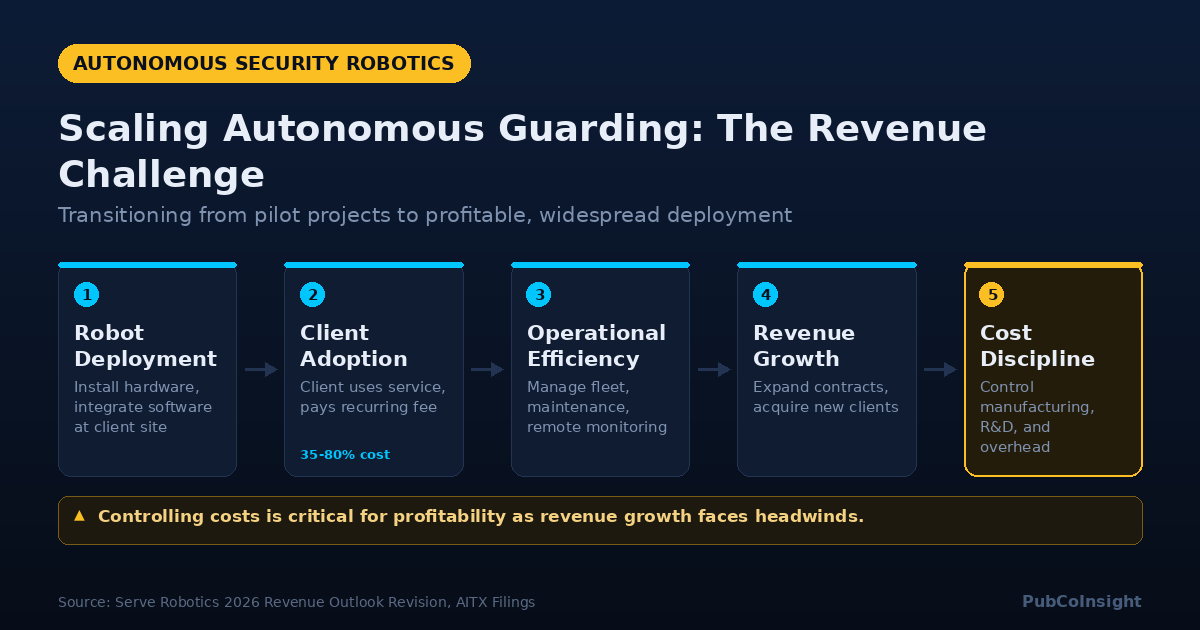
The Mechanism of Disruption and Adoption
The promise of autonomous security robotics centers on cost reduction and enhanced capabilities compared to traditional manned guarding. A human guard costs a client a fully burdened rate, including wages, benefits, training, and overhead. This rate can range from $35 to $75 per hour, depending on location and skill requirements. A robotic solution, offered as a "Security-as-a-Service" (SaaS) model, aims to deliver a similar or superior service at a fraction of that cost, often quoted at 35% to 80% less than human counterparts. The physical AI unit, whether stationary or mobile, integrates sensors, cameras, and AI-driven analytics to detect anomalies, patrol designated areas, and provide real-time alerts. For this to work, the robot must be reliable, its AI must minimize false positives, and its operational footprint must be light. Deployment involves site assessment, network integration, and ongoing maintenance. The bottleneck often sits in the sales cycle and the client's internal validation process. Large enterprises, accustomed to traditional security contracts, require extensive proof of concept, pilot programs, and clear ROI calculations before committing to widespread adoption. This process can stretch over months, sometimes years, delaying the realization of revenue targets for robotics providers. Furthermore, the integration of these systems into existing security infrastructures, often managed by legacy providers, presents its own set of technical and commercial hurdles. The physical AI must communicate seamlessly with central monitoring stations, and the data it collects must be actionable for human security personnel. If the technology is too complex to integrate, or if the cost savings are not immediately apparent and verifiable, adoption stalls.Companies Operating in This Sector
Several companies are actively developing and deploying solutions in this autonomous security space, each with a distinct approach. Axon Enterprise (AXON), for example, is primarily known for its body cameras and Taser devices, but its expansion into AI-powered drone contracts, such as the decade-long agreement with Lakeland, demonstrates a move into broader autonomous security applications. Their focus often involves law enforcement and corrections, as seen with state corrections institutions modernizing operations with Axon technology. In the radar and sensing technology segment, Arbe Robotics Ltd. (ARBE), priced at $0.55, and MicroVision, Inc. (MVIS), at $1.20, focus on the underlying perception systems critical for autonomous navigation and detection. Arbe specializes in 4D imaging radar, essential for robust environmental sensing in complex security environments, while MicroVision develops LiDAR technology. These components are foundational for the mobile autonomous platforms used in guarding. Further up the stack, companies like BigBear.ai Holdings, Inc. (BBAI), at $2.39, and Lantronix, Inc. (LTRX), at $6.85, provide the AI and IoT connectivity layers. BigBear.ai focuses on decision intelligence, which translates sensor data into actionable insights for security operations. Lantronix specializes in secure data access and management for IoT devices, a crucial element for remote monitoring and control of autonomous robots. On the hardware and integrated systems side, Kopin Corporation (KOPN), priced at $4.46, is a microdisplay developer whose technology finds application in augmented reality systems for human operators interacting with robotic platforms. Their recent $18.6 million U.S. Army contract for color MicroLED technology for IBAS systems underscores their role in advanced visual interfaces. Ondas Inc. (ONDS), at $6.73, while seeing its shares fall, continues to secure significant defense orders, adding $270 million in new orders, including $165 million in early October. Their focus on mission-critical wireless networks and autonomous systems positions them in the broader defense and infrastructure security market, which often overlaps with commercial guarding. Newer entrants like Serve Robotics Inc. (SERV), at $4.35, and Unusual Machines, Inc. (UMAC), at $20.83, are exploring specific niches within autonomous robotics. Serve Robotics focuses on last-mile delivery robots, a segment that shares many technological underpinnings with security patrols, particularly in navigation and obstacle avoidance. Unusual Machines, Inc. is a relatively recent listing, and its specific offerings in autonomous security are still emerging in the public record. Red Cat Holdings, Inc. (RCAT), at $5.77, is another player in the drone space, which has growing applications in perimeter security and surveillance.Artificial Intelligence Technology Solutions, Inc.
Artificial Intelligence Technology Solutions, Inc. (AITX), trading on the OTCID tier at $0.0022, develops and leases autonomous security robots and remote monitoring systems. The company operates through a "Solutions-as-a-Service" model, generating recurring monthly subscription revenue rather than one-time hardware sales. Its operations are structured around three principal pillars: stationary security devices through Robotic Assistance Devices, Inc. (RAD-I), mobile autonomous platforms through Robotic Assistance Devices Mobile (RAD-M), and the SARA agentic artificial intelligence platform through Robotic Assistance Devices Group (RAD-G). RAD-I focuses on stationary units designed for fixed-point surveillance and access control. RAD-M includes the ROAMEO mobile security unit, which began early commercial deployment in May 2026. AITX's filings indicate that RAD-M represents a higher potential revenue ceiling than stationary solutions. The company reported revenue of $7,745,336 for the fiscal year ended February 28, 2026, a 26% increase over the prior fiscal year. Gross profit for the same period was $5,533,700, with a gross margin of approximately 71%. Operating expenses remained flat at approximately $17,477,097, leading to an improved loss from operations of $(11,943,397). The net loss for the fiscal year was approximately $14.5 million, with an accumulated deficit of approximately $171 million as of February 28, 2026. The company had negative cash flow from operating activities of $9,344,534 for the year. AITX aims for subscription gross margins to exceed 75% and outright-sale gross margins to exceed 50%, based on average bill of materials costs and market-accepted pricing. The company also states that RAD-G will generate substantial revenue from SARA platform licensing. AITX's wholly-owned subsidiary, RAD Lanka, located in Sri Lanka, supports software development, AI initiatives, and technical operations. The company envisions an integrated autonomous-security deployment across campuses or communities, internally referred to as "RAD Town." While the company articulates a clear strategy for revenue growth, the public record does not yet establish consistent positive cash flow from operations. Recent 8-K filings from October 7 and October 6, 2026, detail a substantial property management relationship from small orders and a third ROAMEO order from a global logistics client, respectively, indicating continued commercial activity and expansion of its installed base.What to watch
Investors should monitor the upcoming quarterly reports from major security providers like ADT (ADT) for further indications of revenue performance and any revised guidance. Specifically, look for management commentary on the adoption rates of autonomous security solutions and the impact on their traditional guarding services. For companies like Axon Enterprise (AXON), the specifics of new drone contracts, including deployment timelines and revenue recognition schedules, will be important. Ondas Inc. (ONDS) investors should watch for details on how their substantial defense orders translate into revenue conversion in future filings. For Artificial Intelligence Technology Solutions, Inc. (AITX), the key will be the trajectory of its recurring monthly subscription revenue and gross margin expansion, particularly the reported number of deployed units and the average revenue per unit. Look for further 8-K filings detailing additional ROAMEO deployments or significant expansions of existing client relationships. The company's ability to transition from pilot programs to widespread commercial adoption and achieve positive cash flow from operations will be critical., {"label": "Pilot Validation", "note": "Trial period for performance and ROI verification."}, {"label": "Client Integration", "note": "Seamless data flow with existing security systems."}, {"label": "Subscription Activation", "note": "Monthly recurring revenue begins."}, {"label": "Scaling Adoption", "note": "Expansion to multiple sites or broader use cases."}], "highlight": 1, "highlight_note": "Long pilot phases and complex validation delay revenue recognition.", "footnote": "Source: Company Filings, News Reports, Zacks 2026-10-09"}Companies mentioned
| Ticker | Company | Price |
|---|---|---|
| AITX client | Artificial Intelligence Technology Solutions Inc | $0.0022 |
| ARBE | Arbe Robotics Ltd. | $0.55 |
| BBAI | BigBear.ai Holdings, Inc. | $2.39 |
| KOPN | Kopin Corporation | $4.46 |
| LTRX | Lantronix, Inc. | $6.85 |
| MVIS | MicroVision, Inc. | $1.2 |
| ONDS | Ondas Inc. | $6.73 |
| RCAT | Red Cat Holdings, Inc. | $5.77 |
| SERV | Serve Robotics Inc. | $4.35 |
| UMAC | Unusual Machines, Inc. | $20.83 |
Listed alphabetically, not ranked. Prices as of 2026-10-10 and they move. Check a live quote before relying on any of this.
How we chose the companies in this article
We cover a fixed universe of companies working in autonomous security robotics, physical AI and the guarding services market they are aimed at. Every one of them that had usable market data on 2026-10-10 appears in this article. We do not pick which ones to mention based on what we think of them, and we do not order them by size, price or trading volume, because an ordered list is a verdict and that is not ours to hand down. Companies left out, and why: none. American Lithium Minerals and Artificial Intelligence Technology Solutions pay us, which is disclosed in full at the foot of every article they appear in.
See the dilution and promotion flags before you see the pitch.
Each week: the micro and small-caps now showing dilution or paid-promotion signals, with the SEC filing behind every flag. No recommendations, no price targets.
Sources used in this article
- This Forgotten AI Stock Is Up 689% and Nobody's Talking About It Motley Fool · 2026-10-10
- Prediction: Zcash (ZEC) Will Be Worth This Much in 5 Years Motley Fool · 2026-10-10
- Which Stocks Have the Biggest Exposure to Anthropic's Growth? Motley Fool · 2026-10-10
- Why AMD's Supply Crunch Could Be Good News for Its Stock Motley Fool · 2026-10-10
- MAG 7 Voices: How Nvidia, Microsoft, Alphabet, Meta Reshaped AI This Week Stocktwits · 2026-10-10
- Jim Cramer sends a reality check to AI stock investors after tumble TheStreet · 2026-10-10
- 10 Words From the Fed Chair That Could Reshape Market Expectations Motley Fool · 2026-10-10
- Sequoia-backed Nuvacore seeks $2.5bn valuation in funding round - Reuters Investing.com · 2026-10-10
- With Oil Over $100 and a $7 Billion Offer on the Table, Is ConocoPhillips the Most Interesting Oil Stock to Buy Right Now? Motley Fool · 2026-10-10
- Why Palantir Stock Powered to a More Than 5% Gain Today Motley Fool · 2026-10-10
- Stocktwits Defense Watch: U.S. Missile Spending Drives $21B In Boeing, RTX Deals, Ondas Adds $270M In Orders Stocktwits · 2026-10-10
- Axon Enterprise (AXON) Stock Looks Fairly Priced Despite Its 133% Five Year Run Simply Wall St. · 2026-10-09
Disclosure required by Section 17(b) of the Securities Act of 1933
Artificial Intelligence Technology Solutions, Inc., a Nevada corporation (OTCID: AITX). Artificial Intelligence Technology Solutions, Inc. pays Strategic Innovations First, Inc., a Wyoming corporation doing business as PulseIR. Compensation received: USD 5,000.00 per month for months 1-3 (August, September, October 2026); USD 10,000.00 per month for months 4-6 (November, December 2026, January 2027) contingent on the 90-day review. Minimum committed USD 15,000.00; USD 45,000.00 if the second-period rate triggers.. Form of payment: cash only, invoiced monthly in advance; no stock, options or warrants received or payable. Services: investor relations services under an Investor Relations Services Agreement effective 2026-08-01. Period: six month term, 2026-08-01 through 2027-01-31; 90-day review on or about 2026-10-30. No stock, options or warrants held by PubCo Insight, Pulse IR, Strategic Innovations First, Inc., or Brad Listermann. Confirmed by the executed agreement and by board record recKwdq39X2caPSX7 (POSITIONS HELD: none).
This is information, not investment, financial, legal or tax advice. It is not a recommendation or solicitation to buy, sell or hold any security and it contains no price target. Nothing here is independently verified by us. Confirm every figure against primary filings on SEC EDGAR before you act. Micro-cap and over-the-counter securities are speculative and illiquid and can lose all of their value. The companies named without a disclosure above pay us nothing and have no relationship with us; they are named because a published, mechanical screen selected them. Full disclosure policy.