Guarding Robotics Firms Face Revenue Target Pressure
Serve Robotics cut its 2026 revenue outlook, highlighting a sector-wide challenge for autonomous security robotics in the guarding services market.
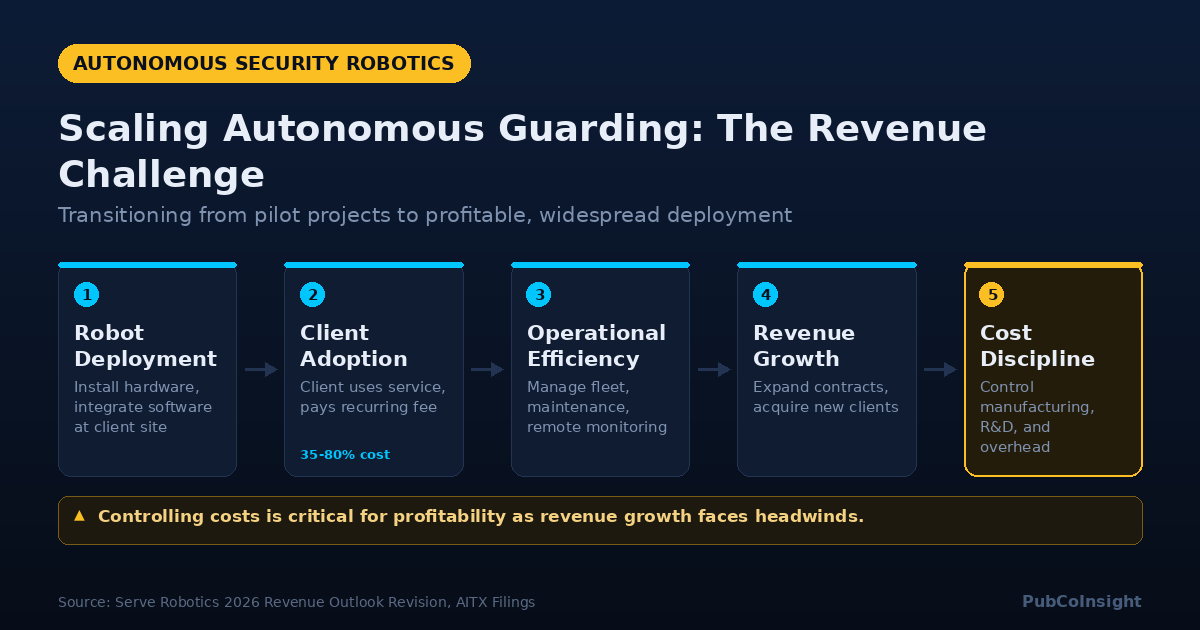
The Mechanism of Autonomous Security Adoption
Autonomous security robots, whether stationary or mobile, operate on a "Solutions-as-a-Service" (SaaS) model. This means clients pay a recurring monthly subscription fee rather than a one-time purchase. The model is attractive because it shifts the financial burden from large upfront capital outlays to predictable operational expenses. For the robotics companies, it theoretically provides a stable, recurring revenue stream. However, this stability only materializes with consistent client acquisition and retention. The core value proposition is labor displacement. A single autonomous robot can monitor areas that would otherwise require multiple human guards, especially for routine patrols or static surveillance. This reduces personnel costs, which are typically the largest component of a traditional guarding contract. The robots integrate sensors, cameras, and AI analytics to detect anomalies, report incidents, and even deter trespassers. The challenge lies in the integration into existing security frameworks. Clients often require custom solutions, robust data privacy, and seamless interoperability with their command centers. Furthermore, the perceived reliability and legal implications of autonomous systems still require extensive field validation and clear contractual agreements. A single high-profile failure can erode client confidence and slow adoption across the sector. The bottleneck is less about the technology's capability and more about the speed and scale of its commercial deployment and the client's willingness to fully replace, rather than merely augment, human personnel.Companies Operating in This Sector
Several companies are actively developing and deploying autonomous security and related AI solutions. Axon Enterprise, Inc. (AXON), though primarily known for its TASER devices and body cameras, is a significant player in public safety technology, with a growing emphasis on integrated software and AI solutions for law enforcement and security. Its September 30 trending stock status suggests continued market interest in its broader public safety ecosystem. In the drone and counter-drone space, Ondas Inc. (ONDS) launched its long-range Dronebuster REACH on September 30, extending its non-kinetic counter-UAS defeat capabilities. This expansion into longer-range systems for neutralizing unauthorized drones highlights a growing segment of the security market, particularly for critical infrastructure and defense applications. Ondas's stock saw increased attention in early October, tied to Pentagon's autonomous warfare push. Red Cat Holdings, Inc. (RCAT) also operates in the drone sector, focusing on defense and enterprise solutions. Its projected H2 ramp for 2026 targets indicates aggressive growth plans, but also the pressure to deliver. Unusual Machines, Inc. (UMAC) has been active, with its merger with Aureus Greenway Holdings completing in October, and the new entity, Powerus Corporation (PUSA), set to ring the Nasdaq opening bell. UMAC's defense-focused counter-drone expansion and stake in Draganfly (DFLY) point to a diversified strategy in autonomous systems. The company also secured a $50 million Series B financing led by Lockheed Martin, underscoring significant institutional interest in its technology. In the core robotics segment, Serve Robotics Inc. (SERV) develops autonomous sidewalk delivery robots, with applications extending to campus security and logistics. Its September 30 revenue outlook cut for 2026 indicates the challenges of scaling operations and achieving projected financial targets in the nascent autonomous services market. The comparison to Symbotic (SYM) on September 28 highlights the ongoing evaluation of different robotics models. Other companies contribute critical components or specialized AI. Arbe Robotics Ltd. (ARBE) focuses on high-resolution radar solutions, which are crucial for autonomous navigation and perception in complex environments. Arbe completed a $15 million registered direct offering in late September. MicroVision, Inc. (MVIS) develops lidar technology, another key sensor for autonomous systems. Kopin Corporation (KOPN) provides micro-displays and optical modules, essential for augmented and virtual reality interfaces that can be integrated into advanced robotic control systems. Lantronix, Inc. (LTRX) offers embedded computing and networking solutions, providing the connectivity and processing power necessary for autonomous devices. BigBear.ai Holdings, Inc. (BBAI) specializes in AI-powered analytics and decision intelligence, which can be applied to interpret data from autonomous security systems and enhance operational efficiency.Artificial Intelligence Technology Solutions, Inc.
Artificial Intelligence Technology Solutions, Inc. (AITX) operates through several subsidiaries, including Robotic Assistance Devices, Inc. (RAD-I), Robotic Assistance Devices Mobile (RAD-M), Robotic Assistance Devices Group (RAD-G), and Robotic Assistance Devices Lanka (Private) Limited (RAD Lanka). The company focuses on developing and leasing AI-driven security robots and remote monitoring systems. AITX employs a "Solutions-as-a-Service" model, providing recurring monthly subscriptions rather than outright hardware sales. The company estimates its target market, the US security and guarding services industry, to be approximately $50 billion. RAD-I, the primary subsidiary, markets stationary security devices. These are designed to offer significant cost savings compared to traditional manned security. RAD-M focuses on mobile autonomous platforms, including the ROAMEO mobile security unit, which began early commercial deployment in May 2026. RAD-G is responsible for the SARA agentic artificial intelligence platform, which the company intends to license for substantial revenue. RAD Lanka, located in Sri Lanka's Port City Colombo, supports software development, AI initiatives, and technical operations across the company's subsidiaries. AITX describes its long-term strategy as "RAD Town," aiming for integrated autonomous security deployments across entire campuses or jurisdictions. For the fiscal year ended February 28, 2026, AITX reported revenue of $7,745,336, a 26% increase over the prior year. Gross profit rose 48% to $5,533,700, with gross margin expanding to approximately 71%. Operating expenses remained flat at around $17,477,097, and the loss from operations improved by approximately $2.0 million to $(11,943,397). The company reported a net loss of approximately $14.5 million for the fiscal year and had an accumulated deficit of approximately $171 million as of that date. The public record does not yet establish consistent positive cash flow from operations. AITX had negative cash flow from operating activities of $9,344,534 for the year ended February 28, 2026, and negative working capital of $17,017,745. The company's independent registered public accounting firm included an explanatory paragraph in its report on consolidated financial statements, expressing substantial doubt about AITX's ability to continue as a going concern. AITX recently updated hardware pricing on September 24 to reflect rising materials, compute, and transportation costs. On September 30, RAD received an additional RIO 360 order from a healthcare client.What to watch
Monitor the next quarterly filings from Serve Robotics (SERV) for further details on their cost discipline measures and revised revenue projections. These filings will provide concrete data on how their strategy shift impacts operational expenses and client acquisition rates. Watch for any similar revenue outlook revisions from other autonomous security providers, as this would signal a broader trend. Track the commercial deployment progress of mobile autonomous platforms like AITX's ROAMEO, specifically looking for announced contract wins, deployment locations, and the scale of these deployments. The financial impact of these deployments, particularly their contribution to recurring revenue, will be key. Observe the uptake of new counter-drone technologies, such as Ondas's (ONDS) Dronebuster REACH. Announcements of government contracts or large-scale enterprise adoptions for these systems will indicate market validation and potential revenue acceleration. Pay attention to any further financing rounds or strategic investments in the sector, especially for companies like Unusual Machines (UMAC) that have recently secured significant capital. These events signal investor confidence and provide capital for scaling operations., {"label": "Client Adoption", "note": "Client uses service, pays recurring fee", "metric": "35-80% cost savings"}, {"label": "Operational Efficiency", "note": "Manage fleet, maintenance, remote monitoring"}, {"label": "Revenue Growth", "note": "Expand contracts, acquire new clients"}, {"label": "Cost Discipline", "note": "Control manufacturing, R&D, and overhead"}], "highlight": 4, "highlight_note": "Controlling costs is critical for profitability as revenue growth faces headwinds.", "footnote": "Source: Serve Robotics 2026 Revenue Outlook Revision, AITX Filings"}
Companies mentioned
| Ticker | Company | Price |
|---|---|---|
| AITX client | Artificial Intelligence Technology Solutions Inc | $0.0027 |
| ARBE | Arbe Robotics Ltd. | $0.592 |
| BBAI | BigBear.ai Holdings, Inc. | $2.74 |
| KOPN | Kopin Corporation | $4.61 |
| LTRX | Lantronix, Inc. | $7.06 |
| MVIS | MicroVision, Inc. | $1.5 |
| ONDS | Ondas Inc. | $7.12 |
| RCAT | Red Cat Holdings, Inc. | $6.33 |
| SERV | Serve Robotics Inc. | $4.75 |
| UMAC | Unusual Machines, Inc. | $21.78 |
Listed alphabetically, not ranked. Prices as of 2026-10-02 and they move. Check a live quote before relying on any of this.
How we chose the companies in this article
We cover a fixed universe of companies working in autonomous security robotics, physical AI and the guarding services market they are aimed at. Every one of them that had usable market data on 2026-10-02 appears in this article. We do not pick which ones to mention based on what we think of them, and we do not order them by size, price or trading volume, because an ordered list is a verdict and that is not ours to hand down. Companies left out, and why: none. American Lithium Minerals and Artificial Intelligence Technology Solutions pay us, which is disclosed in full at the foot of every article they appear in.
See the dilution and promotion flags before you see the pitch.
Each week: the micro and small-caps now showing dilution or paid-promotion signals, with the SEC filing behind every flag. No recommendations, no price targets.
Sources used in this article
- Here's My Top AI Stock to Buy in October Motley Fool · 2026-10-02
- Tesla Is the Only Magnificent Seven Stock in the Red for 2026 Motley Fool · 2026-10-02
- Analysts rank 16-year-old chip firm 61 places above NVIDIA TheStreet · 2026-10-02
- The Supermajor vs. the Shale Specialist: Is ExxonMobil or Devon Energy the Better Buy at $100 Oil? Motley Fool · 2026-10-02
- Trump Reportedly Says Government 'Might' Take a Stake in OpenAI, Anthropic, Just Like It Did With Intel: 'I Have Many Deals Like That' Benzinga · 2026-10-02
- These 3 Dividend Stocks Yield Less Than 10-Year Treasuries Over 5%. Here's Why They Are Better Buys Anyway. Motley Fool · 2026-10-02
- Why Netflix Lost 14% in September Motley Fool · 2026-10-02
- The Semiconductor ETF's 2026 Return Is About 3 Times Nvidia's Motley Fool · 2026-10-02
- Why GE Vernova Stock Crushed it Today Motley Fool · 2026-10-02
- Arm Stocks Moves Higher as Nvidia Security Adds a Second Compute Layer GuruFocus.com · 2026-10-02
- The Nasdaq Rose 1.9% in September. Intel Exploded 34% GuruFocus.com · 2026-10-01
- Unusual Machines Tumbles 8% Despite Pentagon’s Autonomous Warfare Push; AeroVironment Eases, Red Cat Pulls Back 24/7 Wall St. · 2026-10-01
Disclosure required by Section 17(b) of the Securities Act of 1933
Artificial Intelligence Technology Solutions, Inc., a Nevada corporation (OTCID: AITX). Artificial Intelligence Technology Solutions, Inc. pays Strategic Innovations First, Inc., a Wyoming corporation doing business as PulseIR. Compensation received: USD 5,000.00 per month for months 1-3 (August, September, October 2026); USD 10,000.00 per month for months 4-6 (November, December 2026, January 2027) contingent on the 90-day review. Minimum committed USD 15,000.00; USD 45,000.00 if the second-period rate triggers.. Form of payment: cash only, invoiced monthly in advance; no stock, options or warrants received or payable. Services: investor relations services under an Investor Relations Services Agreement effective 2026-08-01. Period: six month term, 2026-08-01 through 2027-01-31; 90-day review on or about 2026-10-30. No stock, options or warrants held by PubCo Insight, Pulse IR, Strategic Innovations First, Inc., or Brad Listermann. Confirmed by the executed agreement and by board record recKwdq39X2caPSX7 (POSITIONS HELD: none).
This is information, not investment, financial, legal or tax advice. It is not a recommendation or solicitation to buy, sell or hold any security and it contains no price target. Nothing here is independently verified by us. Confirm every figure against primary filings on SEC EDGAR before you act. Micro-cap and over-the-counter securities are speculative and illiquid and can lose all of their value. The companies named without a disclosure above pay us nothing and have no relationship with us; they are named because a published, mechanical screen selected them. Full disclosure policy.