Serve Robotics Cuts 2026 Revenue Outlook Amidst Guarding Services Market Shifts
Serve Robotics' recent revenue outlook revision signals a broader challenge for autonomous security providers in converting order books into realized revenue within the competitive guarding services sector.
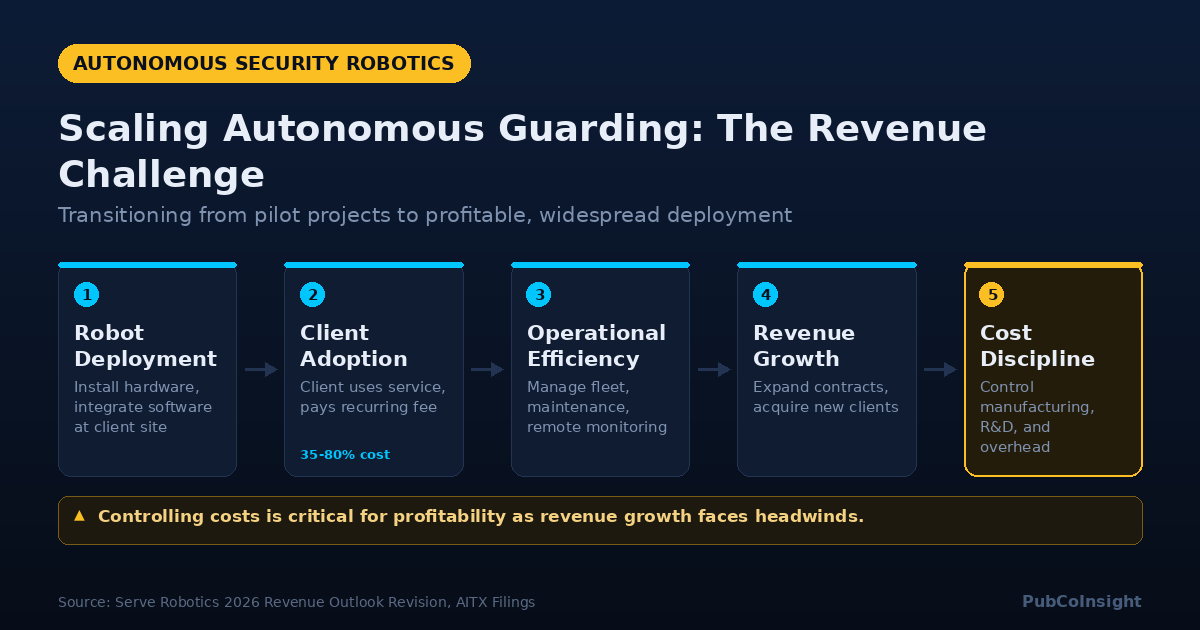
The Mechanism of Revenue Conversion in Guarding Services
The core challenge lies in the deployment cycle and the nature of the "as-a-service" model prevalent in this sector. Unlike a one-off hardware sale, autonomous security robots are typically leased or subscribed to on a recurring basis. This means revenue accrues over time, tied directly to the operational deployment and ongoing service delivery of the units. A large order book, while a positive indicator of demand, only translates to revenue once robots are manufactured, delivered, installed, and actively performing their guarding functions. This process involves several stages: securing a client, often through pilot programs; manufacturing the robotic units, which can be constrained by supply chain bottlenecks for components like specialized sensors or processing units; physical deployment and integration into the client's existing security infrastructure; and finally, consistent uptime and performance to justify the recurring subscription. Any delay in these stages, from component shortages to complex site-specific integrations, directly impacts the pace of revenue recognition. Furthermore, the market for guarding services is accustomed to human labor, where scaling up or down can be more flexible in the short term. Autonomous solutions, while offering long-term cost savings, require a higher initial commitment and integration effort from clients, which can slow adoption. The value sits in the sustained operational deployment, where the robot consistently replaces or augments human labor, generating the promised cost savings for the client and recurring revenue for the provider. If deployments stall or are slower than anticipated, even with strong demand, revenue targets become difficult to meet.Companies Operating in This Sector
Several companies are navigating this complex landscape, each with distinct approaches to the autonomous security and guarding services market. Ondas Inc. (ONDS), for instance, recently announced over $165 million in new defense orders. While these orders indicate strong demand for their drone and autonomous systems, the challenge for Ondas, as with others, will be the speed and efficiency of converting these large contracts into recognized revenue. Their focus includes long-range counter-UAS technology like the Dronebuster REACH, which addresses a specific security need. Red Cat Holdings, Inc. (RCAT) and Unusual Machines, Inc. (UMAC) are both active in the drone space, with Unusual Machines recently seeing its stock tumble despite the Pentagon's push for autonomous warfare. The defense sector, while lucrative, often involves lengthy procurement cycles and rigorous testing, which can extend the time from order to revenue. Red Cat's recent performance also saw a pullback, suggesting similar pressures in the broader drone market. Arbe Robotics Ltd. (ARBE) and MicroVision, Inc. (MVIS) focus on advanced sensing technologies, particularly radar and lidar, which are critical components for autonomous navigation and perception in security robots. Their success is tied to the adoption rates of autonomous platforms that integrate their sensor suites. The more robots deployed, the greater the demand for their core technology. Kopin Corporation (KOPN), through initiatives like Fabric.AI engaging Kearney for commercialization strategy, is working on neural I/o optical interconnect platforms. These foundational technologies are crucial for the processing power and data transfer required by sophisticated AI systems in autonomous robots, but their revenue generation is further upstream from the direct deployment of security robots. Lantronix, Inc. (LTRX) provides secure data access and management solutions, essential for the remote monitoring and control of autonomous security systems. Their revenue growth is linked to the increasing complexity and connectivity requirements of deployed robotic fleets. BigBear.ai Holdings, Inc. (BBAI) operates in the broader AI and data analytics space, with applications that can extend to optimizing security operations and predictive intelligence for autonomous systems. Their value proposition lies in making the deployed robots smarter and more efficient.Artificial Intelligence Technology Solutions, Inc.
Artificial Intelligence Technology Solutions, Inc. (AITX) trades on the OTCID tier under the ticker AITX. The company, through its subsidiaries, builds and leases autonomous security robots and remote monitoring systems. AITX operates on a recurring monthly subscription model, rather than a one-time hardware sale. This "Solutions-as-a-Service" approach is central to its strategy, aiming to provide cost savings of 35% to 80% compared to traditional manned security. AITX's operations are structured across three main pillars. Robotic Assistance Devices, Inc. (RAD-I) focuses on stationary security devices. Robotic Assistance Devices Mobile (RAD-M) develops mobile autonomous platforms, including the ROAMEO mobile security unit, which began early commercial deployment in May 2026. Robotic Assistance Devices Group (RAD-G) is responsible for the SARA agentic artificial intelligence platform. The company’s wholly-owned subsidiary, RAD Lanka, located in Sri Lanka, supports software development, AI initiatives, and technical operations. AITX envisions an integrated autonomous security deployment across campuses or communities, a concept it refers to as "RAD Town." For the fiscal year ended February 28, 2026, AITX reported revenue of $7,745,336, a 26% increase over the prior fiscal year. Gross profit increased 48% to $5,533,700, with gross margin expanding to approximately 71%. Operating expenses remained largely flat at about $17,477,097. The company's loss from operations improved by approximately $2.0 million to $(11,943,397). AITX reported a net loss of approximately $14.5 million for the fiscal year ended February 28, 2026, with an accumulated deficit of approximately $171 million as of that date. The company had negative cash flow from operating activities of $9,344,534 for the same period. The public record does not yet establish a clear timeline for AITX to achieve positive cash flow from operations, despite management's characterization that RAD-I's recurring revenue could, on a standalone basis, support positive cash flow operations. The company expects subscription gross margin to exceed 75% and outright-sale gross margin to exceed 50%, based on average bill of materials costs and market-accepted pricing. Recent news includes AITX's RAD securing a third ROAMEO order from a global logistics client on October 6, 2026, and expanding its relationship with that client. On October 7, 2026, AITX's RAD also turned small orders into a substantial property management relationship. The company's filings indicate a plan for continued product development and commercialization, including the introduction of additional stationary solutions.What to watch
Investors should monitor several concrete indicators to assess the sector's progress. For Ondas (ONDS), the key will be the rate at which its recently announced $165 million in new defense orders translate into revenue in subsequent quarterly reports. Specific deployment schedules and milestones for their Dronebuster REACH system will be important. For Serve Robotics (SERV), following their revised outlook, watch for any further updates on their 2026 revenue figures and any specific explanations for deployment delays or accelerated timelines. For Artificial Intelligence Technology Solutions (AITX), look for details in future filings regarding the expansion of ROAMEO deployments and the SARA platform licensing. Specific customer names and geographic expansions, beyond general "global logistics clients" or "property management relationships," would provide more clarity. Also, track any updates on the company's progress towards positive cash flow from operations, as this remains a stated goal. For the broader sector, watch for quarterly reports from companies like Red Cat (RCAT) and Unusual Machines (UMAC) for insights into the pace of drone deployments, particularly in the defense and commercial sectors, and how quickly new orders are converted into recognized revenue. Any announcements regarding supply chain improvements for critical components, or significant new partnerships for large-scale deployments, would also be material., { "label": "Robot Production", "note": "Manufacturing of units, component sourcing", "metric": "Lead Times" }, { "label": "Physical Deployment", "note": "Installation, integration at client site" }, { "label": "Operational Service", "note": "Robots actively performing security tasks" }, { "label": "Revenue Recognition", "note": "Monthly recurring subscription revenue accrues" } ], "highlight": 3, "highlight_note": "Sustained operational uptime is critical for consistent revenue and client value realization. Delays here impact financial targets.", "footnote": "PubCo Insight analysis of sector filings and news, 2026" }Companies mentioned
| Ticker | Company | Price |
|---|---|---|
| AITX client | Artificial Intelligence Technology Solutions Inc | $0.0025 |
| ARBE | Arbe Robotics Ltd. | $0.592 |
| BBAI | BigBear.ai Holdings, Inc. | $2.51 |
| KOPN | Kopin Corporation | $4.57 |
| LTRX | Lantronix, Inc. | $7.21 |
| MVIS | MicroVision, Inc. | $1.52 |
| ONDS | Ondas Inc. | $7.19 |
| RCAT | Red Cat Holdings, Inc. | $6.15 |
| SERV | Serve Robotics Inc. | $4.66 |
| UMAC | Unusual Machines, Inc. | $21.88 |
Listed alphabetically, not ranked. Prices as of 2026-10-08 and they move. Check a live quote before relying on any of this.
How we chose the companies in this article
We cover a fixed universe of companies working in autonomous security robotics, physical AI and the guarding services market they are aimed at. Every one of them that had usable market data on 2026-10-08 appears in this article. We do not pick which ones to mention based on what we think of them, and we do not order them by size, price or trading volume, because an ordered list is a verdict and that is not ours to hand down. Companies left out, and why: none. American Lithium Minerals and Artificial Intelligence Technology Solutions pay us, which is disclosed in full at the foot of every article they appear in.
See the dilution and promotion flags before you see the pitch.
Each week: the micro and small-caps now showing dilution or paid-promotion signals, with the SEC filing behind every flag. No recommendations, no price targets.
Sources used in this article
- Jim Cramer Spots a Complication in the AXON Story Insider Monkey · 2026-10-08
- Dan Ives Names 5 Tech Stocks for 2027, Including One That Doubled in 2026 BeInCrypto · 2026-10-08
- TSMC Q3 sales beat estimates on surging AI chip demand Investing.com · 2026-10-08
- Here's 1 of the Best AI Stocks Investors Should Consider Buying in October With $1,000 Motley Fool · 2026-10-08
- Nvidia-backed Firmus closes IPO bookbuilding as investor support falter -Bloomberg Investing.com · 2026-10-08
- 'Big Short' Michael Burry Says OpenAI, Anthropic Want To Join Big Tech's Oligopoly — But Much Of AI Spending May Become 'Sunk Cost' Stocktwits · 2026-10-08
- What Stocks Will Shine When the AI Bubble Bursts? John Rogers Says Look to Smucker's BeInCrypto · 2026-10-08
- Morning Bid: Sovereign bonds shouldered aside as AI takes their turf Reuters · 2026-10-08
- SpaceX Reportedly Wants to Borrow $40 Billion for Nvidia Chips Despite a $100 Billion Cash Pile Motley Fool · 2026-10-08
- MSFT Stock On 4-Day Winning Streak: Microsoft Takes On Apple's Macs With Nvidia-Powered Surface Ultra, More On-Device AI Stocktwits · 2026-10-08
- CoreWeave Can Raise Prices Twice in Three Months. Can It Afford to Keep Building? Insider Monkey · 2026-10-08
- AXON Gains From Strong Software & Services Momentum: Can It Sustain? Zacks · 2026-10-07
Disclosure required by Section 17(b) of the Securities Act of 1933
Artificial Intelligence Technology Solutions, Inc., a Nevada corporation (OTCID: AITX). Artificial Intelligence Technology Solutions, Inc. pays Strategic Innovations First, Inc., a Wyoming corporation doing business as PulseIR. Compensation received: USD 5,000.00 per month for months 1-3 (August, September, October 2026); USD 10,000.00 per month for months 4-6 (November, December 2026, January 2027) contingent on the 90-day review. Minimum committed USD 15,000.00; USD 45,000.00 if the second-period rate triggers.. Form of payment: cash only, invoiced monthly in advance; no stock, options or warrants received or payable. Services: investor relations services under an Investor Relations Services Agreement effective 2026-08-01. Period: six month term, 2026-08-01 through 2027-01-31; 90-day review on or about 2026-10-30. No stock, options or warrants held by PubCo Insight, Pulse IR, Strategic Innovations First, Inc., or Brad Listermann. Confirmed by the executed agreement and by board record recKwdq39X2caPSX7 (POSITIONS HELD: none).
This is information, not investment, financial, legal or tax advice. It is not a recommendation or solicitation to buy, sell or hold any security and it contains no price target. Nothing here is independently verified by us. Confirm every figure against primary filings on SEC EDGAR before you act. Micro-cap and over-the-counter securities are speculative and illiquid and can lose all of their value. The companies named without a disclosure above pay us nothing and have no relationship with us; they are named because a published, mechanical screen selected them. Full disclosure policy.