Autonomous Security Robotics Face Rising Hardware Costs
AITX's recent pricing adjustments highlight a sector-wide challenge in managing increasing expenses for materials, compute, and logistics in autonomous security robot production.
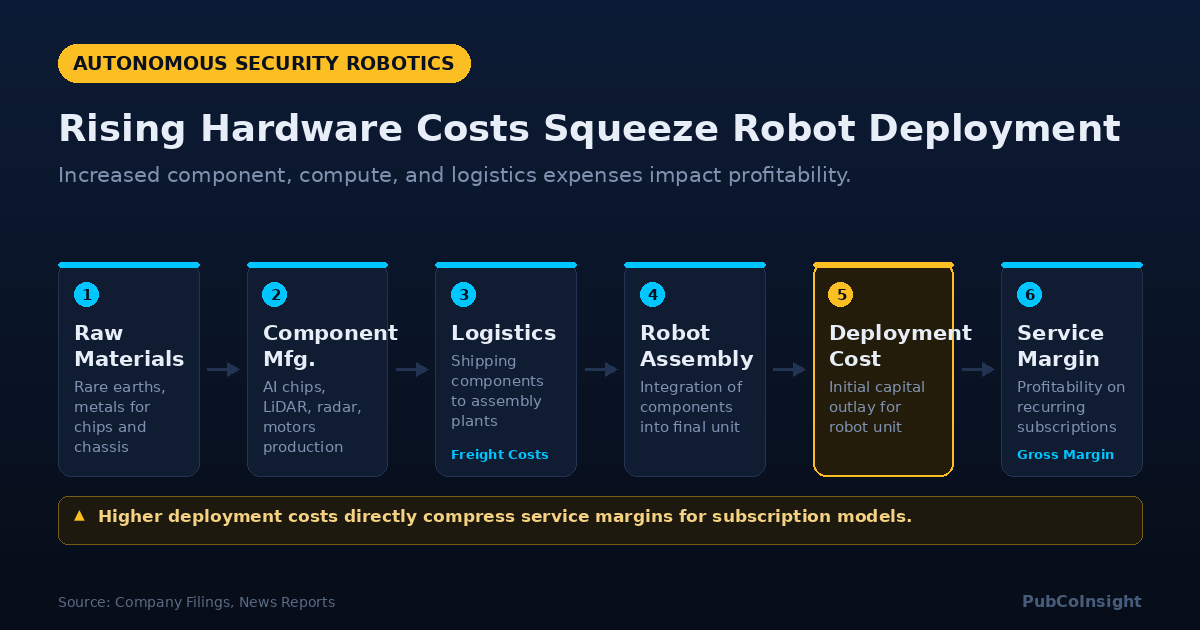
The Mechanism of Cost Escalation
The core of this cost pressure lies in the supply chain for advanced robotics. Autonomous security robots are complex machines. They integrate high-performance processors for real-time AI inference, specialized sensors like LiDAR and radar for environmental mapping and object detection, robust motors for mobility, and durable chassis materials to withstand outdoor conditions. Each of these components has seen its own price volatility. Take compute, for instance. The demand for AI-specific processing units, particularly GPUs, has surged across industries. Nvidia's dominance in this space, with its GB300 NVL72 clusters being deployed in new regions like the Philippines by YCO Cloud and Aolani, illustrates the intense competition for these high-performance components. This demand drives up prices for the chips themselves, but also for the underlying materials like rare earth elements used in their manufacture. Separating rare earth oxides from mined ore is an energy-intensive process, often involving complex chemical leaching and solvent extraction, which adds significant cost. Any disruption in these supply chains, from mining to fabrication, creates bottlenecks that translate directly into higher component prices. Transportation costs are another factor. Global logistics networks remain sensitive to geopolitical events and energy price fluctuations. Moving specialized components from fabrication plants to assembly lines, and then finished robots to deployment sites, involves significant freight expenses. These are not easily absorbed, especially for heavier, more robust units designed for outdoor security. For companies selling solutions on a subscription basis, these upfront hardware costs are amortized over the contract life, meaning higher initial capital expenditure requires either longer contract terms, higher monthly fees, or a compression of gross margins.Companies in the Sector and Their Approaches
Several companies navigate this landscape with varying strategies. Ondas Inc. (ONDS), for example, recently acquired three defense technology firms for $56 million, including GATE and Bron. This move suggests a strategy of vertical integration, aiming to own more of the component supply chain for its autonomous defense systems. Ondas's focus on defense applications might allow for different pricing structures and contract lengths compared to commercial security, potentially mitigating some hardware cost pressures through larger, longer-term government contracts. Its recent activity, including a $56 million defense bet, points to a focus on building an integrated autonomous warfare stack. Arbe Robotics Ltd. (ARBE), currently priced at $0.635, specializes in high-resolution 4D imaging radar solutions. Their recent $15 million underwritten registered direct offering indicates a need for capital, likely to fund ongoing R&D and scaling efforts for their specialized sensor technology. As a key component supplier, Arbe's ability to manage its own production costs directly impacts the pricing of critical radar systems for autonomous platforms. MicroVision, Inc. (MVIS), trading at $1.6, focuses on LiDAR technology. Like radar, LiDAR is a crucial sensor for environmental perception in autonomous systems. Kopin Corporation (KOPN), at $4.99, works on microLED optical interconnects, as seen in their patent filings with Fabric.AI. These technologies are foundational to advanced sensor suites, and their development and production costs are directly tied to the overall hardware expense of a robot. Lantronix, Inc. (LTRX), priced at $7.02, provides secure data access and management solutions, essential for the connectivity and remote operation of autonomous robots. While not directly producing the physical robot, their embedded solutions are critical to its functionality and contribute to the overall bill of materials. Serve Robotics Inc. (SERV), at $4.45, targets the last-mile delivery market with its autonomous sidewalk robots. Their business model, focused on a $450 billion market, relies on high-volume deployment and efficient hardware production to achieve profitability. Cost increases for their compact robotic units could impact their expansion plans and unit economics. Unusual Machines, Inc. (UMAC), trading at $24.05, and Red Cat Holdings, Inc. (RCAT), at $6.66, both operate in the drone sector. Drones share many component commonalities with ground-based autonomous robots, including advanced sensors, processors, and propulsion systems. Allan Evans' strategic investment in Brightline Interactive, a company with drone executive leadership, highlights the continued focus on hardware and integration in this broader autonomous systems market. BigBear.ai Holdings, Inc. (BBAI), at $2.8, focuses on AI-powered analytics and data solutions. While not a hardware producer, their software platforms are designed to enhance the capabilities of autonomous systems. The efficiency and cost of integrating their AI with various hardware platforms are crucial.Artificial Intelligence Technology Solutions, Inc.
Artificial Intelligence Technology Solutions, Inc. (AITX), trading on the OTCID tier under AITX, builds and leases autonomous security robots and remote monitoring systems. The company operates on a recurring monthly subscription model for its solutions, rather than outright hardware sales. This model means initial hardware costs are a significant capital expenditure for AITX, amortized over the life of the lease agreement. AITX conducts its operations through several subsidiaries. Robotic Assistance Devices, Inc. (RAD-I) handles stationary security devices, targeting the approximately $50 billion U.S. security and guarding services market. RAD-I's solutions aim for cost savings of 35% to 80% compared to traditional manned security. Robotic Assistance Devices Mobile (RAD-M) focuses on mobile autonomous platforms, including the ROAMEO mobile security unit, which began early commercial deployment in May 2026. RAD-M is characterized by the company as having a higher revenue ceiling than stationary solutions. Robotic Assistance Devices Group (RAD-G) develops the SARA agentic artificial intelligence platform, which the company intends to license for substantial revenue. RAD Lanka, a wholly owned subsidiary in Sri Lanka, supports software development, AI initiatives, and technical operations. The company refers to its long-term vision as "RAD Town," an integrated autonomous-security deployment across a campus or community. For the fiscal year ended February 28, 2026, AITX reported revenue of $7,745,336, a 26% increase year-over-year. Gross profit rose 48% to $5,533,700, with gross margin expanding to approximately 71% from 61%. Operating expenses remained flat at about $17,477,097, and the loss from operations improved by approximately $2.0 million to $(11,943,397). The company reported a net loss of approximately $14.5 million for the fiscal year ended February 28, 2026, and had an accumulated deficit of approximately $171 million as of that date. The public record does not yet establish that RAD-I's recurring revenue and gross margin, on a standalone basis, can support positive cash flow operations, or that subscription gross margin will consistently exceed 75% and outright-sale gross margin 50%. These are stated aspirations dependent on continued pricing acceptance and stable input costs. The company had negative cash flow from operating activities of $9,344,534 for the year ended February 28, 2026. AITX's filings indicate management does not anticipate having positive cash flow from operations for at least the next twelve months. AITX's recent 8-K filings include updates on dealer relationships, expanding its presence in higher education, and the September 24th pricing adjustment. These filings reflect ongoing operational activities and responses to market conditions.What to watch
Monitor the quarterly financial filings from companies like AITX, Serve Robotics, and Ondas. Look for specific disclosures on gross margins for hardware-as-a-service offerings. Any sustained contraction in these margins could indicate continued pressure from input costs. Watch for announcements regarding supply chain partnerships or vertical integration efforts, similar to Ondas's recent acquisitions. Such moves could signal attempts to control costs or secure critical components. Observe the pricing strategies of key component suppliers, particularly those in AI chips, LiDAR, and radar. Nvidia's announcements, like its Open Agent Safety Platform, while focused on software, influence the broader AI hardware landscape. Track the permitting and deployment rates of autonomous security robots in new jurisdictions. If hardware costs become too prohibitive, it could slow the adoption rate, particularly in new markets where the economic case is still being proven., { "label": "Component Mfg.", "note": "AI chips, LiDAR, radar, motors production" }, { "label": "Logistics", "note": "Shipping components to assembly plants", "metric": "Freight Costs Up" }, { "label": "Robot Assembly", "note": "Integration of components into final unit" }, { "label": "Deployment Cost", "note": "Initial capital outlay for robot unit" }, { "label": "Service Margin", "note": "Profitability on recurring subscriptions", "metric": "Gross Margin %" } ], "highlight": 4, "highlight_note": "Higher deployment costs directly compress service margins for subscription models.", "footnote": "Source: Company Filings, News Reports" }Companies mentioned
| Ticker | Company | Price |
|---|---|---|
| AITX client | Artificial Intelligence Technology Solutions Inc | $0.003 |
| ARBE | Arbe Robotics Ltd. | $0.635 |
| BBAI | BigBear.ai Holdings, Inc. | $2.8 |
| KOPN | Kopin Corporation | $4.99 |
| LTRX | Lantronix, Inc. | $7.02 |
| MVIS | MicroVision, Inc. | $1.6 |
| ONDS | Ondas Inc. | $7.64 |
| RCAT | Red Cat Holdings, Inc. | $6.66 |
| SERV | Serve Robotics Inc. | $4.45 |
| UMAC | Unusual Machines, Inc. | $24.05 |
Listed alphabetically, not ranked. Prices as of 2026-09-28 and they move. Check a live quote before relying on any of this.
How we chose the companies in this article
We cover a fixed universe of companies working in autonomous security robotics, physical AI and the guarding services market they are aimed at. Every one of them that had usable market data on 2026-09-28 appears in this article. We do not pick which ones to mention based on what we think of them, and we do not order them by size, price or trading volume, because an ordered list is a verdict and that is not ours to hand down. Companies left out, and why: none. American Lithium Minerals and Artificial Intelligence Technology Solutions pay us, which is disclosed in full at the foot of every article they appear in.
See the dilution and promotion flags before you see the pitch.
Each week: the micro and small-caps now showing dilution or paid-promotion signals, with the SEC filing behind every flag. No recommendations, no price targets.
Sources used in this article
- MAG 7 Voices: Jensen Huang, Elon Musk, Mark Zuckerberg Shape A Week Of AI Debate Stocktwits · 2026-09-28
- Stock market today: Dow, S&P 500, Nasdaq slip as AI safety concerns and US-Iran tensions resurface Yahoo Finance · 2026-09-28
- Better AI Stock: SpaceX or Nvidia? Motley Fool · 2026-09-28
- NVIDIA Unveils Open Agent Safety Platform to Secure AI Agents MT Newswires · 2026-09-28
- 18 of 21 Analysts Still Think Alnylam Stock Is a Buy. Here's Why They're Right. Motley Fool · 2026-09-28
- Oracle vs. Salesforce: Which Enterprise AI Stock Has More Room to Run? Motley Fool · 2026-09-28
- YCO Cloud and Aolani Partner to Deliver One of the First NVIDIA GB300 NVL72 Cluster Rollouts in the Philippines ACCESS Newswire · 2026-09-28
- This Could Be Nvidia’s Biggest Challenger in the AI Chip Market. Hint: It’s Not AMD Motley Fool · 2026-09-28
- Warren Buffett Issued a Stark Warning About His Favorite Stock 11 Years Ago. He and His Successor, Greg Abel, Then Proceeded to Pile $82 Billion Into It. Motley Fool · 2026-09-28
- Axon Enterprise (AXON) Stock Sinks As Market Gains: What You Should Know Zacks · 2026-09-25
- Sterling, Axon, Herc, Nextpower, and FTAI Aviation Shares Plummet, What You Need To Know StockStory · 2026-09-25
- Serve Robotics Targets a $450B Market: How Big Is Its Growth Runway? Zacks · 2026-09-25
Disclosure required by Section 17(b) of the Securities Act of 1933
Artificial Intelligence Technology Solutions, Inc., a Nevada corporation (OTCID: AITX). Artificial Intelligence Technology Solutions, Inc. pays Strategic Innovations First, Inc., a Wyoming corporation doing business as PulseIR. Compensation received: USD 5,000.00 per month for months 1-3 (August, September, October 2026); USD 10,000.00 per month for months 4-6 (November, December 2026, January 2027) contingent on the 90-day review. Minimum committed USD 15,000.00; USD 45,000.00 if the second-period rate triggers.. Form of payment: cash only, invoiced monthly in advance; no stock, options or warrants received or payable. Services: investor relations services under an Investor Relations Services Agreement effective 2026-08-01. Period: six month term, 2026-08-01 through 2027-01-31; 90-day review on or about 2026-10-30. No stock, options or warrants held by PubCo Insight, Pulse IR, Strategic Innovations First, Inc., or Brad Listermann. Confirmed by the executed agreement and by board record recKwdq39X2caPSX7 (POSITIONS HELD: none).
This is information, not investment, financial, legal or tax advice. It is not a recommendation or solicitation to buy, sell or hold any security and it contains no price target. Nothing here is independently verified by us. Confirm every figure against primary filings on SEC EDGAR before you act. Micro-cap and over-the-counter securities are speculative and illiquid and can lose all of their value. The companies named without a disclosure above pay us nothing and have no relationship with us; they are named because a published, mechanical screen selected them. Full disclosure policy.