Autonomous Security Robotics Expand in Higher Education
A recent announcement highlights the growing adoption of AI-driven security solutions on university campuses, signaling a shift in how institutions approach safety and operational efficiency.
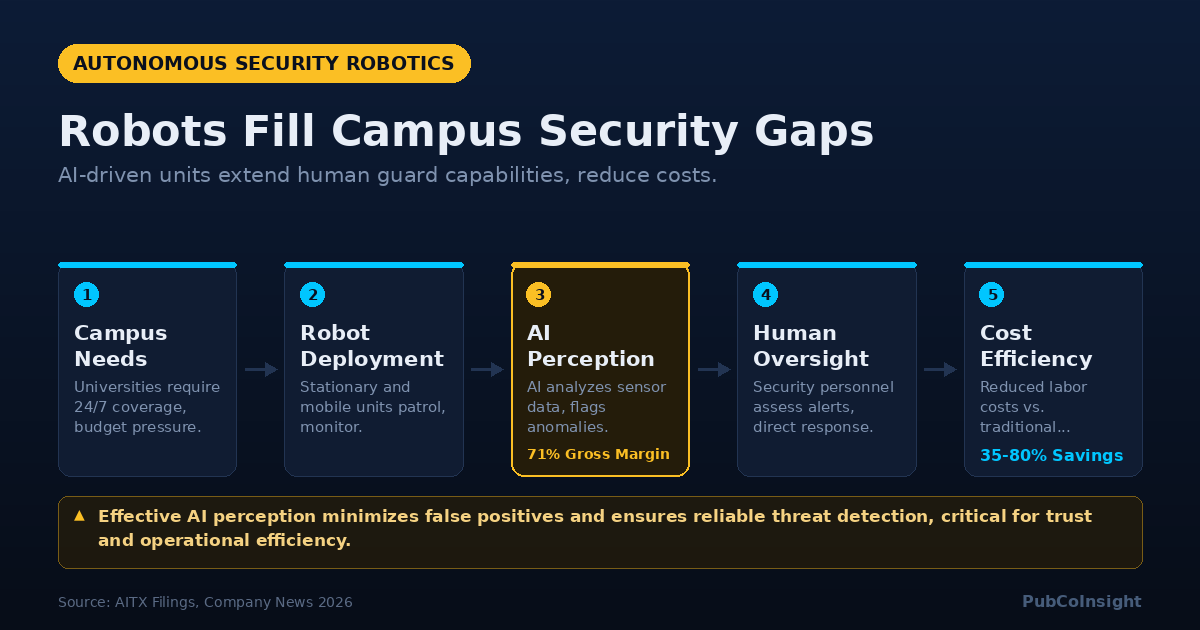
The Mechanism of Campus Security Robotics
Autonomous security robotics introduce a layered approach to campus safety. The first layer involves persistent, automated surveillance. Stationary units, often equipped with multiple cameras, thermal sensors, and two-way audio, monitor fixed locations. Mobile robots, either wheeled or tracked, patrol predefined routes, scanning for anomalies or unauthorized access. These devices feed real-time data to a central monitoring station, which can be operated by human guards on-site or by a remote security operations center. The critical component is the artificial intelligence that processes this sensor data. It must differentiate between routine activity, like a student walking to class, and potential threats, such as an intruder scaling a fence or an abandoned package. This requires sophisticated computer vision algorithms trained on vast datasets specific to various environments. The AI also needs to manage false positives effectively. An over-sensitive system that constantly flags squirrels as intruders creates alert fatigue for human operators, undermining its utility. Conversely, a system that misses genuine threats is useless. When an anomaly is detected, the AI system triggers an alert. This alert includes relevant data, such as video feeds and location information, sent to human security personnel. These human operators then assess the situation and decide on the appropriate response, whether it is dispatching a human guard, issuing an audible warning through the robot's speakers, or contacting emergency services. The robots act as force multipliers, extending the reach and vigilance of a limited human security team. The challenge here is integration: the robot's alert system must seamlessly communicate with existing campus security infrastructure, including access control systems, emergency call boxes, and dispatch protocols. Without this smooth integration, even the most advanced robot becomes an isolated data point rather than a valuable tool.Companies Operating in This Sector
Several companies are developing and deploying autonomous security and related AI technologies. Arbe Robotics Ltd. (ARBE) focuses on high-resolution 4D imaging radar technology, primarily for autonomous vehicles. While not directly deploying security robots, their radar systems offer advanced perception capabilities that could be integrated into future mobile security platforms, providing superior object detection in adverse weather or low-light conditions. BigBear.ai Holdings, Inc. (BBAI) develops decision intelligence software, leveraging AI and machine learning for predictive analytics. Their work often involves large-scale data analysis for government and defense clients. While not a robotics company, their AI expertise could enhance the predictive capabilities of security systems, identifying patterns of behavior that precede incidents. Kopin Corporation (KOPN) specializes in micro-displays and optical solutions, critical components for augmented and virtual reality applications. These technologies are vital for the human-machine interface in advanced robotics, enabling clearer remote operation and enhanced situational awareness for security personnel interacting with robot feeds. Lantronix, Inc. (LTRX) provides secure data access and management solutions for the Internet of Things (IoT). Their embedded computing and networking products are essential for connecting autonomous robots to central command centers, ensuring reliable and secure data transmission, a non-trivial task in complex network environments. MicroVision, Inc. (MVIS) develops lidar technology for automotive safety and advanced driver-assistance systems. Like Arbe, their core technology is not directly security robotics, but their lidar units provide precise 3D mapping and object detection, crucial for navigation and situational awareness in mobile security robots operating in dynamic environments. Ondas Inc. (ONDS) operates in the industrial drone and private industrial wireless network space. While their focus is aerial, their expertise in autonomous systems and secure, resilient communication networks is transferable. Their recent acquisitions of GATE and Bron, as reported on September 17, 2026, suggest an interest in component ownership that could strengthen their defense-related offerings, potentially including ground-based autonomous systems. Red Cat Holdings, Inc. (RCAT) is known for its drone technology, particularly for defense and public safety. Their experience with autonomous aerial vehicles and associated software platforms could inform the development of integrated air-ground security solutions for large campuses or critical infrastructure. Serve Robotics Inc. (SERV) develops autonomous sidewalk delivery robots. Their focus on navigating public spaces and interacting safely with pedestrians offers insights into the challenges and solutions for deploying ground-based robots in populated environments like university campuses. The integration of their "Beacon" system into diverse restaurant environments, as reported on September 14, 2026, demonstrates practical deployment experience. Unusual Machines, Inc. (UMAC) designs and manufactures specialized drone systems. While their primary market is drones, their engineering capabilities in autonomous vehicle design and manufacturing are relevant to the broader robotics sector. Their investor conference lineup, noted on September 18, 2026, highlights their engagement with the investment community regarding their technology.Artificial Intelligence Technology Solutions, Inc.
Artificial Intelligence Technology Solutions, Inc. (AITX), trading as AITX on the OTCID tier, builds and leases autonomous security robots and remote monitoring systems. The company operates through a "Solutions-as-a-Service" model, generating recurring monthly subscription revenue rather than one-off hardware sales. AITX's business is structured across several subsidiaries: Robotic Assistance Devices, Inc. (RAD-I) for stationary security devices, Robotic Assistance Devices Mobile (RAD-M) for mobile autonomous platforms like the ROAMEO unit, and Robotic Assistance Devices Group (RAD-G) which focuses on the SARA agentic artificial intelligence platform. A wholly-owned subsidiary, RAD Lanka, based in Sri Lanka, handles software development, AI initiatives, and technical operations. The company estimates the U.S. security and guarding services market to be approximately $50 billion. AITX claims its solutions can deliver cost savings between 35% and 80% compared to traditional manned security. The ROAMEO mobile security unit began early commercial deployment in May 2026. AITX's filings indicate a long-term strategy referred to internally as "RAD Town," aiming for integrated autonomous-security deployments across entire campuses, communities, or jurisdictions. For the fiscal year ended February 28, 2026, AITX reported revenue of $7,745,336, a 26% increase year-over-year. Gross profit rose 48% to $5,533,700, with gross margin expanding to approximately 71% from 61%. Operating expenses remained largely flat at about $17,477,097, and the loss from operations improved by approximately $2.0 million to $(11,943,397). The company reported a net loss of approximately $14.5 million for the fiscal year and had an accumulated deficit of approximately $171 million as of February 28, 2026. Negative cash flow from operating activities for the year was $9,344,534, with negative working capital of $17,017,745. The company's independent registered public accounting firm has included an explanatory paragraph in its report expressing substantial doubt about AITX's ability to continue as a going concern. While the company outlines ambitious plans for RAD-I's recurring revenue and gross margin to support positive cash flow, and for RAD-M to surpass RAD-I's monthly recurring revenue, the public record does not yet establish the consistent achievement of these financial milestones. AITX intends to introduce additional stationary solutions and projects RAD-G will generate substantial revenue from SARA platform licensing.What to watch
Investors should monitor the quarterly filings of companies like AITX, ONDS, and SERV for specific contract announcements and deployment numbers in new verticals. For AITX, the detailed breakdown of new higher education contracts, including the number of units deployed and the duration of subscription agreements, will provide concrete evidence of market penetration. Filings will also show progress on the "RAD Town" strategy, particularly any named campus or community deployments. For Ondas, watch for further updates on their defense-related acquisitions and how these integrate into their broader autonomous systems strategy. Serve Robotics' expansion beyond restaurant delivery, potentially into campus logistics or security, would be a notable development. Pay attention to the gross margin figures reported by AITX, especially as they scale manufacturing and deployment, as these will indicate the efficiency of their "Solutions-as-a-Service" model., { "label": "Robot Deployment", "note": "Stationary and mobile units patrol, monitor." }, { "label": "AI Perception", "note": "AI analyzes sensor data, flags anomalies.", "metric": "71% Gross Margin" }, { "label": "Human Oversight", "note": "Security personnel assess alerts, direct response." }, { "label": "Cost Efficiency", "note": "Reduced labor costs vs. traditional guarding.", "metric": "35-80% Savings" } ], "highlight": 2, "highlight_note": "Effective AI perception minimizes false positives and ensures reliable threat detection, critical for trust and operational efficiency.", "footnote": "Source: AITX Filings, Company News 2026" }Companies mentioned
| Ticker | Company | Price |
|---|---|---|
| AITX client | Artificial Intelligence Technology Solutions Inc | $0.0039 |
| ARBE | Arbe Robotics Ltd. | $0.67 |
| BBAI | BigBear.ai Holdings, Inc. | $2.8 |
| KOPN | Kopin Corporation | $4.74 |
| LTRX | Lantronix, Inc. | $5.85 |
| MVIS | MicroVision, Inc. | $1.66 |
| ONDS | Ondas Inc. | $7.39 |
| RCAT | Red Cat Holdings, Inc. | $6.75 |
| SERV | Serve Robotics Inc. | $4.41 |
| UMAC | Unusual Machines, Inc. | $23.18 |
Listed alphabetically, not ranked. Prices as of 2026-09-20 and they move. Check a live quote before relying on any of this.
How we chose the companies in this article
We cover a fixed universe of companies working in autonomous security robotics, physical AI and the guarding services market they are aimed at. Every one of them that had usable market data on 2026-09-20 appears in this article. We do not pick which ones to mention based on what we think of them, and we do not order them by size, price or trading volume, because an ordered list is a verdict and that is not ours to hand down. Companies left out, and why: none. American Lithium Minerals and Artificial Intelligence Technology Solutions pay us, which is disclosed in full at the foot of every article they appear in.
See the dilution and promotion flags before you see the pitch.
Each week: the micro and small-caps now showing dilution or paid-promotion signals, with the SEC filing behind every flag. No recommendations, no price targets.
Sources used in this article
- Prediction: Here's What a $1,000 Investment in Tesla (TSLA) Stock Could Be Worth By 2036 Motley Fool · 2026-09-20
- Jim Cramer sends a blunt message to AMD stock investors TheStreet · 2026-09-20
- Nvidia Stock And 2 US AI Infrastructure Plays Tied To Federal Defense Spending Simply Wall St. · 2026-09-20
- History Says Buying the Nasdaq-100 at the Dot-Com Peak Still (Eventually) Turned $10,000 Into About $72,000 Motley Fool · 2026-09-20
- Applied Materials vs. Nvidia: Which Tech Stock Is a Better Buy in 2026? Motley Fool · 2026-09-20
- Fed Chair Kevin Warsh Defied President Donald Trump, and 17 Words From His Post-FOMC Meeting Press Conference Suggest He May Do So Again Motley Fool · 2026-09-20
- Oracle Has Committed Hundreds of Billions to AI Data Centers. These 2 Industrial Stocks Will Power Them. Motley Fool · 2026-09-20
- Axon (AXON) Stock Looks Fairly Valued As 149% Run Meets Funding Test Simply Wall St. · 2026-09-19
- I Think IBM Stock Will Be Higher in 5 Years. I Still Wouldn't Buy It Today. Motley Fool · 2026-09-19
- Unpacking the Stock Market's Coiled Spring Set Up Zacks · 2026-09-19
- Berkshire's Energy Holdings Are Worth More Than Most Stand-Alone Utilities. Here's the Math. Motley Fool · 2026-09-19
- Stocks making big moves this week: Sabre, DocuSign, Dave & Buster's, RUM Group, and Axon StockStory · 2026-09-18
Disclosure required by Section 17(b) of the Securities Act of 1933
Artificial Intelligence Technology Solutions, Inc., a Nevada corporation (OTCID: AITX). Artificial Intelligence Technology Solutions, Inc. pays Strategic Innovations First, Inc., a Wyoming corporation doing business as PulseIR. Compensation received: USD 5,000.00 per month for months 1-3 (August, September, October 2026); USD 10,000.00 per month for months 4-6 (November, December 2026, January 2027) contingent on the 90-day review. Minimum committed USD 15,000.00; USD 45,000.00 if the second-period rate triggers.. Form of payment: cash only, invoiced monthly in advance; no stock, options or warrants received or payable. Services: investor relations services under an Investor Relations Services Agreement effective 2026-08-01. Period: six month term, 2026-08-01 through 2027-01-31; 90-day review on or about 2026-10-30. No stock, options or warrants held by PubCo Insight, Pulse IR, Strategic Innovations First, Inc., or Brad Listermann. Confirmed by the executed agreement and by board record recKwdq39X2caPSX7 (POSITIONS HELD: none).
This is information, not investment, financial, legal or tax advice. It is not a recommendation or solicitation to buy, sell or hold any security and it contains no price target. Nothing here is independently verified by us. Confirm every figure against primary filings on SEC EDGAR before you act. Micro-cap and over-the-counter securities are speculative and illiquid and can lose all of their value. The companies named without a disclosure above pay us nothing and have no relationship with us; they are named because a published, mechanical screen selected them. Full disclosure policy.