Lithium Outlooks Diverge: A Deep Dive into Brine, Clay, and Hard Rock
Analyst ratings for major lithium players split last week, highlighting the complex and varied paths companies are taking to secure critical battery minerals.
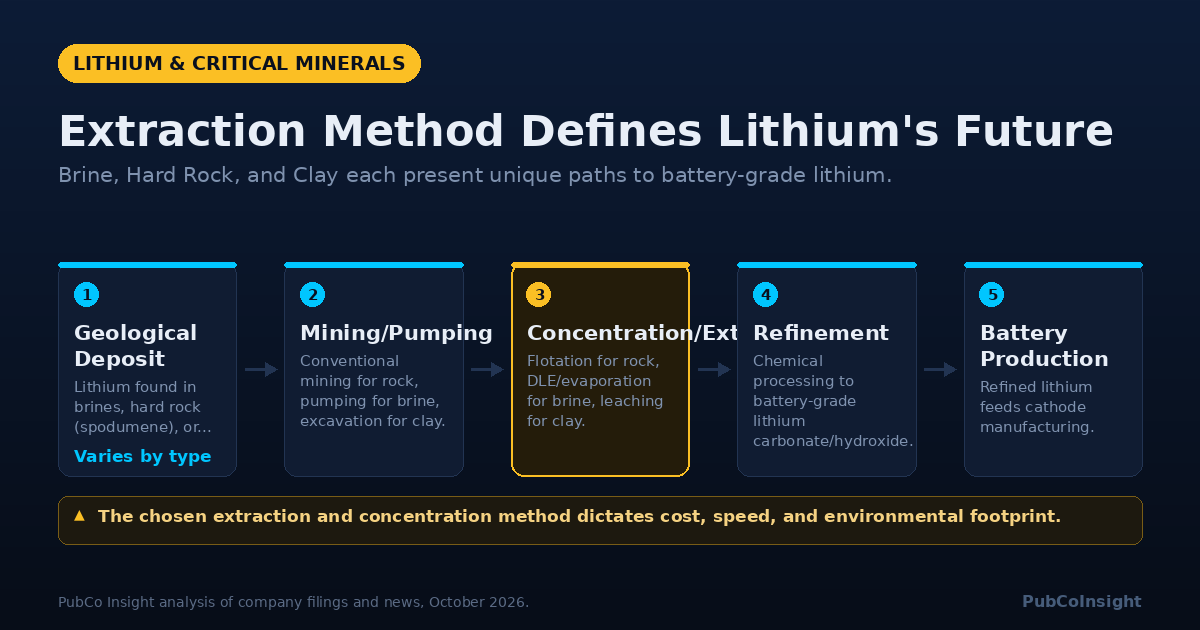
The Chemistry of Extraction: Brine, Clay, and Hard Rock
Lithium comes from three primary sources: brines, hard rock, and clays. Each demands a distinct extraction and processing pathway, carrying its own cost structure, environmental footprint, and technical risks. Understanding these differences is crucial for evaluating any lithium project. Brine operations, like those common in South America's "lithium triangle," involve pumping subterranean, lithium-rich saltwater to the surface. Traditional methods use large evaporation ponds, relying on solar energy to concentrate the lithium before chemical processing. This is energy-intensive and requires vast land areas and significant water resources, but can yield high-purity lithium carbonate. Newer direct lithium extraction (DLE) technologies aim to bypass evaporation ponds, using selective adsorption or ion exchange to extract lithium more efficiently. DLE promises faster production and a smaller environmental footprint, but these technologies are still scaling up and proving commercial viability. Hard rock deposits, primarily spodumene, are found in pegmatite formations. These require conventional mining techniques: drilling, blasting, and crushing the ore. The spodumene mineral is then concentrated through flotation, followed by a high-temperature roasting process to convert it into a chemical form suitable for further refining into lithium hydroxide or carbonate. This pathway is capital-intensive and requires significant energy for mining and roasting, but it delivers a high-grade concentrate that is relatively well-understood commercially. Clay-hosted lithium deposits, often found in volcanic ash beds, represent a newer frontier. These deposits, like those in Nevada, typically contain lithium in minerals such as hectorite or jadarite. Extraction from clays is complex. It often involves acid leaching or sulfation roasting to dissolve the lithium, followed by purification steps to remove impurities. The challenge lies in developing cost-effective and environmentally sound methods to separate lithium from the clay matrix, which can vary significantly from one deposit to another. These projects often face higher R&D costs and longer timelines to commercial production compared to established brine or hard rock operations. The value in clay projects often hinges on novel processing technologies that can unlock the resource economically.Operators and Their Assets
The critical minerals sector features a diverse set of companies, each navigating these geological and technical realities. In the hard rock segment, Piedmont Lithium (PLL) is developing its Carolina Lithium project in North Carolina, aiming to be a fully integrated producer of lithium hydroxide. The project intends to mine spodumene and process it on-site. Piedmont also holds interests in other hard rock projects globally, including a stake in Sayona Mining's North American Lithium operation in Quebec. For brine and DLE technologies, Standard Lithium (SLI) is focused on extracting lithium from brine resources in Arkansas, specifically from the Smackover Formation. The company is advancing its flagship Lanxess project, leveraging existing brine infrastructure from a bromine operation. Standard Lithium is working on a DLE process designed to selectively extract lithium from the brine. Ioneer Ltd (IONR) is developing its Rhyolite Ridge project in Nevada, a unique deposit that contains both lithium and boron. The project plans to extract both minerals from a clay-like ore body. Several companies are focused on rare earth elements (REEs), which are crucial for magnets in EVs and wind turbines. MP Materials (MP) operates the Mountain Pass mine in California, the only integrated rare earth mining and processing site in North America. MP Materials ships rare earth concentrate for further processing offshore but aims to bring full separation and magnet manufacturing capabilities to the US. USA Rare Earth, Inc. (USAR) is developing the Round Top project in Texas, which is a heavy rare earth and critical minerals project. Critical Metals Corp. (CRML) is focused on acquiring and developing projects for critical minerals, including rare earths, outside of China. NioCorp Developments Ltd. (NB) is developing the Elk Creek project in Nebraska, which targets niobium, scandium, and titanium, with potential for rare earth byproducts. Atlas Lithium Corporation (ATLX) is advancing its hard rock lithium project in Brazil's Lithium Valley. The company recently reported progress on pre-assembly steps for its processing plant, indicating movement towards production. American Battery Technology Company (ABAT) is focused on lithium-ion battery recycling and the development of primary lithium resources from Nevada claystone. Its strategy spans both circular economy solutions and new resource extraction.American Lithium Minerals, Inc.
American Lithium Minerals, Inc. (AMLM) is an exploration stage company focused on lithium and boron properties in Nevada. The company trades over the counter and files with the SEC under CIK 1356371. AMLM's primary asset is the Sarcobatus Lithium property, which comprises 1,780 acres of mining claims in Central Nevada. This project is in an early exploration phase. The company’s filings indicate a long-term strategy to expand its exploration and acquisition for mineral properties worldwide, beyond its current Nevada focus. AMLM was incorporated in Nevada in March 2005. Its activities since 2009 have centered on lithium exploration in Central Nevada. The company has also acquired and divested cobalt, nickel, and graphite prospects in Central Nevada, and rare earth elements projects in Arizona and Illinois. The public record does not yet establish a measured or indicated resource for the Sarcobatus project. AMLM intends to develop the use of Real World Asset Tokens to provide capital for mining, aiming to create an interoperable ecosystem where mining assets can be tokenized and traded. On October 15, AMLM announced the appointment of independent directors and the launch of a shareholder ambassador program. Earlier, on October 7, the company announced the conversion of a Worldwide Diversified Holdings, Inc. note into common shares, which strengthens its balance sheet. The company qualified a Regulation A offering on Form 1-A on February 4, 2026, covering up to 80,000,000 units, with up to 120,000,000 shares issuable if attached warrants are exercised in full. Each unit includes one share of common stock and a warrant to purchase 1.5 shares of common stock, exercisable at $0.05 per share until December 31, 2028.What to watch
Several key developments will shape the trajectory of these companies and the broader sector. Keep an eye on the progress of DLE technologies, particularly from companies like Standard Lithium (SLI), as successful commercialization could significantly alter the economics of brine extraction. For clay-based projects, permits and definitive feasibility studies are critical milestones. Ioneer (IONR) will need to demonstrate its ability to extract both lithium and boron economically from its Rhyolite Ridge deposit. Permitting remains a bottleneck for many projects, particularly in North America. Watch for updates on environmental impact assessments and federal or state approvals for projects like Piedmont Lithium's (PLL) Carolina Lithium. Any permitting delays or advancements can significantly impact project timelines and capital expenditures. Offtake agreements and strategic partnerships are also crucial. These deals provide financial backing and market certainty. Any announcements of new or expanded offtake agreements for processed lithium or rare earth products will signal market confidence and de-risk projects. For American Lithium Minerals (AMLM), watch for further details on exploration results from the Sarcobatus project and progress on its stated intention to expand its exploration and acquisition efforts. Specific drilling results or resource estimates would be significant for an exploration-stage company., { "label": "Mining/Pumping", "note": "Conventional mining for rock, pumping for brine, excavation for clay." }, { "label": "Concentration/Extraction", "note": "Flotation for rock, DLE/evaporation for brine, leaching for clay." }, { "label": "Refinement", "note": "Chemical processing to battery-grade lithium carbonate/hydroxide." }, { "label": "Battery Production", "note": "Refined lithium feeds cathode manufacturing." } ], "highlight": 2, "highlight_note": "The chosen extraction and concentration method dictates cost, speed, and environmental footprint.", "footnote": "PubCo Insight analysis of company filings and news, October 2026." }Companies mentioned
| Ticker | Company | Price |
|---|---|---|
| ABAT | American Battery Technology Company | $1.48 |
| AMLM client | American Lithium Minerals, Inc. | $0.0599 |
| ATLX | Atlas Lithium Corporation | $2.26 |
| CRML | Critical Metals Corp. | $6.97 |
| IONR | ioneer Ltd | $2.76 |
| NB | NioCorp Developments Ltd. | $3.125 |
| SLI | Standard Lithium Ltd. | $1.45 |
| USAR | USA Rare Earth, Inc. | $10.54 |
Listed alphabetically, not ranked. Prices as of 2026-10-19 and they move. Check a live quote before relying on any of this.
How we chose the companies in this article
We cover a fixed universe of companies working in lithium, boron and the critical minerals that feed battery and energy-storage supply chains. Every one of them that had usable market data on 2026-10-19 appears in this article. We do not pick which ones to mention based on what we think of them, and we do not order them by size, price or trading volume, because an ordered list is a verdict and that is not ours to hand down. Companies left out, and why: none. American Lithium Minerals and Artificial Intelligence Technology Solutions pay us, which is disclosed in full at the foot of every article they appear in.
See the dilution and promotion flags before you see the pitch.
Each week: the micro and small-caps now showing dilution or paid-promotion signals, with the SEC filing behind every flag. No recommendations, no price targets.
Sources used in this article
- Top 3 Canadian Lithium Stocks To Watch In October 2026 Simply Wall St. · 2026-10-17
- MP Materials vs. USA Rare Earth: Which Rare Earth Stock Is the Better Buy? Motley Fool · 2026-10-17
- Albemarle (ALB) Sees a More Significant Dip Than Broader Market: Some Facts to Know Zacks · 2026-10-16
- Rocket Thrusters on a Road Car Arrive as EV Makers Split Into Winners and Laggards CNW Group · 2026-10-16
- What US Small Cap Value Portfolio ETF (DFSV) Bought: Dick's Leads on Wednesday GuruFocus.com · 2026-10-16
- 2 Best Tire Stocks to Own as Premium Makers Navigate Inflation Risks Investing.com · 2026-10-16
- U.S. Targeted Value Portfolio ETF (DFAT) Adds GameStop and Dick's on Oct. 13 GuruFocus.com · 2026-10-15
- RBC Cuts Price Target on Albemarle to $129 From $157, Keeps Outperform Rating MT Newswires · 2026-10-15
- Lithium Americas Shares Rise After Canaccord Genuity Upgrade MT Newswires · 2026-10-15
- Canaccord Genuity Upgrades Lithium Americas to Speculative Buy From Hold MT Newswires · 2026-10-15
- Why Pirelli & C (BIT:PIRC) Is Getting Attention Today Simply Wall St. · 2026-10-15
- USA Rare Earth Climbs 4% as Month-Long Selloff Pauses; MP Materials Ticks Up, United States Antimony Dips 24/7 Wall St. · 2026-10-15
Disclosure required by Section 17(b) of the Securities Act of 1933
American Lithium Minerals, Inc.. American Lithium Minerals, Inc. (issuer) paid Strategic Innovations First, Inc., an affiliate of PubCo Insight and Pulse IR. Compensation received: USD 11,550.00 total, three equal monthly installments of USD 3,850.00. Form of payment: cash only; no stock, options or warrants. Services: investor relations, marketing and content creation under Master Services Agreement dated June 22, 2026. Period: three month initial term, June 2026 through August 2026. No position, options or warrants held by PubCo Insight, Pulse IR, Strategic Innovations First, Inc., or Brad Listermann.
This is information, not investment, financial, legal or tax advice. It is not a recommendation or solicitation to buy, sell or hold any security and it contains no price target. Nothing here is independently verified by us. Confirm every figure against primary filings on SEC EDGAR before you act. Micro-cap and over-the-counter securities are speculative and illiquid and can lose all of their value. The companies named without a disclosure above pay us nothing and have no relationship with us; they are named because a published, mechanical screen selected them. Full disclosure policy.