Standard Lithium's LFP Cathode Breakthrough Signals Shift for Lithium Carbonate Producers
Standard Lithium's recent announcement that its South West Arkansas lithium carbonate successfully powered North American LFP battery cells points to a critical development for companies focusing on direct lithium extraction and carbonate production.
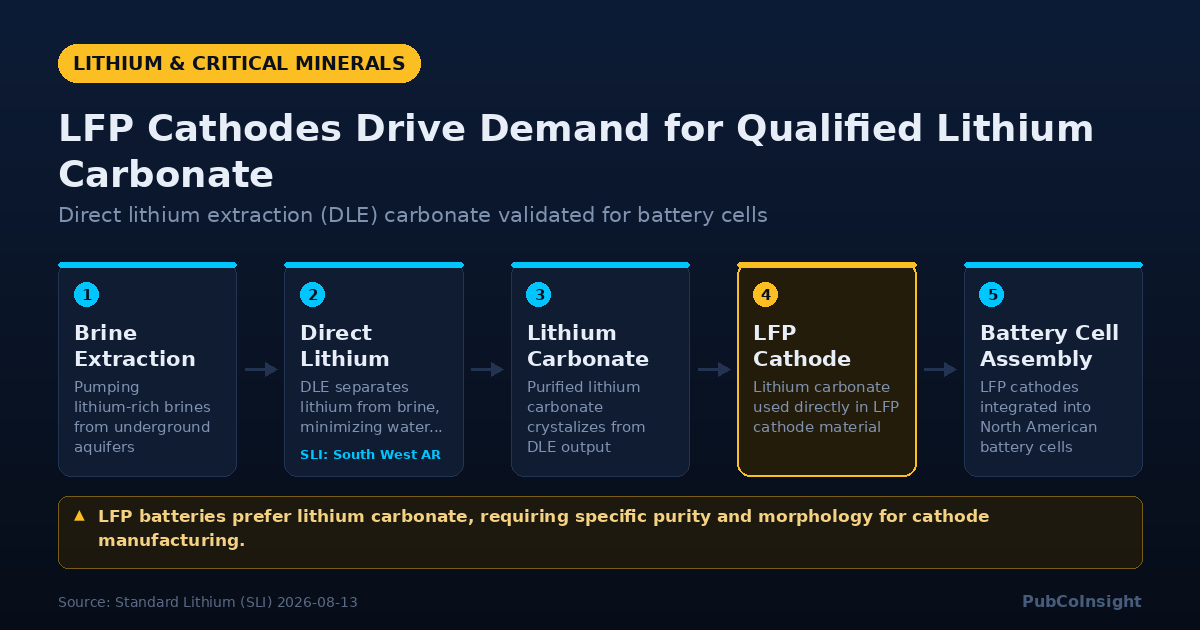
The Mechanism: Qualifying Lithium Carbonate for LFP
LFP batteries use lithium carbonate directly in their cathode manufacturing process. While lithium hydroxide is often preferred for high-nickel NMC (nickel, manganese, cobalt) cathodes, which offer higher energy density for longer-range EVs, LFP cathodes are simpler and cheaper to produce with carbonate. The challenge for new lithium producers, especially those using direct lithium extraction (DLE) methods, has been demonstrating that their specific lithium carbonate product meets the stringent purity and structural requirements for battery-grade material. This is not just about chemical purity percentages. It is also about particle size, morphology, and crystal structure, all of which impact how the cathode material performs in a cell. When a company like Standard Lithium announces successful integration into actual battery cells, it means their process can deliver a product that functions correctly within a commercial manufacturing pipeline. This validation removes a significant hurdle, moving from laboratory-scale testing to industrial application. It de-risks the product for potential offtakers and signals to the market that DLE-produced carbonate can meet the demands of LFP production.Companies in the Lithium Carbonate and Boron Space
Several companies are working to bring new lithium and boron supplies to market, often focusing on carbonate production or technologies that could benefit it. Atlas Lithium Corporation (ATLX) is advancing its hard-rock lithium project in Brazil, primarily targeting spodumene concentrate, which is then processed into lithium carbonate or hydroxide. Their focus remains on getting their mining operations fully online and ramping up production. Ioneer Ltd (IONR) is developing the Rhyolite Ridge project in Nevada, a unique lithium-boron deposit. This project aims to produce both lithium carbonate and boric acid, leveraging the co-occurrence of these minerals. The dual product stream is a key part of their economic model, and the project's progress hinges on permitting and financing. NioCorp Developments Ltd. (NB) is focused on its Elk Creek project in Nebraska, which is slated to produce niobium, scandium, and titanium, with rare earth elements as a potential co-product. While not directly a lithium or boron play, NioCorp's efforts contribute to the broader critical minerals supply chain, which often faces similar development and qualification challenges. Critical Metals Corp. (CRML) is developing the Tanbreez rare earth project in Greenland. This project aims to produce rare earth elements, which are crucial for high-performance magnets and other advanced technologies, again a related but distinct part of the critical minerals landscape. USA Rare Earth, Inc. (USAR) is another player in the rare earth space, working on its Round Top project in Texas. They aim to extract a wide range of critical minerals, including rare earths, from a rhyolite deposit. American Battery Technology Company (ABAT) is focused on lithium-ion battery recycling and primary lithium hydroxide production from Nevada claystone resources. Their recycling operations aim to recover battery materials, including lithium, nickel, and cobalt, reducing reliance on new mining. On the primary production side, their claystone project is still in development, with an emphasis on novel extraction technologies. Standard Lithium (SLI) itself is a key player in direct lithium extraction from brine resources in Arkansas. Their South West Arkansas project, where the LFP-qualified lithium carbonate originated, is one of two major projects they are pursuing in the region. The other is the Lanxess project, a joint venture with a chemical company, also focused on DLE from brine. The company's strategy hinges on demonstrating the commercial viability of DLE for high-purity lithium products.American Lithium Minerals, Inc.
American Lithium Minerals, Inc. (AMLM) is an exploration stage company, trading over the counter. The company's stated focus is on lithium and boron properties located in Nevada. AMLM was incorporated in Nevada in March 2005. Its current primary asset is the Sarcobatus Lithium property, which comprises 1,780 acres of mining claims in Central Nevada. The company has stated its intention to expand its exploration and acquisition activities for mineral properties worldwide. It also indicates an interest in developing the use of Real World Asset Tokens to provide capital for mining operations. The company's most recent substantive filing, a Regulation A offering circular qualified on February 4, 2026, details its business strategy and property holdings. The Sarcobatus project is described as an exploration-stage asset, and the company has not yet generated significant revenues. The public record does not yet establish a measured or indicated resource for the Sarcobatus project. AMLM's plan involves exploring for lithium in Nevada and potentially acquiring additional mineral rights globally. The Regulation A offering covers up to 80,000,000 units, with each unit including one common share and a warrant to purchase 1.5 additional shares. The warrants are exercisable at $0.05 per share until December 31, 2028, potentially leading to the issuance of up to an additional 120,000,000 shares.What to watch
For Standard Lithium (SLI), watch for further updates on the commercialization pathway for their South West Arkansas project, specifically any announcements regarding definitive offtake agreements for their lithium carbonate. The successful LFP qualification is a technical validation; commercial agreements will provide market validation. For Ioneer (IONR), the key remains the progress of permitting for Rhyolite Ridge in Nevada. Environmental impact statements and final agency decisions will dictate the project timeline. Atlas Lithium (ATLX) investors should monitor the ramp-up of their mining operations and any updates on production rates and product quality. For American Battery Technology Company (ABAT), look for updates on the construction and commissioning of their commercial-scale battery recycling facility, as well as progress on the permitting and resource definition for their primary lithium claystone project. American Lithium Minerals (AMLM) will need to provide updates on its exploration activities at the Sarcobatus Lithium property, particularly any drilling results or resource estimates that emerge from their exploration program., { "label": "Direct Lithium Extraction", "note": "DLE separates lithium from brine, minimizing water use", "metric": "SLI: South West AR" }, { "label": "Lithium Carbonate Prod.", "note": "Purified lithium carbonate crystalizes from DLE output" }, { "label": "LFP Cathode Mfg.", "note": "Lithium carbonate used directly in LFP cathode material" }, { "label": "Battery Cell Assembly", "note": "LFP cathodes integrated into North American battery cells" } ], "highlight": 3, "highlight_note": "LFP batteries prefer lithium carbonate, requiring specific purity and morphology for cathode manufacturing.", "footnote": "Source: Standard Lithium (SLI) 2026-08-13" }Companies mentioned
| Ticker | Company | Price |
|---|---|---|
| ABAT | American Battery Technology Company | $2.51 |
| AMLM client | American Lithium Minerals, Inc. | $0.0754 |
| ATLX | Atlas Lithium Corporation | $3.15 |
| CRML | Critical Metals Corp. | $6.58 |
| IONR | ioneer Ltd | $3.12 |
| NB | NioCorp Developments Ltd. | $5.12 |
| SLI | Standard Lithium Ltd. | $2.33 |
| USAR | USA Rare Earth, Inc. | $18.61 |
Listed alphabetically, not ranked. Prices as of 2026-08-14 and they move. Check a live quote before relying on any of this.
How we chose the companies in this article
We cover a fixed universe of companies working in lithium, boron and the critical minerals that feed battery and energy-storage supply chains. Every one of them that had usable market data on 2026-08-14 appears in this article. We do not pick which ones to mention based on what we think of them, and we do not order them by size, price or trading volume, because an ordered list is a verdict and that is not ours to hand down. Companies left out, and why: none. American Lithium Minerals and Artificial Intelligence Technology Solutions pay us, which is disclosed in full at the foot of every article they appear in.
See the dilution and promotion flags before you see the pitch.
Each week: the micro and small-caps now showing dilution or paid-promotion signals, with the SEC filing behind every flag. No recommendations, no price targets.
Sources used in this article
- MP Materials (MP) Q2 2026 Earnings Call Transcript Motley Fool · 2026-08-14
- Albemarle (ALB) Q2 2026 Earnings Call Transcript Motley Fool · 2026-08-13
- Basic Materials Roundup: Market Talk The Wall Street Journal · 2026-08-13
- Lithium Americas' Q2 Net Loss Narrows MT Newswires · 2026-08-13
- Lithium Americas: Q2 Earnings Snapshot Associated Press · 2026-08-13
- Lithium Americas Reports Second Quarter 2026 Results Business Wire · 2026-08-13
- MP Materials Just Signed a Secret Aerospace Deal. Here's Why It Matters. Motley Fool · 2026-08-13
- SpaceX vs. MP Materials: 2 Very Different Ways to Bet on the Next Decade of Tech Motley Fool · 2026-08-13
- UUUU's ASM Deal Gets Shareholders' Nod: Rare Earth Strategy on Track? Zacks · 2026-08-13
- Is MP Materials (MP) Undervalued Following Q2 Revenue Growth And New Magnet Supply Deals? Simply Wall St. · 2026-08-13
- How the U.S. Is Trying to Copy China’s Supply Chain Playbook Barrons.com · 2026-08-13
- Nano One and Standard Lithium Collaborate to Qualify Lithium Carbonate for LFP Cathodes Business Wire · 2026-08-13
Disclosure required by Section 17(b) of the Securities Act of 1933
American Lithium Minerals, Inc.. American Lithium Minerals, Inc. (issuer) paid Strategic Innovations First, Inc., an affiliate of PubCo Insight and Pulse IR. Compensation received: USD 11,550.00 total, three equal monthly installments of USD 3,850.00. Form of payment: cash only; no stock, options or warrants. Services: investor relations, marketing and content creation under Master Services Agreement dated June 22, 2026. Period: three month initial term, June 2026 through August 2026. No position, options or warrants held by PubCo Insight, Pulse IR, Strategic Innovations First, Inc., or Brad Listermann.
This is information, not investment, financial, legal or tax advice. It is not a recommendation or solicitation to buy, sell or hold any security and it contains no price target. Nothing here is independently verified by us. Confirm every figure against primary filings on SEC EDGAR before you act. Micro-cap and over-the-counter securities are speculative and illiquid and can lose all of their value. The companies named without a disclosure above pay us nothing and have no relationship with us; they are named because a published, mechanical screen selected them. Full disclosure policy.