Arbe Robotics Raises $15 Million, Highlighting Lidar's Role in Autonomous Security
Arbe Robotics' recent capital raise underscores the critical importance of advanced lidar technology in the expanding market for autonomous security robotics and guarding services.
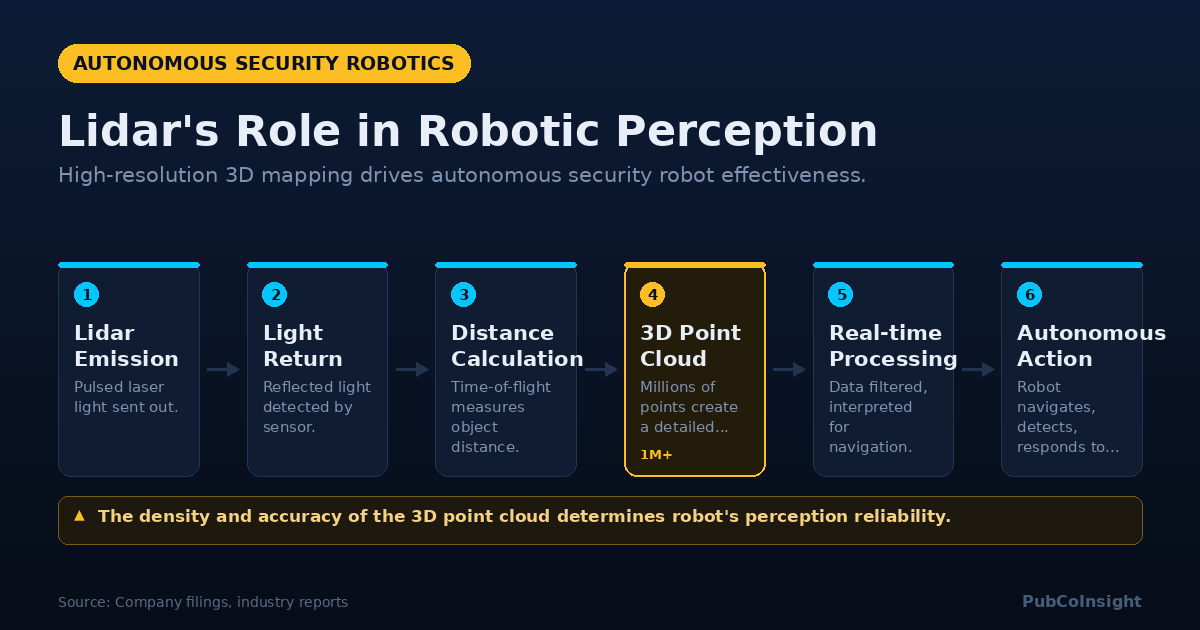
The Mechanism of Lidar Perception
Lidar, or Light Detection and Ranging, operates by emitting pulsed laser light and measuring the time it takes for the light to return to the sensor. This time-of-flight measurement allows the system to calculate precise distances to objects. By emitting millions of these pulses per second and sweeping them across a scene, a lidar unit constructs a dense "point cloud," a 3D representation of the environment. Each point in this cloud has an X, Y, and Z coordinate, providing spatial data far richer than traditional 2D cameras alone. For autonomous security robots, this 3D data is essential. It allows robots to differentiate between a static pole and a moving person, to navigate cluttered outdoor environments without collision, and to accurately identify intrusions in low-light or adverse weather conditions where optical cameras struggle. The challenge lies in processing this massive amount of data in real-time, filtering out noise, and integrating it with other sensor inputs, like radar and cameras, to create a robust and reliable perception system. The accuracy and density of the point cloud, combined with the speed of processing, dictate the robot's ability to operate safely and effectively. A higher resolution lidar can distinguish smaller objects at greater distances, reducing false positives and improving detection capabilities.Companies Advancing Autonomous Security
Several companies are developing and deploying technologies critical to this evolving market. Arbe Robotics (ARBE), with its recent $15 million raise, focuses on high-resolution 4D imaging radar solutions, which complement lidar by offering superior performance in adverse weather conditions and at longer ranges. This technology is vital for both autonomous vehicles and robotic security platforms that need to operate reliably outdoors. In the broader sensing and perception space, MicroVision, Inc. (MVIS) develops MEMS-based lidar technology, aiming for miniaturization and cost reduction, which could expand the addressable market for these sensors in smaller, more agile security robots. Kopin Corporation (KOPN) provides micro-displays and optical modules, components that often find their way into advanced sensor systems and augmented reality interfaces for human operators interacting with robotic fleets. On the AI and software side, BigBear.ai Holdings, Inc. (BBAI) offers AI-powered analytics and decision intelligence, which can be integrated into autonomous platforms for predictive security analysis and optimized patrol routes. Lantronix, Inc. (LTRX) provides embedded computing and networking solutions, crucial for connecting and managing fleets of autonomous devices, ensuring secure data transmission and remote control. Companies like Ondas Inc. (ONDS) are active in the drone and counter-drone space, with products like the Dronebuster REACH extending non-kinetic counter-UAS defeat to long ranges. While focused on aerial systems, their expertise in autonomous navigation and threat detection is directly relevant to ground-based security robotics. Red Cat Holdings, Inc. (RCAT) also operates in the drone sector, developing hardware and software for various applications, including defense and public safety, where autonomous capabilities are paramount. Serve Robotics Inc. (SERV) focuses on last-mile delivery robots, showcasing the broader application of autonomous navigation in real-world environments, a foundation for security patrols. Unusual Machines, Inc. (UMAC) is another player in the counter-drone market, with recent news highlighting its defense-focused expansion, underscoring the increasing demand for autonomous and semi-autonomous systems in security.Artificial Intelligence Technology Solutions, Inc.
Artificial Intelligence Technology Solutions, Inc. (AITX) operates through several subsidiaries, including Robotic Assistance Devices, Inc. (RAD-I), Robotic Assistance Devices Mobile (RAD-M), and Robotic Assistance Devices Group (RAD-G). The company focuses on developing and deploying AI-driven security and productivity solutions for enterprise clients. AITX's business model centers on a "Solutions-as-a-Service" approach, offering autonomous security robots and remote monitoring systems via recurring monthly subscriptions rather than outright hardware sales. RAD-I is the primary subsidiary, marketing stationary security devices to the security and guarding services industry. The company estimates this market to be approximately $50 billion in the United States. AITX states its solutions are designed to deliver significant cost savings, between 35% and 80%, compared to traditional manned security. These solutions integrate stationary and mobile devices with AITX's proprietary software and monitoring platforms. RAD-M handles mobile autonomous platforms, including the ROAMEO mobile security unit, which began early commercial deployment in May 2026. This expansion into mobile units represents a strategic move to address a wider range of security needs, potentially offering a higher revenue ceiling than stationary solutions alone. RAD-G focuses on the SARA agentic artificial intelligence platform, which the company intends to license for substantial revenue. AITX also operates RAD Lanka, a wholly owned subsidiary in Sri Lanka with Port City Colombo status, dedicated to software development, AI initiatives, and technical operations across its subsidiaries. The company refers to its long-term strategy as "RAD Town," envisioning integrated autonomous-security deployments across entire campuses, communities, or jurisdictions. For the fiscal year ended February 28, 2026, AITX reported revenue of $7,745,336, a 26% increase from the prior year. Gross profit rose 48% to $5,533,700, with gross margin expanding to approximately 71% from 61%. Operating expenses remained largely flat at about $17,477,097, and the loss from operations improved by approximately $2.0 million to $(11,943,397). The company reported a net loss of approximately $14.5 million for the fiscal year ended February 28, 2026, with an accumulated deficit of approximately $171 million as of that date. The public record does not yet establish the full market penetration or sustained profitability of its mobile autonomous platforms. As of February 28, 2026, AITX had negative cash flow from operating activities of $9,344,534 and negative working capital of $17,017,745. A recent 8-K filing on September 30, 2026, noted an additional RIO 360 order from a healthcare client, indicating continued traction for its stationary solutions. The company's filings also discuss its expectations for RAD-I's recurring revenue and gross margin to support positive cash flow operations, and for RAD-M to eventually surpass RAD-I's monthly recurring revenue contribution. Subscription gross margin is projected to exceed 75%, and outright-sale gross margin to exceed 50%, based on average bill of materials costs and market-accepted pricing.What to watch
Investors should monitor the revenue trajectory of companies like AITX, particularly the growth in recurring monthly subscription figures for their deployed robotic units. Filings detailing new deployments, especially for mobile platforms like ROAMEO, will offer insight into market acceptance and scaling. For lidar and sensor companies such as Arbe Robotics (ARBE) and MicroVision (MVIS), watch for announcements of new design wins with major robotics integrators or autonomous vehicle manufacturers, as these partnerships validate their technology and expand market reach. Further capital raises or strategic investments in the sensor component sector will also signal continued investor confidence in the underlying technology. Pay attention to the reported gross margins for both hardware and service components, as these metrics directly reflect the efficiency of production and the profitability of the service model., { "label": "Light Return", "note": "Reflected light detected by sensor." }, { "label": "Distance Calculation", "note": "Time-of-flight measures object distance." }, { "label": "3D Point Cloud", "note": "Millions of points create a detailed map.", "metric": "1M+ points/sec" }, { "label": "Real-time Processing", "note": "Data filtered, interpreted for navigation." }, { "label": "Autonomous Action", "note": "Robot navigates, detects, responds to threats." } ], "highlight": 3, "highlight_note": "The density and accuracy of the 3D point cloud determines robot's perception reliability.", "footnote": "Source: Company filings, industry reports" }Companies mentioned
| Ticker | Company | Price |
|---|---|---|
| AITX client | Artificial Intelligence Technology Solutions Inc | $0.0027 |
| ARBE | Arbe Robotics Ltd. | $0.613 |
| BBAI | BigBear.ai Holdings, Inc. | $2.65 |
| KOPN | Kopin Corporation | $4.91 |
| LTRX | Lantronix, Inc. | $7.19 |
| MVIS | MicroVision, Inc. | $1.48 |
| ONDS | Ondas Inc. | $7.24 |
| RCAT | Red Cat Holdings, Inc. | $6.4 |
| SERV | Serve Robotics Inc. | $4.615 |
| UMAC | Unusual Machines, Inc. | $22.37 |
Listed alphabetically, not ranked. Prices as of 2026-10-05 and they move. Check a live quote before relying on any of this.
How we chose the companies in this article
We cover a fixed universe of companies working in autonomous security robotics, physical AI and the guarding services market they are aimed at. Every one of them that had usable market data on 2026-10-05 appears in this article. We do not pick which ones to mention based on what we think of them, and we do not order them by size, price or trading volume, because an ordered list is a verdict and that is not ours to hand down. Companies left out, and why: none. American Lithium Minerals and Artificial Intelligence Technology Solutions pay us, which is disclosed in full at the foot of every article they appear in.
See the dilution and promotion flags before you see the pitch.
Each week: the micro and small-caps now showing dilution or paid-promotion signals, with the SEC filing behind every flag. No recommendations, no price targets.
Sources used in this article
- Market Chatter: Firmus Grid Set to Offer Half of IPO Shares to Existing Backers MT Newswires · 2026-10-05
- The Most Important Number in Robinhood's Business Isn't Revenue. It's This. Motley Fool · 2026-10-05
- What Trumpflation Data Reveals About Rising Prices and the Risk to Your Portfolio Motley Fool · 2026-10-05
- BNP Paribas Adjusts Price Target on Nvidia to $345 From $285, Keeps Outperform Rating MT Newswires · 2026-10-05
- History Says Sandisk Stock Crashes Soon. Here's Why That's Not Going to Happen. Motley Fool · 2026-10-05
- Nvidia's $20bn licensing deal with Groq faces lawsuit from jilted engineers Financial Times · 2026-10-05
- Is Upstart Stock a Buy, Sell, or Hold At Its New 52-Week Low? Motley Fool · 2026-10-05
- Nvidia Just Added $150 Billion to Its Buyback Plan. Selling Shares Inside Your IRA Won’t Make More Social Security Taxable, but Taking the Money Out Could 24/7 Wall St. · 2026-10-05
- Warren Buffett Has Only Recommended 1 Investment in Over 60 Years, and It's Never Lost Money (but There's a Catch) Motley Fool · 2026-10-05
- Where Will Nvidia Stock Be in 2030? Three Scenarios for the World's Most Valuable AI Company Motley Fool · 2026-10-05
- Stocktwits Defense Watch: BA, RTX, LHX Score Major Deals As ONDS Expands Counter-Drone Push Stocktwits · 2026-10-03
- Axon Enterprise (AXON) Stock Falls Amid Market Uptick: What Investors Need to Know Zacks · 2026-10-02
Disclosure required by Section 17(b) of the Securities Act of 1933
Artificial Intelligence Technology Solutions, Inc., a Nevada corporation (OTCID: AITX). Artificial Intelligence Technology Solutions, Inc. pays Strategic Innovations First, Inc., a Wyoming corporation doing business as PulseIR. Compensation received: USD 5,000.00 per month for months 1-3 (August, September, October 2026); USD 10,000.00 per month for months 4-6 (November, December 2026, January 2027) contingent on the 90-day review. Minimum committed USD 15,000.00; USD 45,000.00 if the second-period rate triggers.. Form of payment: cash only, invoiced monthly in advance; no stock, options or warrants received or payable. Services: investor relations services under an Investor Relations Services Agreement effective 2026-08-01. Period: six month term, 2026-08-01 through 2027-01-31; 90-day review on or about 2026-10-30. No stock, options or warrants held by PubCo Insight, Pulse IR, Strategic Innovations First, Inc., or Brad Listermann. Confirmed by the executed agreement and by board record recKwdq39X2caPSX7 (POSITIONS HELD: none).
This is information, not investment, financial, legal or tax advice. It is not a recommendation or solicitation to buy, sell or hold any security and it contains no price target. Nothing here is independently verified by us. Confirm every figure against primary filings on SEC EDGAR before you act. Micro-cap and over-the-counter securities are speculative and illiquid and can lose all of their value. The companies named without a disclosure above pay us nothing and have no relationship with us; they are named because a published, mechanical screen selected them. Full disclosure policy.