Market Pulse: Biotech & MedTech Catalysts
Lilly's China Win Ignites Biotech M&A, Squeezing Small Cap Cash Runways
Eli Lilly's latest approval in China for Orforglipron sends ripples through the biotech sector, sharpening focus on cash-strapped small caps and their critical clinical milestones.
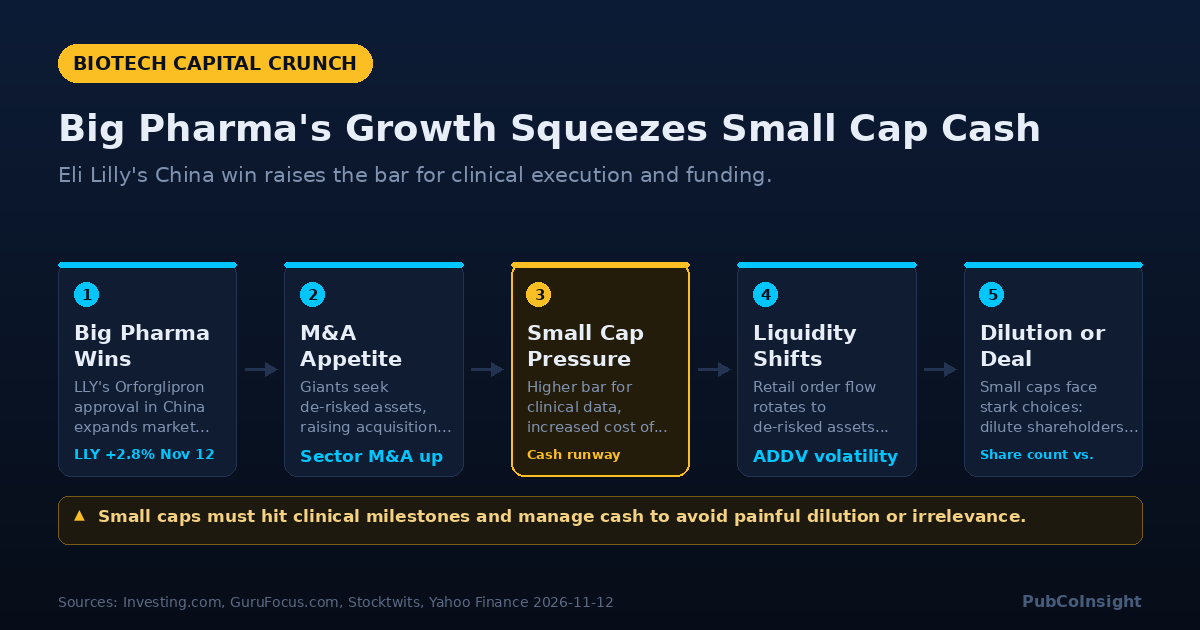
Eli Lilly (LLY) just landed a major win, with China clearing its weight-loss pill, Orforglipron. This news, reported by Investing.com and GuruFocus.com on November 12, 2026, sent Lilly shares up 2.8%, further cementing its leadership in the GLP-1 and obesity market. This isn't just a headline for Big Pharma; it's a seismic event for small-cap, microcap, and OTC biotech firms. Lilly's expanding pipeline, alongside giants like Johnson & Johnson (JNJ) and Vertex Pharmaceuticals (VRTX), signals a relentless pursuit of new therapies and market share.
This aggressive expansion by the sector's titans creates a dual pressure point for smaller players. On one hand, it validates the underlying science and market demand for innovative treatments, potentially attracting investment. On the other, it raises the bar significantly for clinical execution, regulatory navigation, and, critically, cash runway. Big Pharma's M&A appetite often targets de-risked assets, meaning small caps must hit their milestones precisely, or face the stark reality of dilution or irrelevance.
The Market Transmission Mechanism: Big Pharma's Appetite and Small Cap Survival
When Eli Lilly secures a multi-billion dollar market like China for a novel drug, it doesn't just add to their bottom line; it recalibrates the entire biotech landscape. This move, highlighted by Stocktwits as giving Lilly an edge over Novo Nordisk in a potential $4.5 billion market, amplifies the capital intensity of drug development. Big Pharma's cash flows, bolstered by blockbusters like Mounjaro and Zepbound, enable them to acquire promising assets or outspend smaller competitors in clinical trials and commercialization. This dynamic directly impacts the cost of capital for small-cap biotechs. If a small firm has a promising drug but a short cash runway, its negotiating position for partnerships or funding rounds weakens. Investors, seeing the deep pockets and rapid execution of companies like Lilly and Vertex, demand higher discounts or more favorable terms from smaller, riskier ventures. The FDA's busy calendar, noted by CNW Group for Vertex Pharmaceuticals, underscores the high-stakes environment. Every clinical trial readout, every regulatory target date, becomes a make-or-break moment. A delay or a less-than-stellar result can trigger a sharp sell-off, as retail order flow, often sensitive to news, pulls liquidity. Conversely, a positive readout can attract significant institutional and retail interest, but the window for such opportunities is narrowing as Big Pharma accelerates its pace.
The weekly Flags Watchlist: small-caps now showing dilution or promotion signals, each linked to the SEC filing behind the flag.
How the Small-Cap and Microcap Cohort Positions Around This Trend
Against this backdrop, smaller biotech and medtech companies are navigating a treacherous path, balancing innovation with financial prudence. Capricor Therapeutics, Inc. (CAPR), with its last close at $11.22 and a robust 30-day average daily dollar volume of $28.4M, stands out for its relatively strong liquidity. Capricor focuses on Duchenne muscular dystrophy and advanced heart failure, areas with significant unmet needs. Their ability to manage clinical trial progress and secure funding will be critical. Inovio Pharmaceuticals, Inc. (INO), trading at $1.48 with a 30-day average daily dollar volume of $27.3M, recently had its Q3 2026 earnings call highlighting FDA approval and commercialization efforts, according to GuruFocus.com. Inovio's focus on DNA medicines, particularly in infectious diseases and oncology, positions it in a high-risk, high-reward segment. Their cash burn rate and progress towards commercialization will be closely scrutinized. PDS Biotechnology Corporation (PDSB), last closing at $1.02 with a 30-day average daily dollar volume of $12.4M, is developing immunotherapies for cancer and infectious diseases. Their proprietary Versamune platform aims to enhance the immune response. For PDSB, demonstrating clear clinical efficacy and safety data will be paramount to attract further investment or potential M&A interest from larger players. Ocugen, Inc. (OCGN), trading at $0.96 with a 30-day average daily dollar volume of $5.9M, is working on gene therapies for eye diseases and vaccines. The company faces the challenge of advancing complex therapies through rigorous regulatory pathways, requiring substantial capital. Their ability to secure partnerships or non-dilutive funding will be key to extending their runway. Autonomix Medical, Inc. (AMIX), at $1.48 with a 30-day average daily dollar volume of $5.0M, operates in the medical device space, developing technologies for peripheral nerve stimulation. While not directly in drug development, their success depends on FDA clearance and market adoption, which also demands significant capital for R&D and commercialization. Intuitive Surgical (ISRG), despite a recent $450M settlement, remains a solid growth stock, as noted by Zacks, illustrating the potential for medtech firms that achieve market penetration. Adagio Medical Holdings, Inc. (ADGM), closing at $1.87 with a lower 30-day average daily dollar volume of $323K, is focused on cardiac ablation technologies. Companies with lower liquidity like ADGM face a tougher challenge in raising capital, as institutional investors often prefer more liquid names. Their operational execution and ability to generate revenue or secure strategic partnerships become even more critical. Kiora Pharmaceuticals, Inc. (KPRX), at $1.35 with a 30-day average daily dollar volume of $87K, is developing therapies for rare ophthalmic diseases. With the lowest average daily dollar volume in this cohort, Kiora exemplifies the microcap challenge. Every dollar spent, every clinical trial result, carries immense weight. Their cash runway and ability to communicate progress effectively to a limited investor base are paramount for survival.What Active Traders and Desks Are Watching Next
- FDA Target Dates: Monitor the calendar for upcoming Prescription Drug User Fee Act (PDUFA) dates, particularly for Vertex Pharmaceuticals (VRTX) and other major biotech players, as these often set the tone for sector sentiment and M&A speculation.
- Q4 2026 Earnings Calls: Pay close attention to cash burn rates, guidance on clinical trial timelines, and any commentary on strategic partnerships or financing plans from small-cap and microcap biotechs like Capricor Therapeutics (CAPR) and Inovio Pharmaceuticals (INO).
- Big Pharma M&A Activity: Watch for any further acquisition announcements from Eli Lilly (LLY), Johnson & Johnson (JNJ), or other large pharmaceutical companies. These deals can signal which therapeutic areas are hot and which assets are being de-risked.
- Clinical Trial Readouts: Specific data releases from ongoing Phase 2 or Phase 3 trials for companies like PDS Biotechnology (PDSB) and Ocugen (OCGN) will be critical catalysts, determining their ability to attract follow-on funding or partnerships.
- Retail Order Flow Trends: Observe shifts in average daily dollar volume (ADDV) for names like Autonomix Medical (AMIX), Adagio Medical Holdings (ADGM), and Kiora Pharmaceuticals (KPRX). Sudden spikes or drops can indicate changing sentiment or significant news.
Companies mentioned
| Ticker | Company | Price |
|---|---|---|
| ADGM | Adagio Medical Holdings, Inc. | $1.87 |
| AMIX | Autonomix Medical, Inc. | $1.48 |
| CAPR | Capricor Therapeutics, Inc. | $11.22 |
| INO | Inovio Pharmaceuticals, Inc. | $1.48 |
| KPRX | Kiora Pharmaceuticals, Inc. | $1.35 |
| OCGN | Ocugen, Inc. | $0.96 |
| PDSB | PDS Biotechnology Corporation | $1.02 |
Listed alphabetically, not ranked. Prices as of 2026-11-12 and they move. Check a live quote before relying on any of this.
How we chose the companies in this article
Candidate pool of 10 small-cap, microcap, and OTC names in Market Pulse: Biotech & MedTech Catalysts; ranked by 30-day average daily dollar volume (Yahoo Finance) as of 2026-11-12. All compensated IR clients are excluded from this editorial lane.
PubCo Insight
See the dilution and promotion flags before you see the pitch.
Each week: the micro and small-caps now showing dilution or paid-promotion signals, with the SEC filing behind every flag. No recommendations, no price targets.
Every flag links to its EDGAR filing so you can check it yourself. Sponsored coverage disclosed under SEC 17(b). One-click unsubscribe.
Sources used in this article
- The RFK Jr. Effect: Why GLP-1s Won't Be The Last 'Explosive' Story In Peptides Investor's Business Daily · 2026-11-12
- Is There A Risk Hiding In Johnson & Johnson Stock's Earnings? Trefis · 2026-11-12
- Premarket movers: Nvidia sinks; Lilly gains on China approval Investing.com · 2026-11-12
- Baron Funds Sees Eli Lilly’s (LLY) Mounjaro, Zepbound and Orforglipron as Transformational Insider Monkey · 2026-11-12
- Can LLY's Expanding Obesity Pipeline Sustain Its GLP-1 Leadership? Zacks · 2026-11-12
- Eli Lilly Shares Rise 2.8% After China Approves Orforglipron Weight-Loss Pill InvestorsHub · 2026-11-12
- Lilly Stock Rises as China Clears Its Weight-Loss Pill GuruFocus.com · 2026-11-12
- State Street Health Care SPDR (XLV) Adds Eli Lilly and Johnson & Johnson on Nov. 10 GuruFocus.com · 2026-11-12
- Eli Lilly’s Orforglipron Wins Big In China – Gains Edge Over Novo In Race For Potential $4.5B Market Stocktwits · 2026-11-12
- Eli Lilly stock rises after China approves weight-loss pill Investing.com · 2026-11-12
- A Run of FDA Target Dates Fills the Biotech Calendar From Late November to Year End CNW Group · 2026-11-12
- ISRG Agrees to $450M Settlement: What Does It Mean for Investors? Zacks · 2026-11-12
PubCo Insight publishes research on small and micro-cap companies. Nothing here is investment advice, we make no buy or sell recommendations, and we publish no price targets. Small and micro-cap shares are speculative and illiquid and you can lose everything you put into them. Check every figure against primary filings on SEC EDGAR before you act on it.