Critical Minerals Analysts Re-Evaluate as Thacker Pass Costs Climb
Lithium Americas' Thacker Pass project faces a significant cost increase, prompting analyst adjustments and underscoring the precarious economics of new lithium extraction.
The Extraction Bottleneck: From Brine to Battery Grade
Extracting lithium, particularly from hard rock or brine sources, is a multi-stage process fraught with technical and economic hurdles. For brine operations, like those in South America's salt flats, the challenge lies in concentrating lithium chloride from vast, low-concentration brines. This typically involves solar evaporation ponds, a slow process that can take 18-24 months, followed by chemical precipitation and purification. The sheer scale of water management and the time lag create significant capital expenditure and operational risk. Hard rock mining, common in Australia and increasingly in North America, involves extracting spodumene or other lithium-bearing minerals. This requires traditional mining techniques - drilling, blasting, and crushing - to liberate the mineral. The subsequent step, chemical processing, is where the real difficulty lies. Separating lithium from other elements, such as aluminum, iron, and magnesium, demands sophisticated hydrometallurgical or pyrometallurgical circuits. These processes often involve multiple stages of leaching, solvent extraction, and precipitation, each requiring precise chemical controls and significant energy input. The goal is to achieve battery-grade lithium carbonate or hydroxide, a purity level exceeding 99.5%, a standard that few operations can consistently meet without extensive refinement. The Thacker Pass project, a hard rock deposit, faces precisely these downstream processing challenges. While the ore body itself is substantial, transforming the mined material into a usable product for battery manufacturers is the crucial, and most expensive, step. Any misstep in the chemical engineering or scale-up of these purification circuits can lead to significant cost overruns and project delays, as LAC has now demonstrated.Operators Navigating the Critical Minerals Landscape
The critical minerals sector is a dynamic arena, with companies ranging from established giants to nascent explorers. Albemarle Corporation (ALB), a global leader, operates diverse lithium assets, including the Silver Peak mine in Nevada and significant brine operations in Chile and Australia. Sociedad Quimica y Minera de Chile (SQM), another major player, also boasts extensive brine operations in Chile's Atacama Desert. These companies represent the established supply, but their large market capitalizations and existing infrastructure mean that incremental growth is often the narrative. On the emerging side, MP Materials (MP) operates the Mountain Pass mine in California, a significant source of rare earth elements. Their focus on building a fully integrated domestic rare earth supply chain, from mining to processing and separation, highlights a strategic push to reduce reliance on China. USA Rare Earth, Inc. (USAR) is also active in the rare earth space, with operations and partnerships aimed at establishing U.S.-based processing capabilities. Critical Metals Corp. (CRML) recently took full ownership of the Tanbreez rare earth project, signaling a drive to consolidate assets. Standard Lithium Ltd. (SLI) is pursuing direct lithium extraction (DLE) technologies, aiming to bypass the lengthy evaporation process of traditional brine operations. Their projects in Arkansas and Louisiana represent an attempt to innovate the extraction method. Ioneer Ltd (IONR) is developing the Rhyolite Ridge lithium-boron project in Nevada, a joint venture with a significant offtake agreement with Ford. NioCorp Developments Ltd. (NB) is focused on its Elk Creek project in Nebraska, which contains niobium, scandium, and titanium, alongside significant potential for rare earth elements. American Battery Technology Company (ABAT) is developing integrated lithium-ion battery recycling and manufacturing capabilities, aiming to create a circular economy for battery materials. Atlas Lithium Corporation (ATLX) is exploring lithium projects in Brazil, seeking to tap into new geological provinces.American Lithium Minerals, Inc.
American Lithium Minerals, Inc. (AMLM), trading over-the-counter, is an exploration-stage company with stated interests in lithium and boron properties in Nevada. Its filings indicate a focus on the Sarcobatus Lithium property, covering 1,780 acres of mining claims in Central Nevada. The company has also previously acquired and divested interests in cobalt, nickel, and graphite prospects in the region, as well as rare earth element projects in Arizona and Illinois. The company’s current strategy, as outlined in its February 4, 2026, Regulation A offering, includes developing the use of Real World Asset Tokens to provide capital for mining. The offering aimed to raise up to $20 million, structured with units comprising common stock and warrants. The Sarcobatus property is located in a region known for its geological potential for lithium deposits. However, the public record does not yet establish the grade or economic viability of the lithium mineralization at Sarcobatus. AMLM is a pre-revenue entity, and its ability to advance its projects will depend on its success in capital raising and exploration outcomes. The company's business plan acknowledges the potential for significant modifications based on future events and market conditions.What to watch
* **February 15, 2027:** American Battery Technology Company (ABAT) is expected to file its Q2 FY27 financial results. * **March 1, 2027:** Lithium Americas (LAC) is anticipated to release its Q4 2026 financial results. This release will provide crucial updates on the ongoing Thacker Pass project development and any further cost escalations or mitigation strategies. * **March 15, 2027:** MP Materials (MP) is due to file its Q4 2026 financial results, offering insights into rare earth production and sales. * **March 31, 2027:** Standard Lithium (SLI) is expected to report its Q4 2026 financial results, which will include updates on its direct lithium extraction pilot projects. * **April 1, 2027:** Albemarle (ALB) is expected to provide its Q1 2027 financial results, offering a view into the performance of its diverse lithium operations amid evolving market dynamics., { "label": "Concentration", "note": "Initial separation of lithium.", "metric": "18-24 mos (brine)" }, { "label": "Chemical Processing", "note": "Purifying lithium compounds.", "highlight": true, "highlight_note": "This stage demands precise chemistry and scale-up.", "metric": "99.5%+ purity" }, { "label": "Battery Grade Product", "note": "Lithium carbonate/hydroxide." } ], "highlight": 2, "highlight_note": "This stage demands precise chemistry and scale-up.", "footnote": "Based on industry processes for lithium extraction and purification." }Companies mentioned
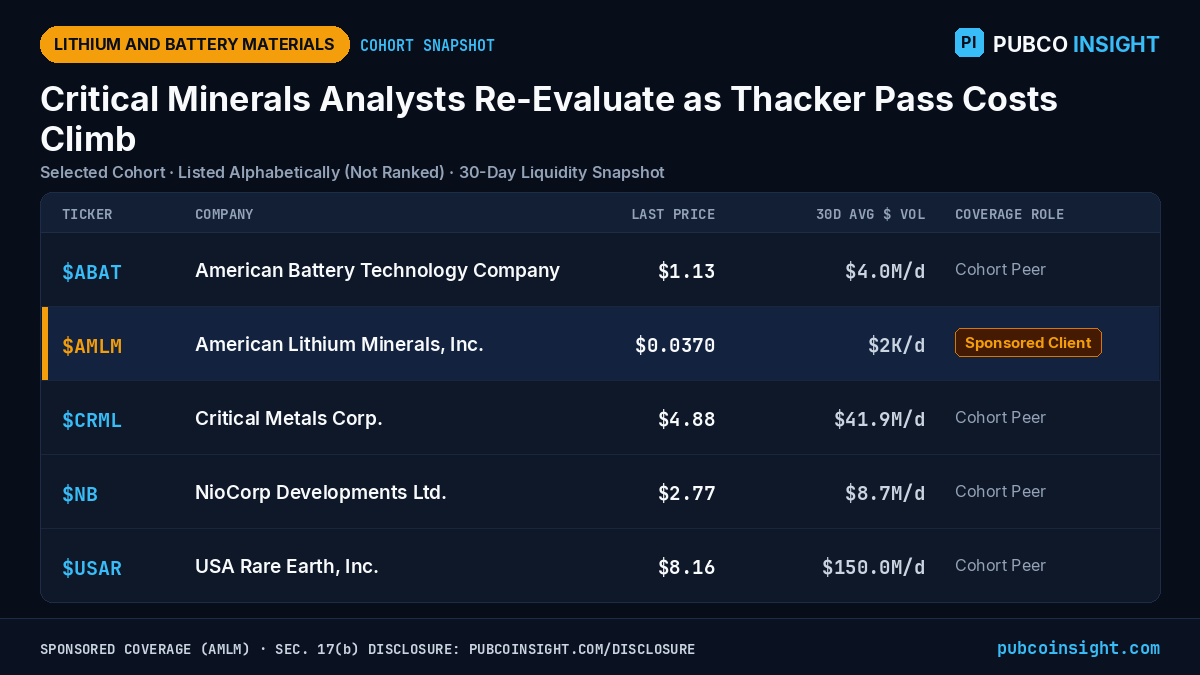
| Ticker | Company | Price |
|---|---|---|
| ABAT | American Battery Technology Company | $1.13 |
| AMLM client | American Lithium Minerals, Inc. | $0.037 |
| ATLX | Atlas Lithium Corporation | $1.54 |
| CRML | Critical Metals Corp. | $4.88 |
| IONR | ioneer Ltd | $2.18 |
| NB | NioCorp Developments Ltd. | $2.77 |
| SLI | Standard Lithium Ltd. | $1.37 |
| USAR | USA Rare Earth, Inc. | $8.16 |
Listed alphabetically, not ranked. Prices as of 2026-11-16 and they move. Check a live quote before relying on any of this.
How we chose the companies in this article
We cover a fixed universe of companies working in lithium, boron and the critical minerals that feed battery and energy-storage supply chains. Every one of them that had usable market data on 2026-11-16 appears in this article. We do not pick which ones to mention based on what we think of them, and we do not order them by size, price or trading volume, because an ordered list is a verdict and that is not ours to hand down. Companies left out, and why: none. American Lithium Minerals and Artificial Intelligence Technology Solutions pay us, which is disclosed in full at the foot of every article they appear in.
See the dilution and promotion flags before you see the pitch.
Each week: the micro and small-caps now showing dilution or paid-promotion signals, with the SEC filing behind every flag. No recommendations, no price targets.
Sources used in this article
- 3 Lithium Stocks Investors Are Watching After EnergyX News Simply Wall St. · 2026-11-15
- Could Investing $5,000 in MP Materials Help Make You a Millionaire? Motley Fool · 2026-11-14
- Are Wall Street Analysts Predicting Albemarle Stock Will Climb or Sink? Barchart · 2026-11-13
- Are Options Traders Betting on a Big Move in Sociedad Quimica y Minera Stock? Zacks · 2026-11-13
- Deutsche Bank Lowers Price Target on Lithium Americas to $2.20 From $2.80, Keeps Hold Rating MT Newswires · 2026-11-13
- Critical Metals Rises 3% as Rare Earth Stocks Extend Rally; USA Rare Earth Climbs 3%, MP Materials Gains 2% 24/7 Wall St. · 2026-11-13
- Heavy Lifting: Can USA Rare Earth Turn Its First Sales Into Big Profits? MarketBeat · 2026-11-13
- MP's Q3 Revenues Jump 176%: Can This Growth Be Sustained? Zacks · 2026-11-13
- Wall Street Wrap: Nvidia Faces Downgrades As Jensen Huang’s Exit Rattles Analysts — AMD, MP Materials, Riot Platforms Get Bullish Calls Stocktwits · 2026-11-13
- Rare Earth Wars: U.S. General Sounds Alarm Over China's Military Leverage Oilprice.com · 2026-11-13
- American Battery Technology Company Announces First Quarter FY27 Financial Results Including 83% Year-Over-Year Revenue Growth GlobeNewswire · 2026-11-13
- BofA Adjusts Price Target on Albemarle to $120 From $131 MT Newswires · 2026-11-12
Disclosure required by Section 17(b) of the Securities Act of 1933
American Lithium Minerals, Inc.. American Lithium Minerals, Inc. (issuer) paid Strategic Innovations First, Inc., an affiliate of PubCo Insight and Pulse IR. Compensation received: USD 11,550.00 total, three equal monthly installments of USD 3,850.00. Form of payment: cash only; no stock, options or warrants. Services: investor relations, marketing and content creation under Master Services Agreement dated June 22, 2026. Period: three month initial term, June 2026 through August 2026. No position, options or warrants held by PubCo Insight, Pulse IR, Strategic Innovations First, Inc., or Brad Listermann.
This is information, not investment, financial, legal or tax advice. It is not a recommendation or solicitation to buy, sell or hold any security and it contains no price target. Nothing here is independently verified by us. Confirm every figure against primary filings on SEC EDGAR before you act. Micro-cap and over-the-counter securities are speculative and illiquid and can lose all of their value. The companies named without a disclosure above pay us nothing and have no relationship with us; they are named because a published, mechanical screen selected them. Full disclosure policy.