Albemarle Target Cut Exposes the Cost Floor for Domestic Battery Metals
When Wall Street resets its price decks for Tier-1 lithium producers, it redraws the margin profile for every extraction project and processing circuit in North America.
On September 18, 2026, Mizuho Securities lowered its price target on Albemarle Corporation to $140 from $160, maintaining a neutral rating. The revision was not an isolated adjustment. Zacks and Simply Wall St. flagged a broader compression across lithium valuation models the same day, reflecting a coordinated recalibration of medium-term pricing decks. For institutional investors holding major chemical producers, the trim represents an overdue concession to persistent supply overhangs in raw spodumene and technical-grade carbonate.
The significance of a target reduction at Albemarle extends far beyond the equity itself. Albemarle operates the only active commercial lithium brine operation currently producing in the United States, at Silver Peak in Esmeralda County, Nevada. When sell-side desks reduce fair-value multiples on the incumbent operator, they simultaneously redefine the cost hurdles that development-stage projects must clear to secure capital. The pricing assumptions that justified multi-billion-dollar greenfield expansions in 2022 do not survive an environment where benchmark contracts settle at conservative baselines.
What is at stake is the margin threshold separating viable domestic supply from projects that exist strictly on paper. As chemical conversion margins tighten, market attention is shifting from gross tonnage projections toward unit recovery costs, reagent consumption, and the separation metallurgy required to produce commercial-grade salts. Capital is no longer rewarding generalized resource scale. It is looking for process flowsheets that can operate inside compressed commodity cycles.
The Chemistry, Reagents, and Marginal Unit Economics
Lithium deposits present fundamentally distinct chemical problems depending on whether the host matrix is an evaporative brine, an intrusive pegmatite, or an illite-smectite clay. In traditional continental brines, like those pumped from subterranean aquifers in the Clayton Valley basin, raw brine is concentrated through series of solar evaporation ponds over 12 to 24 months. The process removes magnesium, calcium, and sodium through fractional precipitation before the concentrated liquor is reacted with sodium carbonate, soda ash, to precipitate lithium carbonate. While operating expenditures for mature brine operations sit low on the global cost curve, often between $4,000 and $6,000 per metric ton of lithium carbonate equivalent, recovery rates rarely exceed 50 percent, and the upfront capital expenditure for pond footprints is restrictive.
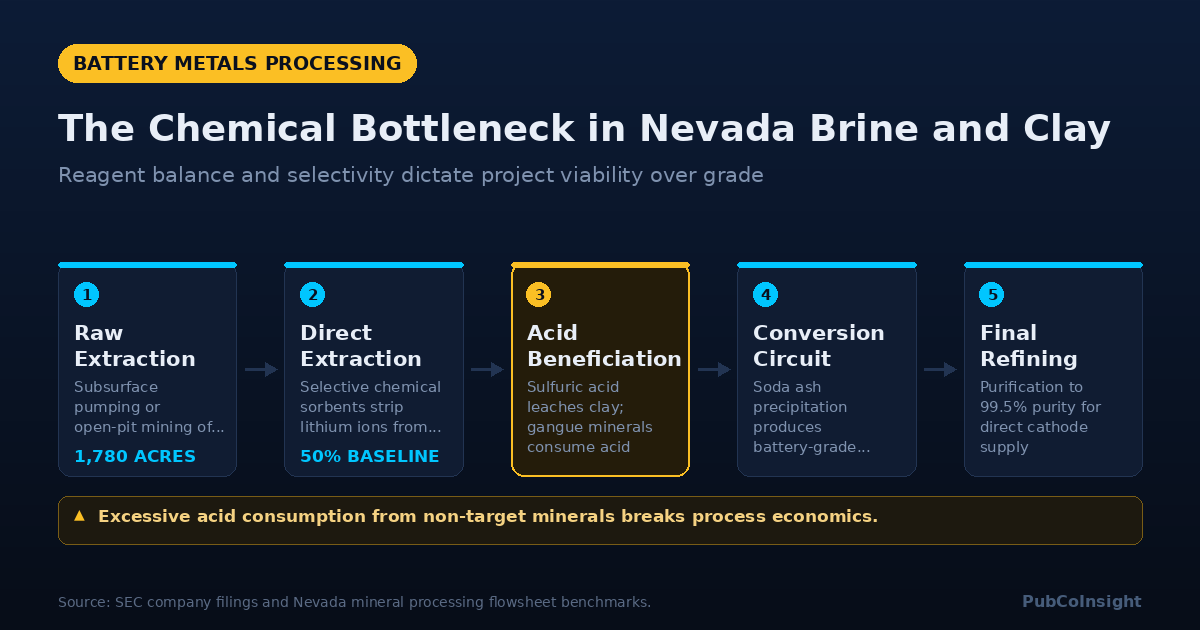
Direct Lithium Extraction, or DLE, attempts to eliminate the pond phase through chemical sorbents, ion-exchange media, or nanofiltration membranes that strip lithium ions directly from raw eluate. For a DLE circuit to achieve commercial viability, three engineering conditions must hold true. First, the sorbent must demonstrate high selectivity against competing divalent ions, particularly magnesium and calcium, without rapid structural degradation under continuous brine flow. Second, the elution cycle must yield an eluate sufficiently concentrated to limit the parasitic energy required for downstream mechanical vapor recompression. Third, the volume of fresh wash water required to displace entrained brine must remain low enough to satisfy strict hydrological permitting in arid basins. If reagent replacement costs exceed the margin delta gained by higher recovery, the theoretical processing advantage collapses.
Sedimentary claystones and hard-rock pegmatites face an entirely different economic constraint: acid consumption and calcination energy. Spodumene pegmatites require thermal decrepitation at roughly 1,050 degrees Celsius to convert alpha-spodumene into the reactive beta phase before acid leaching can occur. Claystone deposits, such as those found across southern and central Nevada, can often bypass the high-temperature calcination stage but demand immense volumes of sulfuric acid to break down the silicate lattice. If a sedimentary deposit contains elevated calcium or carbonate mineralization, that gangue material consumes sulfuric acid non-productively, driving up reagent expenses per ton of recovered metal. To prove these flowsheets wrong, an observer only needs to track reagent balance sheets: when the dollar cost of acid and neutralizing bases exceeds the market value of the extracted metal, the deposit cannot be economically beneficiated, regardless of the headline grade in the ground.
Operators Across the North American and Global Critical Minerals Pipeline
The tension between resource location and processing economics is visible across the entire critical materials universe, spanning lithium, rare earths, and industrial boron. In the brine space, Standard Lithium Ltd. (SLI, trading at $2.13) has pursued continuous direct extraction from subterranean oilfield brines, where existing infrastructure offsets discovery costs. The regional potential of commercial direct extraction gained additional data on September 20, 2026, when Equinor posted a positive preliminary economic assessment for its Texas lithium project, validating the broader Gulf Coast Smackover trend where SLI also operates.
In Nevada, ioneer Ltd (IONR, $3.25) anchors the sedimentary end of the domestic spectrum at its Rhyolite Ridge project. The asset couples lithium with a substantial co-product credit in boric acid, a commercial dynamic that lowers net operating costs per ton of lithium carbonate equivalent because boron sales absorb a major portion of the acid plant expenditures. Farther north along the Nevada-Oregon border, Lithium Americas Corp. (LAC) has seen its shares sell off alongside broader sector weakness, closing lower on September 18 as the market recalibrates the financing burden and construction timelines for large-scale sedimentary assets.
Downstream recycling and refining operators are testing alternative routes to domestic feedstock. American Battery Technology Company (ABAT, $2.33) filed its fiscal year 2026 financial results on September 14, delivering 407 percent year-over-year revenue growth and reporting positive adjusted gross profit from its recycling plant in Nevada. However, on September 16, market commentary highlighted that the firm faces evolving trade restrictions on recycled battery black mass and intermediate hydroxide exports, demonstrating that domestic processing capacity must find domestic off-takers to remain insulated from trade friction.
In hard-rock pegmatites, Atlas Lithium Corporation (ATLX, $2.94) is pursuing modular dense media separation at its properties in Minas Gerais, Brazil. Dense media separation relies on specific gravity differentials rather than chemical leaching, keeping initial capital expenditure significantly lower than chemical conversion plants, though it yields an intermediate concentrate rather than a battery-grade chemical.
Beyond lithium, the critical minerals sector is navigating severe geopolitical cross-currents that parallel the domestic refining bottleneck. USA Rare Earth, Inc. (USAR, $16.78) and MP Materials Corp. (MP) have experienced sharp trading sessions driven by sovereign realignments. On September 18, reports surfaced that Shenghe Resources, a major Chinese shareholder in MP Materials, entered discussions to be acquired by state-backed China Rare Earth, reigniting debate over supply chain independence. Meanwhile, Critical Metals Corp. (CRML, $9.33) surged 35 percent on September 21 following a geopolitical security agreement involving Greenland, putting its Tanbreez rare earth project permit into immediate focus alongside its stated plans for a low-waste refining plant in Romania, before shares eased 6 percent on September 22 as early gains met profit taking. In Nebraska, NioCorp Developments Ltd. (NB, $3.72) continues work on advancing its Elk Creek deposit, where the flowsheet targets a polymetallic basket of niobium, scandium, and titanium, three critical metals with domestic supply profiles entirely independent of the light rare earth complex.
American Lithium Minerals, Inc.
American Lithium Minerals, Inc. (AMLM, $0.07) operates as an early-stage exploration company focused on identifying mineral assets in Nevada. The company was incorporated in Nevada on March 10, 2005, and is pre-revenue. Its primary exploration asset is the Sarcobatus lithium property, which encompasses 1,780 acres of unpatented mining claims located in Central Nevada, situated in Nye County along the Sarcobatus Flat basin. Historical corporate activities detailed in company filings include legacy exploration work on cobalt, nickel, and graphite prospects within Nevada, as well as past claim acquisitions in rare earth prospects near Kingman, Arizona, and in southern Illinois.
On February 4, 2026, the Securities and Exchange Commission qualified a Regulation A offering circular on Form 1-A filed by American Lithium Minerals, Inc. under CIK 1356371. The qualified circular covers a maximum total offering of $20,000,000 on a best-efforts basis. The financing structure includes up to 80,000,000 units, priced with attached warrants to acquire up to 120,000,000 additional shares of common stock. Each unit consists of one share of common stock with a par value of $0.001 and a warrant to purchase 1.5 shares of common stock at an exercise price of $0.05 per share, expiring on December 31, 2028. The offering contains no minimum funding threshold, meaning funds cleared through subscriptions become immediately accessible to the issuer.
The public record on EDGAR does not establish whether any material proceeds have been raised under this qualified Regulation A offering, nor does it contain a certified National Instrument 43-101 or SEC subpart 1300 technical resource estimate detailing lithium grade or tonnage at the Sarcobatus claim block.
In its recent regulatory filings, management has outlined a dual corporate focus. Alongside baseline mineral claim exploration, American Lithium Minerals has stated an intention to pursue real-world asset, or RWA, tokenization structures to finance mining acquisition and exploration work. The company's circular notes that it owns no physical real estate, plants, or processing facilities. Future field operations at Sarcobatus remain dependent on management allocating proceeds toward ground-based geophysics, hydrological mapping, or exploratory drill programs to determine whether the lithium-bearing brines or sedimentary clays documented in adjacent basins extend across its acreage.
What to watch
- October 2026 SEC quarterly filings: Disclosures from early-stage explorers, including American Lithium Minerals, Inc., detailing cash balances, capital expenditures, and any proceeds realized from open Regulation A share issuances.
- Bureau of Land Management permitting notices: Federal register updates regarding final environmental approvals for ioneer Ltd's Rhyolite Ridge project and federal loan closing timelines for Lithium Americas Corp.
- Commercial offtake executions: Downstream battery black-mass sales agreements from American Battery Technology Company verifying domestic customer adoption following its fiscal fourth-quarter operational expansion.
- Danish and Greenlandic administrative decisions: Regulatory filings tracking the final mining license and exploitation permits for Critical Metals Corp.'s Tanbreez rare earth deposit in southern Greenland.
- Sell-side chemical price adjustments: Third-quarter earnings commentary from Albemarle Corporation regarding contract floor renegotiations and capital budget curtailments across its North American and Australian assets.
Companies mentioned
| Ticker | Company | Price |
|---|---|---|
| ABAT | American Battery Technology Company | $2.33 |
| AMLM client | American Lithium Minerals, Inc. | $0.07 |
| ATLX | Atlas Lithium Corporation | $2.94 |
| CRML | Critical Metals Corp. | $9.33 |
| IONR | ioneer Ltd | $3.25 |
| NB | NioCorp Developments Ltd. | $3.72 |
| SLI | Standard Lithium Ltd. | $2.13 |
| USAR | USA Rare Earth, Inc. | $16.78 |
Listed alphabetically, not ranked. Prices as of 2026-09-23 and they move. Check a live quote before relying on any of this.
How we chose the companies in this article
We cover a fixed universe of companies working in lithium, boron and the critical minerals that feed battery and energy-storage supply chains. Every one of them that had usable market data on 2026-09-23 appears in this article. We do not pick which ones to mention based on what we think of them, and we do not order them by size, price or trading volume, because an ordered list is a verdict and that is not ours to hand down. Companies left out, and why: none. American Lithium Minerals and Artificial Intelligence Technology Solutions pay us, which is disclosed in full at the foot of every article they appear in.
See the dilution and promotion flags before you see the pitch.
Each week: the micro and small-caps now showing dilution or paid-promotion signals, with the SEC filing behind every flag. No recommendations, no price targets.
Sources used in this article
- Is Albemarle Stock Outperforming the S&P 500? Barchart · 2026-09-22
- PIRELLI: BOARD OF DIRECTORS MAJORITY APPROVES US MULTI-YEAR INVESTMENT PLAN OF APPROXIMATELY €1 BILLION PR Newswire · 2026-09-22
- Critical Metals Drops 6% as Greenland Surge Meets Profit Taking; USA Rare Earth Slips, MP Materials Eases 24/7 Wall St. · 2026-09-22
- Rare Earth Elements Market Projected to Reach $10.44 Billion by 2030 CNW Group · 2026-09-22
- American Battery Technology Co (ABAT) (Q4 2026) Earnings Call Highlights: Record Revenue Growth ... GuruFocus.com · 2026-09-22
- Wall Street Bulls Look Optimistic About Albemarle (ALB): Should You Buy? Zacks · 2026-09-21
- Rare Earth Stocks With Supply Chain Leverage Investors Should Watch Simply Wall St. · 2026-09-21
- Greenland Deal Fuels Critical Metals; Rare Earth Stocks Hinge On Trump-Xi Investor's Business Daily · 2026-09-21
- UUUU vs. MP: Which Rare Earth Stock is a Better Pick Now? Zacks · 2026-09-21
- Critical Metals Surges 25% as Greenland Security Pact Puts Tanbreez Rare Earth Permit in Focus; USA Rare Earth Climbs 6%, MP Materials Rises 4% 24/7 Wall St. · 2026-09-21
- Stocks to Watch Recap: Paramount, Intel, Strategy, Critical Metals The Wall Street Journal · 2026-09-21
- Critical Metals Surges 38% and These Greenland Stocks Soar on Trump’s Security Deal Barrons.com · 2026-09-21
Disclosure required by Section 17(b) of the Securities Act of 1933
American Lithium Minerals, Inc.. American Lithium Minerals, Inc. (issuer) paid Strategic Innovations First, Inc., an affiliate of PubCo Insight and Pulse IR. Compensation received: USD 11,550.00 total, three equal monthly installments of USD 3,850.00. Form of payment: cash only; no stock, options or warrants. Services: investor relations, marketing and content creation under Master Services Agreement dated June 22, 2026. Period: three month initial term, June 2026 through August 2026. No position, options or warrants held by PubCo Insight, Pulse IR, Strategic Innovations First, Inc., or Brad Listermann.
This is information, not investment, financial, legal or tax advice. It is not a recommendation or solicitation to buy, sell or hold any security and it contains no price target. Nothing here is independently verified by us. Confirm every figure against primary filings on SEC EDGAR before you act. Micro-cap and over-the-counter securities are speculative and illiquid and can lose all of their value. The companies named without a disclosure above pay us nothing and have no relationship with us; they are named because a published, mechanical screen selected them. Full disclosure policy.