Albemarle's Q2 Lithium Surge Highlights Upstream Bottlenecks
Albemarle's recent earnings show lithium prices are driving record profits, but the challenge remains moving raw resources into battery-grade material.
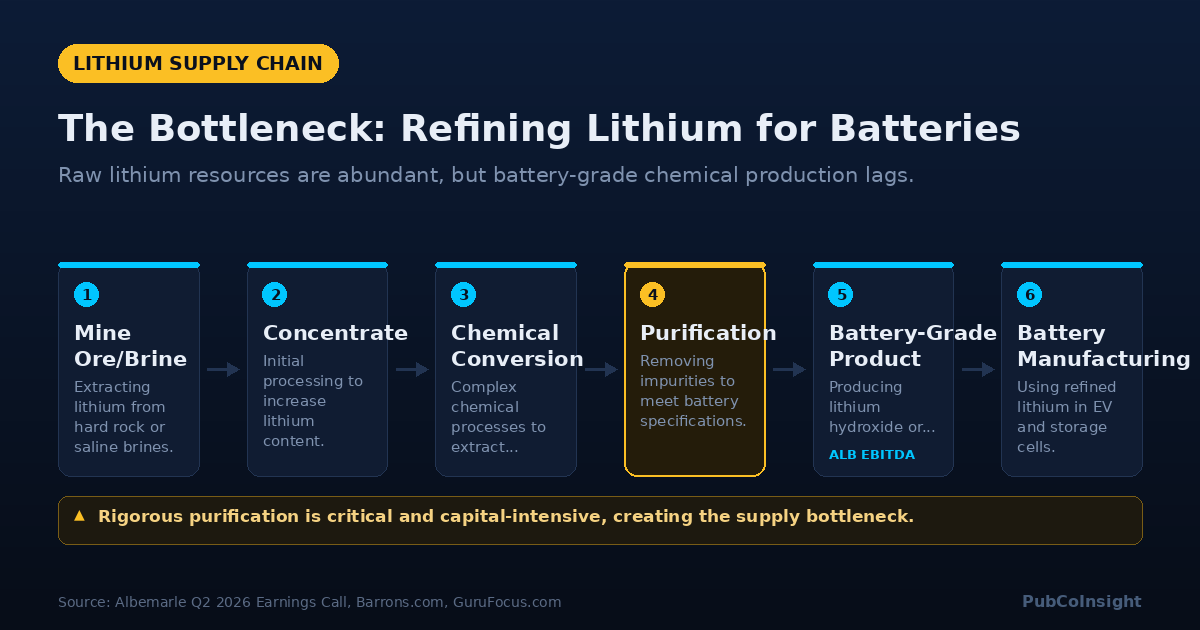
The Chemical Chasm: From Ore to Battery Grade
Converting raw lithium sources into battery-grade material is a multi-stage chemical engineering challenge. For hard rock deposits, like those found in Australia or Canada, spodumene ore must first be mined and concentrated. This concentrate then undergoes a calcination process, heating it to high temperatures to change its crystal structure. Next, it is acid-leached, typically with sulfuric acid, to dissolve the lithium. The resulting lithium sulfate solution then goes through a series of purification steps, including filtration, precipitation, and ion exchange, to remove impurities like iron, magnesium, and calcium. Finally, the purified lithium sulfate is converted into lithium hydroxide or lithium carbonate, depending on the battery chemistry requirements, through further precipitation and crystallization. Each step requires precise control of temperature, pressure, and chemical reagents. Impurities at any stage can degrade the final product's quality, making it unsuitable for high-performance batteries. The capital expenditure for a fully integrated spodumene-to-hydroxide plant can run into billions of dollars, with lead times stretching over many years. This complex, expensive, and time-consuming process is the real choke point.Operators in the Critical Minerals Space
Several companies are navigating this complex landscape, each with distinct approaches to securing and processing critical minerals. In the lithium brine sector, ioneer Ltd (IONR) is advancing its Rhyolite Ridge lithium-boron project in Nevada. This project aims to produce both lithium carbonate and boric acid, leveraging a unique co-production model. Standard Lithium Ltd. (SLI) is focused on extracting lithium from brine resources in Arkansas, utilizing direct lithium extraction (DLE) technologies. DLE aims to reduce the environmental footprint and accelerate production compared to traditional evaporation ponds. Hard rock lithium players include Atlas Lithium Corporation (ATLX), which holds lithium properties in Brazil's Lithium Valley. Their focus is on developing spodumene deposits to feed the global demand for hard rock concentrates. Lithium Americas Corp. (LAC) is developing the Thacker Pass lithium clay project in Nevada, which received a $175 million financing boost in early August. Thacker Pass is one of the largest known lithium resources in the United States, targeting production of battery-grade lithium carbonate. Beyond lithium, the broader critical minerals supply chain sees companies like NioCorp Developments Ltd. (NB) working on the Elk Creek project in Nebraska, which targets niobium, scandium, and titanium. These metals are crucial for high-strength alloys and advanced materials. Critical Metals Corp. (CRML) is active in rare earth elements, having advanced to the final round of a Kenyan government tender for the Mrima Hill Rare Earth and Niobium Project in July. CRML's CEO has publicly stated the need to challenge China's rare earth monopoly, highlighting the geopolitical dimension of these minerals. USA Rare Earth, Inc. (USAR) is also focused on rare earth elements, with its Round Top project in Texas aiming to produce a wide range of heavy and light rare earth oxides. MP Materials (MP) operates the Mountain Pass rare earth mine in California, the only integrated rare earth mining and processing site in North America. MP Materials reported strong Q2 earnings in early August, with its CEO noting demand continues to "outpace our production growth," particularly for magnet production. American Battery Technology Company (ABAT) is tackling the supply chain from a different angle: battery recycling. Their focus is on developing and commercializing technologies to recover battery metals from spent lithium-ion batteries, creating a circular economy for these critical resources. Stardust Power (ABAT) announced an offtake agreement in early August, signaling progress in securing customers for its recycled materials.American Lithium Minerals, Inc.
American Lithium Minerals, Inc. (AMLM) is an exploration stage company, pre-revenue, trading over the counter. The company, incorporated in Nevada in 2005, has stated its primary focus is lithium and boron properties in Nevada. AMLM's current project is the Sarcobatus Lithium property, comprising 1,780 acres of mining claims in Central Nevada. The company has historically acquired and divested cobalt, nickel, and graphite prospects in Central Nevada, and rare earth elements projects in Kingman, Arizona, and Southeast Illinois. AMLM filed a Regulation A offering on Form 1-A, qualified by the SEC on February 4, 2026. This offering covers up to 80,000,000 units, with each unit including one share of common stock and one warrant to purchase 1.5 shares of common stock. The warrants are exercisable at $0.05 per share until their expiration on December 31, 2028. The offering could result in up to 120,000,000 additional shares if all warrants are exercised. The company's stated plan is to explore for lithium in Nevada and to expand its exploration and acquisition for mineral properties worldwide. AMLM also states it is developing the use of Real World Asset Tokens to provide capital for mining, a strategy it describes as creating an interoperable ecosystem for asset acquisition, tokenization, and trading. The public record does not yet establish how this tokenization strategy will integrate with the physical development of its mineral properties. The company does not own any real property such as land or buildings. Its activities since 2009 have focused on lithium exploration in Central Nevada.What to watch
Investors should monitor specific, checkable developments. For Lithium Americas (LAC), watch for progress on the Thacker Pass construction timeline and any updates on permitting or further financing rounds following the $175 million injection. For ioneer Ltd (IONR), the focus will be on advancements in the Rhyolite Ridge project, particularly permitting milestones for the co-production of lithium and boron. MP Materials (MP) investors should track the ramp-up of their magnet production facility and any further details on demand outpacing production. Critical Metals Corp. (CRML) will likely provide updates on the outcome of the Kenyan government tender for the Mrima Hill project. For American Lithium Minerals (AMLM), watch for specific exploration results from the Sarcobatus Lithium property, details on the deployment of capital from its Regulation A offering, and concrete steps taken regarding its Real World Asset Token strategy. For Standard Lithium (SLI), progress on DLE technology deployment and commercial scale-up in Arkansas will be key. Any new offtake agreements from American Battery Technology Company (ABAT) will signal further market traction for recycled battery materials., { "label": "Concentrate", "note": "Initial processing to increase lithium content." }, { "label": "Chemical Conversion", "note": "Complex chemical processes to extract lithium salts." }, { "label": "Purification", "note": "Removing impurities to meet battery specifications." }, { "label": "Battery-Grade Product", "note": "Producing lithium hydroxide or carbonate.", "metric": "ALB EBITDA +3300%" }, { "label": "Battery Manufacturing", "note": "Using refined lithium in EV and storage cells." } ], "highlight": 3, "highlight_note": "Rigorous purification is critical and capital-intensive, creating the supply bottleneck.", "footnote": "Source: Albemarle Q2 2026 Earnings Call, Barrons.com, GuruFocus.com" }Companies mentioned
| Ticker | Company | Price |
|---|---|---|
| ABAT | American Battery Technology Company | $2.61 |
| AMLM client | American Lithium Minerals, Inc. | $0.068 |
| ATLX | Atlas Lithium Corporation | $3.11 |
| CRML | Critical Metals Corp. | $7.25 |
| IONR | ioneer Ltd | $3.5 |
| NB | NioCorp Developments Ltd. | $5.36 |
| SLI | Standard Lithium Ltd. | $2.37 |
| USAR | USA Rare Earth, Inc. | $19.33 |
Listed alphabetically, not ranked. Prices as of 2026-08-10 and they move. Check a live quote before relying on any of this.
How we chose the companies in this article
We cover a fixed universe of companies working in lithium, boron and the critical minerals that feed battery and energy-storage supply chains. Every one of them that had usable market data on 2026-08-10 appears in this article. We do not pick which ones to mention based on what we think of them, and we do not order them by size, price or trading volume, because an ordered list is a verdict and that is not ours to hand down. Companies left out, and why: none. American Lithium Minerals and Artificial Intelligence Technology Solutions pay us, which is disclosed in full at the foot of every article they appear in.
See the dilution and promotion flags before you see the pitch.
Each week: the micro and small-caps now showing dilution or paid-promotion signals, with the SEC filing behind every flag. No recommendations, no price targets.
Sources used in this article
- MP Materials Q2 Earnings Call Highlights MarketBeat · 2026-08-08
- Albemarle Q2 Earnings Call Highlights MarketBeat · 2026-08-07
- S&P 500 Posts Weekly Gain as Tech Giants Surge MT Newswires · 2026-08-07
- Baird Adjusts Albemarle Price Target to $157 From $178 MT Newswires · 2026-08-07
- Citigroup Adjusts Albemarle Price Target to $175 From $225 MT Newswires · 2026-08-07
- BMO Capital Adjusts Albemarle Price Target to $200 From $250 MT Newswires · 2026-08-07
- UBS Adjusts Price Target on Albemarle to $175 From $205, Maintains Buy Rating MT Newswires · 2026-08-07
- ALB Q2 Earnings Call Highlights Storage Demand, Q3 Pressure Zacks · 2026-08-07
- MP Earnings Show Chinese Rare-Earth Monopoly Is Fading. The Stock Is Up. Barrons.com · 2026-08-07
- MP Materials to Participate in Canaccord Genuity’s 46th Annual Growth Conference Business Wire · 2026-08-07
- Trump Touts $3 Billion in Minerals Projects to Counter China Bloomberg · 2026-08-07
- Top Rare-Earths Stocks Poised to Ride the U.S. Reshoring Wave Motley Fool · 2026-08-07
Disclosure required by Section 17(b) of the Securities Act of 1933
American Lithium Minerals, Inc.. American Lithium Minerals, Inc. (issuer) paid Strategic Innovations First, Inc., an affiliate of PubCo Insight and Pulse IR. Compensation received: USD 11,550.00 total, three equal monthly installments of USD 3,850.00. Form of payment: cash only; no stock, options or warrants. Services: investor relations, marketing and content creation under Master Services Agreement dated June 22, 2026. Period: three month initial term, June 2026 through August 2026. No position, options or warrants held by PubCo Insight, Pulse IR, Strategic Innovations First, Inc., or Brad Listermann.
This is information, not investment, financial, legal or tax advice. It is not a recommendation or solicitation to buy, sell or hold any security and it contains no price target. Nothing here is independently verified by us. Confirm every figure against primary filings on SEC EDGAR before you act. Micro-cap and over-the-counter securities are speculative and illiquid and can lose all of their value. The companies named without a disclosure above pay us nothing and have no relationship with us; they are named because a published, mechanical screen selected them. Full disclosure policy.