SQM's Iodine Surge Reveals a Broader Critical Minerals Play
Record lithium earnings at a major producer were overshadowed by an unexpected commodity, highlighting the complex, interconnected nature of battery and energy-storage supply chains.
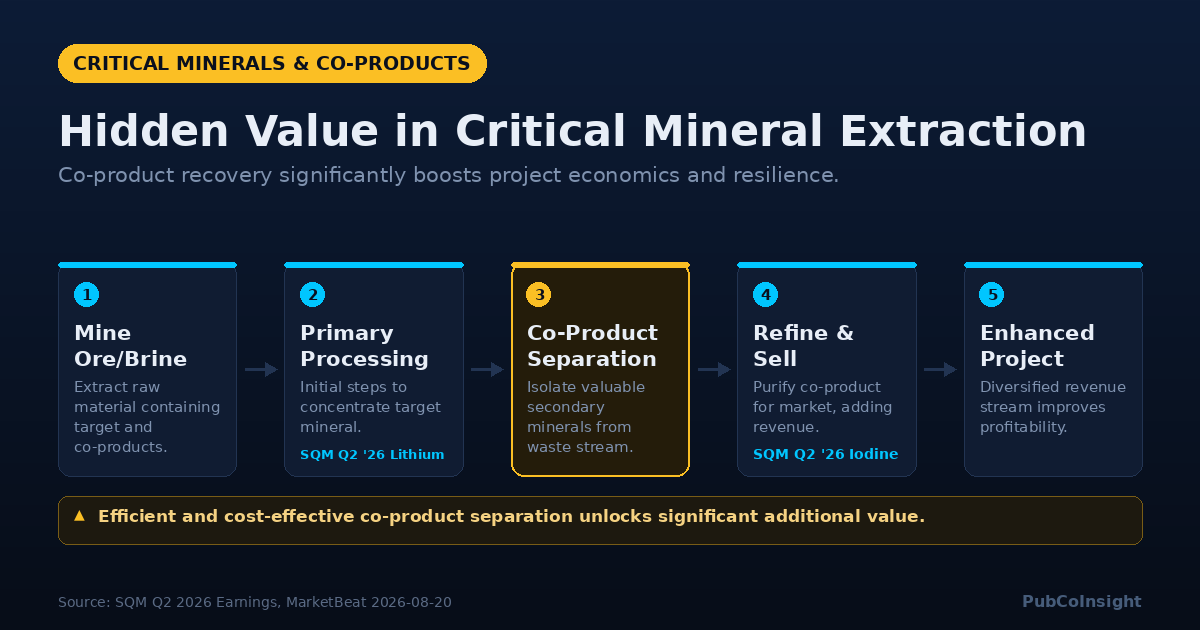
The Mechanism of Co-Product Value
Many critical minerals do not occur in isolation. Lithium, for example, is often found alongside boron, potassium, and magnesium in brines, or with various silicates in hard rock deposits. Rare earth elements, the lanthanides and actinides, are almost always found together, often with thorium or uranium. Extracting one requires processing the ore or brine, which then presents opportunities to recover others. The challenge lies in the separation. Consider rare earths. They are chemically very similar, making their individual isolation a complex, energy-intensive process. Solvent extraction, a multi-stage liquid-liquid separation technique, is the industry standard. This involves dissolving the mixed rare earth oxides, then repeatedly contacting the solution with an organic solvent that preferentially extracts one rare earth over another. Each stage increases purity, but also cost and complexity. The more valuable the co-product, and the easier its separation, the greater its contribution to overall project economics. For SQM, iodine, a halogen, is chemically distinct from lithium, a Group 1 alkali metal. This makes their separation less complex than, say, separating neodymium from praseodymium. The iodine contribution demonstrates how a valuable, relatively easy-to-separate co-product can significantly bolster a company's financial performance, even when its primary commodity is booming.Companies in the Critical Minerals Space
Several companies are navigating this complex landscape, focusing on various critical minerals essential for energy storage and advanced technologies. Standard Lithium Ltd. (SLI), trading at $2.48, is working on lithium extraction from brine in Arkansas. Their collaboration with Nano One to qualify lithium carbonate for LFP cathodes highlights the ongoing effort to refine and optimize lithium products for specific battery chemistries. This focus on end-product specification is key. Lithium Americas Corp. (LAC), with its stock at $13.68, is developing the Thacker Pass lithium project in Nevada. Recent news indicated a rating upgrade to Buy from Zacks, reflecting market sentiment around its progress. LAC's focus is on a large-scale claystone deposit, a different geological challenge from brines or hard rock. In the rare earths sector, MP Materials (MP), trading at $25.30, operates the Mountain Pass mine in California, the only integrated rare earth mining and processing site in North America. MP's materials segment reported an 80% revenue jump in 1H26, demonstrating strong demand for its separated rare earth products. The company's focus on domestic supply chain integration is a significant differentiator. USA Rare Earth, Inc. (USAR), priced at $19.26, is another player in the rare earths space. The company saw its stock rise 8% on August 21st, 2026, as the resource sector gained momentum. USAR is working on the Round Top project in Texas, which is known for its heavy rare earth and critical mineral endowment. Critical Metals Corp. (CRML), at $7.11, is involved in European lithium projects. News on August 19th, 2026, detailed an update on its proposed acquisition of European Lithium. The company also saw a 22.6% gain on August 21st, with its CEO highlighting progress at the Greenland Rare Earth Project. This dual focus on lithium and rare earths reflects the broader critical minerals strategy. American Battery Technology Company (ABAT), trading at $2.57, is focused on lithium-ion battery recycling and primary lithium extraction from Nevada claystone. ABAT announced its highest ever gross profit in Q4 FY2026 and successfully appealed for reinstatement of a $57 million US Department of Energy grant, indicating progress on both fronts. ioneer Ltd (IONR), at $3.29, is developing the Rhyolite Ridge lithium-boron project in Nevada. This project is a prime example of co-product potential, as it aims to produce both lithium carbonate and boric acid from a single ore body. The efficient recovery of both minerals is crucial for its economic viability. Atlas Lithium Corporation (ATLX), priced at $3.32, is exploring for lithium in Brazil. Their focus is on hard rock spodumene deposits, which require different processing techniques than brines or clays. NioCorp Developments Ltd. (NB), at $4.64, is developing a niobium, scandium, and titanium project in Nebraska. This project highlights the importance of other critical minerals beyond lithium and rare earths for high-tech applications and advanced alloys.American Lithium Minerals, Inc.
American Lithium Minerals, Inc. trades over the counter under the ticker AMLM. The company is an exploration stage entity, currently pre-revenue, with a stated focus on lithium and boron properties in Nevada. AMLM was incorporated in Nevada on March 10, 2005. Its primary project is the Sarcobatus Lithium property, located in Central Nevada. This property comprises 1,780 acres of mining claims. The company has also stated an intention to expand its exploration and acquisition of mineral properties globally. AMLM's most recent substantive filing, a Regulation A offering on Form 1-A qualified on February 4, 2026, outlines its business and financial condition. The offering covers up to 80,000,000 units, with an additional 120,000,000 shares potentially issuable if attached warrants are fully exercised. Each unit includes one share of common stock and a warrant to purchase 1.5 shares of common stock at an exercise price of $0.05 per share, expiring on December 31, 2028. The company's activities since 2009 have centered on lithium exploration in Central Nevada. While AMLM has acquired and divested cobalt, nickel, graphite, and rare earth element prospects in the past, its current stated focus is the Sarcobatus Lithium property. The public record does not yet establish a definitive resource estimate for the Sarcobatus project. The company also states it is developing the use of Real World Asset Tokens to provide capital for mining, aiming to create an interoperable ecosystem for asset acquisition, tokenization, and trading.What to watch
Investors should track several concrete developments. For Lithium Americas (LAC), watch for progress on the Thacker Pass permitting and construction timelines, especially any updates on the $500 million critical minerals push mentioned on August 20th. Standard Lithium (SLI) investors should look for further announcements regarding the qualification of their lithium carbonate for LFP cathodes, following the August 13th collaboration with Nano One. For MP Materials (MP), continued revenue growth in its materials segment, particularly the breakdown of separated rare earth product sales, will be key to understanding the sustainability of its 1H26 performance. Critical Metals Corp. (CRML) investors should monitor the finalization of the proposed acquisition of European Lithium and any further updates on the Greenland Rare Earth Project. Ioneer (IONR) will need to demonstrate continued progress at Rhyolite Ridge, particularly on the co-production of lithium and boron. American Battery Technology Company (ABAT) stakeholders should look for specific milestones related to the deployment of their recycling and extraction technologies, especially how the reinstated $57 million DOE grant is allocated. For American Lithium Minerals (AMLM), look for any announcements regarding exploration results, resource estimates, or updates on the development of the Sarcobatus Lithium property in Central Nevada., { "label": "Primary Processing", "note": "Initial steps to concentrate target mineral.", "metric": "SQM Q2 '26 Lithium" }, { "label": "Co-Product Separation", "note": "Isolate valuable secondary minerals from waste stream." }, { "label": "Refine & Sell", "note": "Purify co-product for market, adding revenue.", "metric": "SQM Q2 '26 Iodine" }, { "label": "Enhanced Project Economics", "note": "Diversified revenue stream improves profitability." } ], "highlight": 2, "highlight_note": "Efficient and cost-effective co-product separation unlocks significant additional value.", "footnote": "Source: SQM Q2 2026 Earnings, MarketBeat 2026-08-20" }Companies mentioned
| Ticker | Company | Price |
|---|---|---|
| ABAT | American Battery Technology Company | $2.57 |
| AMLM client | American Lithium Minerals, Inc. | $0.0791 |
| ATLX | Atlas Lithium Corporation | $3.32 |
| CRML | Critical Metals Corp. | $7.11 |
| IONR | ioneer Ltd | $3.29 |
| NB | NioCorp Developments Ltd. | $4.64 |
| SLI | Standard Lithium Ltd. | $2.48 |
| USAR | USA Rare Earth, Inc. | $19.26 |
Listed alphabetically, not ranked. Prices as of 2026-08-24 and they move. Check a live quote before relying on any of this.
How we chose the companies in this article
We cover a fixed universe of companies working in lithium, boron and the critical minerals that feed battery and energy-storage supply chains. Every one of them that had usable market data on 2026-08-24 appears in this article. We do not pick which ones to mention based on what we think of them, and we do not order them by size, price or trading volume, because an ordered list is a verdict and that is not ours to hand down. Companies left out, and why: none. American Lithium Minerals and Artificial Intelligence Technology Solutions pay us, which is disclosed in full at the foot of every article they appear in.
See the dilution and promotion flags before you see the pitch.
Each week: the micro and small-caps now showing dilution or paid-promotion signals, with the SEC filing behind every flag. No recommendations, no price targets.
Sources used in this article
- MP Materials vs. The Metals Company: Which Rare-Earth Bet Actually Pays Off First? Motley Fool · 2026-08-23
- MarketBeat Week in Review – 08/17 - 08/21 MarketBeat · 2026-08-22
- USA Rare Earth Rises 8%, Critical Metals Jumps 10%, MP Materials Climbs 5% as the Resource Sector Catches a Bid 24/7 Wall St. · 2026-08-21
- Why Did Critical Metals Stock Just Gain 22.6%? Motley Fool · 2026-08-21
- Will Albemarle's Cash Strength Support Higher Shareholder Returns? Zacks · 2026-08-20
- Sociedad Química y Minera’s Lithium Boom Is Back, But Iodine Steals the Show MarketBeat · 2026-08-20
- Sociedad Quimica Y Minera De Chile SA (SQM) (Q2 2026) Earnings Call Highlights: Record Lithium ... GuruFocus.com · 2026-08-20
- Trump's $500 Million Critical Minerals Push: 5 Battery Stocks That Could Benefit Benzinga · 2026-08-20
- MP's Materials Segment 1H26 Revenues Jump 80%: Can This Momentum Last? Zacks · 2026-08-20
- US Rare Earth Pure Play: Fireside with Tactical Resources CEO Ranjeet Sundher IPO-Edge.com · 2026-08-20
- Is MP Materials (MP) Too Expensive After Its Sales Surge? Simply Wall St. · 2026-08-20
- American Battery Technology Company Announces Highest Ever Gross Profit and Successful Appeal for Reinstatement of $57 Million US Department of Energy Grant in Fourth Quarter FY2026 Financial Results GlobeNewswire · 2026-08-20
Disclosure required by Section 17(b) of the Securities Act of 1933
American Lithium Minerals, Inc.. American Lithium Minerals, Inc. (issuer) paid Strategic Innovations First, Inc., an affiliate of PubCo Insight and Pulse IR. Compensation received: USD 11,550.00 total, three equal monthly installments of USD 3,850.00. Form of payment: cash only; no stock, options or warrants. Services: investor relations, marketing and content creation under Master Services Agreement dated June 22, 2026. Period: three month initial term, June 2026 through August 2026. No position, options or warrants held by PubCo Insight, Pulse IR, Strategic Innovations First, Inc., or Brad Listermann.
This is information, not investment, financial, legal or tax advice. It is not a recommendation or solicitation to buy, sell or hold any security and it contains no price target. Nothing here is independently verified by us. Confirm every figure against primary filings on SEC EDGAR before you act. Micro-cap and over-the-counter securities are speculative and illiquid and can lose all of their value. The companies named without a disclosure above pay us nothing and have no relationship with us; they are named because a published, mechanical screen selected them. Full disclosure policy.