Lithium Demand Rebound: Direct Extraction and Boron Co-Production Drive New Supply Focus
Major producers like SQM are raising lithium output forecasts, pushing the spotlight onto new extraction technologies and co-production of critical minerals like boron, which could reshape supply chains.
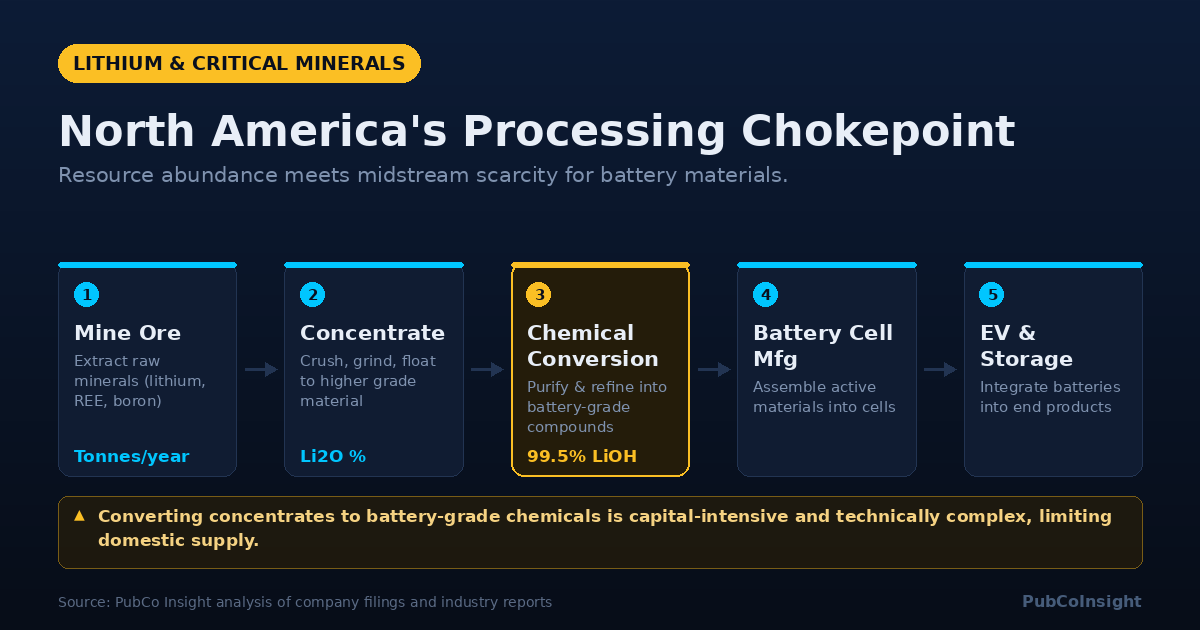
The Mechanism: Direct Lithium Extraction and Boron Recovery
Direct Lithium Extraction, or DLE, is a set of technologies designed to selectively extract lithium from brines without the need for large evaporation ponds. This contrasts sharply with conventional solar evaporation, which can take months to years and requires vast land areas. DLE processes typically involve sorbents, ion exchange resins, or solvent extraction to pull lithium ions from the brine, leaving other dissolved minerals behind. The key advantage is speed and a significantly smaller environmental footprint, especially in arid regions. DLE operations can also achieve higher recovery rates and produce a purer lithium concentrate. The challenge with DLE often lies in the specific chemistry of the brine. Each DLE technology performs differently depending on the concentration of lithium, magnesium, potassium, and other impurities. High magnesium-to-lithium ratios, common in many brines, can make DLE more complex and costly. The process must be tailored to the specific geological characteristics of the deposit. Boron co-production adds another layer of economic efficiency, especially in brines where boron is naturally present alongside lithium. Boron is a critical mineral for high-strength alloys, ceramics, and some advanced battery chemistries. Recovering boron during lithium extraction can turn a potential impurity into a valuable co-product. This dual recovery improves project economics, reduces waste, and diversifies the revenue stream beyond just lithium. The separation of boron from lithium, and from other brine components, requires precise chemical engineering, often involving solvent extraction or crystallization steps after the initial lithium separation. The market for boron compounds, while smaller than lithium, is stable and growing.Companies Operating in This Part of the Sector
Several companies are advancing projects that leverage DLE technology and, in some cases, boron co-production. Standard Lithium Ltd. (SLI), trading at $2.49, is a notable player. On August 31, Standard Lithium announced that its joint venture with Equinor, Smackover Lithium, signed a 10-year lithium offtake deal with LG Energy Solution for its South West Arkansas Project. This agreement covers U.S.-produced lithium carbonate, highlighting the commercial viability and market acceptance of DLE-derived lithium. The Smackover project focuses on extracting lithium from brine in Arkansas, a region known for its high-grade brine resources. ioneer Ltd (IONR), priced at $3.11, is developing the Rhyolite Ridge project in Nevada. This project is unique for its significant co-production of lithium and boron from a single ore body. The Rhyolite Ridge deposit is a large sedimentary deposit containing both minerals. The company's plan involves open-pit mining followed by a sulfuric acid leach process to extract both lithium carbonate and boric acid. This integrated approach aims to capitalize on the dual demand for these critical minerals. American Battery Technology Company (ABAT), trading at $2.59, is also active in the U.S. critical minerals space. On August 31, ABAT hosted Department of Energy leadership to showcase its commercial technologies aimed at strengthening U.S. critical minerals supply chains. On August 20, the company announced its highest ever gross profit and the reinstatement of a $57 million DOE grant, indicating progress in its battery recycling and primary extraction efforts. ABAT is focused on sustainable extraction methods and lithium-ion battery recycling, which complements the broader push for domestic supply. Atlas Lithium Corporation (ATLX), at $3.13, is developing lithium projects in Brazil. While primarily focused on hard rock lithium, the broader market shift towards diversified supply benefits all producers. Critical Metals Corp. (CRML), trading at $6.92, is pursuing the acquisition of European Lithium, with a September court date set for the merger deal. This move aims to consolidate lithium assets and expand its European footprint. NioCorp Developments Ltd. (NB), priced at $4.00, is developing a critical minerals project in Nebraska, focusing on niobium, scandium, and titanium. While not directly a lithium or boron play, its progress in securing domestic supply of other critical minerals aligns with the broader theme of reducing reliance on foreign sources. USA Rare Earth, Inc. (USAR), at $17.26, is focused on rare earth elements, another segment of the critical minerals market receiving government tailwinds, as seen by its August 24 mention of a $1.55 billion government-backed funding.American Lithium Minerals, Inc.
American Lithium Minerals, Inc. (AMLM) trades over the counter at $0.0786 and is an exploration stage company with no current revenue. The company's stated focus is lithium and boron properties in Nevada. AMLM was incorporated in Nevada on March 10, 2005. Its current project is the Sarcobatus Lithium property, which consists of 1,780 acres of mining claims located in Central Nevada. The company has focused its activities on lithium exploration in this region since 2009. AMLM has also acquired and divested cobalt, nickel, and graphite prospects in Central Nevada, and rare earth elements projects in Arizona and Illinois. The company's strategy includes exploring for lithium in Nevada and expanding its exploration and acquisition of mineral properties globally. AMLM also states an intention to develop Real World Asset Tokens to provide capital for mining. On February 4, 2026, the SEC qualified a Regulation A offering on Form 1-A, covering up to 80,000,000 units. Each unit includes one share of common stock and a warrant to purchase 1.5 shares of common stock, exercisable at $0.05 per share until December 31, 2028. An additional 120,000,000 shares are issuable if all warrants are exercised. The public record does not yet establish a definitive resource estimate or a timeline for commercial production at the Sarcobatus property. The company's filings indicate that if it brings one or more mines into production, the likely products would be a lithium compound and/or a rare earth concentrate.What to watch
The LG Energy Solution offtake deal with Standard Lithium's Smackover Lithium JV sets a precedent for DLE project validation. Watch for further DLE offtake agreements from other developers. The September court date for Critical Metals Corp.'s proposed acquisition of European Lithium will determine the merger's path forward. Keep an eye on the progress of ioneer's Rhyolite Ridge project, specifically permitting updates and construction milestones, as it represents a significant integrated lithium-boron operation. Any new Department of Energy grants or government funding announcements for U.S.-based critical mineral projects, particularly those involving DLE or boron co-production, will be important indicators of policy support., { "label": "Direct Extraction", "note": "DLE selectively removes lithium from brine, faster than evaporation.", "metric": "90% Recovery" }, { "label": "Boron Recovery", "note": "Separation of boron compounds from remaining brine." }, { "label": "Lithium Refining", "note": "Conversion to battery-grade lithium carbonate or hydroxide." }, { "label": "Battery Production", "note": "Lithium feeds EV and energy storage battery manufacturing." } ], "highlight": 1, "highlight_note": "DLE enables faster, more efficient lithium recovery, unlocking new resources.", "footnote": "Source: Company Filings, News Reports" }Companies mentioned
| Ticker | Company | Price |
|---|---|---|
| ABAT | American Battery Technology Company | $2.59 |
| AMLM client | American Lithium Minerals, Inc. | $0.0786 |
| ATLX | Atlas Lithium Corporation | $3.13 |
| CRML | Critical Metals Corp. | $6.92 |
| IONR | ioneer Ltd | $3.11 |
| NB | NioCorp Developments Ltd. | $4.0 |
| SLI | Standard Lithium Ltd. | $2.49 |
| USAR | USA Rare Earth, Inc. | $17.26 |
Listed alphabetically, not ranked. Prices as of 2026-09-02 and they move. Check a live quote before relying on any of this.
How we chose the companies in this article
We cover a fixed universe of companies working in lithium, boron and the critical minerals that feed battery and energy-storage supply chains. Every one of them that had usable market data on 2026-09-02 appears in this article. We do not pick which ones to mention based on what we think of them, and we do not order them by size, price or trading volume, because an ordered list is a verdict and that is not ours to hand down. Companies left out, and why: none. American Lithium Minerals and Artificial Intelligence Technology Solutions pay us, which is disclosed in full at the foot of every article they appear in.
See the dilution and promotion flags before you see the pitch.
Each week: the micro and small-caps now showing dilution or paid-promotion signals, with the SEC filing behind every flag. No recommendations, no price targets.
Sources used in this article
- William Blair Says These Stocks Are Must-Own Picks GuruFocus.com · 2026-09-01
- LG Energy signs lithium carbonate deal with Smackover Mining Technology · 2026-09-01
- Energy Fuels' ASM Buy Strengthens Rare Earth Push: What's Next? Zacks · 2026-08-31
- MP vs. NB: Which Critical Minerals Stock is the Better Buy? Zacks · 2026-08-31
- MP Materials Stock: Bull vs. Bear on This Top Rare Earth Bet Motley Fool · 2026-08-31
- Update: Standard Lithium, Equinor JV Signs 10-Year Lithium Offtake Deal With LG Energy Solution; Shares Rise MT Newswires · 2026-08-31
- Standard Lithium, Equinor JV Signs 10-Year Lithium Offtake Deal With LG Energy Solution MT Newswires · 2026-08-31
- Standard Lithium's Smackover Signs Offtake Agreement with LG Energy Solution MT Newswires · 2026-08-31
- LG Energy Solution Secures Multi-Year Supply of U.S.-Produced Lithium Carbonate from Smackover Lithium PR Newswire · 2026-08-31
- Smackover Lithium Signs Binding Customer Offtake with LG Energy Solution for the South West Arkansas Project GlobeNewswire · 2026-08-31
- American Battery Technology Company Hosts DOE Leadership to Showcase Commercial Technologies Strengthening U.S. Critical Minerals Supply Chains GlobeNewswire · 2026-08-31
- Could a Chinese Blacklist Be Bullish for Rare-Earth Stocks? Motley Fool · 2026-08-29
Disclosure required by Section 17(b) of the Securities Act of 1933
American Lithium Minerals, Inc.. American Lithium Minerals, Inc. (issuer) paid Strategic Innovations First, Inc., an affiliate of PubCo Insight and Pulse IR. Compensation received: USD 11,550.00 total, three equal monthly installments of USD 3,850.00. Form of payment: cash only; no stock, options or warrants. Services: investor relations, marketing and content creation under Master Services Agreement dated June 22, 2026. Period: three month initial term, June 2026 through August 2026. No position, options or warrants held by PubCo Insight, Pulse IR, Strategic Innovations First, Inc., or Brad Listermann.
This is information, not investment, financial, legal or tax advice. It is not a recommendation or solicitation to buy, sell or hold any security and it contains no price target. Nothing here is independently verified by us. Confirm every figure against primary filings on SEC EDGAR before you act. Micro-cap and over-the-counter securities are speculative and illiquid and can lose all of their value. The companies named without a disclosure above pay us nothing and have no relationship with us; they are named because a published, mechanical screen selected them. Full disclosure policy.