Brine Economics Recalibrate as Developers Target Continental Basins and Smarter Extraction
With major lithium targets coming down and brine processing margins under pressure, developers across North America are adjusting their strategies from Texas to the Great Basin.
On October 27, Deutsche Bank cut its price target on Lithium Americas Corp. (LAC) from $4.20 to $2.80, maintaining a Hold rating. The reduction followed comparable cuts on Albemarle Corporation (ALB), reinforcing a persistent reality across the battery materials sector: margins in lithium brine extraction and primary processing are being squeezed, forcing the industry to re-examine the economics of mineral extraction across North America.
The adjustment did not happen in isolation. With broader market fluctuations testing major producers like Albemarle, and peer operations feeling pressure from sustained pricing headwinds, institutional attention is increasingly shifting toward processing bottlenecks, direct lithium extraction (DLE) efficiencies, and asset-level capital intensity. The capital-expenditure requirements for multi-billion-dollar greenfield evaporation ponds and conventional processing infrastructure are facing rigorous tests from analysts and credit committees alike.
For resource developers and market participants operating beyond the tier-one producers, the margin compression among conventional operators creates an opening to prove alternate commercial designs. Lowering the cost of production per ton of lithium carbonate equivalent is no longer just a marketing slogan, it is the sole criterion dictating which North American resources advance toward commercialization.
The Physics and Flowsheets of Continental Brines
Extracting lithium from continental brine deposits requires separating dilute lithium ions from a complex chemical soup dominated by sodium, magnesium, calcium, and potassium. In conventional operations, this process relies on solar evaporation ponds spanning thousands of acres. Raw brine is pumped from underground aquifers into shallow, lined basins, where sun and wind evaporate water over 12 to 24 months, gradually concentrating the lithium from a few hundred parts per million to several thousand. Lime is introduced sequentially to precipitate magnesium, while sodium and potassium salts crystallize out as halite and sylvite.
This classic approach breaks down under specific geological and commercial conditions. First, high magnesium-to-lithium ratios drive chemical consumption through the roof, because magnesium precipitates as magnesium hydroxide, consuming massive volumes of reagents and trapping lithium in the filter cake. Second, solar evaporation recovers only 30% to 50% of the lithium contained in the initial brine pumped to surface, leaving the rest lost to entrainment in salt beds. Finally, unseasonal rainfall or low evaporation rates stall production schedules entirely.
To bypass these bottlenecks, developers are leaning into direct extraction mechanisms, predominantly based on physical adsorption, ion exchange, or solvent extraction. Adsorption flowsheets pump raw brine through columns packed with proprietary media, such as aluminum hydroxide matrices or titanium oxides. The media selectively capture lithium chloride molecules while rejecting the surrounding salts. Once the column is saturated, a warm water or mild acid wash desorbs the lithium, producing a concentrated, purified lithium chloride eluate in hours rather than years.
What has to be true for this alternate model to work commercially is strict fluid management and cheap energy. The flowsheet must process enormous volumetric throughput, often thousands of gallons per minute, without fouling the resin, degrading the sorbent through osmotic shock, or consuming excessive volumes of freshwater. If sorbent replacement rates exceed baseline operating projections, or if reinjection wells clog with spent brine precipitates, the operational costs rapidly eclipse the capital savings. Success is defined by long sorbent life cycles, high reinjection recoveries, and a minimal thermal energy requirement to concentrate the final eluate.
How North American Developers Are Positioned
Operators across the critical minerals ecosystem are pursuing distinct geological architectures to crack this balance sheet puzzle. Standard Lithium Ltd. (SLI, $1.45) has anchored its flowsheet directly against industrial brine infrastructure. On October 20, the company filed a positive Preliminary Economic Assessment and technical report for its high-grade 70,000 tonnes per year Franklin Project in East Texas, advancing its DLE deployment adjacent to commercial oilfield operations.
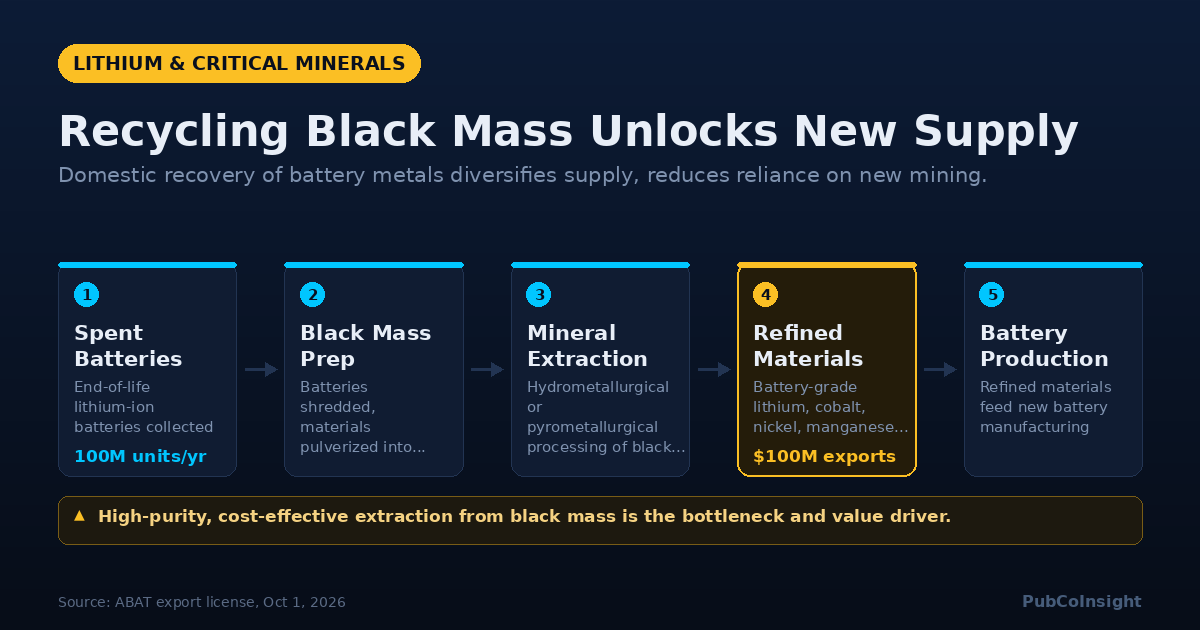
In Nevada, ioneer Ltd (IONR, $2.82) is balancing lithium extraction with boron co-production at its Rhyolite Ridge project. The presence of boron provides a commercial byproduct stream that cushions margins against pure lithium pricing volatility, altering the net unit cost of battery-grade lithium carbonate production. Concurrently, American Battery Technology Company (ABAT, $1.56) is advancing its domestic battery metals footprint through a dual strategy of recycling and claystone lithium resource development in Nevada, targeting localized feedstocks for the domestic supply chain.
Other resource players are focusing on distinct hard-rock and co-mineralized assets across the globe to avoid brine chemical processing altogether:
- Critical Metals Corp. (CRML, $7.95): Secured court approval on October 26 for its European Lithium transaction, completing the acquisition effective October 27 to consolidate its hard-rock European footprint alongside institutional support, as iShares Russell funds added to CRML positions.
- USA Rare Earth, Inc. (USAR, $10.52): Advancing domestic heavy rare earth and critical mineral assets, with market activity rallying across specialized critical mineral developers.
- Atlas Lithium Corporation (ATLX, $1.82): Moving forward with hard-rock spodumene projects in Brazil, prioritizing open-pit hard-rock mining flowsheets over brine basins.
- NioCorp Developments Ltd. (NB, $3.56): Focusing on multi-element critical mineral separation at its Elk Creek project in Nebraska, targeting niobium, scandium, and titanium to diversify away from pure-play battery metal cycles.
American Lithium Minerals, Inc. (AMLM)
American Lithium Minerals, Inc. (AMLM, $0.0518) operates at the early exploration tier of the Nevada critical minerals landscape. Formed in Nevada in 2005, the company has historically assembled and divested early-stage exploration ground across multiple critical mineral domains, including cobalt, nickel, and graphite prospects in Central Nevada, alongside legacy rare earth targets in Arizona and Illinois. Today, AMLM is pre-revenue and maintains an exploration focus targeting lithium and boron deposits in the Great Basin.
The company's primary asset base is the Sarcobatus Lithium property, which covers 1,780 acres of unpatented mining claims located in Nye County's Sarcobatus Flat in Central Nevada. The Sarcobatus basin represents an enclosed playa system with structural and hydrological similarities to the Clayton Valley basin to the north. Exploration in this region centers on identifying shallow alluvial and playa-hosted lithium brine horizons, as well as enriched sedimentary and claystone beds formed by weathering volcanic tuffs.
Capital structure and corporate access have seen formal shifts this year. On February 4, 2026, the SEC qualified AMLM's Form 1-A Regulation A offering. The circular authorizes the company to offer up to 80,000,000 units on a best-efforts basis for a maximum offering amount of $8,000,000, with each unit comprising one common share and a warrant to purchase 1.5 common shares at $0.05 per share through December 31, 2028. If warrants are exercised in full, up to 120,000,000 additional shares could be issued, raising potential gross proceeds to $20,000,000.
The public record does not establish any defined mineral resources, mineral reserves, or metallurgical recovery rates for the Sarcobatus claims under SEC Subpart 1300 standards. Furthermore, AMLM does not own physical plant facilities, extraction infrastructure, or surface land outright, relying instead on federal mining claims.
In its recent SEC filings, management has outlined a dual corporate initiative. Beyond traditional ground exploration and regional asset acquisition, the company has stated an intention to pursue digital asset structures, specifically exploring Real World Asset (RWA) tokens to tokenize in-ground resource claims and provide alternative capital formation pathways for mineral projects. How this blockchain-based capitalization model integrates with the underlying exploration programs on its Nevada mining claims remains an evolving corporate strategy.
What to watch
Over the coming quarters, several falsifiable data points will clarify operational progress across both major producers and exploration-stage developers:
- Standard Lithium (SLI): Technical study advancement and commercial FEED milestones tied to the East Texas Franklin DLE flowsheet following its October 20 PEA filing.
- Lithium Americas (LAC): Construction capex updates and Department of Energy loan disbursement schedules at the Thacker Pass project site in Humboldt County, Nevada.
- Critical Metals Corp. (CRML): Post-merger operational integration timelines and formal mineral reserve updates for the European Lithium assets following the court-approved closing on October 27.
- American Lithium Minerals (AMLM): Subscription updates and capital intake reports under the qualified Tier 2 Regulation A offering, alongside formal announcements of Phase 1 surface sampling, geophysics, or drill permitting at the 1,780-acre Sarcobatus property.
Companies mentioned
| Ticker | Company | Price |
|---|---|---|
| ABAT | American Battery Technology Company | $1.56 |
| AMLM client | American Lithium Minerals, Inc. | $0.0518 |
| ATLX | Atlas Lithium Corporation | $1.82 |
| CRML | Critical Metals Corp. | $7.95 |
| IONR | ioneer Ltd | $2.82 |
| NB | NioCorp Developments Ltd. | $3.56 |
| SLI | Standard Lithium Ltd. | $1.45 |
| USAR | USA Rare Earth, Inc. | $10.52 |
Listed alphabetically, not ranked. Prices as of 2026-10-30 and they move. Check a live quote before relying on any of this.
How we chose the companies in this article
We cover a fixed universe of companies working in lithium, boron and the critical minerals that feed battery and energy-storage supply chains. Every one of them that had usable market data on 2026-10-30 appears in this article. We do not pick which ones to mention based on what we think of them, and we do not order them by size, price or trading volume, because an ordered list is a verdict and that is not ours to hand down. Companies left out, and why: none. American Lithium Minerals and Artificial Intelligence Technology Solutions pay us, which is disclosed in full at the foot of every article they appear in.
See the dilution and promotion flags before you see the pitch.
Each week: the micro and small-caps now showing dilution or paid-promotion signals, with the SEC filing behind every flag. No recommendations, no price targets.
Sources used in this article
- Elektros Inc. Examines Potential U.S. Lithium Opportunity ACCESS Newswire · 2026-10-29
- Albemarle (ALB) Dips More Than Broader Market: What You Should Know Zacks · 2026-10-29
- Air Products and Chemicals (APD) Earnings Expected to Grow: Should You Buy? Zacks · 2026-10-29
- Do Options Traders Know Something About Albemarle Stock We Don't? Zacks · 2026-10-29
- 3 Rare Earth Stocks With Market Caps Over $1 Billion Simply Wall St. · 2026-10-29
- Should You Buy MP Materials Stock at $38? Motley Fool · 2026-10-29
- MP Materials Corp. (MP) May Report Negative Earnings: Know the Trend Ahead of Next Week's Release Zacks · 2026-10-29
- What Needs To Be True To Buy USA Rare Earth Stock? Trefis · 2026-10-29
- Critical Metals And 2 Other Top Lithium Stocks Simply Wall St. · 2026-10-29
- iShares Russell 2000 Growth (IWO) Buys $3.5 Million More Critical Metals on Oct. 27 GuruFocus.com · 2026-10-29
- iShares Russell 2000 (IWM) Adds Critical Metals and Vaxcyte on Oct. 27 GuruFocus.com · 2026-10-29
- Albemarle (ALB) Earnings Expected to Grow: What to Know Ahead of Next Week's Release Zacks · 2026-10-28
Disclosure required by Section 17(b) of the Securities Act of 1933
American Lithium Minerals, Inc.. American Lithium Minerals, Inc. (issuer) paid Strategic Innovations First, Inc., an affiliate of PubCo Insight and Pulse IR. Compensation received: USD 11,550.00 total, three equal monthly installments of USD 3,850.00. Form of payment: cash only; no stock, options or warrants. Services: investor relations, marketing and content creation under Master Services Agreement dated June 22, 2026. Period: three month initial term, June 2026 through August 2026. No position, options or warrants held by PubCo Insight, Pulse IR, Strategic Innovations First, Inc., or Brad Listermann.
This is information, not investment, financial, legal or tax advice. It is not a recommendation or solicitation to buy, sell or hold any security and it contains no price target. Nothing here is independently verified by us. Confirm every figure against primary filings on SEC EDGAR before you act. Micro-cap and over-the-counter securities are speculative and illiquid and can lose all of their value. The companies named without a disclosure above pay us nothing and have no relationship with us; they are named because a published, mechanical screen selected them. Full disclosure policy.