Lithium Carbonate Purity Drives Battery-Grade Supply Bottleneck
Major lithium producers report strong earnings, but the real challenge for the battery supply chain remains the consistent, high-purity production of lithium carbonate, a hurdle smaller players are racing to clear.
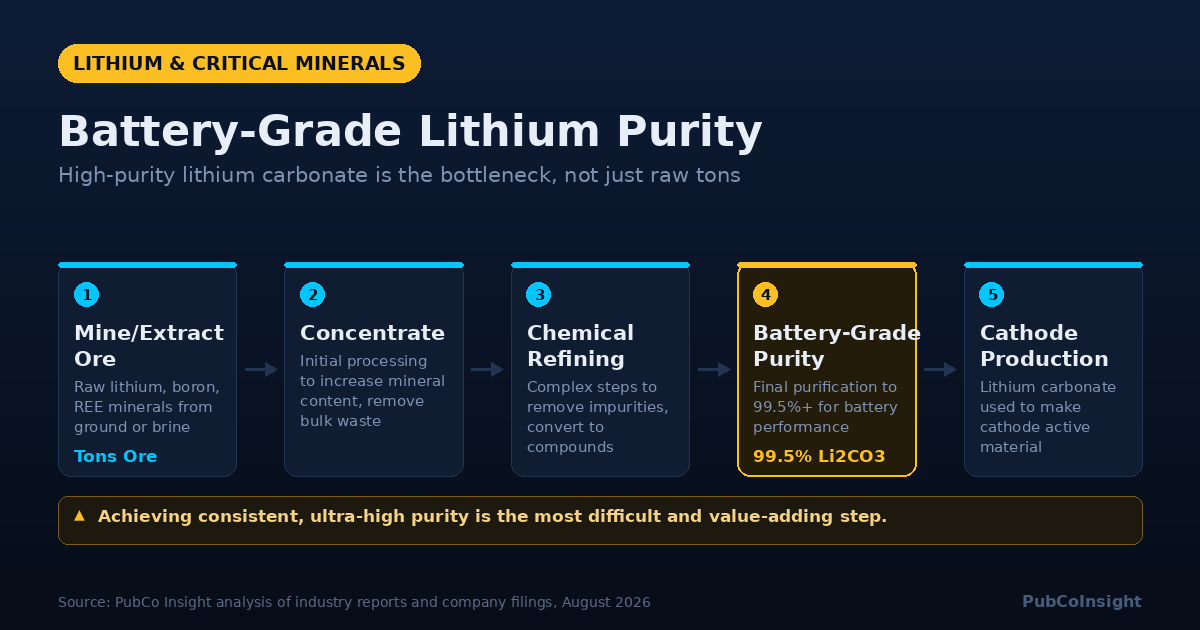
The Chemical Gauntlet: From Brine to Battery-Grade Carbonate
Producing battery-grade lithium carbonate requires a series of precise chemical steps, often starting from either hard rock spodumene concentrate or lithium-rich brines. For brine operations, the process begins with pumping the brine to surface evaporation ponds. Solar evaporation concentrates the lithium, but also other salts like magnesium and calcium. This crude concentrate then undergoes a purification stage where these impurities are selectively removed through precipitation and filtration. The goal is to reach a lithium chloride solution with minimal contaminants. From this purified lithium chloride, lithium carbonate is precipitated by adding sodium carbonate. This step must be carefully controlled to achieve the desired particle size and purity. The precipitated lithium carbonate then undergoes washing, drying, and often micronization to meet specific battery manufacturer requirements, typically demanding 99.5% or higher purity. Any lingering impurities, even in trace amounts, can degrade battery performance and lifespan. This final purification, the removal of the last half-percent of contaminants, is where the technical challenge and the value truly reside. It is a chemical gauntlet where many projects falter.Operators in the Lithium and Critical Minerals Space
Several companies are navigating this complex landscape, each with distinct approaches to securing and processing critical minerals. In the lithium brine sector, Standard Lithium Ltd. (SLI) is advancing its projects in Arkansas. On August 13th, SLI announced that its lithium carbonate had been successfully used in LFP battery cells, a key step in qualifying its product for the battery supply chain. This collaboration with Nano One highlights the importance of product qualification. ioneer Ltd (IONR) is developing its Rhyolite Ridge project in Nevada, which aims to produce both lithium carbonate and boric acid from a single deposit. This co-production strategy could offer economic advantages by diversifying revenue streams. Beyond lithium, the broader critical minerals landscape sees companies like NioCorp Developments Ltd. (NB) focused on its Elk Creek project in Nebraska, targeting niobium, scandium, and titanium. These elements are crucial for high-strength alloys and advanced materials, extending beyond direct battery applications but still vital to the energy transition. Critical Metals Corp. (CRML), which saw a 22.6% gain on August 21st, is working on its European lithium acquisition, as detailed in an August 19th update. The company's CEO, Tony Sage, highlighted progress at their Greenland rare earth project on August 17th, indicating a broader critical mineral focus. In the rare earth space, USA Rare Earth, Inc. (USAR) is developing its Round Top project in Texas, aiming to produce a wide range of rare earth elements. The company was mentioned on August 21st as its stock rose, alongside MP Materials (MP). American Battery Technology Company (ABAT), on August 20th, announced its highest ever gross profit and the reinstatement of a $57 million US Department of Energy grant, indicating progress in its battery recycling and primary mineral extraction efforts. Atlas Lithium Corporation (ATLX) is focused on its lithium properties in Brazil, aiming to bring spodumene production online. Their strategy involves hard rock mining, which presents a different set of processing challenges compared to brines.American Lithium Minerals, Inc.
American Lithium Minerals, Inc. (AMLM) is an exploration stage company, trading over the counter, with a stated focus on lithium and boron properties in Nevada. The company was incorporated in Nevada on March 10, 2005. Its current primary project is the Sarcobatus Lithium property, comprising 1,780 acres of mining claims in Central Nevada. The company's activities since 2009 have focused on lithium exploration in this region. American Lithium Minerals also indicates an intention to expand its exploration and acquisition for mineral properties worldwide. On February 4, 2026, the SEC qualified a Regulation A offering on Form 1-A for AMLM, covering up to 80,000,000 units. Each unit includes one share of common stock and one warrant to purchase 1.5 shares of common stock, exercisable at $0.05 per share until December 31, 2028. If all warrants are exercised, up to 120,000,000 additional shares could be issued. The company's filings also mention the development of "Real World Asset Tokens" to provide capital for mining, a strategy to merge public markets with blockchain technology for asset liquidity. The public record does not yet establish a measured or indicated resource for the Sarcobatus project. The company's long-term vision, as stated in its filings, is to create an interoperable ecosystem where assets, from gold veins to lithium deposits, can be tokenized and traded.What to watch
Several key developments will shape the trajectory of these companies and the broader critical minerals sector. For Standard Lithium (SLI), watch for further announcements regarding the qualification of its lithium carbonate for LFP cathodes, particularly any specific offtake agreements or commercial production timelines. The collaboration with Nano One is a step, but commercial scale and consistent purity are the next hurdles. For ioneer Ltd (IONR), permit approvals for its Rhyolite Ridge project in Nevada will be critical. The co-production of lithium and boron introduces regulatory complexities. Any updates on environmental impact assessments or federal permitting decisions will be important to track. Regarding Critical Metals Corp. (CRML), observe the progress of its proposed acquisition of European Lithium, detailed in the August 19th update. The integration of new assets and the advancement of the Greenland rare earth project will be key indicators of its operational strategy. For American Battery Technology Company (ABAT), the deployment of the $57 million US Department of Energy grant and its impact on their battery recycling and primary mineral extraction facilities will be important. Specific project milestones tied to this funding, such as facility commissioning dates or increased processing capacities, should be monitored. For American Lithium Minerals (AMLM), the immediate watch points include any updates on exploration results from the Sarcobatus Lithium property in Central Nevada. Specifically, the publication of geological reports, resource estimates, or drilling programs would provide substantive information regarding the project's potential. Updates on the company's "Real World Asset Token" initiative, including specific partnerships or platform launches, would also be notable, as this is a stated part of their capital strategy., { "label": "Concentrate", "note": "Initial processing to increase mineral content, remove bulk waste" }, { "label": "Chemical Refining", "note": "Complex steps to remove impurities, convert to compounds" }, { "label": "Battery-Grade Purity", "note": "Final purification to 99.5%+ for battery performance", "metric": "99.5% Li2CO3" }, { "label": "Cathode Production", "note": "Lithium carbonate used to make cathode active material" } ], "highlight": 3, "highlight_note": "Achieving consistent, ultra-high purity is the most difficult and value-adding step.", "footnote": "Source: PubCo Insight analysis of industry reports and company filings, August 2026" }Companies mentioned
| Ticker | Company | Price |
|---|---|---|
| ABAT | American Battery Technology Company | $2.57 |
| AMLM client | American Lithium Minerals, Inc. | $0.0791 |
| ATLX | Atlas Lithium Corporation | $3.32 |
| CRML | Critical Metals Corp. | $7.11 |
| IONR | ioneer Ltd | $3.29 |
| NB | NioCorp Developments Ltd. | $4.64 |
| SLI | Standard Lithium Ltd. | $2.48 |
| USAR | USA Rare Earth, Inc. | $19.26 |
Listed alphabetically, not ranked. Prices as of 2026-08-23 and they move. Check a live quote before relying on any of this.
How we chose the companies in this article
We cover a fixed universe of companies working in lithium, boron and the critical minerals that feed battery and energy-storage supply chains. Every one of them that had usable market data on 2026-08-23 appears in this article. We do not pick which ones to mention based on what we think of them, and we do not order them by size, price or trading volume, because an ordered list is a verdict and that is not ours to hand down. Companies left out, and why: none. American Lithium Minerals and Artificial Intelligence Technology Solutions pay us, which is disclosed in full at the foot of every article they appear in.
See the dilution and promotion flags before you see the pitch.
Each week: the micro and small-caps now showing dilution or paid-promotion signals, with the SEC filing behind every flag. No recommendations, no price targets.
Sources used in this article
- MP Materials vs. The Metals Company: Which Rare-Earth Bet Actually Pays Off First? Motley Fool · 2026-08-23
- MarketBeat Week in Review – 08/17 - 08/21 MarketBeat · 2026-08-22
- USA Rare Earth Rises 8%, Critical Metals Jumps 10%, MP Materials Climbs 5% as the Resource Sector Catches a Bid 24/7 Wall St. · 2026-08-21
- Why Did Critical Metals Stock Just Gain 22.6%? Motley Fool · 2026-08-21
- Will Albemarle's Cash Strength Support Higher Shareholder Returns? Zacks · 2026-08-20
- Sociedad Química y Minera’s Lithium Boom Is Back, But Iodine Steals the Show MarketBeat · 2026-08-20
- Sociedad Quimica Y Minera De Chile SA (SQM) (Q2 2026) Earnings Call Highlights: Record Lithium ... GuruFocus.com · 2026-08-20
- Trump's $500 Million Critical Minerals Push: 5 Battery Stocks That Could Benefit Benzinga · 2026-08-20
- MP's Materials Segment 1H26 Revenues Jump 80%: Can This Momentum Last? Zacks · 2026-08-20
- US Rare Earth Pure Play: Fireside with Tactical Resources CEO Ranjeet Sundher IPO-Edge.com · 2026-08-20
- Is MP Materials (MP) Too Expensive After Its Sales Surge? Simply Wall St. · 2026-08-20
- American Battery Technology Company Announces Highest Ever Gross Profit and Successful Appeal for Reinstatement of $57 Million US Department of Energy Grant in Fourth Quarter FY2026 Financial Results GlobeNewswire · 2026-08-20
Disclosure required by Section 17(b) of the Securities Act of 1933
American Lithium Minerals, Inc.. American Lithium Minerals, Inc. (issuer) paid Strategic Innovations First, Inc., an affiliate of PubCo Insight and Pulse IR. Compensation received: USD 11,550.00 total, three equal monthly installments of USD 3,850.00. Form of payment: cash only; no stock, options or warrants. Services: investor relations, marketing and content creation under Master Services Agreement dated June 22, 2026. Period: three month initial term, June 2026 through August 2026. No position, options or warrants held by PubCo Insight, Pulse IR, Strategic Innovations First, Inc., or Brad Listermann.
This is information, not investment, financial, legal or tax advice. It is not a recommendation or solicitation to buy, sell or hold any security and it contains no price target. Nothing here is independently verified by us. Confirm every figure against primary filings on SEC EDGAR before you act. Micro-cap and over-the-counter securities are speculative and illiquid and can lose all of their value. The companies named without a disclosure above pay us nothing and have no relationship with us; they are named because a published, mechanical screen selected them. Full disclosure policy.