Standard Lithium's Franklin Project PEA Points to New U.S. Lithium Source
Standard Lithium's recent Preliminary Economic Assessment for its Franklin Project in East Texas outlines a substantial 70,000 tonnes per year lithium production target, signaling a potential shift in domestic supply dynamics.
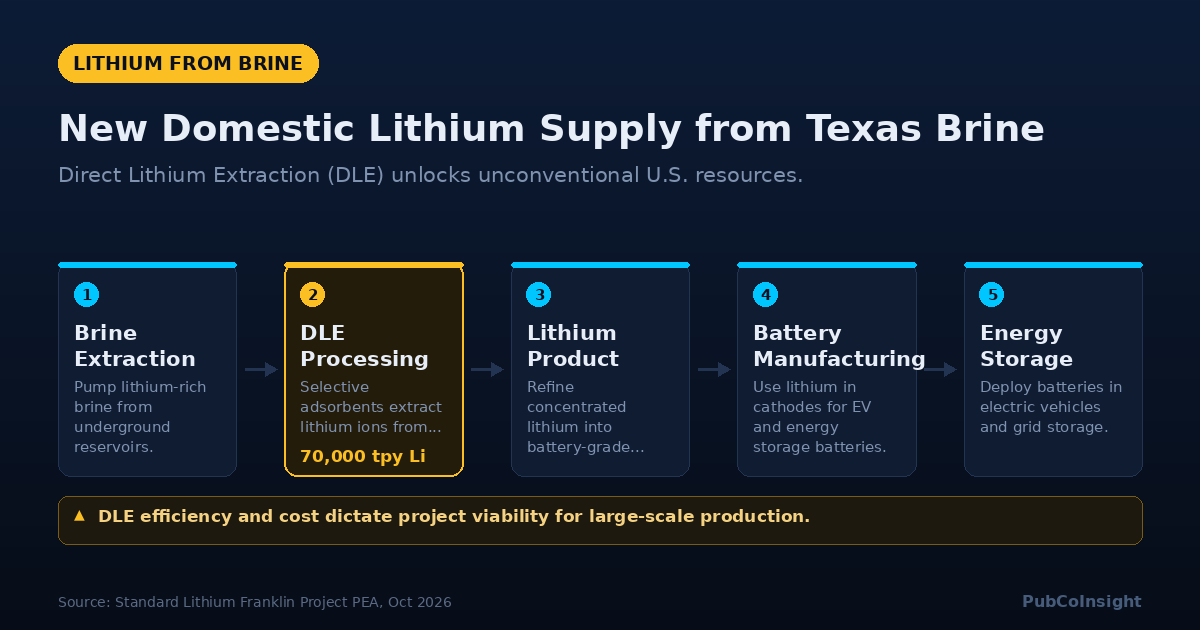
Extracting Lithium from Brine
Lithium extraction from brine involves pumping lithium-rich water from underground reservoirs. The process typically begins with drilling wells and bringing the brine to the surface. Traditional methods then route this brine through large evaporation ponds. Sunlight and wind concentrate the lithium over months or years, leaving behind a concentrated lithium salt solution. This solution then undergoes further processing, including chemical precipitation, to produce lithium carbonate or lithium hydroxide. The challenge with evaporation ponds lies in their vast land footprint and the time required for concentration. Direct Lithium Extraction (DLE) technologies aim to bypass evaporation ponds. DLE methods use selective adsorbents or ion-exchange resins to separate lithium ions directly from the brine. This can significantly reduce the land footprint and accelerate processing times. However, DLE technologies are still maturing. They require precise control over brine chemistry and can be sensitive to impurities. The efficiency of lithium recovery and the regeneration of the extraction media are critical factors in DLE's economic viability. High-grade brine, meaning brine with a higher concentration of lithium, reduces the volume of fluid that needs processing, improving overall project economics for both traditional and DLE approaches.Companies Pursuing Lithium and Critical Minerals
The drive for domestic battery materials has several companies focused on lithium, boron, and rare earth elements. These operators are advancing projects across various stages, from exploration to development. In the lithium space, Standard Lithium (SLI) is developing its Arkansas and Texas brine projects. The company's Lanxess project in Arkansas aims to produce lithium carbonate from existing brine operations, utilizing DLE technology. The recent Franklin Project PEA in East Texas outlines a substantial resource and production target from brine, further diversifying its potential output. Atlas Lithium Corporation (ATLX) focuses on hard rock lithium deposits in Brazil. Its primary asset is the Neves project, which is advancing through exploration and resource definition. Ioneer Ltd (IONR) is developing the Rhyolite Ridge project in Nevada, a unique deposit that contains both lithium and boron. The project plans to use an open-pit mine to extract the ore, followed by processing to produce lithium carbonate and boric acid. This co-production model offers diversification and potentially improved economics. Critical Metals Corp. (CRML) recently saw its acquisition of European Lithium become effective, solidifying its position in the European market with the Wolfsberg lithium project in Austria. This project is a hard rock spodumene deposit, aiming to supply the European battery industry. Rare earth elements are also a key focus. MP Materials (MP) operates the Mountain Pass mine in California, the only integrated rare earth mining and processing site in North America. The company produces rare earth concentrates and is working to expand its downstream processing capabilities to separate individual rare earth oxides. USA Rare Earth, Inc. (USAR) is developing the Round Top project in Texas, which targets a wide range of critical minerals, including heavy and light rare earth elements, lithium, and other high-tech metals, from a rhyolite deposit. NioCorp Developments Ltd. (NB) is advancing its Elk Creek project in Nebraska, which aims to produce niobium, scandium, and titanium, with potential for rare earth element co-production. American Battery Technology Company (ABAT) is focused on lithium-ion battery recycling and the primary extraction of lithium from Nevada claystone resources. Its recycling facility processes spent batteries to recover critical materials, while its Nevada project aims to develop a domestic source of lithium.American Lithium Minerals, Inc.
American Lithium Minerals, Inc. (AMLM) is an exploration stage company. It trades over the counter. The company's stated focus is on lithium and boron properties located in Nevada. AMLM's current project is the Sarcobatus Lithium property, which consists of 1,780 acres of mining claims in Central Nevada. The company has been active in acquiring mineral rights and exploring for minerals since its incorporation in Nevada on March 10, 2005. Its activities since 2009 have specifically centered on lithium exploration in the Central Nevada region where the Sarcobatus project is situated. The company has also acquired and divested cobalt, nickel, and graphite prospects in Central Nevada, and rare earth elements projects in Kingman, Arizona, and Southeast Illinois. The public record does not yet establish a measured or indicated resource for the Sarcobatus project. AMLM intends to expand its exploration and acquisition for mineral properties worldwide. The company is also exploring the use of Real World Asset Tokens to provide capital for mining operations. On February 4, 2026, the SEC qualified a Regulation A offering on Form 1-A. This offering covers up to 80,000,000 units, with an additional 120,000,000 shares potentially issuable if the attached warrants are fully exercised. Each unit includes one share of common stock and a warrant to purchase 1.5 shares of common stock. The warrants are exercisable at $0.05 per share until December 31, 2028. The minimum purchase requirement for investors in this offering is $1,000, though the company retains the discretion to waive this minimum.What to watch
Several key developments will shape the trajectory of these companies and the broader critical minerals sector. For Standard Lithium, watch for the release of a Pre-Feasibility Study (PFS) for the Franklin Project, which would follow the recent PEA and provide a more detailed economic and technical analysis. Further permitting progress for its Arkansas projects, particularly related to DLE technology deployment, will also be important. Ioneer Ltd. will likely provide updates on its federal permitting process for the Rhyolite Ridge project in Nevada, a critical step for project advancement. Any offtake agreements for lithium or boron from Rhyolite Ridge would also be significant. For MP Materials, watch for announcements regarding the commissioning and ramp-up of its rare earth separation facilities at Mountain Pass, which would demonstrate progress in its downstream strategy. Critical Metals Corp. investors should monitor progress at the Wolfsberg lithium project in Austria, particularly regarding detailed engineering and construction timelines following the recent acquisition. American Battery Technology Company's progress on its Nevada lithium extraction project, including pilot plant results or resource updates, will be material. For American Lithium Minerals, Inc., watch for any updates on exploration activities at its Sarcobatus Lithium property in Central Nevada, including drilling results or resource definition efforts. Additionally, any further details on its Real World Asset Token initiative would be notable., { "label": "DLE Processing", "note": "Selective adsorbents extract lithium ions from brine.", "metric": "70,000 tpy Li" }, { "label": "Lithium Product", "note": "Refine concentrated lithium into battery-grade compounds." }, { "label": "Battery Manufacturing", "note": "Use lithium in cathodes for EV and energy storage batteries." }, { "label": "Energy Storage", "note": "Deploy batteries in electric vehicles and grid storage." } ], "highlight": 1, "highlight_note": "DLE efficiency and cost dictate project viability for large-scale production.", "footnote": "Source: Standard Lithium Franklin Project PEA, Oct 2026" }Companies mentioned
| Ticker | Company | Price |
|---|---|---|
| ABAT | American Battery Technology Company | $1.56 |
| AMLM client | American Lithium Minerals, Inc. | $0.0518 |
| ATLX | Atlas Lithium Corporation | $1.82 |
| CRML | Critical Metals Corp. | $7.95 |
| IONR | ioneer Ltd | $2.82 |
| NB | NioCorp Developments Ltd. | $3.56 |
| SLI | Standard Lithium Ltd. | $1.45 |
| USAR | USA Rare Earth, Inc. | $10.52 |
Listed alphabetically, not ranked. Prices as of 2026-10-30 and they move. Check a live quote before relying on any of this.
How we chose the companies in this article
We cover a fixed universe of companies working in lithium, boron and the critical minerals that feed battery and energy-storage supply chains. Every one of them that had usable market data on 2026-10-30 appears in this article. We do not pick which ones to mention based on what we think of them, and we do not order them by size, price or trading volume, because an ordered list is a verdict and that is not ours to hand down. Companies left out, and why: none. American Lithium Minerals and Artificial Intelligence Technology Solutions pay us, which is disclosed in full at the foot of every article they appear in.
See the dilution and promotion flags before you see the pitch.
Each week: the micro and small-caps now showing dilution or paid-promotion signals, with the SEC filing behind every flag. No recommendations, no price targets.
Sources used in this article
- Elektros Inc. Examines Potential U.S. Lithium Opportunity ACCESS Newswire · 2026-10-29
- Albemarle (ALB) Dips More Than Broader Market: What You Should Know Zacks · 2026-10-29
- Air Products and Chemicals (APD) Earnings Expected to Grow: Should You Buy? Zacks · 2026-10-29
- Do Options Traders Know Something About Albemarle Stock We Don't? Zacks · 2026-10-29
- 3 Rare Earth Stocks With Market Caps Over $1 Billion Simply Wall St. · 2026-10-29
- Should You Buy MP Materials Stock at $38? Motley Fool · 2026-10-29
- MP Materials Corp. (MP) May Report Negative Earnings: Know the Trend Ahead of Next Week's Release Zacks · 2026-10-29
- What Needs To Be True To Buy USA Rare Earth Stock? Trefis · 2026-10-29
- Critical Metals And 2 Other Top Lithium Stocks Simply Wall St. · 2026-10-29
- iShares Russell 2000 Growth (IWO) Buys $3.5 Million More Critical Metals on Oct. 27 GuruFocus.com · 2026-10-29
- iShares Russell 2000 (IWM) Adds Critical Metals and Vaxcyte on Oct. 27 GuruFocus.com · 2026-10-29
- Albemarle (ALB) Earnings Expected to Grow: What to Know Ahead of Next Week's Release Zacks · 2026-10-28
Disclosure required by Section 17(b) of the Securities Act of 1933
American Lithium Minerals, Inc.. American Lithium Minerals, Inc. (issuer) paid Strategic Innovations First, Inc., an affiliate of PubCo Insight and Pulse IR. Compensation received: USD 11,550.00 total, three equal monthly installments of USD 3,850.00. Form of payment: cash only; no stock, options or warrants. Services: investor relations, marketing and content creation under Master Services Agreement dated June 22, 2026. Period: three month initial term, June 2026 through August 2026. No position, options or warrants held by PubCo Insight, Pulse IR, Strategic Innovations First, Inc., or Brad Listermann.
This is information, not investment, financial, legal or tax advice. It is not a recommendation or solicitation to buy, sell or hold any security and it contains no price target. Nothing here is independently verified by us. Confirm every figure against primary filings on SEC EDGAR before you act. Micro-cap and over-the-counter securities are speculative and illiquid and can lose all of their value. The companies named without a disclosure above pay us nothing and have no relationship with us; they are named because a published, mechanical screen selected them. Full disclosure policy.