Thacker Pass Cost Hike Shows the Price of New Lithium Supply
Lithium Americas' 31% capital cost increase for Thacker Pass Phase 1 spotlights the growing financial hurdles in bringing critical battery minerals from ground to market.
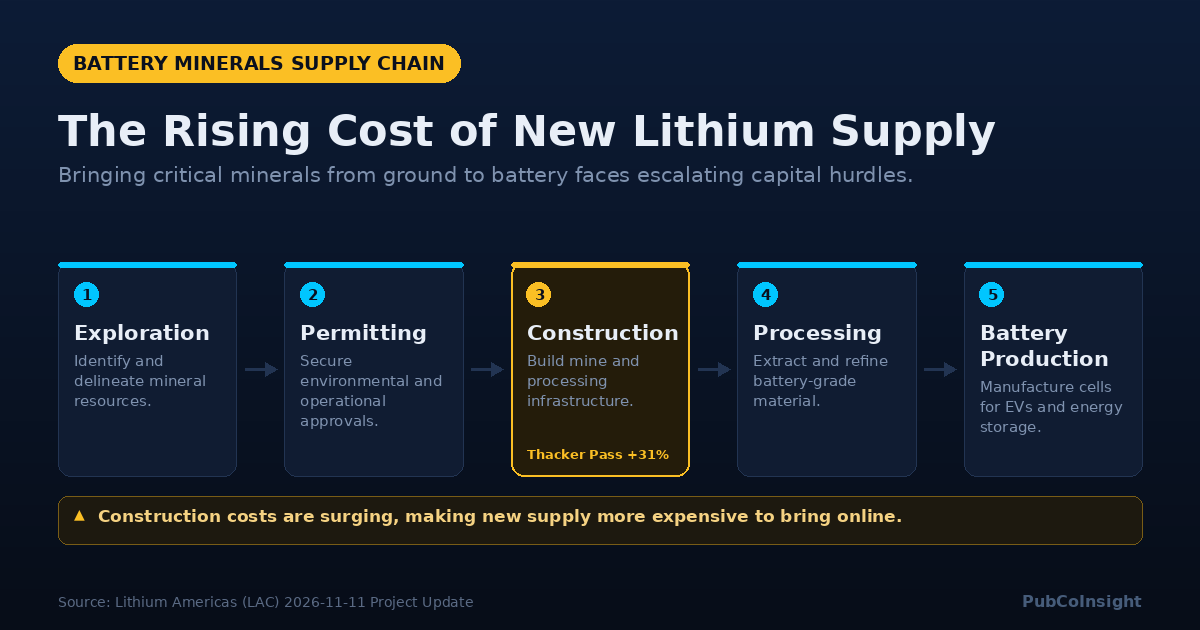
The Mechanics of Rising Costs
Bringing a greenfield lithium project online involves a complex sequence of steps, each vulnerable to cost inflation. First, exploration and resource definition require extensive drilling and geological modeling. Permitting, especially for large-scale mining and processing operations, can take years and accrue significant legal and environmental consulting fees. Construction then demands heavy machinery, skilled labor, and vast quantities of concrete, steel, and specialized processing equipment. The Thacker Pass project, for example, will use an acid leach process to extract lithium from clay, a method that requires substantial infrastructure and energy inputs. This process involves crushing the ore, mixing it with sulfuric acid, and then a series of purification steps to produce battery-grade lithium carbonate. Each stage is sensitive to commodity prices, labor rates, and regulatory changes. Delays in any one area cascade into higher overall project costs, as financing charges accrue and equipment sits idle. The sheer scale of these operations means even minor percentage increases in input costs translate into hundreds of millions of dollars.Operators in the Critical Minerals Space
Several companies are navigating these capital-intensive waters, each with distinct approaches to resource development. In the lithium sector, Atlas Lithium Corporation (ATLX) is advancing its hard-rock lithium projects in Brazil. Their focus is on pegmatite deposits, which typically involve crushing and flotation to produce a spodumene concentrate. This concentrate then needs further processing into battery-grade lithium chemicals, often overseas. ioneer Ltd (IONR) is developing the Rhyolite Ridge lithium-boron project in Nevada, a unique deposit where both minerals are co-located. Their proposed process involves an acid leach, similar in some respects to Thacker Pass, but with the added complexity of separating boron. The dual product stream could offer cost efficiencies, but also introduces additional processing challenges. Standard Lithium Ltd. (SLI) is focused on direct lithium extraction (DLE) from brine resources in Arkansas, adjacent to existing bromine operations. DLE technologies promise lower environmental footprints and potentially faster production, but their commercial scalability across diverse brines is still being proven. American Battery Technology Company (ABAT) is also active in Nevada, developing both primary lithium resources and battery recycling technologies. Their strategy aims to address supply from multiple angles, including claystone lithium projects. In rare earths, MP Materials (MP) operates Mountain Pass in California, the only integrated rare earth mining and processing facility in North America. They extract rare earth minerals, primarily bastnäsite, and then process it into separated rare earth oxides. Separating rare earth oxides is difficult because these elements have similar chemical properties, requiring complex, multi-stage solvent extraction circuits to achieve high purity. This process is energy-intensive and requires significant technical expertise. Critical Metals Corp. (CRML) recently announced full ownership of the Tanbreez Rare Earth Project in Greenland, a large-scale heavy rare earth deposit. Their focus is on securing a diversified supply chain for these critical magnets and alloys. USA Rare Earth, Inc. (USAR) is developing the Round Top heavy rare earth and critical minerals project in Texas. This project targets a wide array of critical minerals, including lithium, uranium, and beryllium, alongside rare earths, from a rhyolite deposit. NioCorp Developments Ltd. (NB) is working on the Elk Creek project in Nebraska, which aims to produce niobium, scandium, and titanium, with potential for rare earth co-products. These projects face similar capital cost pressures, with the added complexity of developing novel processing routes for diverse mineral suites.American Lithium Minerals, Inc.
American Lithium Minerals, Inc. (AMLM), trading over the counter, is an exploration stage company focused on lithium and boron properties in Nevada. The company was incorporated in Nevada in 2005. Its primary asset is the Sarcobatus Lithium property, comprising 1,780 acres of mining claims in Central Nevada. The company’s activities since 2009 have centered on lithium exploration at Sarcobatus. AMLM’s Regulation A offering, qualified by the SEC on February 4, 2026, covers up to 80,000,000 units, with an additional 120,000,000 shares issuable upon full exercise of attached warrants. Each unit includes one share of common stock and one warrant to purchase 1.5 shares, exercisable at $0.05 per share until December 31, 2028. The company has stated intentions to expand its exploration and acquisition for mineral properties worldwide and is also developing the use of Real World Asset Tokens to provide capital for mining. The public record does not yet establish a measured or indicated resource for the Sarcobatus property. AMLM's filings indicate that if the company is able to bring a mine into production, the likely products would be a lithium compound and/or a rare earth concentrate. The company does not own any real property such as land or buildings.What to watch
Investors should track specific, verifiable milestones. For Lithium Americas, watch for updates on the Thacker Pass Phase 1 construction schedule and any further capital cost revisions. The company targets mechanical completion in late 2027. For ioneer, a key event will be the final investment decision for Rhyolite Ridge and progress on securing project financing. Standard Lithium's commercial demonstration plant performance in Arkansas will offer insights into DLE scalability. For MP Materials, the ramp-up of their rare earth magnet production facility and any new offtake agreements beyond GM are critical. Critical Metals Corp. will need to detail development plans and permitting timelines for Tanbreez. American Lithium Minerals, Inc. will need to disclose results from its ongoing exploration at Sarcobatus, particularly any resource estimates filed with the SEC. Across the sector, watch for new government funding initiatives, particularly from the Department of Energy, which can significantly de-risk early-stage projects, and any shifts in permitting timelines for major projects., { "label": "Permitting", "note": "Secure environmental and operational approvals." }, { "label": "Construction", "note": "Build mine and processing infrastructure.", "metric": "Thacker Pass +31% CAPEX" }, { "label": "Processing", "note": "Extract and refine battery-grade material." }, { "label": "Battery Production", "note": "Manufacture cells for EVs and energy storage." } ], "highlight": 2, "highlight_note": "Construction costs are surging, making new supply more expensive to bring online.", "footnote": "Source: Lithium Americas (LAC) 2026-11-11 Project Update" }Companies mentioned
| Ticker | Company | Price |
|---|---|---|
| ABAT | American Battery Technology Company | $1.335 |
| AMLM client | American Lithium Minerals, Inc. | $0.0429 |
| ATLX | Atlas Lithium Corporation | $1.73 |
| CRML | Critical Metals Corp. | $5.61 |
| IONR | ioneer Ltd | $2.58 |
| NB | NioCorp Developments Ltd. | $2.92 |
| SLI | Standard Lithium Ltd. | $1.46 |
| USAR | USA Rare Earth, Inc. | $8.265 |
Listed alphabetically, not ranked. Prices as of 2026-11-12 and they move. Check a live quote before relying on any of this.
How we chose the companies in this article
We cover a fixed universe of companies working in lithium, boron and the critical minerals that feed battery and energy-storage supply chains. Every one of them that had usable market data on 2026-11-12 appears in this article. We do not pick which ones to mention based on what we think of them, and we do not order them by size, price or trading volume, because an ordered list is a verdict and that is not ours to hand down. Companies left out, and why: none. American Lithium Minerals and Artificial Intelligence Technology Solutions pay us, which is disclosed in full at the foot of every article they appear in.
See the dilution and promotion flags before you see the pitch.
Each week: the micro and small-caps now showing dilution or paid-promotion signals, with the SEC filing behind every flag. No recommendations, no price targets.
Sources used in this article
- Lithium Americas (TSX:LAC) Stock Could Be Cheap After A Sharp Reset Simply Wall St. · 2026-11-12
- Lithium Americas (TSX:LAC) Resets Thacker Pass Costs, Is The 0.4x P B Valuation Justified? Simply Wall St. · 2026-11-12
- Should Sherwin-Williams Stock Holders Look At Albemarle Instead? Trefis · 2026-11-11
- Is Albemarle (ALB) a Buy as Wall Street Analysts Look Optimistic? Zacks · 2026-11-11
- Rothschild & Co Redburn Adjusts Price Target on Albemarle to $86 From $100 MT Newswires · 2026-11-11
- Lithium Americas Says Thacker Pass Phase 1 Costs Up 31% MT Newswires · 2026-11-11
- Lithium Americas Raises Thacker Pass Phase 1 Capital Cost Estimate to $3.83 Billion InvestorsHub · 2026-11-11
- Lithium Americas Raises Flagship Project Cost Estimate By $900M – CEO Says Phase 1 Completion Targeted For Late 2027 Stocktwits · 2026-11-11
- Lithium Americas' Phase 1 Thacker Pass Lithium Project Construction on Track for Mechanical Completion in Late 2027 MT Newswires · 2026-11-11
- Lithium Americas Provides Thacker Pass Project Update Business Wire · 2026-11-11
- MP Materials (MP) Q3 Beat Raises The Question Of Whether Its Story Is Already Priced In Simply Wall St. · 2026-11-11
- MP Materials (MP) Heads For Review As $400 Million Federal Stake Draws Scrutiny Simply Wall St. · 2026-11-11
Disclosure required by Section 17(b) of the Securities Act of 1933
American Lithium Minerals, Inc.. American Lithium Minerals, Inc. (issuer) paid Strategic Innovations First, Inc., an affiliate of PubCo Insight and Pulse IR. Compensation received: USD 11,550.00 total, three equal monthly installments of USD 3,850.00. Form of payment: cash only; no stock, options or warrants. Services: investor relations, marketing and content creation under Master Services Agreement dated June 22, 2026. Period: three month initial term, June 2026 through August 2026. No position, options or warrants held by PubCo Insight, Pulse IR, Strategic Innovations First, Inc., or Brad Listermann.
This is information, not investment, financial, legal or tax advice. It is not a recommendation or solicitation to buy, sell or hold any security and it contains no price target. Nothing here is independently verified by us. Confirm every figure against primary filings on SEC EDGAR before you act. Micro-cap and over-the-counter securities are speculative and illiquid and can lose all of their value. The companies named without a disclosure above pay us nothing and have no relationship with us; they are named because a published, mechanical screen selected them. Full disclosure policy.