Standard Lithium Pushes Arkansas Decision to 2026, Highlighting DLE Bottlenecks
Standard Lithium's updated timeline for its Arkansas Lithium Project underscores the permitting and technical hurdles facing direct lithium extraction, a process critical for domestic supply.
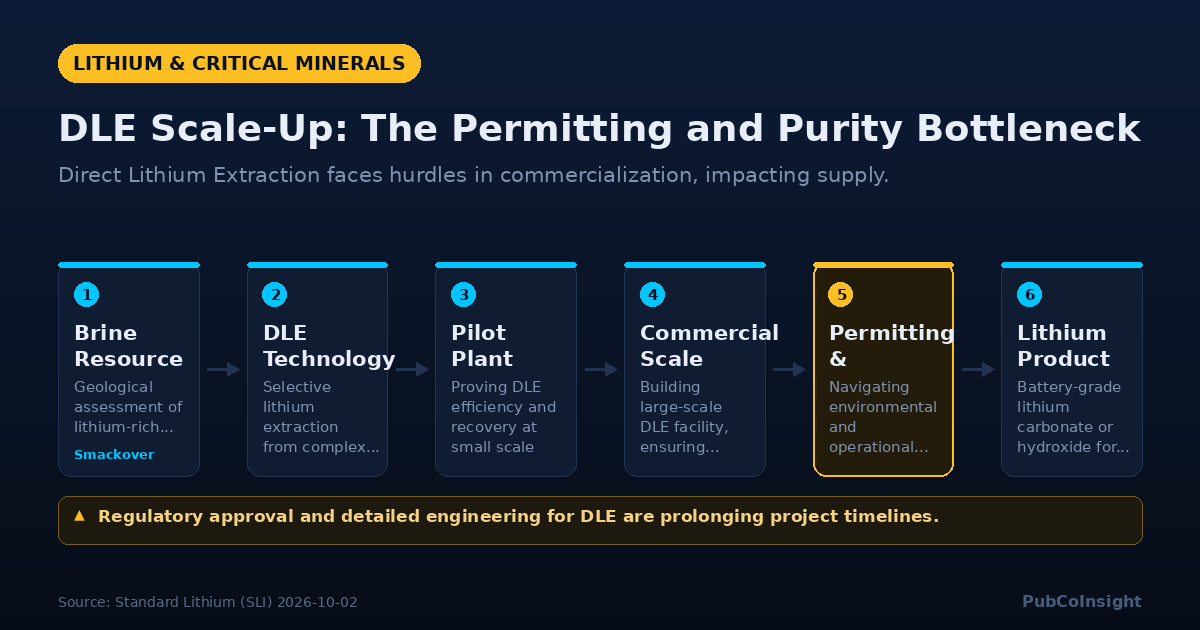
The Direct Lithium Extraction Bottleneck
Direct lithium extraction is a suite of technologies designed to selectively remove lithium from brines, often with lower environmental footprints than traditional evaporation ponds or hard rock mining. The core challenge lies in selectivity and efficiency. Brine reservoirs, like those in Arkansas's Smackover Formation, contain not just lithium but also high concentrations of other salts like magnesium, calcium, and sodium. Conventional methods use vast evaporation ponds, which are slow and land-intensive, or process hard rock, requiring significant energy for mining and beneficiation. DLE aims to bypass these by using adsorbents, ion-exchange resins, or solvent extraction to pull lithium out while leaving other elements behind. The goal is a clean lithium chloride solution ready for conversion to battery-grade lithium carbonate or hydroxide. The difficulty is that each brine chemistry is unique. A DLE technology optimized for one geological setting may perform poorly in another. Scaling these processes from lab to pilot to commercial operation involves proving out material durability, regeneration cycles, energy consumption, and overall recovery rates in real-world conditions. Even small impurities can degrade battery performance, so the purity of the DLE output is paramount. This requires extensive testing, engineering, and often bespoke solutions for each project, leading to longer development cycles and higher upfront capital requirements than initially projected. Regulatory bodies also lack a standardized framework for DLE, adding another layer of uncertainty to permitting timelines.Operators in the DLE and Critical Minerals Space
Several companies are navigating these complexities, each with distinct approaches to securing critical mineral supply. Standard Lithium (SLI), with its Arkansas Lithium Project, is focused on the Smackover Formation brines. The company has partnered with Equinor and has a supply deal with Trafigura for its South West Arkansas Project. Standard Lithium is working on a DLE process that extracts lithium from existing brine operations, aiming to leverage existing infrastructure. The 2026 decision target for its Arkansas project underscores the detailed engineering and permitting work still required for large-scale DLE. ioneer Ltd (IONR) is developing the Rhyolite Ridge Lithium-Boron Project in Nevada. This project is unique because it targets both lithium and boron from a single ore body. Boron is a critical mineral with diverse industrial applications, including high-strength ceramics and permanent magnets. Extracting both minerals efficiently from the same deposit requires a complex processing flow sheet. The company holds a significant resource in Esmeralda County, Nevada. Atlas Lithium Corporation (ATLX) is advancing its hard rock lithium projects in Brazil. While not focused on DLE, Atlas Lithium represents a different approach to battery mineral supply, emphasizing conventional spodumene concentrate production. The company is actively exploring and developing its properties in the Lithium Valley region of Minas Gerais. NioCorp Developments Ltd. (NB) is developing the Elk Creek Critical Minerals Project in Nebraska, targeting niobium, scandium, and titanium. While not a lithium play, NioCorp highlights the broader push for domestic critical mineral supply chains beyond just lithium. Niobium is crucial for high-strength steel, scandium for aerospace alloys, and titanium for various high-performance applications. The company's focus is on developing a multi-product mine. Critical Metals Corp. (CRML) is involved in various critical mineral projects, including tungsten. Tungsten prices have seen significant increases, with reports of a tripling in 2026. This illustrates the demand across a range of strategic metals. Critical Metals has been active in exploring for these resources. American Battery Technology Company (ABAT) focuses on battery recycling and primary mineral extraction. The company recently received an export license for up to $100 million of recycled black mass critical minerals, demonstrating its role in closing the loop on battery materials. ABAT's efforts in Nevada include a lithium-ion battery recycling plant and the exploration of lithium resources. Their strategy addresses both new supply and resource recovery. USA Rare Earth, Inc. (USAR) is focused on rare earth elements (REEs) from its Round Top project in Texas. Rare earths are essential for electric vehicle motors and wind turbines, but their extraction and separation are notoriously difficult. Separating individual rare earth oxides requires complex hydrometallurgical processes that involve multiple solvent extraction stages. Each rare earth element has slightly different chemical properties, necessitating precise control over pH, solvent mixtures, and temperature to achieve high purity. This multi-stage separation is energy and reagent intensive, making it a critical bottleneck in the rare earth supply chain. USAR aims to establish a fully integrated domestic rare earth supply chain.American Lithium Minerals, Inc.
American Lithium Minerals, Inc. (AMLM) operates as an exploration-stage company, focusing on lithium and boron properties in Nevada. The company, trading over the counter, was incorporated in Nevada in 2005. Its primary asset is the Sarcobatus Lithium property, encompassing 1,780 acres of mining claims in Central Nevada. This project is the stated focus of its lithium exploration activities since 2009. The company's filings indicate an intention to expand its exploration and acquisition of mineral properties globally. AMLM has also stated an interest in developing Real World Asset Tokens to secure capital for mining projects. The public record does not yet establish a measured or indicated resource for the Sarcobatus property. In February 2026, the SEC qualified a Regulation A offering, allowing the company to offer up to 80,000,000 units, with an additional 120,000,000 shares potentially issuable upon full exercise of attached warrants. Each unit includes one share of common stock and one warrant to purchase 1.5 shares, exercisable at $0.05 per share until December 31, 2028. The company is pre-revenue and has stated that its ability to generate revenue depends on executing its business plan and expanding its client base. AMLM has also explored and divested cobalt, nickel, and graphite prospects in Central Nevada, and rare earth elements projects in Arizona and Illinois.What to watch
Investors should monitor several key developments. Standard Lithium's 2026 decision for its Arkansas Lithium Project will be a major indicator of DLE commercialization timelines. This includes any updates on permitting, engineering studies, and potential financing arrangements. For American Battery Technology Company, watch for further announcements regarding the deployment of its recycled black mass materials and progress on its Nevada lithium projects. Ioneer Ltd's Rhyolite Ridge project will require continued focus on its dual lithium-boron extraction process and any regulatory milestones. NioCorp Developments' Elk Creek project will provide insights into the broader critical minerals landscape, particularly regarding niobium and scandium. For American Lithium Minerals, Inc., the completion of its stated uplisting to OTCQB in the fourth quarter of 2026, as announced on September 30, 2026, and any updates regarding exploration results from its Sarcobatus property, will be relevant., { "label": "DLE Technology", "note": "Selective lithium extraction from complex brine chemistry" }, { "label": "Pilot Plant", "note": "Proving DLE efficiency and recovery at small scale" }, { "label": "Commercial Scale", "note": "Building large-scale DLE facility, ensuring purity" }, { "label": "Permitting & Approvals", "note": "Navigating environmental and operational regulations" }, { "label": "Lithium Product", "note": "Battery-grade lithium carbonate or hydroxide for market" } ], "highlight": 4, "highlight_note": "Regulatory approval and detailed engineering for DLE are prolonging project timelines.", "footnote": "Source: Standard Lithium (SLI) 2026-10-02" }Companies mentioned
| Ticker | Company | Price |
|---|---|---|
| ABAT | American Battery Technology Company | $2.19 |
| AMLM client | American Lithium Minerals, Inc. | $0.065 |
| ATLX | Atlas Lithium Corporation | $2.41 |
| CRML | Critical Metals Corp. | $7.03 |
| IONR | ioneer Ltd | $2.93 |
| NB | NioCorp Developments Ltd. | $3.47 |
| SLI | Standard Lithium Ltd. | $1.74 |
| USAR | USA Rare Earth, Inc. | $13.59 |
Listed alphabetically, not ranked. Prices as of 2026-10-04 and they move. Check a live quote before relying on any of this.
How we chose the companies in this article
We cover a fixed universe of companies working in lithium, boron and the critical minerals that feed battery and energy-storage supply chains. Every one of them that had usable market data on 2026-10-04 appears in this article. We do not pick which ones to mention based on what we think of them, and we do not order them by size, price or trading volume, because an ordered list is a verdict and that is not ours to hand down. Companies left out, and why: none. American Lithium Minerals and Artificial Intelligence Technology Solutions pay us, which is disclosed in full at the foot of every article they appear in.
See the dilution and promotion flags before you see the pitch.
Each week: the micro and small-caps now showing dilution or paid-promotion signals, with the SEC filing behind every flag. No recommendations, no price targets.
Sources used in this article
- 3 U.S. Solar And Storage Stocks With Tariff Resilient Supply Chains Simply Wall St. · 2026-10-03
- Alaska Energy Metals Appoints Independent Director, Thomas Benson ACCESS Newswire · 2026-10-02
- 3 Canadian Lithium Stocks With Earnings Growth Up To 61% Simply Wall St. · 2026-10-02
- Standard Lithium Targets 2026 Decision for Arkansas Lithium Project MarketBeat · 2026-10-02
- American Battery granted export license for $100M in black mass Waste Dive · 2026-10-02
- Albemarle Corporation to Release Third Quarter 2026 Earnings Results on Wednesday, November 4, 2026 PR Newswire · 2026-10-01
- Mizuho Cuts Price Target on Albemarle to $130 From $140, Keeps Neutral Rating MT Newswires · 2026-10-01
- Mizuho Adjusts Price Target on Albemarle to $130 From $140, Maintains Neutral Rating MT Newswires · 2026-10-01
- Is Sociedad Química Y Minera De Chile (NYSE:SQM) Reasonable After A 52% Run? Simply Wall St. · 2026-10-01
- Sociedad Química Y Minera De Chile (SQM) Looks Undervalued On Paper, So Why Is The Market Hesitant? Simply Wall St. · 2026-10-01
- Lithium Americas Corp. (LAC) Stock Declines While Market Improves: Some Information for Investors Zacks · 2026-10-01
- MP Materials CEO Earns C$39 Million to Top Bedford's 2026 Mining Compensation Rankings CNW Group · 2026-10-01
Disclosure required by Section 17(b) of the Securities Act of 1933
American Lithium Minerals, Inc.. American Lithium Minerals, Inc. (issuer) paid Strategic Innovations First, Inc., an affiliate of PubCo Insight and Pulse IR. Compensation received: USD 11,550.00 total, three equal monthly installments of USD 3,850.00. Form of payment: cash only; no stock, options or warrants. Services: investor relations, marketing and content creation under Master Services Agreement dated June 22, 2026. Period: three month initial term, June 2026 through August 2026. No position, options or warrants held by PubCo Insight, Pulse IR, Strategic Innovations First, Inc., or Brad Listermann.
This is information, not investment, financial, legal or tax advice. It is not a recommendation or solicitation to buy, sell or hold any security and it contains no price target. Nothing here is independently verified by us. Confirm every figure against primary filings on SEC EDGAR before you act. Micro-cap and over-the-counter securities are speculative and illiquid and can lose all of their value. The companies named without a disclosure above pay us nothing and have no relationship with us; they are named because a published, mechanical screen selected them. Full disclosure policy.