Equinor's Texas Lithium Project PEA Signals New DLE Focus for Energy Majors
Equinor's positive preliminary economic assessment for its Texas Lithium Project on September 20, 2026, highlights the growing interest of large energy companies in direct lithium extraction, shifting the landscape for battery mineral development.
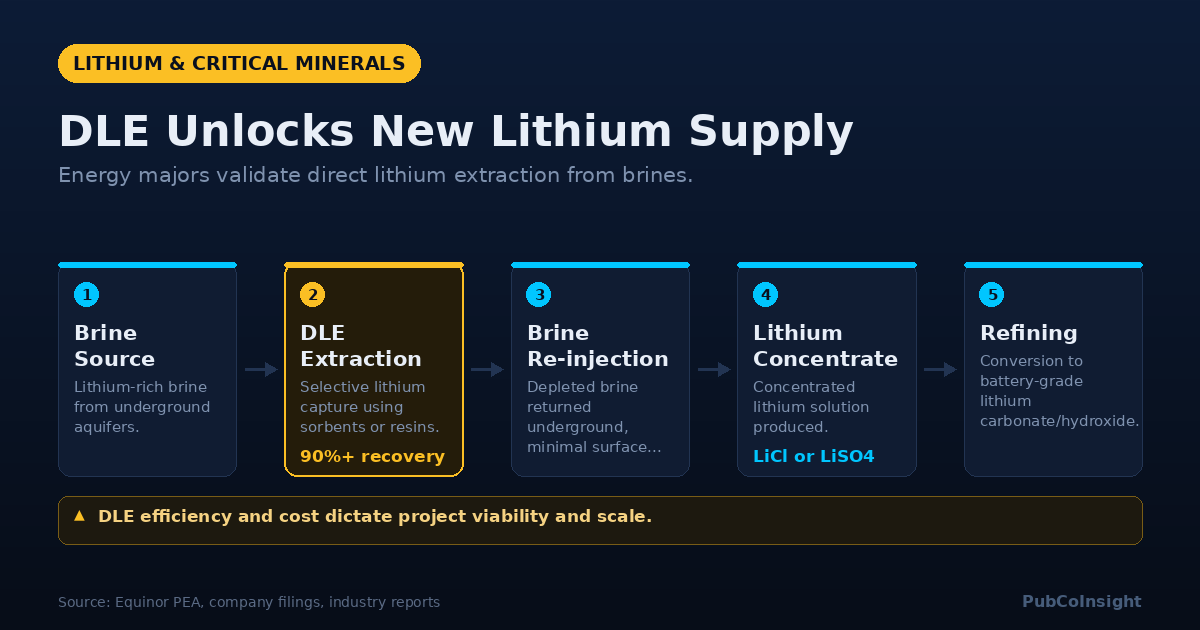
The Mechanism of Direct Lithium Extraction
Direct Lithium Extraction, or DLE, is a suite of technologies designed to selectively remove lithium from brines, leaving other dissolved minerals largely untouched. This contrasts with traditional evaporative ponds, which rely on sunlight and time to concentrate lithium, often over months or years. DLE processes typically involve sorbents, ion-exchange resins, or solvent extraction. Each method uses a material that binds specifically with lithium ions. The brine is pumped from underground aquifers, passed through the DLE system, and then reinjected, often with a lower environmental footprint than evaporation ponds. For DLE to be effective, the brine must contain a sufficient concentration of lithium to justify the capital and operating costs. The brine chemistry also matters. High concentrations of impurities like magnesium or calcium can foul DLE systems, reducing efficiency and increasing maintenance. The DLE process then typically produces a concentrated lithium solution, which still requires further refining to battery-grade lithium carbonate or hydroxide. The key advantage lies in speed, reduced land footprint, and potentially higher recovery rates, especially from lower-grade brines or those with challenging impurity profiles. The main challenge remains scaling these technologies economically and demonstrating long-term operational stability.Companies Operating in the DLE and Critical Minerals Space
The move by Equinor into DLE highlights a broader trend among companies seeking efficient, environmentally conscious methods for critical mineral extraction. Standard Lithium Ltd. (SLI), with a price of $2.13, is a prominent player in the DLE space, focused on its Lanxess project in Arkansas. SLI aims to extract lithium from brine produced as a byproduct of bromine operations, demonstrating a co-production model. The company has published a definitive feasibility study for its South West Arkansas Project, detailing its DLE technology. ioneer Ltd (IONR), trading at $3.25, is developing the Rhyolite Ridge Lithium-Boron Project in Nevada. This project is unique because it targets both lithium and boron from an open-pit mine, leveraging a co-product strategy. The simultaneous extraction of these two critical minerals presents a distinct processing challenge and opportunity. American Battery Technology Company (ABAT), priced at $2.33, focuses on lithium-ion battery recycling and primary mineral extraction. ABAT reported positive adjusted gross profit and 407% revenue growth in its Q4 2026 earnings, indicating progress in its recycling operations. While not exclusively DLE, ABAT's work in extracting lithium from spent batteries shares the theme of advanced, efficient recovery. In the broader critical minerals landscape, NioCorp Developments Ltd. (NB), at $3.72, is advancing its Elk Creek project in Nebraska. This project aims to produce niobium, scandium, and titanium, with potential for rare earth elements. The complexity of separating these high-value metals from a single ore body requires sophisticated metallurgical processing. Critical Metals Corp. (CRML), trading at $9.33, has seen significant attention, with its stock surging on news related to a Greenland security pact and its Tanbreez rare earth permit. CRML's focus includes a low-waste refinery plan in Romania, indicating a commitment to advanced processing and supply chain localization for rare earth elements. The company's recent activity underscores the geopolitical importance of diversified rare earth supply. USA Rare Earth, Inc. (USAR), priced at $16.78, is also active in the rare earth sector, with an emphasis on US-based processing and an AI-driven approach to enhance rare-earth separation. Atlas Lithium Corporation (ATLX), at $2.94, operates in the traditional hard rock lithium mining sector, with projects in Brazil. Its focus is on developing spodumene deposits, which require conventional mining and concentration before further refining.American Lithium Minerals, Inc.
American Lithium Minerals, Inc. (AMLM), trading over the counter at $0.0721, is an exploration-stage company focused on lithium and boron properties in Nevada. The company was incorporated in Nevada in March 2005. Its primary asset is the Sarcobatus Lithium property, comprising 1,780 acres of mining claims in Central Nevada. AMLM's filings indicate a strategy to acquire and explore mineral properties, with a stated intention to expand exploration and acquisition globally. The company also states an interest in developing Real World Asset Tokens to provide capital for mining operations. AMLM's Regulation A offering, qualified by the SEC on February 4, 2026, covers up to 80,000,000 units, each including one share of common stock and a warrant to purchase 1.5 shares. An additional 120,000,000 shares are issuable if all warrants are exercised. The warrants are exercisable at $0.05 per share until December 31, 2028. The company has not generated significant revenues to date and remains in the exploration phase. Its business plan emphasizes the acquisition of undervalued projects in various metals, alongside its tokenization strategy. The public record does not yet establish a definitive resource estimate or a preliminary economic assessment for the Sarcobatus Lithium property. AMLM's historical activities since 2009 have centered on lithium exploration in Central Nevada, and it has previously acquired and divested cobalt, nickel, graphite, and rare earth element prospects. The company's long-term vision, as outlined in its filings, is to create an interoperable ecosystem where mining assets can be tokenized and traded.What to watch
Investors should monitor several specific developments. First, watch for further updates from Equinor on its Texas Lithium Project, particularly any detailed technical reports or permitting milestones following its positive PEA. These will provide more insight into the commercial viability and scalability of its chosen DLE technology. Second, keep an eye on progress from Standard Lithium (SLI) at its Lanxess project, specifically any announcements regarding commercial production or expansion. The operational success of SLI's DLE system could further validate the technology. Third, for ioneer (IONR), watch for updates on its Rhyolite Ridge project, particularly regarding permitting decisions and financing for its integrated lithium-boron operation. The dual-commodity nature presents unique challenges and opportunities. Fourth, observe the rare earth sector, specifically Critical Metals (CRML) and USA Rare Earth (USAR). Any concrete developments from CRML's Romanian refinery plan or USAR's AI-driven processing could signal progress in diversifying and localizing rare earth supply chains. Finally, for American Lithium Minerals (AMLM), look for announcements of drilling results, resource estimates, or any preliminary economic studies for its Sarcobatus Lithium property in Nevada. These would provide more clarity on the geological potential and economic prospects of its assets., { "label": "DLE Extraction", "note": "Selective lithium capture using sorbents or resins.", "metric": "90%+ recovery" }, { "label": "Brine Re-injection", "note": "Depleted brine returned underground, minimal surface impact." }, { "label": "Lithium Concentrate", "note": "Concentrated lithium solution produced.", "metric": "LiCl or LiSO4" }, { "label": "Refining", "note": "Conversion to battery-grade lithium carbonate/hydroxide." } ], "highlight": 1, "highlight_note": "DLE efficiency and cost dictate project viability and scale.", "footnote": "Source: Equinor PEA, company filings, industry reports" }Companies mentioned
| Ticker | Company | Price |
|---|---|---|
| ABAT | American Battery Technology Company | $2.33 |
| AMLM client | American Lithium Minerals, Inc. | $0.0721 |
| ATLX | Atlas Lithium Corporation | $2.94 |
| CRML | Critical Metals Corp. | $9.33 |
| IONR | ioneer Ltd | $3.25 |
| NB | NioCorp Developments Ltd. | $3.72 |
| SLI | Standard Lithium Ltd. | $2.13 |
| USAR | USA Rare Earth, Inc. | $16.78 |
Listed alphabetically, not ranked. Prices as of 2026-09-22 and they move. Check a live quote before relying on any of this.
How we chose the companies in this article
We cover a fixed universe of companies working in lithium, boron and the critical minerals that feed battery and energy-storage supply chains. Every one of them that had usable market data on 2026-09-22 appears in this article. We do not pick which ones to mention based on what we think of them, and we do not order them by size, price or trading volume, because an ordered list is a verdict and that is not ours to hand down. Companies left out, and why: none. American Lithium Minerals and Artificial Intelligence Technology Solutions pay us, which is disclosed in full at the foot of every article they appear in.
See the dilution and promotion flags before you see the pitch.
Each week: the micro and small-caps now showing dilution or paid-promotion signals, with the SEC filing behind every flag. No recommendations, no price targets.
Sources used in this article
- Wall Street Bulls Look Optimistic About Albemarle (ALB): Should You Buy? Zacks · 2026-09-21
- Rare Earth Stocks With Supply Chain Leverage Investors Should Watch Simply Wall St. · 2026-09-21
- Greenland Deal Fuels Critical Metals; Rare Earth Stocks Hinge On Trump-Xi Investor's Business Daily · 2026-09-21
- UUUU vs. MP: Which Rare Earth Stock is a Better Pick Now? Zacks · 2026-09-21
- Critical Metals Surges 25% as Greenland Security Pact Puts Tanbreez Rare Earth Permit in Focus; USA Rare Earth Climbs 6%, MP Materials Rises 4% 24/7 Wall St. · 2026-09-21
- Stocks to Watch Recap: Paramount, Intel, Strategy, Critical Metals The Wall Street Journal · 2026-09-21
- Critical Metals Surges 38% and These Greenland Stocks Soar on Trump’s Security Deal Barrons.com · 2026-09-21
- Critical Metals (CRML) Dropped, So What Is Driving Attention Now? Simply Wall St. · 2026-09-21
- Critical Metals Surges 35% on Greenland Pact. The Tanbreez Opportunity Is Huge — But So Is the Risk. Barchart · 2026-09-21
- Why Critical Metals Stock Is Rocketing Higher Today Motley Fool · 2026-09-21
- What Critical Metals (CRML)'s Low-Waste Romanian Refinery Plan Means For Shareholders Simply Wall St. · 2026-09-21
- CRML Stock Heads For Best Day In Nearly A Year – Why This Analyst Sees A Further 110% Upside Stocktwits · 2026-09-21
Disclosure required by Section 17(b) of the Securities Act of 1933
American Lithium Minerals, Inc.. American Lithium Minerals, Inc. (issuer) paid Strategic Innovations First, Inc., an affiliate of PubCo Insight and Pulse IR. Compensation received: USD 11,550.00 total, three equal monthly installments of USD 3,850.00. Form of payment: cash only; no stock, options or warrants. Services: investor relations, marketing and content creation under Master Services Agreement dated June 22, 2026. Period: three month initial term, June 2026 through August 2026. No position, options or warrants held by PubCo Insight, Pulse IR, Strategic Innovations First, Inc., or Brad Listermann.
This is information, not investment, financial, legal or tax advice. It is not a recommendation or solicitation to buy, sell or hold any security and it contains no price target. Nothing here is independently verified by us. Confirm every figure against primary filings on SEC EDGAR before you act. Micro-cap and over-the-counter securities are speculative and illiquid and can lose all of their value. The companies named without a disclosure above pay us nothing and have no relationship with us; they are named because a published, mechanical screen selected them. Full disclosure policy.