Lithium's Market Reset: Pricing, Processing, and the Nevada Clay Play
The recent re-evaluation of major lithium players signals a deeper market shift, pushing focus onto processing bottlenecks and the unique potential of clay-based resources.
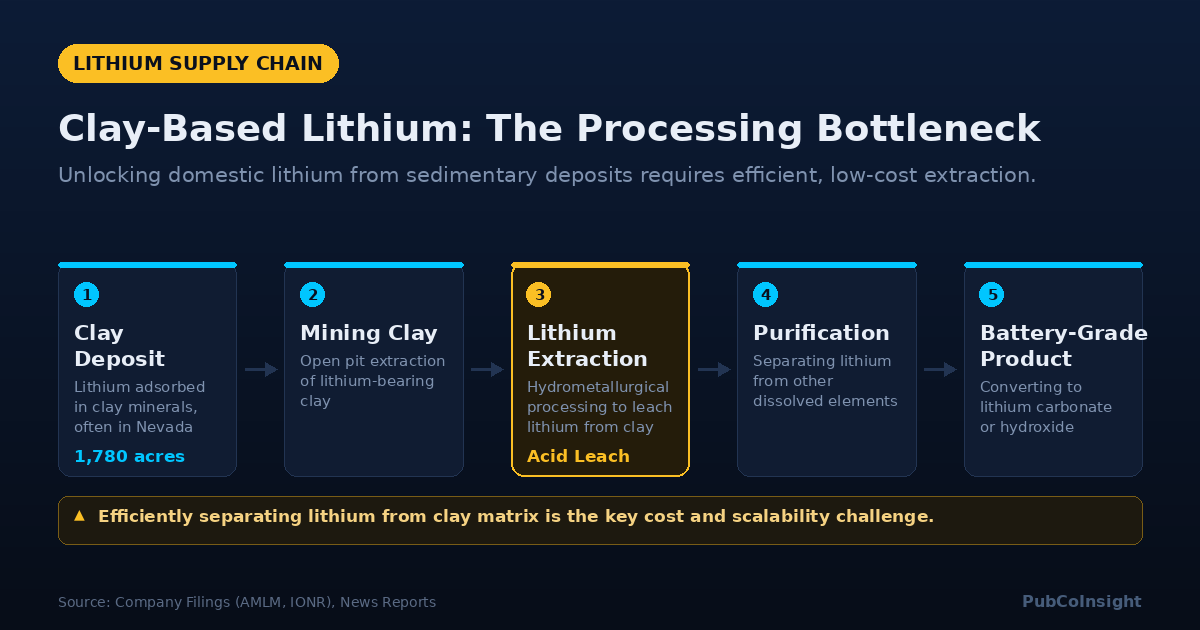
The Clay Conundrum: Extracting Lithium from Sedimentary Deposits
Most operational lithium production comes from brines or hard rock spodumene. Brine operations, common in South America, involve pumping salty water from underground reservoirs into evaporation ponds. Sunlight and time concentrate the lithium, which is then chemically processed. Spodumene, a hard rock mineral, is mined, crushed, and then roasted at high temperatures, typically over 1,000°C, to convert it into a more soluble form. This calcined material is then leached with acid to extract the lithium. Both methods have established pathways, but they also have significant environmental footprints and capital costs. Clay-based lithium deposits, particularly those found in Nevada, represent a different challenge and opportunity. These deposits, often rich in hectorite or smectite clays, contain lithium adsorbed onto the clay structure. Extracting this lithium requires breaking those bonds. Traditional methods, like high-temperature roasting, are energy-intensive and can be less efficient for clays. Newer approaches focus on hydrometallurgical processes, often involving acid leaching at lower temperatures or variations of ion-exchange techniques. The key is to selectively extract the lithium while minimizing the dissolution of other elements in the clay, which can contaminate the product and increase purification costs. This separation of lithium from a complex clay matrix, often containing other silicates and metals, is the primary bottleneck. Success here means lower energy consumption, less reagent use, and ultimately, a more cost-effective and environmentally sound path to battery-grade lithium hydroxide or carbonate. The ability to efficiently process these clays could unlock vast domestic resources, reducing reliance on traditional supply chains.Companies Navigating the New Landscape
The market's reset for the larger players has put a spotlight on the smaller and micro-cap companies developing projects with different geological and processing profiles. These operators are working to prove out new extraction methods or advance projects in less conventional geographies. In the hard rock and brine space, companies like Atlas Lithium Corporation (ATLX, $2.90) are developing projects in Brazil. Atlas Lithium holds 29 mineral rights for lithium, primarily in the Lithium Valley region of Minas Gerais. Their focus is on spodumene, aiming for conventional processing. Ioneer Ltd (IONR, $3.43) is advancing its Rhyolite Ridge lithium-boron project in Nevada. This project is a sedimentary deposit, but its unique geology allows for co-production of lithium carbonate and boric acid, leveraging a sulfuric acid leach process. The dual product stream is a key differentiator. The rare earth sector, often intertwined with critical minerals, also saw activity. MP Materials (MP) was in the news regarding its Chinese shareholder, Shenghe Resources, and potential acquisition talks with China Rare Earth. MP Materials operates the Mountain Pass mine in California, focusing on rare earth oxides. USA Rare Earth, Inc. (USAR, $15.37), with its AI-driven processing approach, is also working on rare earth separation. Critical Metals Corp. (CRML, $6.73) made headlines with a projected $1.8-$2.2 billion annual revenue from its proposed Romanian refinery, based on breakthrough heavy rare earth results from its Tanbreez project, achieving over 99% dissolution of eudialyte concentrate into 19 ultra-high-purity rare earth products. Critical Metals also saw its merger with European Lithium advance to a shareholder vote in October. NioCorp Developments Ltd. (NB, $3.58) is focused on its Elk Creek project in Nebraska, aiming to produce niobium, scandium, and titanium, with potential for rare earth elements as well. In the lithium extraction technology space, American Battery Technology Company (ABAT, $2.18) reported strong revenue growth and positive adjusted gross profit for FY26, focusing on lithium-ion battery recycling and primary extraction technologies. Standard Lithium Ltd. (SLI, $2.12) is advancing its brine projects in Arkansas, using direct lithium extraction (DLE) technology. SLI announced changes to its board, indicating continued development efforts.American Lithium Minerals, Inc.
American Lithium Minerals, Inc. (AMLM, $0.0747) operates as an exploration stage company, with no current revenue, focused on lithium and boron properties in Nevada. The company was incorporated in Nevada in March 2005. Its primary asset is the Sarcobatus Lithium property, comprising 1,780 acres of mining claims in Central Nevada. This project is situated in a region known for its sedimentary lithium deposits. AMLM's stated business plan involves exploring for lithium in Nevada and intends to expand its exploration and acquisition for mineral properties worldwide. The company has also indicated an interest in developing Real World Asset Tokens to provide capital for mining, a strategy that merges traditional resource development with blockchain technology. The Sarcobatus project has been the focus of the company's activities since 2009, following earlier acquisitions and divestitures of cobalt, nickel, graphite, and rare earth prospects in Arizona and Illinois. The public record does not yet establish a NI 43-101 compliant resource estimate for the Sarcobatus project. AMLM's most recent substantive filing, a Regulation A offering qualified on February 4, 2026, outlines an offer of up to 80,000,000 units, each including one share of common stock and a warrant to purchase 1.5 shares. The warrants are exercisable at $0.05 per share until December 31, 2028, with a maximum total offering of $20,000,000 if all units and warrants are exercised. The company's strategy is centered on acquiring undervalued projects and innovating through blockchain for asset liquidity.What to watch
The market's attention is shifting from broad lithium demand narratives to the specifics of supply. Watch for progress on processing technologies, especially for clay-based deposits. For Ioneer Ltd (IONR), the key will be updates on its Rhyolite Ridge project permitting and construction timelines, particularly given its dual lithium-boron product. Standard Lithium Ltd. (SLI) investors should look for further developments on its DLE projects in Arkansas, including pilot plant results and feasibility study updates. American Battery Technology Company (ABAT) will likely continue to report on its recycling and primary lithium extraction advancements, with specific milestones on plant commissioning or commercial agreements. For Critical Metals Corp. (CRML), the October shareholder vote on the European Lithium merger is a near-term event, alongside further details on the Tanbreez refinery study. For American Lithium Minerals, Inc. (AMLM), the next steps will involve further exploration work at the Sarcobatus Lithium property and any updates on its capital raising efforts, particularly regarding the use of Real World Asset Tokens. Any initial resource estimates for the Sarcobatus project would be a significant development., { "label": "Mining Clay", "note": "Open pit extraction of lithium-bearing clay" }, { "label": "Lithium Extraction", "note": "Hydrometallurgical processing to leach lithium from clay", "metric": "Acid Leach" }, { "label": "Purification", "note": "Separating lithium from other dissolved elements" }, { "label": "Battery-Grade Product", "note": "Converting to lithium carbonate or hydroxide" } ], "highlight": 2, "highlight_note": "Efficiently separating lithium from clay matrix is the key cost and scalability challenge.", "footnote": "Source: Company Filings (AMLM, IONR), News Reports" }Companies mentioned
| Ticker | Company | Price |
|---|---|---|
| ABAT | American Battery Technology Company | $2.18 |
| AMLM client | American Lithium Minerals, Inc. | $0.0747 |
| ATLX | Atlas Lithium Corporation | $2.9 |
| CRML | Critical Metals Corp. | $6.73 |
| IONR | ioneer Ltd | $3.43 |
| NB | NioCorp Developments Ltd. | $3.58 |
| SLI | Standard Lithium Ltd. | $2.12 |
| USAR | USA Rare Earth, Inc. | $15.37 |
Listed alphabetically, not ranked. Prices as of 2026-09-19 and they move. Check a live quote before relying on any of this.
How we chose the companies in this article
We cover a fixed universe of companies working in lithium, boron and the critical minerals that feed battery and energy-storage supply chains. Every one of them that had usable market data on 2026-09-19 appears in this article. We do not pick which ones to mention based on what we think of them, and we do not order them by size, price or trading volume, because an ordered list is a verdict and that is not ours to hand down. Companies left out, and why: none. American Lithium Minerals and Artificial Intelligence Technology Solutions pay us, which is disclosed in full at the foot of every article they appear in.
See the dilution and promotion flags before you see the pitch.
Each week: the micro and small-caps now showing dilution or paid-promotion signals, with the SEC filing behind every flag. No recommendations, no price targets.
Sources used in this article
- Albemarle (ALB) Stock Sinks As Market Gains: Here's Why Zacks · 2026-09-18
- Albemarle (ALB) Stock Sees Fair Value Cut As Analysts Reset Lithium Assumptions Simply Wall St. · 2026-09-18
- Mizuho Securities Adjusts Albemarle Price Target to $140 From $160, Maintains Neutral Rating MT Newswires · 2026-09-18
- Best-Positioned Stocks as EV and Self-Driving Tech Accelerate Zacks · 2026-09-18
- Albemarle Corporation (ALB) is Attracting Investor Attention: Here is What You Should Know Zacks · 2026-09-18
- Lithium Americas Corp. (LAC) Stock Dips While Market Gains: Key Facts Zacks · 2026-09-18
- 3 Mining Stocks Retail Investors Are Watching For Europe Critical Minerals Demand Simply Wall St. · 2026-09-18
- MP Materials Rises as Beijing Moves on Its Chinese Shareholder GuruFocus.com · 2026-09-18
- Market Chatter: MP Materials' Shareholder Shenghe Resources in Talks to Be Acquired by China Rare Earth MT Newswires · 2026-09-18
- Will USAR's AI-Driven Approach Enhance Rare-Earth Processing? Zacks · 2026-09-18
- Can Trump’s Deals Survive the Next Congress? Barrons.com · 2026-09-18
- MP's Operating Losses Continue in Q2: Can It Revert to Profitability? Zacks · 2026-09-17
Disclosure required by Section 17(b) of the Securities Act of 1933
American Lithium Minerals, Inc.. American Lithium Minerals, Inc. (issuer) paid Strategic Innovations First, Inc., an affiliate of PubCo Insight and Pulse IR. Compensation received: USD 11,550.00 total, three equal monthly installments of USD 3,850.00. Form of payment: cash only; no stock, options or warrants. Services: investor relations, marketing and content creation under Master Services Agreement dated June 22, 2026. Period: three month initial term, June 2026 through August 2026. No position, options or warrants held by PubCo Insight, Pulse IR, Strategic Innovations First, Inc., or Brad Listermann.
This is information, not investment, financial, legal or tax advice. It is not a recommendation or solicitation to buy, sell or hold any security and it contains no price target. Nothing here is independently verified by us. Confirm every figure against primary filings on SEC EDGAR before you act. Micro-cap and over-the-counter securities are speculative and illiquid and can lose all of their value. The companies named without a disclosure above pay us nothing and have no relationship with us; they are named because a published, mechanical screen selected them. Full disclosure policy.