Kopin's $2.4 Million Order Highlights Thermal Imaging's Role in Autonomous Security
A recent order for OLED microdisplays points to a specific, high-value component within the rapidly expanding autonomous security and physical AI sector, driving demand for advanced sensor technology.
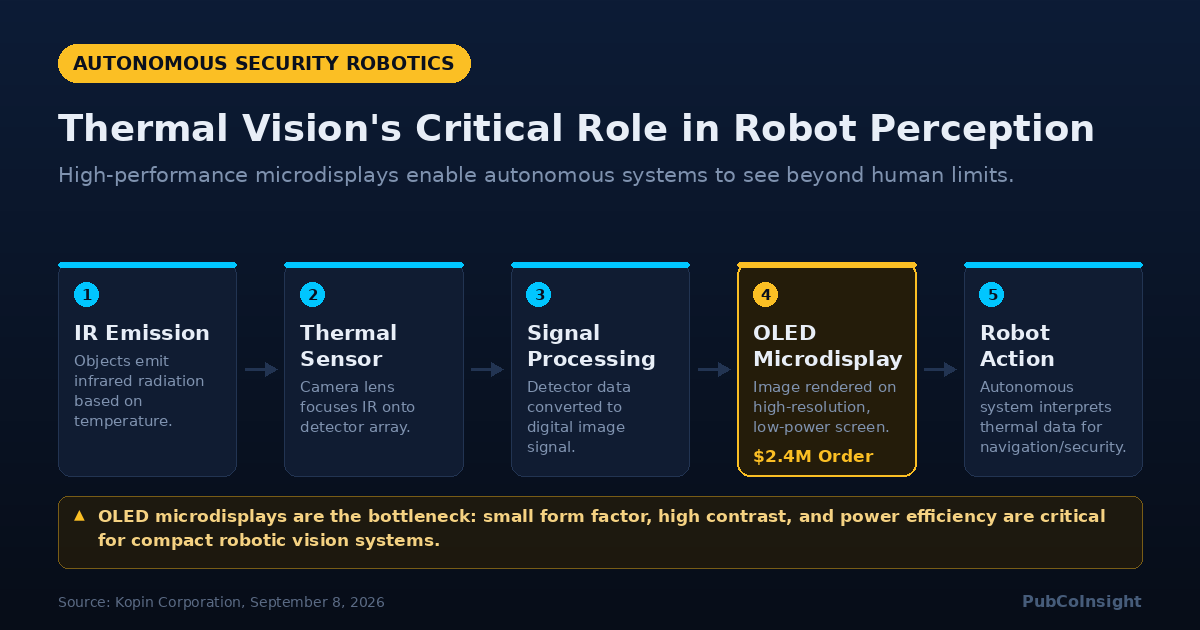
The Mechanism of Thermal Vision in Robotics
Thermal imaging works by detecting infrared radiation emitted by objects, not reflected light. Every object with a temperature above absolute zero emits some level of infrared energy. The hotter an object, the more infrared radiation it emits. Thermal cameras convert this radiation into a visible image, displaying temperature differences as varying colors or shades. This capability is critical for autonomous security robotics because it allows detection and identification in complete darkness, through smoke, fog, or light foliage, and even when camouflage is used. The core of this technology, especially for compact, high-performance applications like weapon sights or robotic sensors, lies in the microdisplay. OLED, or Organic Light-Emitting Diode, microdisplays are particularly suited for these roles. They offer high contrast, true blacks, wide viewing angles, and fast response times, all while consuming less power than traditional LCDs. Their small form factor is crucial for integration into the constrained spaces of robotic platforms or soldier-worn devices. The challenge in manufacturing these microdisplays at scale involves precise deposition of organic materials and meticulous control over pixel uniformity, ensuring consistent image quality across the display area. A faulty pixel in a thermal sight can mean a missed threat. The bottleneck often sits not just in the raw material supply, but in the highly specialized manufacturing equipment and cleanroom environments required to produce these sensitive components consistently. Any disruption in this specialized supply chain directly impacts the ability to scale production of the final autonomous systems.Companies Building the Autonomous Future
The demand for advanced sensing and processing capabilities drives a diverse group of companies in this sector. Kopin Corporation (KOPN), with its recent $2.4 million order, is a key player in high-performance microdisplays, essential for both human-operated thermal sights and the visual systems of advanced robots. Their focus on display technology underpins many of the visual interfaces and sensor outputs in the field. Further up the stack, companies like Arbe Robotics Ltd. (ARBE) develop high-resolution 4D imaging radar solutions. Arbe's technology provides precise object detection and tracking, critical for autonomous navigation and threat assessment, especially in adverse weather conditions where optical sensors may struggle. Hirain and Arbe were recently selected by a major automotive group for a Level 3 program, demonstrating the market's increasing reliance on advanced radar for autonomous functions. In the realm of drone technology, Ondas Inc. (ONDS) and Red Cat Holdings, Inc. (RCAT) are active. Ondas focuses on critical infrastructure and industrial markets with its drone solutions, recently raising its 2026 revenue outlook due to a surging backlog. Red Cat Holdings provides drone hardware and software, including solutions for defense and public safety, indicating a broad application across security needs. Unusual Machines, Inc. (UMAC) also operates in the drone space, recently strengthening its supply chain intelligence through a partnership with Altana to improve component manufacturing. UMAC's activity, including a CFO stock sale in early September, shows ongoing internal movement within the company. Beyond specialized sensors and aerial platforms, other companies focus on the broader AI and hardware integration needed for autonomous operations. BigBear.ai Holdings, Inc. (BBAI) offers AI-powered analytics and decision intelligence, providing the brains behind many complex autonomous systems. Lantronix, Inc. (LTRX) provides secure data access and management solutions for the Internet of Things (IoT), essential for connecting and controlling distributed robotic fleets. MicroVision, Inc. (MVIS) develops lidar technology, another crucial sensor for autonomous navigation and environmental mapping, complementing thermal and radar systems. Serve Robotics Inc. (SERV) focuses on last-mile delivery robots, demonstrating a different application of autonomous physical AI, with a reported $240 million liquidity cushion to fund its ambitions.Artificial Intelligence Technology Solutions, Inc.
Artificial Intelligence Technology Solutions, Inc. (AITX) trades over the counter, building and leasing autonomous security robots and remote monitoring systems. The company structures its revenue through recurring monthly subscriptions, rather than one-off hardware sales, a model that aims for predictable income streams. AITX's subsidiaries focus on deploying these robotic platforms, which are designed for physical security applications. The company has been active in its corporate communications, with recent 8-K filings on September 8th, September 3rd, and September 1st, among others, indicating ongoing operational and financial disclosures. AITX recently announced efforts to accelerate its path to positive monthly cash flow through spending reductions, a direct operational adjustment. The public record does not yet establish consistent, positive free cash flow from operations. The company's plan involves continued deployment of its robotic units and expansion of its subscription base. Its filings detail its capital structure, share count, and cash position, which are the primary sources for understanding its financial standing. AITX's strategy centers on scaling its installed base of robots and leveraging the subscription model to grow revenue.What to watch
Investors should monitor Kopin's (KOPN) progress on the $2.4 million OLED microdisplay order. Specific delivery timelines or further details on the International Thermal Weapon Sight Program could provide insight into the scale and duration of demand. For Ondas Inc. (ONDS), watch for updates on their 2026 revenue outlook and how their backlog translates into realized sales figures in upcoming quarterly reports. Unusual Machines, Inc.'s (UMAC) collaboration with Altana on supply chain intelligence, announced September 3rd, bears watching for any concrete improvements in manufacturing efficiency or cost reductions. Artificial Intelligence Technology Solutions, Inc. (AITX) investors should track the impact of their announced spending reductions on cash flow in future financial statements, as well as any updates on subscription growth rates. Axon (AXON), while not directly in the micro-cap autonomous robotics space, often serves as a bellwether for law enforcement and security technology trends, and their connected devices unit growth, noted September 4th, could indicate broader market appetite for integrated security solutions., { "label": "Thermal Sensor", "note": "Camera lens focuses IR onto detector array." }, { "label": "Signal Processing", "note": "Detector data converted to digital image signal." }, { "label": "OLED Microdisplay", "note": "Image rendered on high-resolution, low-power screen.", "metric": "$2.4M Order" }, { "label": "Robot Action", "note": "Autonomous system interprets thermal data for navigation/security." } ], "highlight": 3, "highlight_note": "OLED microdisplays are the bottleneck: small form factor, high contrast, and power efficiency are critical for compact robotic vision systems.", "footnote": "Source: Kopin Corporation, September 8, 2026" }Companies mentioned
| Ticker | Company | Price |
|---|---|---|
| AITX client | Artificial Intelligence Technology Solutions Inc | $0.0044 |
| ARBE | Arbe Robotics Ltd. | $0.743 |
| BBAI | BigBear.ai Holdings, Inc. | $2.92 |
| KOPN | Kopin Corporation | $4.56 |
| LTRX | Lantronix, Inc. | $5.27 |
| MVIS | MicroVision, Inc. | $1.67 |
| ONDS | Ondas Inc. | $7.62 |
| RCAT | Red Cat Holdings, Inc. | $8.695 |
| SERV | Serve Robotics Inc. | $4.9 |
| UMAC | Unusual Machines, Inc. | $25.98 |
Listed alphabetically, not ranked. Prices as of 2026-09-09 and they move. Check a live quote before relying on any of this.
How we chose the companies in this article
We cover a fixed universe of companies working in autonomous security robotics, physical AI and the guarding services market they are aimed at. Every one of them that had usable market data on 2026-09-09 appears in this article. We do not pick which ones to mention based on what we think of them, and we do not order them by size, price or trading volume, because an ordered list is a verdict and that is not ours to hand down. Companies left out, and why: none. American Lithium Minerals and Artificial Intelligence Technology Solutions pay us, which is disclosed in full at the foot of every article they appear in.
See the dilution and promotion flags before you see the pitch.
Each week: the micro and small-caps now showing dilution or paid-promotion signals, with the SEC filing behind every flag. No recommendations, no price targets.
Sources used in this article
- 1 Chart That Destroys The Nvidia Bear Thesis Motley Fool · 2026-09-09
- Dow Jones Futures: Dow Skids But AMD, HPE Are New Buys; Apple iPhone Event Due Investor's Business Daily · 2026-09-09
- Rocket Lab's Next Neutron Milestone Is a Pad Delivery, Not a Launch. I'd Hold Off on Buying the Stock. Motley Fool · 2026-09-09
- Fed Chairman Kevin Warsh Called Inflation 'More Concerning' at His First Jackson Hole Speech. Does That Signal a Rate Hike Is Coming? Motley Fool · 2026-09-09
- TSLA Stock Slips Overnight Even As Musk Hypes Cybercab Speed And Cathie Wood’s ARK Sees Trillions Ahead Stocktwits · 2026-09-09
- If I Were in My 20s, I'd Buy This Vanguard ETF Warren Buffett Recommended and Hold It Forever Motley Fool · 2026-09-09
- Why Sept. 11 Could Be a Massive Day for the Stock Market Motley Fool · 2026-09-09
- Super Micro Computer Sees AI Demand Driving Growth, Diversification and Cash Flow MarketBeat · 2026-09-09
- Meta Platforms Settles Major Lawsuit, Pays $18 Billion Motley Fool · 2026-09-09
- History Says September Is the Worst Month for Stocks. Here’s 1 Stock With a Major Catalyst This Month to Buy and Hold Motley Fool · 2026-09-09
- Brokers Suggest Investing in Axon (AXON): Read This Before Placing a Bet Zacks · 2026-09-08
- Unusual Machines Just Doubled in a Month: Take Profits, or Buy More? 24/7 Wall St. · 2026-09-08
Disclosure required by Section 17(b) of the Securities Act of 1933
Artificial Intelligence Technology Solutions, Inc., a Nevada corporation (OTCID: AITX). Artificial Intelligence Technology Solutions, Inc. pays Strategic Innovations First, Inc., a Wyoming corporation doing business as PulseIR. Compensation received: USD 5,000.00 per month for months 1-3 (August, September, October 2026); USD 10,000.00 per month for months 4-6 (November, December 2026, January 2027) contingent on the 90-day review. Minimum committed USD 15,000.00; USD 45,000.00 if the second-period rate triggers.. Form of payment: cash only, invoiced monthly in advance; no stock, options or warrants received or payable. Services: investor relations services under an Investor Relations Services Agreement effective 2026-08-01. Period: six month term, 2026-08-01 through 2027-01-31; 90-day review on or about 2026-10-30. No stock, options or warrants held by PubCo Insight, Pulse IR, Strategic Innovations First, Inc., or Brad Listermann. Confirmed by the executed agreement and by board record recKwdq39X2caPSX7 (POSITIONS HELD: none).
This is information, not investment, financial, legal or tax advice. It is not a recommendation or solicitation to buy, sell or hold any security and it contains no price target. Nothing here is independently verified by us. Confirm every figure against primary filings on SEC EDGAR before you act. Micro-cap and over-the-counter securities are speculative and illiquid and can lose all of their value. The companies named without a disclosure above pay us nothing and have no relationship with us; they are named because a published, mechanical screen selected them. Full disclosure policy.