Kopin Secures $18.6 Million Army Contract for MicroLED Displays, Highlighting Defense Sector's AI Vision Needs
A recent U.S. Army contract awarded to Kopin Corporation for advanced display technology underscores the critical role of specialized optics in military AI applications, a segment with direct implications for autonomous security robotics.
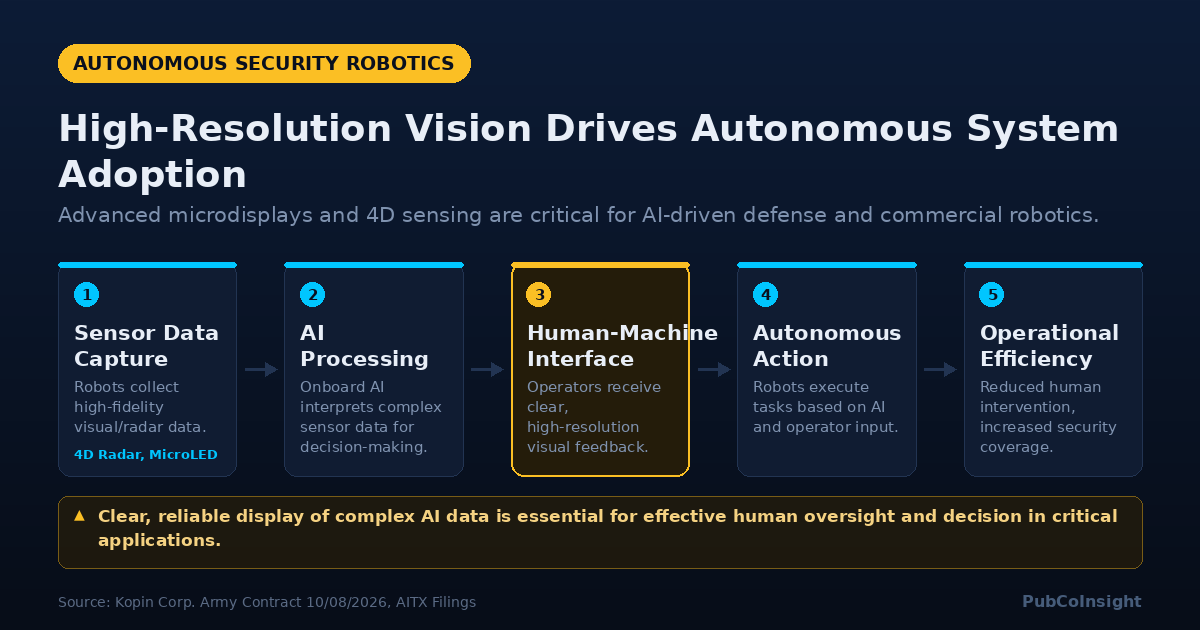
The Mechanism of High-Performance Vision
The core of this development lies in microdisplay technology, specifically Color MicroLEDs. Traditional displays, even high-definition ones, struggle with the extreme brightness, contrast ratios, and power efficiency required for soldier-worn or vehicle-integrated optics. MicroLEDs, however, use arrays of microscopic light-emitting diodes, one for each pixel. Each pixel is individually addressable, meaning it can be turned on or off, or dimmed, with extreme precision. This offers several advantages. First, true black is achieved by simply turning off the pixel, leading to infinite contrast ratios. Second, they can achieve extremely high brightness, crucial for daylight visibility and for projecting clear images onto a soldier's retina or a vehicle operator's field of view. Third, their power consumption is significantly lower than traditional LCDs or even OLEDs for comparable brightness, extending battery life in mission-critical applications. The difficulty in MicroLED manufacturing centers on two main challenges: pixel size and yield. To achieve the resolutions needed for immersive or detailed displays, individual LEDs must be on the order of microns. Fabricating millions of these tiny, perfect LEDs on a single substrate, and then ensuring each one functions flawlessly, is a formidable engineering task. A single dead pixel in a standard display might be ignorable, but in a microdisplay meant for direct optical viewing, it becomes a significant defect. The current bottleneck sits in achieving high manufacturing yields at scale without compromising on pixel density or color fidelity. Overcoming this requires advanced semiconductor fabrication techniques, precise material deposition, and sophisticated testing protocols. When these displays are integrated into systems like the IBAS, they become the crucial interface between complex sensor data, AI processing, and human decision-making, demanding absolute reliability and clarity.Companies in the Autonomous Vision and Guarding Sector
Several companies operate in the broader autonomous security robotics and physical AI space, with some directly addressing the vision and sensing requirements that contracts like Kopin's highlight. Kopin Corporation (KOPN), with its $3.81 price, is a direct beneficiary of the defense sector's demand for advanced microdisplays. Their expertise in Color MicroLED technology positions them as a critical supplier for high-end optical systems, extending beyond military applications into areas like augmented and virtual reality. The recent Army contract reinforces their established position in specialized display manufacturing. Companies like MicroVision, Inc. (MVIS), priced at $1.23, focus on LiDAR technology, a key sensing component for autonomous systems. While not directly producing displays, their work in laser scanning and 3D perception is fundamental for robots navigating and understanding complex environments. Similarly, Arbe Robotics Ltd. (ARBE), trading at $0.487, specializes in 4D imaging radar solutions. Their radar systems provide high-resolution sensing in all weather conditions, complementing optical sensors and enhancing the situational awareness of autonomous vehicles and robots. In the realm of AI and data processing for these systems, BigBear.ai Holdings, Inc. (BBAI), at $2.33, provides decision intelligence solutions, often integrating data from various sensors for predictive analytics. Lantronix, Inc. (LTRX), with a price of $5.85, offers secure data access and management solutions, essential for the reliable operation and communication of connected autonomous devices. The drone and mobile robotics segments also involve significant vision and sensing components. Red Cat Holdings, Inc. (RCAT), priced at $4.90, develops and manufactures drones and related software. Their focus includes advanced tactical drones, which rely heavily on sophisticated cameras and AI for navigation and reconnaissance. Ondas Inc. (ONDS), at $6.35, through its American Robotics subsidiary, offers autonomous drone solutions for industrial inspection and monitoring, requiring robust vision systems for data collection and analysis. Ondas also recently partnered with Palantir to launch Regna AI, a venture focused on defense missions, indicating a direct push into AI-driven defense applications that will require advanced sensing. Unusual Machines, Inc. (UMAC), trading at $17.83, also operates in the drone sector, with their CEO Dr. Allan Evans recently appointed Chairman of XTI Aerospace, suggesting a focus on advanced aerial platforms. Serve Robotics Inc. (SERV), priced at $3.49, deploys autonomous sidewalk delivery robots. These robots navigate urban environments, relying on a suite of sensors, including cameras and LiDAR, to detect obstacles, pedestrians, and traffic signals, demonstrating the practical application of advanced vision in a commercial context.Artificial Intelligence Technology Solutions, Inc.
Artificial Intelligence Technology Solutions, Inc. (AITX), trading over the counter at $0.0015, develops and leases autonomous security robots and remote monitoring systems. The company operates through a Solutions-as-a-Service model, generating recurring monthly subscription revenue rather than one-time hardware sales. Its primary subsidiary, Robotic Assistance Devices, Inc. (RAD-I), markets AI-driven stationary security devices to the guarding services industry. AITX estimates this market to be approximately $50 billion in the United States. The company states its solutions aim to deliver cost savings of between 35% and 80% compared with traditional manned security. AITX's operations are structured around three main pillars: stationary security devices (RAD-I), mobile autonomous platforms (RAD-M), and its SARA agentic artificial intelligence platform (RAD-G). The RAD-M segment includes the ROAMEO mobile security unit, which began early commercial deployment in May 2026. The company's wholly-owned subsidiary in Sri Lanka, RAD Lanka, supports software development, AI initiatives, and technical operations. AITX's internal long-term strategy is referred to as "RAD Town," envisioning integrated autonomous security deployments across large campuses or communities. For the fiscal year ended February 28, 2026, AITX reported revenue of $7,745,336, a 26% increase over the prior fiscal year. Gross profit increased 48% to $5,533,700, with gross margin expanding to approximately 71% from 61%. Operating expenses remained largely flat at about $17,477,097, leading to an improved loss from operations of $(11,943,397). The company reported a net loss of approximately $14.5 million for the fiscal year ended February 28, 2026, and had an accumulated deficit of approximately $171 million as of that date. The company's independent registered public accounting firm included an explanatory paragraph in its report on consolidated financial statements, expressing substantial doubt about AITX's ability to continue as a going concern. For the year ended February 28, 2026, the company had negative cash flow from operating activities of $9,344,534 and negative working capital of $17,017,745. The public record does not yet establish positive cash flow from operations, which management does not anticipate in the immediate future. AITX states that RAD-I's recurring revenue and gross margin could, on a standalone basis, support positive cash flow operations, and that RAD-I has "achieved a point" where it could support positive cash flow today, dependent on assumptions about continued pricing acceptance, stable input costs, and manufacturing scale. The company also projects RAD-M will surpass RAD-I's monthly recurring revenue contribution at some future point. Recent activity includes AITX's RAD adding another municipal customer with a seven-unit ROSA order on October 14, 2026, and securing a third ROAMEO order from a global logistics client on October 6, 2026. On October 7, 2026, AITX's RAD also announced turning small orders into a substantial property management relationship.What to watch
Investors should monitor the continued development and commercialization of advanced microdisplay technologies, particularly for defense applications. Kopin's IBAS contract progression will offer insight into the scaling of Color MicroLED production and its integration into complex military systems. Watch for further contract awards or production milestones from Kopin (KOPN) related to this or similar defense programs. For the broader autonomous sector, observe how companies like MicroVision (MVIS) and Arbe Robotics (ARBE) translate their sensor technology advancements into concrete commercial deployments with significant revenue impact. The pace of adoption for high-resolution LiDAR and 4D radar in autonomous vehicles and robotics will be a key indicator. Regarding Artificial Intelligence Technology Solutions (AITX), attention should be paid to the company's reported subscription counts and recurring revenue figures in upcoming quarterly filings. The company's stated goal of RAD-I supporting positive cash flow operations, and RAD-M surpassing RAD-I's revenue contribution, are specific metrics to track in future financial reports. Look for updates on the commercial deployment scale of ROAMEO units and any further details on the development and licensing of the SARA platform. The company's NT 10-Q filing on October 15, 2026, and subsequent 8-K filings, will provide the latest operational and financial specifics. The performance of companies like Ondas (ONDS) and Red Cat Holdings (RCAT) in securing and executing defense-related drone contracts, especially following Ondas's Regna AI launch, will also indicate the market's trajectory for AI-driven aerial autonomy., { "label": "AI Processing", "note": "Onboard AI interprets complex sensor data for decision-making." }, { "label": "Human-Machine Interface", "note": "Operators receive clear, high-resolution visual feedback." }, { "label": "Autonomous Action", "note": "Robots execute tasks based on AI and operator input." }, { "label": "Operational Efficiency", "note": "Reduced human intervention, increased security coverage." } ], "highlight": 2, "highlight_note": "Clear, reliable display of complex AI data is essential for effective human oversight and decision in critical applications.", "footnote": "Source: Kopin Corp. Army Contract 10/08/2026, AITX Filings" }Companies mentioned
| Ticker | Company | Price |
|---|---|---|
| AITX client | Artificial Intelligence Technology Solutions Inc | $0.0015 |
| ARBE | Arbe Robotics Ltd. | $0.487 |
| BBAI | BigBear.ai Holdings, Inc. | $2.33 |
| KOPN | Kopin Corporation | $3.81 |
| LTRX | Lantronix, Inc. | $5.85 |
| MVIS | MicroVision, Inc. | $1.23 |
| ONDS | Ondas Inc. | $6.35 |
| RCAT | Red Cat Holdings, Inc. | $4.9 |
| SERV | Serve Robotics Inc. | $3.49 |
| UMAC | Unusual Machines, Inc. | $17.83 |
Listed alphabetically, not ranked. Prices as of 2026-10-16 and they move. Check a live quote before relying on any of this.
How we chose the companies in this article
We cover a fixed universe of companies working in autonomous security robotics, physical AI and the guarding services market they are aimed at. Every one of them that had usable market data on 2026-10-16 appears in this article. We do not pick which ones to mention based on what we think of them, and we do not order them by size, price or trading volume, because an ordered list is a verdict and that is not ours to hand down. Companies left out, and why: none. American Lithium Minerals and Artificial Intelligence Technology Solutions pay us, which is disclosed in full at the foot of every article they appear in.
See the dilution and promotion flags before you see the pitch.
Each week: the micro and small-caps now showing dilution or paid-promotion signals, with the SEC filing behind every flag. No recommendations, no price targets.
Sources used in this article
- OpenAI's 2026 Revenue Estimate Just Got Cut by $20 Billion. Anthropic's Quarterly Revenue Just Climbed to $16.8 Billion. Motley Fool · 2026-10-16
- Taiwan plans $4 bln Texas park to support Nvidia’s AI supply chain - Bloomberg Investing.com · 2026-10-16
- TSMC Just Posted Record Profit for the Sixth Straight Quarter. Why Did the Stock Fall? Motley Fool · 2026-10-16
- How Investors Are Reacting To NVIDIA (NVDA) AI Partnership Wave Simply Wall St. · 2026-10-16
- LITEON Showcases at NVIDIA MGX Ecosystem at OCP, Highlighting 800 VDC Power Technologies to Advance Next-Generation AI Infrastructure PR Newswire · 2026-10-16
- SOXX Extends Selloff After 8-Day Decline, KOSPI Rebounds: Jim Cramer Calls SK Hynix ‘Epicenter Of Fear’ Stocktwits · 2026-10-16
- Asian stocks rise as tech bounces from rout, eyes on Warsh AFP · 2026-10-16
- The S&P 500 Went More Than 50 Trading Days Without a 1% Drop. That Streak Just Ended. What's Next? Motley Fool · 2026-10-16
- Elon Musk Promised "a Million Robotaxis" by 2020. None Materialized, and a Dedicated Robotaxi Fleet Isn't Expected Until at Least 2027. Here's What That Track Record Means for Tesla's Valuation. Motley Fool · 2026-10-16
- How to Earn $600 a Month From a Company That Builds and Operates Power Plants for Data Centers Motley Fool · 2026-10-16
- Axon Reports Significant Momentum Across Federal Sector as U.S. Government Fiscal Year Closes PR Newswire · 2026-10-15
- Revisiting Former Stock Picks Casey’s General Stores, Tradeweb Markets, Motorola Solutions Barrons.com · 2026-10-15
Disclosure required by Section 17(b) of the Securities Act of 1933
Artificial Intelligence Technology Solutions, Inc., a Nevada corporation (OTCID: AITX). Artificial Intelligence Technology Solutions, Inc. pays Strategic Innovations First, Inc., a Wyoming corporation doing business as PulseIR. Compensation received: USD 5,000.00 per month for months 1-3 (August, September, October 2026); USD 10,000.00 per month for months 4-6 (November, December 2026, January 2027) contingent on the 90-day review. Minimum committed USD 15,000.00; USD 45,000.00 if the second-period rate triggers.. Form of payment: cash only, invoiced monthly in advance; no stock, options or warrants received or payable. Services: investor relations services under an Investor Relations Services Agreement effective 2026-08-01. Period: six month term, 2026-08-01 through 2027-01-31; 90-day review on or about 2026-10-30. No stock, options or warrants held by PubCo Insight, Pulse IR, Strategic Innovations First, Inc., or Brad Listermann. Confirmed by the executed agreement and by board record recKwdq39X2caPSX7 (POSITIONS HELD: none).
This is information, not investment, financial, legal or tax advice. It is not a recommendation or solicitation to buy, sell or hold any security and it contains no price target. Nothing here is independently verified by us. Confirm every figure against primary filings on SEC EDGAR before you act. Micro-cap and over-the-counter securities are speculative and illiquid and can lose all of their value. The companies named without a disclosure above pay us nothing and have no relationship with us; they are named because a published, mechanical screen selected them. Full disclosure policy.