MicroLED Optical Interconnects Advance AI Robotics Hardware
Fabric.AI and Kopin's planned CES 2027 demonstration of Neural I/o MicroLED Optical Interconnect points to a hardware evolution that could reshape autonomous security system capabilities and efficiency.
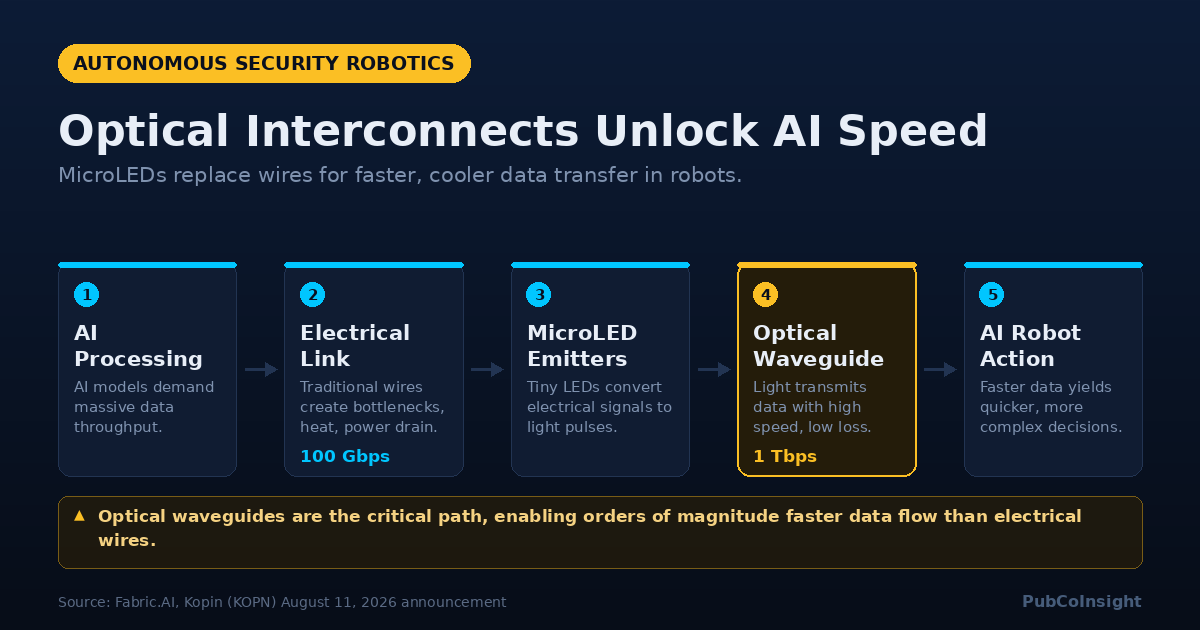
The Mechanism of Optical Interconnects
Optical interconnects replace electrical wires with optical waveguides, essentially tiny fiber optic cables, to transmit data using light pulses. Imagine a data center where every connection between chips, boards, and racks is made with light, not copper. The core advantage is speed and efficiency. Electrical signals suffer from resistance and capacitance, which degrade signal integrity and limit bandwidth over distance. Light, however, travels through waveguides with far less attenuation and can carry much more information simultaneously through wavelength division multiplexing. MicroLEDs are crucial here because they are small enough to be integrated directly onto chip substrates, allowing for very short, high-bandwidth optical links between processing cores. This direct chip-to-chip optical communication bypasses many of the bottlenecks inherent in traditional electrical buses. For an autonomous security robot, this translates into faster sensor data processing, quicker command execution, and more sophisticated on-board AI without relying solely on cloud processing, which can introduce latency. If the integration proves robust and cost-effective for mass production, it would invalidate much of the current design philosophy around power management and thermal dissipation in high-performance edge AI devices.Companies Working in This Part of the Sector
The broader autonomous security robotics and physical AI sector includes a range of companies developing solutions from hardware to software and services. Kopin Corporation (KOPN), with its focus on microdisplays and optical components, plays a direct role in the underlying hardware advancements like the Neural I/o MicroLED. Kopin reported break-even earnings for Q2 2026, with shares rising sharply after the MicroLED development award. Their expertise in miniature, high-performance optics positions them as a key enabler for next-generation AI processing. In the mobile robotics space, Serve Robotics Inc. (SERV) focuses on last-mile delivery robots, recently seeing Uber fully exit its stake. Serve’s Q2 earnings call centered on this Uber reset and a lower outlook. Unusual Machines, Inc. (UMAC) also operates in the drone and robotics sector, with its stock climbing recently, suggesting broader interest in the drone group. Their Q2 earnings call emphasized capacity ahead of Q3 growth. Ondas Inc. (ONDS) is expanding its reach into defense and infrastructure drones, recently winning Israel's ‘Digital Bat’ drone tender and an NFL counter-drone deal to protect EverBank Stadium. Ondas's CEO sees a fundamental shift in defense priorities. Red Cat Holdings, Inc. (RCAT) is another player in the drone market, providing hardware and software solutions. On the AI processing and perception side, Arbe Robotics Ltd. (ARBE) is pushing its AI radar technology, targeting defense, drones, and robotaxis. BigBear.ai Holdings, Inc. (BBAI) focuses on AI-powered analytics and decision intelligence, often for government and defense applications. Lantronix, Inc. (LTRX) provides intelligent edge solutions, including embedded computing and connectivity, crucial for linking robotic hardware to broader networks. MicroVision, Inc. (MVIS) develops MEMS-based laser beam scanning technology, primarily for automotive lidar, which is a critical sensor for autonomous navigation.Artificial Intelligence Technology Solutions, Inc.
Artificial Intelligence Technology Solutions, Inc. (AITX) operates through its subsidiaries, primarily focused on building and leasing autonomous security robots and remote monitoring systems. The company's business model centers on a recurring monthly subscription for its AI-driven "Solutions-as-a-Service." Its primary subsidiary, Robotic Assistance Devices, Inc. (RAD-I), markets these solutions to the security and guarding services industry, a market estimated at $50 billion in the United States. AITX states its solutions offer cost savings between 35% and 80% compared to traditional manned security. AITX's operations are structured around three main pillars: stationary security devices (RAD-I), mobile autonomous platforms (RAD-M), and its SARA agentic artificial intelligence platform (RAD-G). The ROAMEO mobile security unit, part of RAD-M, began early commercial deployment in May 2026. The company also maintains Robotic Assistance Devices Lanka (Private) Limited (RAD Lanka) in Sri Lanka, which supports software development, AI initiatives, and technical operations. AITX describes its long-term vision as "RAD Town," an integrated autonomous-security deployment across a campus or community. For the fiscal year ended February 28, 2026, AITX reported revenue of $7,745,336, a 26% increase year-over-year. Gross profit rose 48% to $5,533,700, expanding the gross margin to approximately 71% from 61%. Operating expenses remained flat at approximately $17,477,097, and the loss from operations improved by $2.0 million to $(11,943,397). The company reported a net loss of approximately $14.5 million and an accumulated deficit of approximately $171 million as of February 28, 2026. The company's filings state that management does not anticipate having positive cash flow from operations in the near term. AITX's independent registered public accounting firm has included an explanatory paragraph in its report on the consolidated financial statements, expressing substantial doubt about the company's ability to continue as a going concern. The company's recent 8-K filings on August 12 and August 11, 2026, indicate ongoing operational activities and disclosures. AITX's July 16, 2026 S-1 filing outlines its business strategy, including projections that RAD-I's recurring revenue and gross margin could, on a standalone basis, support positive cash flow operations, and that RAD-M will surpass RAD-I's monthly recurring revenue contribution at some future point. It also projects subscription gross margins exceeding 75% and outright-sale gross margins over 50%, based on accepted pricing and stable input costs. The public record does not yet establish the consistent achievement of these financial projections. AITX intends for RAD-G to generate substantial revenue from SARA platform licensing and views RAD-M as having a higher revenue ceiling than stationary solutions. The company's common stock is quoted on the OTC Markets under the symbol AITX.What to watch
The immediate focus for the Neural I/o MicroLED Optical Interconnect is the CES 2027 demonstration by Fabric.AI and Kopin. Details on the performance metrics achieved, the scale of integration, and any announced commercialization timelines will be critical. For Kopin (KOPN), watch for further developments on production readiness and potential partnerships beyond Fabric.AI that leverage this technology. In the broader sector, monitor the Q3 earnings calls for Ondas (ONDS) and Unusual Machines (UMAC) for updates on their drone deployments and capacity expansions. Serve Robotics (SERV) will need to articulate a clear path forward following the Uber stake divestment. For Artificial Intelligence Technology Solutions (AITX), continued attention to their 8-K filings will show the pace of ROAMEO deployments and subscription growth, particularly any data supporting the stated gross margin and cash flow projections from the July 16, 2026 S-1 filing., { "label": "Electrical Link", "note": "Traditional wires create bottlenecks, heat, power drain.", "metric": "100 Gbps" }, { "label": "MicroLED Emitters", "note": "Tiny LEDs convert electrical signals to light pulses." }, { "label": "Optical Waveguide", "note": "Light transmits data with high speed, low loss.", "metric": "1 Tbps" }, { "label": "AI Robot Action", "note": "Faster data yields quicker, more complex decisions." } ], "highlight": 3, "highlight_note": "Optical waveguides are the critical path, enabling orders of magnitude faster data flow than electrical wires.", "footnote": "Source: Fabric.AI, Kopin (KOPN) August 11, 2026 announcement" }Companies mentioned
| Ticker | Company | Price |
|---|---|---|
| AITX client | Artificial Intelligence Technology Solutions Inc | $0.0065 |
| ARBE | Arbe Robotics Ltd. | $0.756 |
| BBAI | BigBear.ai Holdings, Inc. | $3.33 |
| KOPN | Kopin Corporation | $5.2 |
| LTRX | Lantronix, Inc. | $5.91 |
| MVIS | MicroVision, Inc. | $3.64 |
| ONDS | Ondas Inc. | $9.74 |
| RCAT | Red Cat Holdings, Inc. | $10.66 |
| SERV | Serve Robotics Inc. | $4.9 |
| UMAC | Unusual Machines, Inc. | $25.97 |
Listed alphabetically, not ranked. Prices as of 2026-08-12 and they move. Check a live quote before relying on any of this.
How we chose the companies in this article
We cover a fixed universe of companies working in autonomous security robotics, physical AI and the guarding services market they are aimed at. Every one of them that had usable market data on 2026-08-12 appears in this article. We do not pick which ones to mention based on what we think of them, and we do not order them by size, price or trading volume, because an ordered list is a verdict and that is not ours to hand down. Companies left out, and why: none. American Lithium Minerals and Artificial Intelligence Technology Solutions pay us, which is disclosed in full at the foot of every article they appear in.
See the dilution and promotion flags before you see the pitch.
Each week: the micro and small-caps now showing dilution or paid-promotion signals, with the SEC filing behind every flag. No recommendations, no price targets.
Sources used in this article
- I've Been Wrong About Microsoft Stock for Years. Here's Why I'm Finally Changing My Mind. Motley Fool · 2026-08-12
- Michael Burry Calls Nvidia’s $500B AI Financing Plan A ‘Wall Street Stunt’: ‘Meet The New Boss’ Stocktwits · 2026-08-12
- Prediction: Solana Will Replace Ethereum as the No. 1 Altcoin by 2030 Motley Fool · 2026-08-12
- Forget big tech: the real AI money is in plumbing Yahoo Finance Video · 2026-08-12
- CoreWeave, Super Micro climb on signs of sustained AI buildout Reuters · 2026-08-12
- River AI secures $1.1bn investment for full-stack AI development Verdict · 2026-08-12
- The Stock Market Is Flashing the Same Warning Signal That It Did Before the Dot-Com Bubble. Here's What History Says Comes Next. Motley Fool · 2026-08-12
- Better AI Infrastructure Stock: Vertiv vs. Eaton Motley Fool · 2026-08-12
- Visa and Mastercard Have Both Reported. Which Payments Giant Is the Best Buy Now? Motley Fool · 2026-08-12
- Elon Musk Says Optimus Will Be a $10 Trillion Business. Here Are 2 Industrial Stocks That Could Actually Cash In Motley Fool · 2026-08-12
- ONDS Stock Rises Overnight: Retail Bulls Eye Return To Double-Digit Price As Q2 Results Loom Stocktwits · 2026-08-12
- Axon Jumps After Earnings Beat and Analyst Target Hikes: Here’s The Next Catalyst Investors Are Waiting On 24/7 Wall St. · 2026-08-11
Disclosure required by Section 17(b) of the Securities Act of 1933
Artificial Intelligence Technology Solutions, Inc., a Nevada corporation (OTCID: AITX). Artificial Intelligence Technology Solutions, Inc. pays Strategic Innovations First, Inc., a Wyoming corporation doing business as PulseIR. Compensation received: USD 5,000.00 per month for months 1-3 (August, September, October 2026); USD 10,000.00 per month for months 4-6 (November, December 2026, January 2027) contingent on the 90-day review. Minimum committed USD 15,000.00; USD 45,000.00 if the second-period rate triggers.. Form of payment: cash only, invoiced monthly in advance; no stock, options or warrants received or payable. Services: investor relations services under an Investor Relations Services Agreement effective 2026-08-01. Period: six month term, 2026-08-01 through 2027-01-31; 90-day review on or about 2026-10-30. No stock, options or warrants held by PubCo Insight, Pulse IR, Strategic Innovations First, Inc., or Brad Listermann. Confirmed by the executed agreement and by board record recKwdq39X2caPSX7 (POSITIONS HELD: none).
This is information, not investment, financial, legal or tax advice. It is not a recommendation or solicitation to buy, sell or hold any security and it contains no price target. Nothing here is independently verified by us. Confirm every figure against primary filings on SEC EDGAR before you act. Micro-cap and over-the-counter securities are speculative and illiquid and can lose all of their value. The companies named without a disclosure above pay us nothing and have no relationship with us; they are named because a published, mechanical screen selected them. Full disclosure policy.