Market Pulse: Crypto Treasury & FinTech Movers
MicroStrategy Downgrade Rattles Crypto Treasuries, Small Caps Eye AI Compute
Monness Crespi & Hardt's MSTR downgrade and Bitcoin premium pressure force a hard look at small-cap crypto miners' balance sheets and AI pivot strategies.
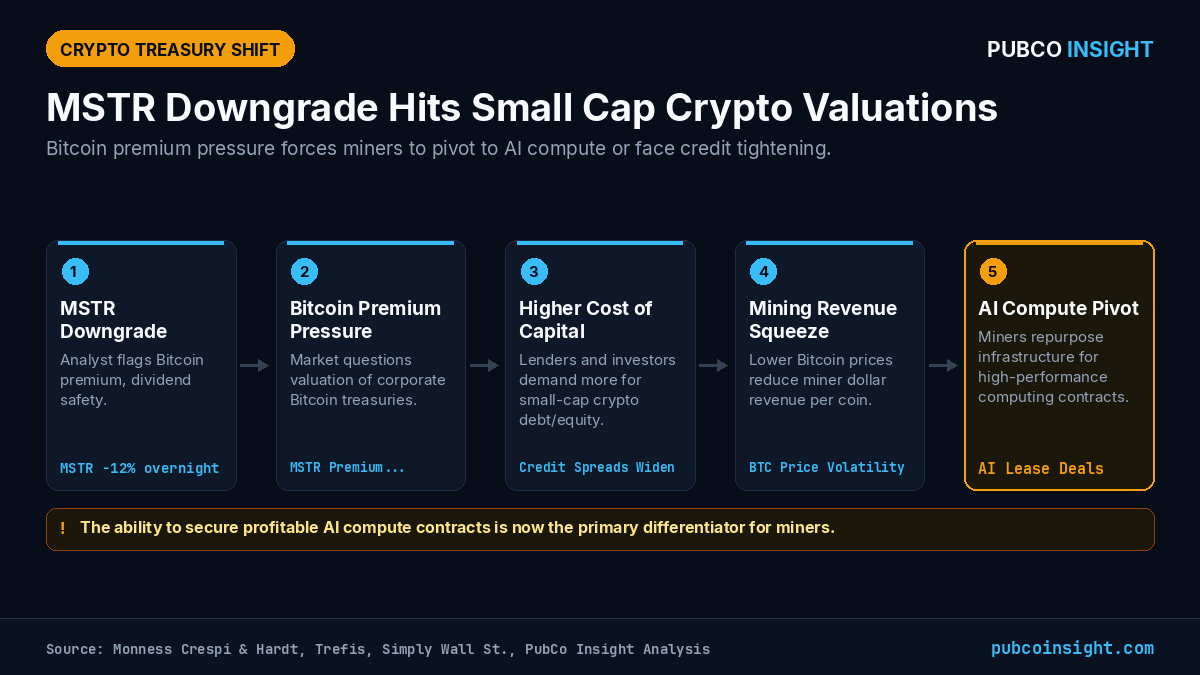
Monness Crespi & Hardt's downgrade of MicroStrategy (MSTR) to "Sell" from "Neutral" on November 19, 2026, sent a clear signal through the digital asset ecosystem. While MSTR stock recovered overnight, the analyst's concern over the Bitcoin premium and the safety of its 12% dividend highlights a critical inflection point. This isn't just about Michael Saylor's treasury strategy; it's a direct challenge to the valuation models underpinning numerous small-cap and microcap companies whose fortunes are tightly bound to Bitcoin's price and the broader institutional perception of digital assets.
This downgrade arrives as Bitcoin itself faces scrutiny, with Trefis asking if the price is "Heading For The $50,000s." Simultaneously, major players like BlackRock are innovating with new ETF structures, as seen with their filing for private companies, and Paul Tudor Jones is doubling down on BlackRock's Bitcoin ETF (IBIT). This creates a bifurcated market: institutional capital is finding new on-ramps, while the legacy crypto treasury model exemplified by MSTR faces re-evaluation. For active small-cap traders and prop desks, this means scrutinizing the balance sheets and operational pivots of companies that have ridden the Bitcoin wave.
Market Transmission Mechanism: From Bitcoin Premium to Compute Contracts
The Monness Crespi & Hardt downgrade on MicroStrategy (MSTR) transmits through the market in several distinct ways, directly impacting small-cap and microcap players. First, the "Bitcoin premium" that MSTR often commanded has historically served as a proxy for institutional confidence in a corporate treasury strategy built around digital assets. When this premium faces pressure, it signals a potential shift in how the market values companies holding significant Bitcoin reserves. For small-cap crypto miners, this means their own Bitcoin holdings, often a substantial portion of their balance sheet, may be subjected to more conservative valuation multiples by investors and lenders. This can tighten credit spreads and increase the cost of capital for expansion or even ongoing operations. Second, the broader sentiment around Bitcoin's price, as Trefis queries about a potential move to "$50,000s," directly affects the revenue streams of mining companies. Lower Bitcoin prices mean reduced dollar revenue per mined coin. This pressure forces miners to seek alternative revenue sources or optimize their operations with extreme efficiency. The most prominent pivot we are seeing is into high-performance computing (HPC) and AI compute contracts. Companies like Riot Platforms, Inc. (RIOT) are actively exploring "AI Lease Deals," which could fundamentally recast their business models. This transition is capital intensive, requiring significant investment in specialized hardware and infrastructure, and the ability to secure long-term, high-margin compute contracts. The ability to execute this pivot effectively, securing power at competitive rates and attracting AI clients, becomes a primary differentiator. Finally, the actions of major fintech players like Coinbase Global (COIN) and Robinhood (HOOD) also influence the small-cap landscape. Coinbase exploring "Tokenized US Stocks Onchain" suggests a future where traditional assets are increasingly digitized, potentially expanding the market for digital asset infrastructure and services. Robinhood adding "Live IPO Pricing Tools" signals increased retail engagement with public offerings, which could provide liquidity for certain small-cap listings, particularly those in emerging tech sectors. However, Cathie Wood's strategic shift, selling Nvidia before earnings to buy crypto stocks, indicates a rotation of institutional capital that small-cap players must track closely. The interplay between institutional appetite for digital assets, the operational realities of mining, and the evolving retail trading landscape creates a complex environment for small-cap and microcap entities.
The weekly Flags Watchlist: small-caps now showing dilution or promotion signals, each linked to the SEC filing behind the flag.
How the Small-Cap and Microcap Cohort Positions Around This Trend
The small-cap and microcap cohort in the digital asset space is navigating this environment with varying degrees of success and strategic focus. TeraWulf Inc. (WULF), with a 30-day average daily dollar volume of $598.6 million, is a significant player in the high-performance computing hosting sector. WULF's operational efficiency and ability to secure cost-effective power are critical as the industry faces Bitcoin price volatility. Simply Wall St. recently listed WULF as one of "Oracle And 2 Other Crypto Stocks To Own," highlighting its perceived strength in the sector. Hut 8 Corp. (HUT), with a 30-day average daily dollar volume of $433.2 million, has pursued a strategy of diversified operations, including self-mining and managed services. Their ability to adapt to changing market conditions, particularly in securing new compute contracts, will be vital. Riot Platforms, Inc. (RIOT), with a 30-day average daily dollar volume of $385.8 million, is actively exploring "AI Lease Deals," as noted by Simply Wall St. This pivot towards AI compute represents a significant strategic shift, aiming to leverage their existing infrastructure for high-demand computing services beyond just Bitcoin mining. The success of these deals will be closely watched by the market. MARA Holdings, Inc. (MARA), with a 30-day average daily dollar volume of $285.1 million, remains a prominent Bitcoin miner. Their operational scale and treasury management become even more critical in an environment where the Bitcoin premium is under pressure. CleanSpark, Inc. (CLSK), with a 30-day average daily dollar volume of $150.2 million, has focused on vertical integration and energy efficiency in its mining operations. Their ability to maintain low operating costs will be a key factor in sustaining profitability amidst market fluctuations. Bit Digital, Inc. (BTBT), a smaller player with a 30-day average daily dollar volume of $20.9 million, faces similar pressures but with potentially less operational scale to absorb shocks. Their strategy for deploying capital and optimizing their mining fleet will be under intense scrutiny. Finally, 1895 Bancorp of Wisconsin Inc (BCOW), a regional bank with a 30-day average daily dollar volume of $355K, represents a different segment of the small-cap financial market. While not directly a crypto treasury play, regional banks like BCOW could be indirectly affected by broader shifts in capital allocation if institutional funds rotate significantly between traditional finance and digital assets. Their ability to manage interest rate spreads and maintain loan portfolio quality remains paramount, regardless of crypto market dynamics. The operational execution and balance sheet resilience of these companies will determine their trajectory in this evolving landscape.What Active Traders and Desks Are Watching Next
* Bitcoin Price Action: Continued monitoring of Bitcoin's price trajectory, specifically whether it approaches or breaches the $50,000 level, will dictate revenue expectations for miners. * MSTR's Q4 2026 Earnings Call: Investors will scrutinize MicroStrategy's (MSTR) updated treasury strategy and any commentary on its Bitcoin premium and dividend safety. * Riot Platforms (RIOT) AI Contract Announcements: Any concrete announcements regarding "AI Lease Deals" or significant high-performance computing contracts from RIOT. * Hut 8 (HUT) Operational Updates: Details on new power purchase agreements, mining fleet expansions, or diversification into managed services for HPC clients. * TeraWulf (WULF) Capacity Expansion: Updates on their mining capacity deployment and progress in securing long-term power agreements at competitive rates. * CleanSpark (CLSK) Efficiency Metrics: Disclosure of updated energy efficiency metrics and operational uptime, key indicators of mining profitability. * Regional Bank Q4 2026 Reports: Analysis of regional banking spreads and loan growth from institutions like 1895 Bancorp of Wisconsin Inc (BCOW) for broader financial market health. * Coinbase (COIN) Tokenization Progress: Any further details or partnerships announced by Coinbase regarding "Tokenized US Stocks Onchain" or other institutional digital asset initiatives. * BlackRock (IBIT) ETF Inflows/Outflows: Daily tracking of capital flows into BlackRock's Bitcoin ETF (IBIT) and other spot Bitcoin ETFs as an indicator of institutional appetite. * SEC Filings for Digital Asset Services: New regulatory filings or approvals for digital asset related services, particularly those impacting custody, trading, or tokenization.Companies mentioned
| Ticker | Company | Price |
|---|---|---|
| BCOW | 1895 Bancorp of Wisconsin Inc | $13.95 |
| BTBT | Bit Digital, Inc. | $0.625 |
| CLSK | CleanSpark, Inc. | $6.21 |
| HUT | Hut 8 Corp. | $57.19 |
| MARA | MARA Holdings, Inc. | $6.56 |
| RIOT | Riot Platforms, Inc. | $18.24 |
| WULF | TeraWulf Inc. | $12.0 |
Listed alphabetically, not ranked. Prices as of 2026-11-19 and they move. Check a live quote before relying on any of this.
How we chose the companies in this article
Candidate pool of 10 small-cap, microcap, and OTC names in Market Pulse: Crypto Treasury & FinTech Movers; ranked by 30-day average daily dollar volume (Yahoo Finance) as of 2026-11-19. All compensated IR clients are excluded from this editorial lane.
PubCo Insight
See the dilution and promotion flags before you see the pitch.
Each week: the micro and small-caps now showing dilution or paid-promotion signals, with the SEC filing behind every flag. No recommendations, no price targets.
Every flag links to its EDGAR filing so you can check it yourself. Sponsored coverage disclosed under SEC 17(b). One-click unsubscribe.
Sources used in this article
- Monness Crespi & Hardt Downgrades Strategy to Sell From Neutral MT Newswires · 2026-11-19
- MSTR Stock Recovers Overnight After Dip – But Analyst Downgrades Strategy To 'Sell' As Bitcoin Premium Faces Pressure Stocktwits · 2026-11-19
- Is MicroStrategy’s 12% Dividend Safe? Its $100 Stock Just Broke Again BeInCrypto · 2026-11-19
- Bitcoin Price: Heading For The $50,000s? Trefis · 2026-11-19
- What Could Coinbase Global (COIN) Gain From Tokenized US Stocks Onchain? Simply Wall St. · 2026-11-19
- Why Did Cathie Wood Sell Nvidia Before Earnings and Buy Crypto Stocks? BeInCrypto · 2026-11-19
- HOOD Adds Live IPO Pricing Tools: Will Anthropic Drive Engagement? Zacks · 2026-11-19
- Which Dates Could Move Bristol Myers Squibb Stock Most? Trefis · 2026-11-19
- Bristol Myers Squibb Demonstrates Breadth and Clinical Momentum Across Blood Cancers and Rare Hematologic Disorders at ASH 2026 Business Wire · 2026-11-19
- Should You Buy Exelixis Stock For Its Cash? Trefis · 2026-11-19
- Where Could Gilead's Next Growth Come From? Trefis · 2026-11-19
- Should Biogen Stock Holders Look At Amgen Instead? Trefis · 2026-11-19
PubCo Insight publishes research on small and micro-cap companies. Nothing here is investment advice, we make no buy or sell recommendations, and we publish no price targets. Small and micro-cap shares are speculative and illiquid and you can lose everything you put into them. Check every figure against primary filings on SEC EDGAR before you act on it.