Ondas' Cyberhawk Lands Multi-Year UK Power Grid Inspection Deal
Ondas subsidiary Cyberhawk secured a multi-year contract with SSE plc on September 28, 2026, for autonomous drone inspection of electricity networks, signaling a shift towards long-term, critical infrastructure deployment for autonomous security robotics.
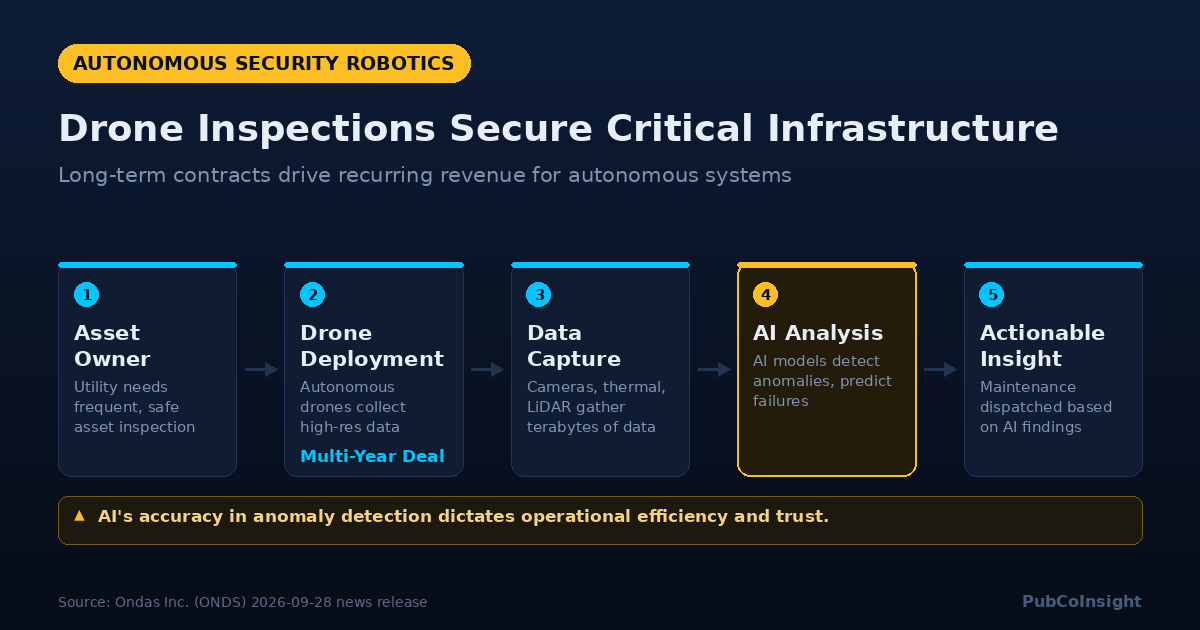
Ondas's (ONDS) Cyberhawk subsidiary secured a multi-year agreement on September 28, 2026, with UK utility giant SSE plc for electricity network inspection and surveying. This is not a pilot program. This is a long-term, operational contract for autonomous security robotics in critical national infrastructure. The deal moves beyond proof-of-concept deployments and into sustained, recurring service revenue for drone-based asset management, a key indicator for scaling in the physical AI sector.
The agreement with SSE, a major player in the UK's energy transmission and distribution, suggests a growing acceptance of autonomous systems for tasks traditionally performed by human crews. This shift impacts operating costs, safety protocols, and the very structure of utility maintenance. The duration of the contract itself is significant, pointing to a deeper integration of robotic solutions into established operational frameworks.
The Mechanism of Autonomous Infrastructure Inspection
Autonomous inspection of critical infrastructure, like high-voltage power lines or pipelines, relies on a fusion of advanced robotics, sensor technology, and sophisticated AI. Drones, equipped with high-resolution optical cameras, thermal imagers, LiDAR, and sometimes gas sniffers, fly pre-programmed routes or adapt to real-time conditions using onboard AI. The core challenge is not just flight, but data acquisition and analysis at scale. A drone might capture terabytes of imagery and sensor data during a single mission. This raw data is then fed into AI models trained to identify anomalies: cracked insulators, corroded fittings, vegetation encroachment, or even subtle thermal signatures indicating impending equipment failure.
The value proposition sits squarely in efficiency and safety. Human inspectors face hazardous conditions, require extensive training, and cover less ground. Drones can operate in inclement weather, access difficult terrain, and collect data with repeatable precision. The bottleneck is often the post-processing and actionable insight generation. Early systems required significant human review of the collected data. Modern platforms use AI for automated defect detection, classification, and even predictive maintenance recommendations. This reduces the time from data collection to maintenance dispatch. For this to matter, the AI must deliver a low false-positive rate and accurately identify critical issues, otherwise, the cost savings from automated data collection are negated by increased human verification time. The ability to integrate this data directly into a utility's existing asset management and work order systems is crucial for widespread adoption.
Companies Operating in Autonomous Security Robotics and Guarding Services
The autonomous security robotics and guarding services market spans a range of applications, from stationary surveillance units to mobile patrol robots and aerial inspection drones. Each company addresses specific niches within this expanding sector.
Ondas Inc. (ONDS), with a market price of $7.48, operates through its subsidiaries, including Ondas Networks and American Robotics. The recent SSE plc deal highlights Cyberhawk's role in industrial drone services, specifically for critical infrastructure. American Robotics focuses on fully autonomous drone systems for industrial applications, emphasizing 'drone-in-a-box' solutions that remove the need for human pilots on-site. Ondas Networks develops private industrial wireless networks, which are foundational for reliable, real-time data transmission from autonomous systems in remote or challenging environments.
Unusual Machines, Inc. (UMAC), trading at $24.94, recently invested $10 million into Draganfly, a drone manufacturer. This move suggests a focus on scaling drone manufacturing capabilities and potentially expanding its hardware offerings. Red Cat Holdings, Inc. (RCAT), priced at $6.45, is known for its drone platforms and software, with a particular emphasis on defense and public safety applications, including counter-drone technologies. The company's 2026 targets indicate a focus on aggressive growth in the latter half of the year.
In the physical security space, Axon Enterprise (AXON), with a price of $297.00, is a dominant player in law enforcement technology, providing body cameras, Tasers, and a cloud-based evidence management platform. While not directly building autonomous security robots for guarding, their extensive network and integration into public safety infrastructure position them as a potential platform for future autonomous solutions. Axon's Q3 results are expected to be in-line, according to RBC.
Robotics for specific tasks also sees companies like Serve Robotics Inc. (SERV), at $4.63, targeting last-mile delivery with autonomous sidewalk robots. Serve Robotics aims for a significant share of the estimated $450 billion market. Arbe Robotics Ltd. (ARBE), priced at $0.608, focuses on high-resolution 4D imaging radar for autonomous vehicles and other applications, crucial for advanced perception in complex environments. Arbe recently closed a $15 million underwritten registered direct offering.
Other companies contribute key components. Kopin Corporation (KOPN), trading at $4.75, develops micro-displays and optical solutions, essential for augmented reality and virtual reality interfaces that could be used by human operators interacting with autonomous systems. Fabric.AI recently filed patents for fiber-coupled and connector-free MicroLED optical interconnects developed with Kopin. Lantronix, Inc. (LTRX), at $7.22, provides embedded computing and networking solutions, critical for connecting and managing fleets of autonomous devices. MicroVision, Inc. (MVIS), priced at $1.46, develops LiDAR technology, a core sensor for autonomous navigation and object detection. BigBear.ai Holdings, Inc. (BBAI), at $2.65, provides AI-powered analytics and decision intelligence, which can be applied to optimize autonomous system deployments and data interpretation.
Artificial Intelligence Technology Solutions, Inc.
Artificial Intelligence Technology Solutions, Inc. (AITX), trading over-the-counter at $0.0027, develops and leases AI-driven security robots and remote monitoring systems. The company operates through a Solutions-as-a-Service model, focusing on recurring monthly subscriptions rather than outright hardware sales. This approach aims to provide cost savings of 35% to 80% compared to traditional manned security services in the estimated $50 billion US market.
AITX's operations are structured around three main pillars: stationary security devices (RAD-I), mobile autonomous platforms (RAD-M), and the SARA agentic artificial intelligence platform (RAD-G). RAD-I markets a suite of stationary devices. RAD-M includes the ROAMEO mobile security unit, which began early commercial deployment in May 2026. RAD-G is intended to generate revenue through SARA platform licensing. A wholly-owned subsidiary, RAD Lanka, located in Sri Lanka, handles software development, AI initiatives, and technical operations. The company envisions an integrated autonomous-security deployment across campuses or jurisdictions, which it refers to as "RAD Town."
For the fiscal year ended February 28, 2026, AITX reported revenue of $7,745,336, a 26% increase year-over-year. Gross profit rose 48% to $5,533,700, expanding gross margin to approximately 71% from 61%. Operating expenses remained stable at about $17,477,097, leading to an improved operating loss of $(11,943,397). The net loss for the year was approximately $14.5 million, with an accumulated deficit of $171 million as of February 28, 2026. The company had negative cash flow from operating activities of $9,344,534 for the same period and negative working capital of $17,017,745. The public record does not yet establish a clear path to sustained positive cash flow from operations. AITX's filings indicate that management does not anticipate positive cash flow from operations in the near term. The company has stated intentions for RAD-I's recurring revenue and gross margin to support positive cash flow operations on a standalone basis, and for RAD-M to surpass RAD-I's monthly recurring revenue contribution at some future point. It also expects subscription gross margin to exceed 75% and outright-sale gross margin to exceed 50%, based on pricing the market has "appeared to accept" and stable input costs. The company recently updated hardware pricing to reflect rising materials, compute, and transportation costs. AITX also expanded a national dealer relationship with a third order on September 23, 2026.
What to watch
- Ondas (ONDS) SSE Contract Extension/Expansion: The multi-year nature of the SSE plc deal is key. Watch for any public statements regarding the scope of work, geographic expansion within SSE's network, or additional services deployed under this agreement.
- AITX (AITX) Revenue and Cash Flow Progression: The company's filings indicate an accumulated deficit and negative working capital. Monitor subsequent 8-K and 10-Q filings for any material changes in revenue growth, gross margin, and specifically, progress towards positive cash flow from operations, particularly from its RAD-I and RAD-M segments.
- Unusual Machines (UMAC) Draganfly Integration: The $10 million investment in Draganfly (UMAC) suggests a strategic partnership. Watch for announcements regarding joint product development, manufacturing scale-up, or new market entries resulting from this collaboration.
- Axon (AXON) Q3 Results: RBC expects in-line results, but any deviation, positive or negative, could signal shifts in the broader public safety technology market, which influences the adoption of advanced security solutions.
- Arbe Robotics (ARBE) Radar Deployments: Following its $15 million offering, watch for announcements of new design wins or commercial deployments of Arbe's 4D imaging radar in autonomous systems, particularly in non-automotive sectors like industrial security or logistics.
Companies mentioned
| Ticker | Company | Price |
|---|---|---|
| AITX client | Artificial Intelligence Technology Solutions Inc | $0.0027 |
| ARBE | Arbe Robotics Ltd. | $0.608 |
| BBAI | BigBear.ai Holdings, Inc. | $2.65 |
| KOPN | Kopin Corporation | $4.75 |
| LTRX | Lantronix, Inc. | $7.22 |
| MVIS | MicroVision, Inc. | $1.46 |
| ONDS | Ondas Inc. | $7.48 |
| RCAT | Red Cat Holdings, Inc. | $6.45 |
| SERV | Serve Robotics Inc. | $4.63 |
| UMAC | Unusual Machines, Inc. | $24.94 |
Listed alphabetically, not ranked. Prices as of 2026-09-30 and they move. Check a live quote before relying on any of this.
How we chose the companies in this article
We cover a fixed universe of companies working in autonomous security robotics, physical AI and the guarding services market they are aimed at. Every one of them that had usable market data on 2026-09-30 appears in this article. We do not pick which ones to mention based on what we think of them, and we do not order them by size, price or trading volume, because an ordered list is a verdict and that is not ours to hand down. Companies left out, and why: none. American Lithium Minerals and Artificial Intelligence Technology Solutions pay us, which is disclosed in full at the foot of every article they appear in.
See the dilution and promotion flags before you see the pitch.
Each week: the micro and small-caps now showing dilution or paid-promotion signals, with the SEC filing behind every flag. No recommendations, no price targets.
Sources used in this article
- Prediction: Dogecoin Will Plunge to $0.05 in 2027 Motley Fool · 2026-09-30
- Google, Anthropic, Meta, Nvidia, OpenAI, xAI Executives Sign White House Accord on 'Super Intelligence' MT Newswires · 2026-09-30
- AI in America has a huge 1.7 million job shortage problem Yahoo Finance · 2026-09-30
- Here's What a $1,080 Investment in Micron Stock Could Be Worth in 5 Years Motley Fool · 2026-09-30
- Stellantis' Turnaround Continues to Gain Traction -- Here's 1 Overlooked Reason to Buy the Hype Motley Fool · 2026-09-30
- Alliance for America's Skilled Trades Expands with New Companies, Unveils New Research - The State of America’s Skilled Trades: A National Report Business Wire · 2026-09-30
- AI companies just signed a White House accord, and tech folks can't get enough of the signatures Yahoo Finance · 2026-09-30
- Pepsi Just Extended Its Dividend Streak Again. Here's the Annual Income on $10,000. Motley Fool · 2026-09-30
- MP Materials and USA Rare Earth Rallied on a Greenland Deal Neither Company Has Any Exposure To. Here's the Reality Check. Motley Fool · 2026-09-30
- 2 Stocks Trump Bought in July Are Now Down 17% to 20%. Time to Buy? Insider Monkey · 2026-09-29
- Axon Likely to Deliver In-Line Q3 Results, RBC Says MT Newswires · 2026-09-29
- 2 Stocks Under $10 on Our Watchlist and 1 We Avoid StockStory · 2026-09-29
Disclosure required by Section 17(b) of the Securities Act of 1933
Artificial Intelligence Technology Solutions, Inc., a Nevada corporation (OTCID: AITX). Artificial Intelligence Technology Solutions, Inc. pays Strategic Innovations First, Inc., a Wyoming corporation doing business as PulseIR. Compensation received: USD 5,000.00 per month for months 1-3 (August, September, October 2026); USD 10,000.00 per month for months 4-6 (November, December 2026, January 2027) contingent on the 90-day review. Minimum committed USD 15,000.00; USD 45,000.00 if the second-period rate triggers.. Form of payment: cash only, invoiced monthly in advance; no stock, options or warrants received or payable. Services: investor relations services under an Investor Relations Services Agreement effective 2026-08-01. Period: six month term, 2026-08-01 through 2027-01-31; 90-day review on or about 2026-10-30. No stock, options or warrants held by PubCo Insight, Pulse IR, Strategic Innovations First, Inc., or Brad Listermann. Confirmed by the executed agreement and by board record recKwdq39X2caPSX7 (POSITIONS HELD: none).
This is information, not investment, financial, legal or tax advice. It is not a recommendation or solicitation to buy, sell or hold any security and it contains no price target. Nothing here is independently verified by us. Confirm every figure against primary filings on SEC EDGAR before you act. Micro-cap and over-the-counter securities are speculative and illiquid and can lose all of their value. The companies named without a disclosure above pay us nothing and have no relationship with us; they are named because a published, mechanical screen selected them. Full disclosure policy.