Municipalities Adopt Autonomous Security: AITX Secures Seven ROSA Units
A recent order for seven autonomous security robots from a municipal customer highlights a growing trend of public sector adoption in the physical AI market, signaling evolving demand for automated guarding services.
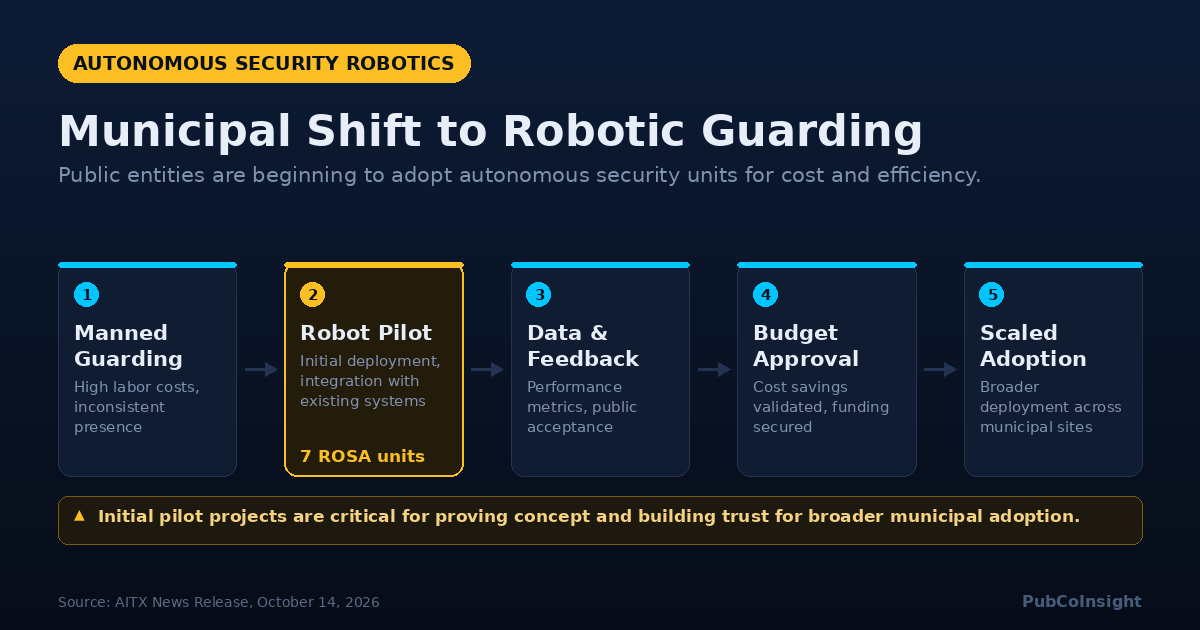
The Mechanism of Municipal Adoption
The adoption of autonomous security robots by municipalities hinges on a clear economic and operational calculus. Traditional manned guarding services are labor-intensive. Wages, benefits, training, and supervision drive high recurring costs. Autonomous units, in contrast, represent a capital expenditure followed by lower operational costs, primarily for maintenance, software subscriptions, and remote monitoring. The stated cost savings for AI-driven solutions, often cited between 35% and 80% compared to human guards, become compelling for budget-constrained public entities. For a municipality to adopt these systems, several factors must align. First, the technology must demonstrate reliability in diverse public environments: parks, public buildings, transit hubs. This means robust sensor suites, effective navigation in varied weather, and the ability to distinguish between routine activity and genuine threats. Second, integration with existing emergency services and dispatch protocols is crucial. A robot detecting an incident must seamlessly alert human responders. Third, public perception and regulatory frameworks play a role. Local ordinances may need to adapt to autonomous patrols. The value proposition is not just about cost reduction, but also about enhanced surveillance capabilities, consistent presence, and the ability to redeploy human officers to higher-priority tasks. The key constraint here is the initial integration and public acceptance phase. Overcoming skepticism and demonstrating tangible benefits in pilot programs is critical for broader rollout. If a system fails to integrate or causes public concern, it will not scale.Companies Operating in Autonomous Security
Several companies are navigating this evolving landscape, each with distinct approaches to physical AI and guarding services. In the realm of mobile robotics and AI, **Serve Robotics Inc. (SERV)**, priced at $3.44, focuses on last-mile delivery, a different application of autonomous movement but one that shares core navigation and obstacle avoidance challenges. Their focus on urban environments and public interaction provides a parallel for the challenges faced by municipal security robots. **Ondas Inc. (ONDS)**, trading at $6.14, recently launched Regna AI with Palantir, aiming to develop sovereign AI models for surveillance systems. While their primary focus appears to be airborne defense and advanced missile protection with EASA certification for Bombardier Global 7500, the underlying AI and surveillance capabilities could find application in broader security contexts, including ground-based autonomous systems. **Red Cat Holdings, Inc. (RCAT)**, at $4.73, also operates in the drone space, recently debuting its TRICHON drone, indicating a focus on aerial surveillance and reconnaissance. For component technologies underpinning autonomous systems, **Arbe Robotics Ltd. (ARBE)**, priced at $0.50, develops 4D imaging radar solutions, critical for precise perception in autonomous vehicles and robots. **MicroVision, Inc. (MVIS)**, at $1.17, works on lidar technology, another essential sensor for environmental mapping and object detection. **Kopin Corporation (KOPN)**, trading at $3.82, recently secured an additional $18.6 million US Army contract for color MicroLED technology, which is vital for advanced display systems in defense applications, including potentially for remote operation or monitoring of autonomous units. **Lantronix, Inc. (LTRX)**, at $5.91, provides secure data access and management solutions for IoT and M2M applications, a critical layer for connecting and managing fleets of autonomous security robots. **Unusual Machines, Inc. (UMAC)**, priced at $17.73, recently saw its CEO, Dr. Allan Evans, appointed Chairman of XTI Aerospace, suggesting a focus on advanced aerial mobility and potentially autonomous flight systems. **BigBear.ai Holdings, Inc. (BBAI)**, at $2.18, offers AI-powered analytics and decision intelligence, which could be leveraged for processing the vast amounts of data generated by autonomous security deployments, enabling predictive insights for security operations.Artificial Intelligence Technology Solutions, Inc.
Artificial Intelligence Technology Solutions, Inc. (AITX), trading OTC under AITX at $0.0019, operates through several subsidiaries to build and lease autonomous security robots and remote monitoring systems. The company emphasizes a "Solutions-as-a-Service" model, generating recurring monthly subscription revenue rather than one-off hardware sales. This model aims to reduce the upfront capital burden for customers, a potential draw for municipalities. AITX's operations are structured around three core pillars. Its primary subsidiary, Robotic Assistance Devices, Inc. (RAD-I), focuses on stationary security devices. Robotic Assistance Devices Mobile (RAD-M) develops mobile autonomous platforms, including the ROAMEO unit, which began early commercial deployment in May 2026. The company's SARA agentic artificial intelligence platform falls under Robotic Assistance Devices Group (RAD-G), intended to generate revenue from licensing. AITX also maintains Robotic Assistance Devices Residential (RAD-R) and Robotic Assistance Devices Lanka (Private) Limited (RAD Lanka), the latter supporting software development and AI initiatives from Sri Lanka. The company states its solutions are designed to deliver significant cost savings, between 35% and 80%, compared to traditional manned security. For the fiscal year ended February 28, 2026, AITX reported revenue of $7,745,336, a 26% increase year-over-year. Gross profit increased 48% to $5,533,700, with gross margin expanding to approximately 71%. Operating expenses remained flat at around $17,477,097, and the loss from operations improved by approximately $2.0 million to $(11,943,397). The company reported a net loss of approximately $14.5 million for the fiscal year ended February 28, 2026, with an accumulated deficit of approximately $171 million. AITX had negative cash flow from operating activities of $9,344,534 for the same period. The public record does not yet establish a clear path to sustained positive cash flow from operations. Management does not anticipate having positive cash flow from operations in the near term. The company's filings indicate a strategy to achieve positive cash flow through increased recurring revenue and gross margin from RAD-I, and future contributions from RAD-M and RAD-G.What to watch
Investors should monitor several specific developments. First, look for further municipal orders for autonomous security units, particularly from AITX or its competitors. The number of units, the duration of contracts, and the specific applications will indicate the depth of public sector penetration. Second, observe the rollout and performance of AITX's ROAMEO mobile security unit, with early commercial deployments having begun in May 2026. Any public reports on its efficacy or challenges will be important. Third, watch for progress on the SARA platform licensing from RAD-G. Specific licensing deals and revenue generated will show its commercial viability. Finally, keep an eye on AITX's cash flow from operations in upcoming financial filings. The company's ability to reduce its accumulated deficit and move towards positive cash flow remains a key metric., { "label": "Robot Pilot", "note": "Initial deployment, integration with existing systems", "metric": "7 ROSA units" }, { "label": "Data & Feedback", "note": "Performance metrics, public acceptance" }, { "label": "Budget Approval", "note": "Cost savings validated, funding secured" }, { "label": "Scaled Adoption", "note": "Broader deployment across municipal sites" } ], "highlight": 1, "highlight_note": "Initial pilot projects are critical for proving concept and building trust for broader municipal adoption.", "footnote": "Source: AITX News Release, October 14, 2026" }Companies mentioned
| Ticker | Company | Price |
|---|---|---|
| AITX client | Artificial Intelligence Technology Solutions Inc | $0.0019 |
| ARBE | Arbe Robotics Ltd. | $0.5 |
| BBAI | BigBear.ai Holdings, Inc. | $2.18 |
| KOPN | Kopin Corporation | $3.82 |
| LTRX | Lantronix, Inc. | $5.91 |
| MVIS | MicroVision, Inc. | $1.17 |
| ONDS | Ondas Inc. | $6.14 |
| RCAT | Red Cat Holdings, Inc. | $4.73 |
| SERV | Serve Robotics Inc. | $3.44 |
| UMAC | Unusual Machines, Inc. | $17.73 |
Listed alphabetically, not ranked. Prices as of 2026-10-15 and they move. Check a live quote before relying on any of this.
How we chose the companies in this article
We cover a fixed universe of companies working in autonomous security robotics, physical AI and the guarding services market they are aimed at. Every one of them that had usable market data on 2026-10-15 appears in this article. We do not pick which ones to mention based on what we think of them, and we do not order them by size, price or trading volume, because an ordered list is a verdict and that is not ours to hand down. Companies left out, and why: none. American Lithium Minerals and Artificial Intelligence Technology Solutions pay us, which is disclosed in full at the foot of every article they appear in.
See the dilution and promotion flags before you see the pitch.
Each week: the micro and small-caps now showing dilution or paid-promotion signals, with the SEC filing behind every flag. No recommendations, no price targets.
Sources used in this article
- Revisiting Former Stock Picks Casey’s General Stores, Tradeweb Markets, Motorola Solutions Barrons.com · 2026-10-15
- 1 of the Stock Market's Most Reliable Recession Warnings Just Disappeared. Here's What Usually Happens Next. Motley Fool · 2026-10-15
- Taiwan chip giant TSMC says net profit hit record in third quarter Euronews · 2026-10-15
- Google Just Started Paying SpaceX $920 Million a Month. Here's What That's Worth per Share. Motley Fool · 2026-10-15
- QCOM, AVGO, NVDA Stocks In Focus As ByteDance Reportedly Closes In On A MediaTek Pact For AI Data Center Chips Stocktwits · 2026-10-15
- TSMC Q3 profit surges to record high on AI demand; says considering Texas fab Investing.com · 2026-10-15
- Polymarket CEO Shayne Coplan Says Crypto Investors Can Achieve Superior Returns With Prediction Markets. Here's Why He's Right. Motley Fool · 2026-10-15
- Anthropic Just Became the First Company in History To Reach This Milestone. Here's What It Means for AI Stocks Motley Fool · 2026-10-15
- Apple's Annual Revenue Quadrupled From $108 Billion to $416 Billion During Tim Cook's 15 Years as CEO, With iPhone Sales Alone Jumping From $47 Billion to Nearly $210 Billion. What That Growth Says About Betting on Apple's Next Chapter Under John Ternus. Motley Fool · 2026-10-15
- Peter Schiff Says Most Stocks Are in Bear Market as AI Leaders Carry the Index BeInCrypto · 2026-10-15
- Meta Reports on Oct. 21. I'd Consider Buying the Stock Before It Does. Motley Fool · 2026-10-15
- Here's Why Axon Enterprise (AXON) Fell More Than Broader Market Zacks · 2026-10-14
Disclosure required by Section 17(b) of the Securities Act of 1933
Artificial Intelligence Technology Solutions, Inc., a Nevada corporation (OTCID: AITX). Artificial Intelligence Technology Solutions, Inc. pays Strategic Innovations First, Inc., a Wyoming corporation doing business as PulseIR. Compensation received: USD 5,000.00 per month for months 1-3 (August, September, October 2026); USD 10,000.00 per month for months 4-6 (November, December 2026, January 2027) contingent on the 90-day review. Minimum committed USD 15,000.00; USD 45,000.00 if the second-period rate triggers.. Form of payment: cash only, invoiced monthly in advance; no stock, options or warrants received or payable. Services: investor relations services under an Investor Relations Services Agreement effective 2026-08-01. Period: six month term, 2026-08-01 through 2027-01-31; 90-day review on or about 2026-10-30. No stock, options or warrants held by PubCo Insight, Pulse IR, Strategic Innovations First, Inc., or Brad Listermann. Confirmed by the executed agreement and by board record recKwdq39X2caPSX7 (POSITIONS HELD: none).
This is information, not investment, financial, legal or tax advice. It is not a recommendation or solicitation to buy, sell or hold any security and it contains no price target. Nothing here is independently verified by us. Confirm every figure against primary filings on SEC EDGAR before you act. Micro-cap and over-the-counter securities are speculative and illiquid and can lose all of their value. The companies named without a disclosure above pay us nothing and have no relationship with us; they are named because a published, mechanical screen selected them. Full disclosure policy.