Market Pulse: Macro & Small-Cap Liquidity
Nasdaq's AI Dip: How Big Tech's Chip Woes Ripple Through Small Cap Balance Sheets
Nvidia's Hong Kong holdup and the Nasdaq's 5.5% plunge signal a capital flow shift that hits small cap AI and hardware plays directly.
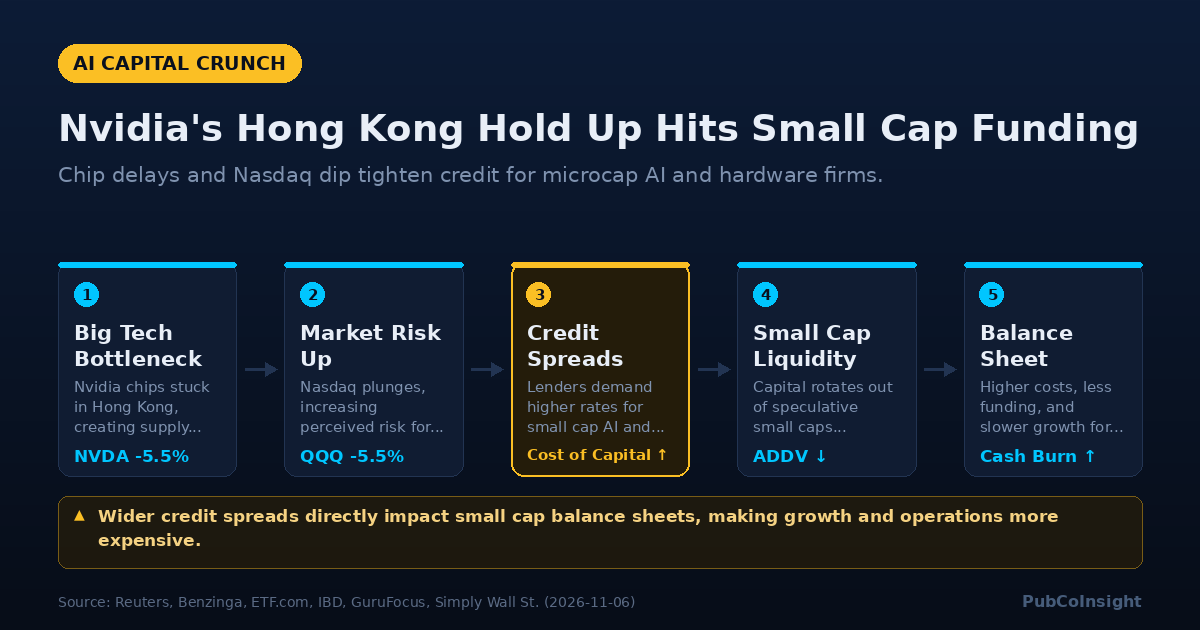
The Nasdaq just took a 5.5% dive, its worst day since 2020, as the AI selloff deepened. ETFs like QQQ are bleeding, and the buzz around Nvidia (NVDA) has shifted from market dominance to supply chain snarls. Reuters reports Nvidia chips are piling up in Hong Kong, awaiting China's import approval, creating a bottleneck that reverberates far beyond Santa Clara. This isn't just a big-cap tech story; it’s a direct hit on the microcap and small-cap ecosystem, where balance sheets are tighter, and access to capital is more sensitive to macro sentiment.
When the giants like Nvidia face friction, the entire AI supply chain feels the tremor. The "AI boom turns chip packaging into the next battleground," as Reuters puts it, means increased costs and potential delays for every player, from the silicon foundries to the specialized systems integrators. For small-cap firms, this translates into higher operational expenditures, longer lead times for critical components, and a tightening credit environment as investors grow cautious. The market’s sudden aversion to risk in the AI sector means that funding rounds become harder to close, and existing debt covenants get a closer look.
The Market Transmission Mechanism: From Chip Delays to Small Cap Credit Spreads
The immediate transmission mechanism from Nvidia's Hong Kong holdup to small-cap balance sheets is straightforward: cost of capital and supply chain stability. When a bellwether like Nvidia faces import approval delays, it signals geopolitical risk and operational uncertainty across the entire semiconductor and AI hardware complex. This uncertainty translates into higher perceived risk for investors, pushing up credit spreads for smaller, less diversified companies. Lenders and venture capitalists become more stringent, demanding higher interest rates or more equity for the same amount of capital. Furthermore, the "chip packaging battleground" means that specialized components and services, often sourced from smaller, niche providers, become more expensive and harder to secure. Small-cap companies, lacking the purchasing power of an Oracle or an Alphabet, find themselves at the mercy of extended lead times and inflated component costs. This directly impacts their ability to meet production schedules, fulfill customer orders, and manage working capital. The Nasdaq's 5.5% plunge, driven by this AI sector anxiety, also triggers a liquidity rotation. Active traders and institutional desks, seeing large-cap tech under pressure, often pull capital from speculative small-cap and microcap plays, exacerbating downward pressure and reducing trading liquidity for these smaller names. This capital flight makes it harder for small caps to raise follow-on funding, potentially forcing dilutive equity raises or even debt restructuring.
The weekly Flags Watchlist: small-caps now showing dilution or promotion signals, each linked to the SEC filing behind the flag.
How the Small Cap and Microcap Cohort Positions Around This Trend
Within this turbulent environment, several small-cap and microcap companies are navigating the shifting sands of the AI landscape, each with unique exposure and operational realities. IonQ, Inc. (IONQ), a quantum computing pure-play, reported record Q3 2026 revenue and a DARPA milestone. Despite this, Simply Wall St. noted analyst caution on dilution and adoption, suggesting that even promising tech faces scrutiny on its path to commercialization. Its 30-day average daily dollar volume (ADDV) stands at a robust $808.0M, indicating significant institutional and retail interest, but also a potential for volatility as market sentiment swings. The company's Elisity deal, as highlighted by Simply Wall St., could offer strategic positioning, but the broader AI sector's capital crunch could impact future funding. Ondas Inc. (ONDS), with a 30-day ADDV of $324.8M, operates in critical infrastructure and drone solutions. While not directly a chip company, its reliance on advanced hardware and software could expose it to the broader supply chain pressures if components become scarce or more expensive. The company's recent contracts in European and Asian counter-UAS markets demonstrate operational traction, but the cost of scaling these deployments could rise in the current environment. SoundHound AI, Inc. (SOUN), an AI voice solutions provider, reported record $62M revenue in its Q3 2026 earnings call. With a 30-day ADDV of $78.3M, it maintains a decent level of liquidity. While its software focus might shield it slightly from direct chip manufacturing woes, the general tightening of capital for AI companies could impact its ability to fund aggressive growth or acquisitions. Simply Wall St. recently listed it as a "Great Penny Stock," a label that often comes with heightened volatility and sensitivity to broader market shifts. BigBear.ai Holdings, Inc. (BBAI), specializing in AI-powered analytics and decision intelligence, has a 30-day ADDV of $47.4M. Its government and defense contracts provide a degree of revenue stability, but its operational efficiency and ability to attract top-tier AI talent could be affected by a broader slowdown in venture funding for AI startups. The company's ability to demonstrate clear ROI on its AI solutions will be critical in a more cautious spending environment. Red Cat Holdings, Inc. (RCAT), focused on drone technology and software, has a 30-day ADDV of $33.7M. Like Ondas, its hardware component exposure could be a factor. The company’s ability to innovate and deliver specialized drone solutions will be tested by any increases in component costs or delays in procurement, potentially affecting its gross margins. In the battery materials sector, American Battery Technology Company (ABAT), with a 30-day ADDV of $5.9M, and Standard Lithium Ltd. (SLI), with a 30-day ADDV of $3.3M, face a different set of challenges. While not directly tied to the AI chip supply chain, the broader macro environment of rising interest rates and tighter capital impacts all resource-intensive industries. The cost of developing new lithium extraction and recycling facilities is substantial, and a less liquid capital market makes securing project financing more difficult. Their operational milestones, such as plant commissioning and resource delineation, become even more critical indicators of progress in a risk-averse market.What Active Traders and Desks Are Watching Next
Active traders and prop desks are not just watching the Nasdaq; they are scrutinizing the granular data points that signal shifts in capital flow and operational execution for small-cap and microcap names. * Nvidia's (NVDA) China Import Resolution: Any news on the resolution of Nvidia's Hong Kong import approval issues will be a key signal for the broader AI hardware supply chain. A clear path forward could alleviate some market anxiety. * Upcoming Q4 2026 Earnings Calls: Pay close attention to management commentary from IonQ (IONQ), SoundHound AI (SOUN), and BigBear.ai (BBAI) regarding inventory levels, component procurement, and capital expenditure plans. Specific mentions of supply chain resilience or cost inflation will be critical. * Federal Reserve Statements and Treasury Yields: Continued hawkish rhetoric or further spikes in Treasury yields will directly impact the cost of capital for all companies, especially those reliant on external financing like ABAT and SLI. * Small-Cap Funding Rounds and Debt Offerings: Watch for announcements of new equity raises or debt placements by small-cap AI and hardware firms. The terms of these deals (e.g., dilution, interest rates) will indicate the market's current risk appetite. * Retail Order Flow Data: Monitor changes in average daily dollar volume (ADDV) for names like Ondas (ONDS) and Red Cat Holdings (RCAT). A sustained decrease could signal retail liquidity rotation out of speculative small-cap plays.Companies mentioned
| Ticker | Company | Price |
|---|---|---|
| ABAT | American Battery Technology Company | $1.195 |
| BBAI | BigBear.ai Holdings, Inc. | $2.22 |
| IONQ | IonQ, Inc. | $26.43 |
| ONDS | Ondas Inc. | $4.52 |
| RCAT | Red Cat Holdings, Inc. | $3.405 |
| SLI | Standard Lithium Ltd. | $1.37 |
| SOUN | SoundHound AI, Inc. | $4.26 |
Listed alphabetically, not ranked. Prices as of 2026-11-06 and they move. Check a live quote before relying on any of this.
How we chose the companies in this article
Candidate pool of 10 small-cap, microcap, and OTC names in Market Pulse: Macro & Small-Cap Liquidity; ranked by 30-day average daily dollar volume (Yahoo Finance) as of 2026-11-06. All compensated IR clients are excluded from this editorial lane.
PubCo Insight
See the dilution and promotion flags before you see the pitch.
Each week: the micro and small-caps now showing dilution or paid-promotion signals, with the SEC filing behind every flag. No recommendations, no price targets.
Every flag links to its EDGAR filing so you can check it yourself. Sponsored coverage disclosed under SEC 17(b). One-click unsubscribe.
Sources used in this article
- Stock Market: Will S&P 500 Open Up or Down Today? Benzinga Prediction Markets · 2026-11-06
- AI Selloff Deepens as Chip ETFs Suffer Worst Day Since 2020 etf.com · 2026-11-06
- Physical AI Empowers Smart Mobility: LUXEED Builds a New Full-Scenario Intelligent Ecosystem GlobeNewswire · 2026-11-06
- AI boom turns chip packaging into the next battleground for semiconductors Reuters · 2026-11-06
- Exclusive-Nvidia chips pile up in Hong Kong as China withholds import approval Reuters · 2026-11-06
- TSS Inc (TSSI) (Q3 2026) Earnings Call Highlights: Record Systems Integration Revenue Drives ... GuruFocus.com · 2026-11-06
- Oracle vs. Alphabet: Which Is the Better AI Cloud Stock to Own for the Next 5 Years? Motley Fool · 2026-11-06
- Dow Jones Futures Fall, Techs Rise After Nasdaq Dives 5.5%; Nvidia, Sandisk, CoreWeave, SpaceX Plunge Investor's Business Daily · 2026-11-06
- Why Warby Parker Stock Popped Today Motley Fool · 2026-11-06
- The Nasdaq Plunges 5%. What the Data Center Crash Means for Investors Motley Fool · 2026-11-06
- Rocket Lab Stock Has Lost About 70% From Its Record. Is It Finally a Buy? Motley Fool · 2026-11-06
- Should You Buy Nvidia Stock Before Nov. 17? Motley Fool · 2026-11-06
PubCo Insight publishes research on small and micro-cap companies. Nothing here is investment advice, we make no buy or sell recommendations, and we publish no price targets. Small and micro-cap shares are speculative and illiquid and you can lose everything you put into them. Check every figure against primary filings on SEC EDGAR before you act on it.