Arbe Robotics Diversifies into Counter-UAS Radar, Shifting Focus Beyond Automotive
Arbe Robotics' September 14, 2026, announcement of its Alerion C-UAS Radar signals a strategic pivot into defense and homeland security, targeting drone threats with advanced radar technology.
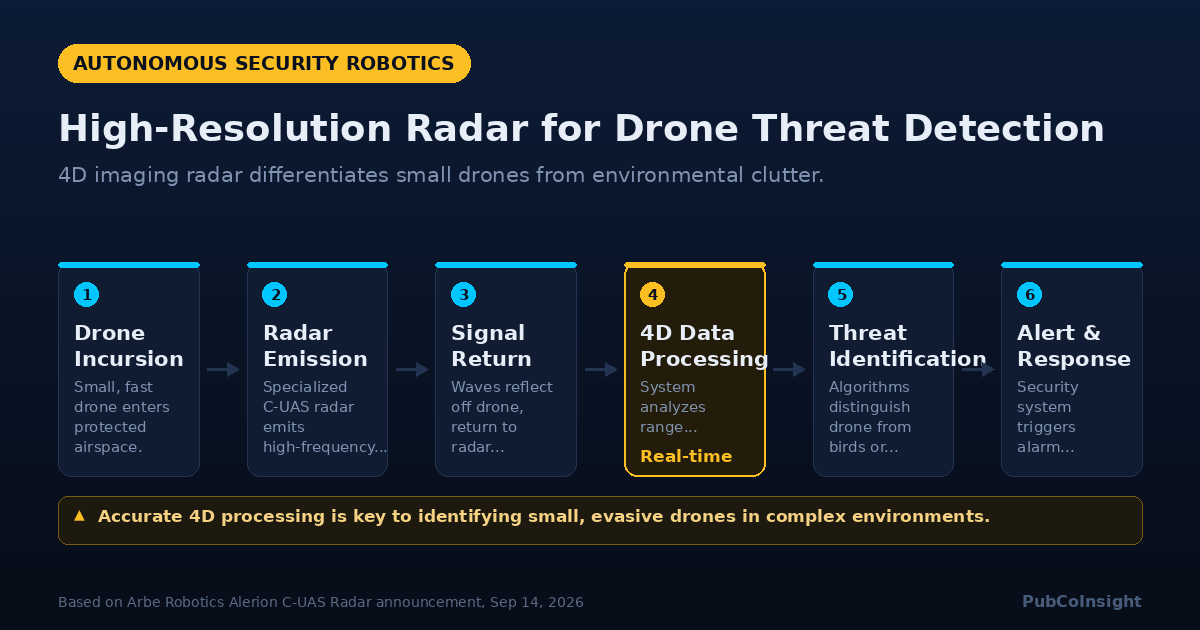
The Mechanism of Counter-UAS Radar
Detecting small, fast-moving drones in complex environments is a formidable challenge. Conventional radar systems, designed for larger aircraft or ground targets, often filter out signals from objects like consumer drones, mistaking them for clutter or birds. The Alerion C-UAS Radar, as described by Arbe, targets this specific blind spot. It uses a high-resolution, 4D imaging radar technology. This means it doesn't just measure range and velocity, like traditional 2D or 3D radar. It adds elevation and azimuth, creating a four-dimensional point cloud that accurately maps an object's position, speed, and trajectory in real-time. The core innovation lies in its ability to differentiate small, non-metallic objects from environmental noise. This requires advanced signal processing algorithms that can identify the unique radar signature of a drone, even when it's flying low, slow, or attempting to evade detection. The system must also operate effectively in various weather conditions and urban landscapes, where buildings and other structures can create significant interference. A false positive rate that is too high renders a system unusable in critical security applications. Conversely, missed detections carry severe consequences. The value sits in the signal processing and the underlying chip architecture that enables this high-fidelity, real-time data interpretation. Without robust, low-latency processing, even the best radar hardware generates unusable data.Companies Operating in Autonomous Security and Robotics
The autonomous security and robotics sector is broad, encompassing everything from stationary surveillance units to mobile patrol robots and, increasingly, aerial defense systems. Many companies focus on specific niches or technological approaches. In the mobile robotics space, Serve Robotics Inc. (SERV) develops autonomous sidewalk delivery robots, primarily for food and grocery delivery. While not directly in security, its navigation and autonomy stack shares common ground with mobile security platforms. Unusual Machines, Inc. (UMAC) and Red Cat Holdings, Inc. (RCAT) operate primarily in the drone and unmanned systems market, with Red Cat specifically focusing on drone technology for defense and public safety, including its Teal Drones subsidiary. Ondas Inc. (ONDS) is another player in the drone ecosystem, with its Ondas Networks subsidiary providing wireless data platforms for critical infrastructure and its American Robotics subsidiary offering autonomous drone-in-a-box solutions for industrial inspection. Ondas recently expanded its defense footprint with the $390M GATE Technologies deal. On the sensor and component side, Kopin Corporation (KOPN) develops micro-displays and optical systems, critical components for augmented and virtual reality applications, which can feed into advanced human-machine interfaces for robotic control. MicroVision, Inc. (MVIS) specializes in lidar technology, another key sensor for autonomous navigation and object detection, primarily in automotive but with potential applications in other autonomous systems. Lantronix, Inc. (LTRX) provides secure data access and management solutions for the Internet of Things (IoT), enabling the connectivity and remote control necessary for autonomous fleets. BigBear.ai Holdings, Inc. (BBAI) focuses on artificial intelligence and machine learning, offering data analytics and decision intelligence solutions, particularly for government and defense clients. This kind of AI capability is crucial for interpreting the vast amounts of data generated by autonomous security systems, including radar data. Arbe Robotics (ARBE), with its Alerion C-UAS Radar, is now directly competing with some of these companies for defense contracts, particularly those focused on drone countermeasures. Its automotive background gives it a unique perspective on high-volume, cost-effective sensor production, which could be an advantage in scaling defense solutions.Artificial Intelligence Technology Solutions, Inc.
Artificial Intelligence Technology Solutions, Inc. (AITX) operates under the OTCID tier, focusing on AI-driven security and productivity solutions for enterprise clients. The company builds and leases autonomous security robots and remote monitoring systems, following a recurring monthly subscription model rather than one-off hardware sales. This Solutions-as-a-Service approach is central to its business. AITX structures its operations through several subsidiaries. Robotic Assistance Devices, Inc., or RAD-I, is its primary subsidiary, marketing AI-driven security solutions to the guarding services industry. The company estimates this market to be approximately $50 billion in the United States. RAD-I's solutions aim to deliver significant cost savings, between 35% and 80%, compared to traditional manned security. This is achieved through a suite of stationary and mobile devices integrated with the company's software and monitoring platforms. Robotic Assistance Devices Mobile, or RAD-M, handles the company's mobile autonomous platforms, including the ROAMEO mobile security unit. Early commercial deployments of ROAMEO began in May 2026. Robotic Assistance Devices Group, or RAD-G, is responsible for the SARA agentic artificial intelligence platform, which the company states could generate substantial revenue from licensing. Robotic Assistance Devices Residential, or RAD-R, targets the residential market. Finally, RAD Lanka, a wholly owned subsidiary in Sri Lanka, supports software development, AI initiatives, and technical operations. The company refers to its long-term strategy as "RAD Town," envisioning integrated autonomous security deployments across campuses, communities, or jurisdictions. For the fiscal year ended February 28, 2026, AITX reported revenue of $7,745,336, a 26% increase over the prior fiscal year. Gross profit rose 48% to $5,533,700, expanding the gross margin to approximately 71% from 61%. Operating expenses remained largely flat at about $17,477,097, and the loss from operations improved by approximately $2.0 million to $(11,943,397). The company reported a net loss of approximately $14.5 million for the fiscal year ended February 28, 2026, with an accumulated deficit of approximately $171 million as of that date. The public record does not yet establish a clear path to sustained positive cash flow from operations. For the year ended February 28, 2026, the company had negative cash flow from operating activities of $9,344,534. As of February 28, 2026, the company had an accumulated deficit of $171,121,742 and negative working capital of $17,017,745. Management does not anticipate having positive cash flow from operations in the near term. The company's filings, including its July 16, 2026, S-1, detail these financial conditions and associated risks. AITX's recent activities include RAD sales reinforcing ROSA's role as a stationary security platform foundation, as reported on September 16, 2026. On September 14, 2026, AITX's RAD went live on Immix with ROSA and RIO, indicating integration with third-party monitoring platforms.What to watch
The defense and homeland security market is driven by government contracts and procurement cycles. For Arbe Robotics, watch for specific contract awards or pilot program announcements for its Alerion C-UAS Radar. The success of this product hinges on its ability to secure substantial orders from defense agencies or critical infrastructure operators. For Ondas (ONDS), the integration and revenue generation from its recent GATE Technologies acquisition will be key. Its ability to leverage this deal for further defense growth will be important. Similarly, Red Cat Holdings (RCAT) and Unusual Machines (UMAC) will be watched for any large-scale defense or public safety contracts for their drone platforms. For Artificial Intelligence Technology Solutions (AITX), the continued expansion of its subscription base and the path to positive cash flow from operations will be critical. The company's future filings, particularly its quarterly and annual reports, will provide updates on revenue growth, gross margins, and operating expenses. Specific announcements regarding RAD-M deployments or SARA platform licensing deals will also be important indicators of its strategic execution. The broader market will also track any new regulations or government spending initiatives related to counter-drone technology, as these could significantly impact demand for all players in the C-UAS space., { "label": "Radar Emission", "note": "Specialized C-UAS radar emits high-frequency waves." }, { "label": "Signal Return", "note": "Waves reflect off drone, return to radar receiver." }, { "label": "4D Data Processing", "note": "System analyzes range, velocity, elevation, azimuth.", "metric": "Real-time" }, { "label": "Threat Identification", "note": "Algorithms distinguish drone from birds or clutter." }, { "label": "Alert & Response", "note": "Security system triggers alarm, initiates counter-measures." } ], "highlight": 3, "highlight_note": "Accurate 4D processing is key to identifying small, evasive drones in complex environments.", "footnote": "Based on Arbe Robotics Alerion C-UAS Radar announcement, Sep 14, 2026" }Companies mentioned
| Ticker | Company | Price |
|---|---|---|
| AITX client | Artificial Intelligence Technology Solutions Inc | $0.0037 |
| ARBE | Arbe Robotics Ltd. | $0.667 |
| BBAI | BigBear.ai Holdings, Inc. | $2.73 |
| KOPN | Kopin Corporation | $4.34 |
| LTRX | Lantronix, Inc. | $5.42 |
| MVIS | MicroVision, Inc. | $1.63 |
| ONDS | Ondas Inc. | $7.2 |
| RCAT | Red Cat Holdings, Inc. | $7.095 |
| SERV | Serve Robotics Inc. | $4.29 |
| UMAC | Unusual Machines, Inc. | $22.01 |
Listed alphabetically, not ranked. Prices as of 2026-09-17 and they move. Check a live quote before relying on any of this.
How we chose the companies in this article
We cover a fixed universe of companies working in autonomous security robotics, physical AI and the guarding services market they are aimed at. Every one of them that had usable market data on 2026-09-17 appears in this article. We do not pick which ones to mention based on what we think of them, and we do not order them by size, price or trading volume, because an ordered list is a verdict and that is not ours to hand down. Companies left out, and why: none. American Lithium Minerals and Artificial Intelligence Technology Solutions pay us, which is disclosed in full at the foot of every article they appear in.
See the dilution and promotion flags before you see the pitch.
Each week: the micro and small-caps now showing dilution or paid-promotion signals, with the SEC filing behind every flag. No recommendations, no price targets.
Sources used in this article
- Why Did Axon Stock Fall Ten Percent On A Convertible That Pays No Interest? Trefis · 2026-09-17
- Nvidia Has Returned $46 Billion to Shareholders This Year, and Another Major Dividend Hike Could Be Coming Motley Fool · 2026-09-17
- SpaceX's First Orbital Starship Flight Is Targeted for Sept. 22. Here's What's Riding on It for the Stock. Motley Fool · 2026-09-17
- Markel Is Built Like a Smaller Berkshire Hathaway. Its Stock Sits 18% Below Its 52-Week High. Motley Fool · 2026-09-17
- If the Pace of AI Is Slowed, Investors Can Turn to Quantum Computing. 4 Quantum Stocks to Buy Now. Motley Fool · 2026-09-17
- Salesforce Unveils AIforce, Expands Agentforce at Dreamforce MarketBeat · 2026-09-17
- Snowflake Surging to All-Time Highs Motley Fool · 2026-09-17
- The Competition's Response to Tesla Robotaxi Day Motley Fool · 2026-09-17
- Trump Compares AI Data Centers To Oil Boom — Nvidia CEO Agrees Benzinga · 2026-09-17
- Tech Week Singapore 2026: Government and Tech Leaders Explore the Next Frontier of Technology and Infrastructure PR Newswire · 2026-09-17
- Old, New, Borrowed & Blue, Vol. 11 Motley Fool · 2026-09-17
- US Equity Markets End Lower After Federal Reserve Increases Policy Rate MT Newswires · 2026-09-16
Disclosure required by Section 17(b) of the Securities Act of 1933
Artificial Intelligence Technology Solutions, Inc., a Nevada corporation (OTCID: AITX). Artificial Intelligence Technology Solutions, Inc. pays Strategic Innovations First, Inc., a Wyoming corporation doing business as PulseIR. Compensation received: USD 5,000.00 per month for months 1-3 (August, September, October 2026); USD 10,000.00 per month for months 4-6 (November, December 2026, January 2027) contingent on the 90-day review. Minimum committed USD 15,000.00; USD 45,000.00 if the second-period rate triggers.. Form of payment: cash only, invoiced monthly in advance; no stock, options or warrants received or payable. Services: investor relations services under an Investor Relations Services Agreement effective 2026-08-01. Period: six month term, 2026-08-01 through 2027-01-31; 90-day review on or about 2026-10-30. No stock, options or warrants held by PubCo Insight, Pulse IR, Strategic Innovations First, Inc., or Brad Listermann. Confirmed by the executed agreement and by board record recKwdq39X2caPSX7 (POSITIONS HELD: none).
This is information, not investment, financial, legal or tax advice. It is not a recommendation or solicitation to buy, sell or hold any security and it contains no price target. Nothing here is independently verified by us. Confirm every figure against primary filings on SEC EDGAR before you act. Micro-cap and over-the-counter securities are speculative and illiquid and can lose all of their value. The companies named without a disclosure above pay us nothing and have no relationship with us; they are named because a published, mechanical screen selected them. Full disclosure policy.