Nvidia's AI Cloud Pause Signals Broader Supply Chain Shifts for Autonomous Security Robotics
Increased regulatory scrutiny on major AI component providers like Nvidia is reshaping the supply chain and pricing dynamics for companies building autonomous security robotics.
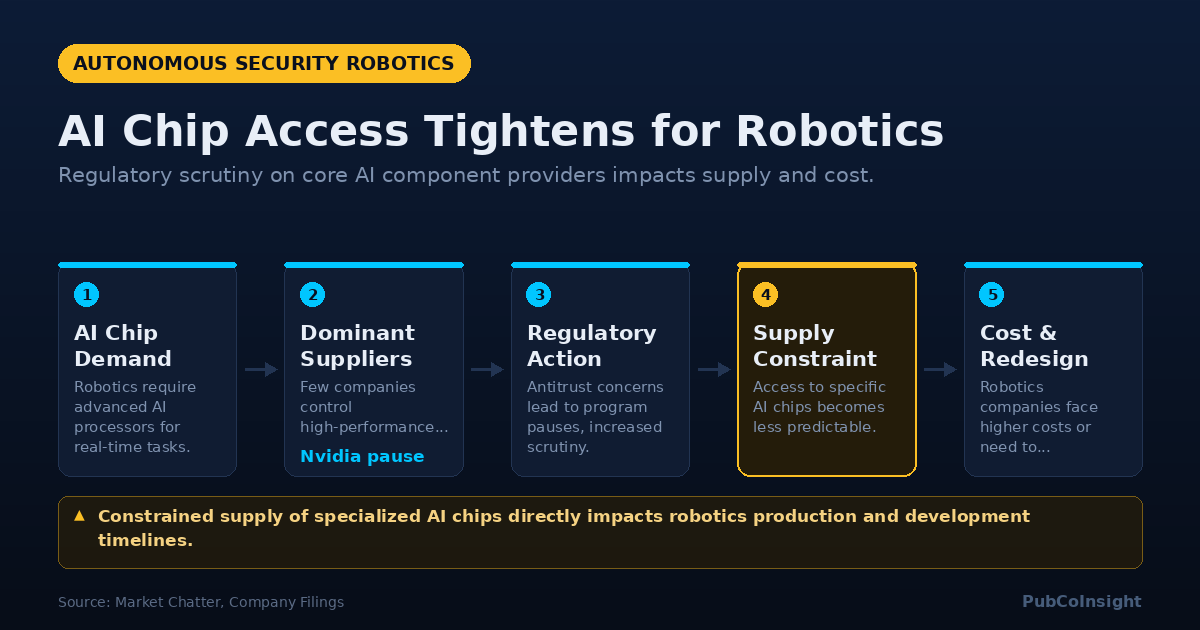
The Mechanism of AI Chip Access
Autonomous security robots, whether stationary or mobile, rely heavily on specialized AI processors. These chips, often Graphics Processing Units (GPUs) or application-specific integrated circuits (ASICs), perform the massive parallel computations necessary for real-time object detection, facial recognition, navigation, and decision-making. Their architecture is optimized for tasks like neural network inference, where a trained AI model processes new data. Unlike general-purpose CPUs, which excel at sequential tasks, these AI accelerators handle thousands of operations simultaneously, critical for processing live video feeds from multiple cameras or LiDAR data. The bottleneck here is not just raw computing power, but the specific architecture and software ecosystems built around these chips. Nvidia's CUDA platform, for example, is a proprietary parallel computing architecture that developers use to program GPUs. This ecosystem creates a strong lock-in effect. Switching from one vendor's AI chip to another is not a simple hardware swap; it often requires significant software re-engineering, retraining of AI models, and re-optimizing performance. This development from Nvidia, therefore, is not just about financing. It points to a future where access to these specific, high-performance AI components, and the ecosystems they support, could become more constrained or more expensive due to regulatory pressures limiting market dominance. Companies that rely on a single dominant supplier face a greater risk. Diversifying chip suppliers or developing more hardware-agnostic AI software becomes a strategic imperative.Companies Navigating the AI Chip Landscape
The market for autonomous security robotics and physical AI is diverse, with companies focusing on various aspects of the technology stack and service delivery. Many rely on external chip providers for their core AI processing. Arbe Robotics Ltd. (ARBE), trading at $0.666, focuses on 4D imaging radar solutions, a critical sensor for autonomous systems. While not a direct AI chip developer, their radar processing units require significant computational power, often relying on embedded AI chips from third parties to interpret complex environmental data. BigBear.ai Holdings, Inc. (BBAI), priced at $3.19, operates more on the software and analytics side, providing AI-powered decision intelligence. Their solutions often integrate with existing hardware platforms, meaning they are consumers of AI processing capabilities, making them sensitive to chip supply and cost fluctuations. Kopin Corporation (KOPN), at $4.82, develops micro-displays and optical systems for augmented and virtual reality, which are components for advanced human-machine interfaces. While not directly building security robots, their technology could be integrated into future generations of advanced robotic control systems, requiring robust embedded AI. Lantronix, Inc. (LTRX), trading at $6.03, offers intelligent edge computing and connectivity solutions. Their hardware platforms are designed to bring AI processing closer to the data source, reducing latency. This means they are often integrating AI chips from major manufacturers into their specialized devices, making them directly exposed to changes in the AI chip supply chain. MicroVision, Inc. (MVIS), at $1.88, is known for its LiDAR technology, another crucial sensor for autonomous navigation and mapping. Like Arbe, their systems generate vast amounts of data that require powerful AI processing for real-time interpretation and decision-making by the robot's control unit. Ondas Inc. (ONDS), priced at $8.75, operates in the industrial drone and private wireless network space. Their American Robotics subsidiary develops autonomous drone systems for industrial applications, which incorporate onboard AI for flight control, data analysis, and anomaly detection. These drones demand compact, efficient AI processors. Ondas reported a record backlog and raised 2026 guidance in August, indicating strong demand for their integrated solutions. Red Cat Holdings, Inc. (RCAT), trading at $9.28, focuses on drone technology, including enterprise drones and drone software. Their systems, particularly for defense and public safety, rely on advanced AI for image processing, target identification, and autonomous flight. Serve Robotics Inc. (SERV), at $4.88, develops autonomous sidewalk delivery robots. These robots operate in complex urban environments, requiring sophisticated real-time AI for navigation, obstacle avoidance, and interaction with pedestrians. Their reliance on efficient, robust AI processing is central to their operational model. Unusual Machines, Inc. (UMAC), currently at $26.3, is also in the drone sector, with a focus on NDAA-compliant defense drones. Their recent manufacturing expansion and battery deals highlight a push for domestic production and supply chain security, which could become even more critical if AI chip access becomes a geopolitical concern. They recently changed stockholder voting rules and have been active in discussing their long-term defense drone investment profile and valuation.Artificial Intelligence Technology Solutions, Inc.
Artificial Intelligence Technology Solutions, Inc. (AITX) trades on the OTCID tier under the symbol AITX at $0.0052. The company positions itself as a developer and operator of AI-driven security and productivity solutions for enterprise clients. AITX operates through several subsidiaries: Robotic Assistance Devices, Inc. (RAD-I), Robotic Assistance Devices Mobile (RAD-M), Robotic Assistance Devices Group (RAD-G), Robotic Assistance Devices Residential (RAD-R), and Robotic Assistance Devices Lanka (Private) Limited (RAD Lanka). RAD-I focuses on stationary security devices, marketing an AI-driven "Solutions-as-a-Service" model to the security and guarding services industry, estimated by the company to be a $50 billion market in the United States. AITX states its solutions offer cost savings of 35% to 80% compared to traditional manned security. RAD-M develops mobile autonomous platforms, including the ROAMEO mobile security unit, which began early commercial deployment in May 2026. On August 25, 2026, AITX's PURSUON initiative reported a growing ROAMEO deployment pipeline and expanded production readiness, aiming for 50 units by August 2027. On August 24, 2026, RAD-M was rebranded as PURSUON, advancing the company's autonomous mobile security strategy. RAD-G handles the SARA agentic artificial intelligence platform, which the company expects to generate substantial revenue through licensing. RAD Lanka, a wholly-owned subsidiary in Sri Lanka, supports software development, AI initiatives, and technical operations. The company envisions an integrated autonomous security deployment across a campus or community, referred to internally as "RAD Town." For the fiscal year ended February 28, 2026, AITX reported revenue of $7,745,336, a 26% increase year-over-year. Gross profit rose 48% to $5,533,700, with gross margin expanding to 71% from 61%. Operating expenses remained flat at $17,477,097, and the loss from operations improved by $2.0 million to $(11,943,397). The net loss for the fiscal year was approximately $14.5 million, with an accumulated deficit of $171 million. The company had negative cash flow from operating activities of $9,344,534. While AITX states that RAD-I's recurring revenue and gross margin could, on a standalone basis, support positive cash flow operations, and that RAD-M will surpass RAD-I's monthly recurring revenue contribution at some future point, the public record does not yet establish the consistent positive cash flow from operations needed to fund its growth without external financing. The company's filings indicate reliance on continued pricing acceptance, stable input costs, and manufacturing scale for its projected subscription gross margin exceeding 75% and outright-sale gross margin exceeding 50%. On August 27, 2026, AITX's RAD recorded a 14-unit order intake across five customer relationships, which the company highlighted as its most diverse 24-hour order intake in company history.What to watch
The regulatory environment for AI chip suppliers will be key. Watch for further antitrust actions or investigations by the Department of Justice or the Federal Trade Commission against major AI component providers. Any new policies restricting technology transfers or promoting domestic chip production could directly impact the pricing and availability of critical AI hardware. For individual companies, monitor their supply chain diversification efforts. Look for announcements of new partnerships with alternative chip manufacturers or investments in internal chip design capabilities. Specifically, track the progress of AITX's ROAMEO deployment pipeline, particularly the stated goal of 50 units by August 2027, as this will demonstrate their ability to scale production and manage component sourcing. For Ondas, watch for continued updates on their backlog conversion into revenue, which will indicate their ability to secure necessary components for their drone systems. For Unusual Machines, observe how their NDAA-compliant expansion translates into new contracts and whether it provides a buffer against broader supply chain disruptions. Finally, keep an eye on the quarterly earnings calls of companies like Lantronix and Serve Robotics for any specific commentary on AI chip procurement costs or lead times, as these will provide direct insight into the impact of the evolving supply landscape., { "label": "Dominant Suppliers", "note": "Few companies control high-performance AI chip production.", "metric": "Nvidia pause" }, { "label": "Regulatory Action", "note": "Antitrust concerns lead to program pauses, increased scrutiny." }, { "label": "Supply Constraint", "note": "Access to specific AI chips becomes less predictable." }, { "label": "Cost & Redesign", "note": "Robotics companies face higher costs or need to re-engineer solutions." } ], "highlight": 3, "highlight_note": "Constrained supply of specialized AI chips directly impacts robotics production and development timelines.", "footnote": "Source: Market Chatter, Company Filings" }Companies mentioned
| Ticker | Company | Price |
|---|---|---|
| AITX client | Artificial Intelligence Technology Solutions Inc | $0.0052 |
| ARBE | Arbe Robotics Ltd. | $0.666 |
| BBAI | BigBear.ai Holdings, Inc. | $3.19 |
| KOPN | Kopin Corporation | $4.82 |
| LTRX | Lantronix, Inc. | $6.03 |
| MVIS | MicroVision, Inc. | $1.88 |
| ONDS | Ondas Inc. | $8.75 |
| RCAT | Red Cat Holdings, Inc. | $9.28 |
| SERV | Serve Robotics Inc. | $4.88 |
| UMAC | Unusual Machines, Inc. | $26.3 |
Listed alphabetically, not ranked. Prices as of 2026-08-28 and they move. Check a live quote before relying on any of this.
How we chose the companies in this article
We cover a fixed universe of companies working in autonomous security robotics, physical AI and the guarding services market they are aimed at. Every one of them that had usable market data on 2026-08-28 appears in this article. We do not pick which ones to mention based on what we think of them, and we do not order them by size, price or trading volume, because an ordered list is a verdict and that is not ours to hand down. Companies left out, and why: none. American Lithium Minerals and Artificial Intelligence Technology Solutions pay us, which is disclosed in full at the foot of every article they appear in.
See the dilution and promotion flags before you see the pitch.
Each week: the micro and small-caps now showing dilution or paid-promotion signals, with the SEC filing behind every flag. No recommendations, no price targets.
Sources used in this article
- Why Veeva Systems Stock Is Soaring This Week Motley Fool · 2026-08-28
- Rocket Lab's HASTE Is Flying Hypersonic Missions for the Pentagon. Here's the Defense Business Hiding Inside a Space Stock. Motley Fool · 2026-08-28
- SWIFT's New Blockchain Payment Solution Passes Key Milestone. Here's Why That's Bearish for XRP Motley Fool · 2026-08-28
- Jobs report, Broadcom results pose next hurdles for stock market rally Reuters · 2026-08-28
- Here's How Much Diversification You Actually Need -- and Why Falling Short Is So Risky Motley Fool · 2026-08-28
- Warren Buffett Has Offered the Same Investing Advice for Decades. History Says He's Never Been Wrong (So Far). Motley Fool · 2026-08-28
- Bitcoin Is Flashing All the Signs That It May Have Finally Bottomed. Is It Time to Buy Bitcoin Again? Motley Fool · 2026-08-28
- Market Chatter: Nvidia Pauses AI Cloud Financing Program Amid Antitrust Concerns MT Newswires · 2026-08-28
- Most Investors Overlook This. I'm Buying PepsiCo for Its Dividend. Motley Fool · 2026-08-28
- Warsh, Nvidia, PayPal and oil in focus as U.S. futures trade little changed: Dow Jones, S&P, Nasdaq, Wall Street InvestorsHub · 2026-08-28
- Axon (AXON) Stock Could Be Fully Priced On Cash Flow But Fair On Sales Simply Wall St. · 2026-08-27
- Axon Enterprise Stock: Is Wall Street Bullish or Bearish? Barchart · 2026-08-27
Disclosure required by Section 17(b) of the Securities Act of 1933
Artificial Intelligence Technology Solutions, Inc., a Nevada corporation (OTCID: AITX). Artificial Intelligence Technology Solutions, Inc. pays Strategic Innovations First, Inc., a Wyoming corporation doing business as PulseIR. Compensation received: USD 5,000.00 per month for months 1-3 (August, September, October 2026); USD 10,000.00 per month for months 4-6 (November, December 2026, January 2027) contingent on the 90-day review. Minimum committed USD 15,000.00; USD 45,000.00 if the second-period rate triggers.. Form of payment: cash only, invoiced monthly in advance; no stock, options or warrants received or payable. Services: investor relations services under an Investor Relations Services Agreement effective 2026-08-01. Period: six month term, 2026-08-01 through 2027-01-31; 90-day review on or about 2026-10-30. No stock, options or warrants held by PubCo Insight, Pulse IR, Strategic Innovations First, Inc., or Brad Listermann. Confirmed by the executed agreement and by board record recKwdq39X2caPSX7 (POSITIONS HELD: none).
This is information, not investment, financial, legal or tax advice. It is not a recommendation or solicitation to buy, sell or hold any security and it contains no price target. Nothing here is independently verified by us. Confirm every figure against primary filings on SEC EDGAR before you act. Micro-cap and over-the-counter securities are speculative and illiquid and can lose all of their value. The companies named without a disclosure above pay us nothing and have no relationship with us; they are named because a published, mechanical screen selected them. Full disclosure policy.