Market Pulse: AI Power, Grid & Robotics
Nvidia's AI Power Play: How Jensen Huang's Return Fuels Small Cap Grid and Robotics Bets
Jensen Huang's return to Nvidia ignites a fresh look at AI infrastructure, pushing capital into the grid and robotics plays powering the next compute wave.
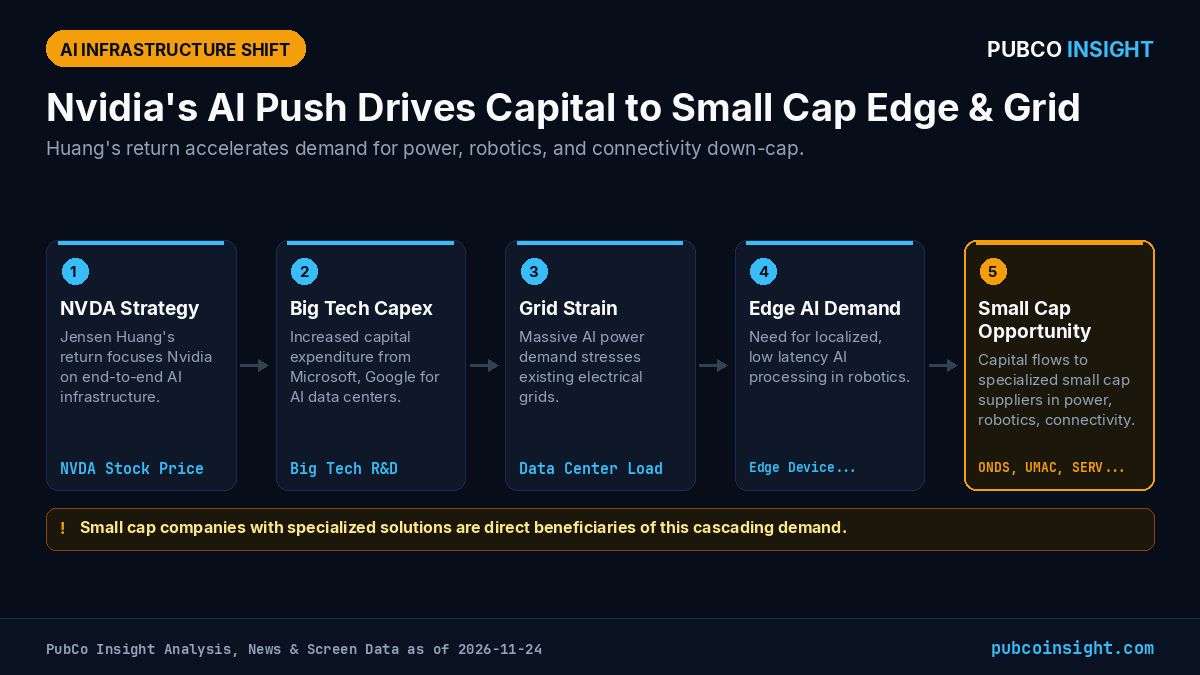
The market just got a jolt. Jensen Huang is back at the helm of Nvidia (NVDA), a move that sent tech futures sliding on November 24, reversing Monday's bounce. This isn't just about Nvidia's stock, which fell 5% after a massive rally, or even the broader tech selloff impacting AMD and Anthropic. This is about the foundational shift in how capital flows through the AI ecosystem, and it has immediate implications for small cap, microcap, and OTC stocks tied to power infrastructure, edge computing, and autonomous systems. The market is digesting the implications of Huang's leadership on Nvidia's future valuation and strategy, but for active traders, the real question is how this translates into tangible opportunities and risks down the cap spectrum.
The Market Transmission Mechanism
Nvidia's renewed focus under Huang means a doubling down on AI infrastructure. This isn't just about GPUs; it is about the entire stack, from data center power consumption to the last mile of autonomous deployment. The sheer scale of AI compute demand is creating unprecedented stress on existing power grids. Vistra (VST) and Exelon (EXC) are already in focus as investors weigh their positions in the evolving power demand landscape. This demand translates directly into opportunities for small cap companies providing grid modernization, power management, and energy efficiency solutions. Furthermore, the push for edge AI, where processing happens closer to the data source, requires robust, low latency hardware and software. This is where specialized robotics and sensor companies, often found in the small cap and microcap space, become critical. Big tech's insatiable appetite for AI capabilities creates a trickle down effect, where their massive capital expenditures spill over into smaller, specialized suppliers. This isn't a theoretical exercise; it is a direct transmission of capital and operational requirements from the top of the tech food chain to the bottom, impacting supply chains, cost of capital for smaller players, and ultimately, their balance sheets.
The weekly Flags Watchlist: small-caps now showing dilution or promotion signals, each linked to the SEC filing behind the flag.
How the Small Cap and Microcap Cohort Positions Around This Trend
The renewed emphasis on AI infrastructure and edge computing directly impacts a cohort of small cap and microcap players. Ondas Inc. (ONDS), with its last close at $4.03 and a robust 30 day average daily dollar volume (ADDV) of $264.5 million, stands out. Ondas CEO recently stated plans to slow acquisition pushes while doubling down on a $1.1 billion 2027 revenue target, signaling a focus on organic growth within its industrial IoT and drone solutions. This positions Ondas to capitalize on the need for secure, reliable wireless connectivity for critical infrastructure, a direct consequence of increased grid demands and autonomous system deployment. BigBear.ai Holdings, Inc. (BBAI), trading at $1.65 with a 30 day ADDV of $45.9 million, develops AI powered analytics and decision support software. As big tech pushes further into AI, the demand for sophisticated analytics platforms that can process vast datasets generated by AI infrastructure will only grow. BigBear.ai's operational milestones in government and commercial sectors will be key indicators of its ability to scale with this trend. Unusual Machines, Inc. (UMAC), closing at $9.51 with a 30 day ADDV of $42.8 million, represents the bleeding edge of specialized robotics. While specific details on their operational focus are often proprietary, companies like UMAC are critical for developing the physical hardware that executes AI decisions at the edge, whether in manufacturing, logistics, or defense. Their ability to secure design wins and scale production will be paramount. Red Cat Holdings, Inc. (RCAT), at $1.89 with a 30 day ADDV of $30.3 million, focuses on drone technology and services. The broader AI push, particularly in autonomous defense and security robotics, directly benefits companies like Red Cat. As AI models become more sophisticated, the demand for advanced, AI enabled drone platforms for data collection, surveillance, and operational execution will intensify. Their balance sheet strength and ability to secure government contracts will be crucial. Kopin Corporation (KOPN), last at $2.80 with a 30 day ADDV of $12.0 million, develops microdisplays and optical solutions. These components are essential for augmented reality (AR) and virtual reality (VR) applications, as well as for advanced sensing systems used in robotics and edge AI devices. As AI becomes more embedded in human machine interfaces and real time data visualization, Kopin's technology could see increased adoption. Serve Robotics Inc. (SERV), closing at $2.26 with a 30 day ADDV of $11.3 million, is a clear play on autonomous last mile delivery. The broader AI infrastructure buildout ultimately aims to enable more efficient and autonomous operations, and companies like Serve Robotics are direct beneficiaries. Their ability to expand deployment footprints and manage operational costs will be key to capturing market share. Lantronix, Inc. (LTRX), at $3.88 with a 30 day ADDV of $4.1 million, specializes in intelligent edge computing and secure connectivity solutions. As more AI processing moves to the edge, the need for robust, secure, and manageable hardware and software platforms becomes critical. Lantronix's offerings directly address this need, providing the foundational technology for deploying and managing distributed AI systems. Their ability to integrate with larger AI ecosystems will determine their growth trajectory.What Active Traders and Desks Are Watching Next
- Q4 2026 Earnings Season: Watch for commentary from big tech on AI capital expenditures and data center expansion plans, especially from Nvidia, Microsoft, and Google. These will signal the continued demand for underlying infrastructure.
- Power Grid Infrastructure Spending: Monitor announcements from major utilities like Vistra and Exelon regarding investments in grid modernization and capacity upgrades to support AI data centers.
- Department of Defense (DoD) AI and Robotics Contracts: Keep an eye on new contract awards for autonomous defense systems and AI enabled robotics, which could directly benefit companies like Red Cat Holdings and BigBear.ai.
- FDA and Regulatory Updates for Robotics: For companies like Serve Robotics, any regulatory clarity or new standards for autonomous systems in public spaces will be a significant catalyst.
- Small Cap Balance Sheet Health: Pay close attention to Q4 2026 and Q1 2027 SEC filings (10-K, 10-Q) for small cap and microcap companies, specifically looking at cash burn rates, debt covenants, and capital raising activities as interest rates remain elevated.
- Copper and Critical Mineral Prices: A rebound in copper prices, which slid 3% on November 24, could signal renewed confidence in industrial demand for AI infrastructure components.
Companies mentioned
| Ticker | Company | Price |
|---|---|---|
| BBAI | BigBear.ai Holdings, Inc. | $1.65 |
| KOPN | Kopin Corporation | $2.8 |
| LTRX | Lantronix, Inc. | $3.88 |
| ONDS | Ondas Inc. | $4.03 |
| RCAT | Red Cat Holdings, Inc. | $1.89 |
| SERV | Serve Robotics Inc. | $2.26 |
| UMAC | Unusual Machines, Inc. | $9.51 |
Listed alphabetically, not ranked. Prices as of 2026-11-24 and they move. Check a live quote before relying on any of this.
How we chose the companies in this article
Candidate pool of 10 small-cap, microcap, and OTC names in Market Pulse: AI Power, Grid & Robotics; ranked by 30-day average daily dollar volume (Yahoo Finance) as of 2026-11-24. All compensated IR clients are excluded from this editorial lane.
PubCo Insight
See the dilution and promotion flags before you see the pitch.
Each week: the micro and small-caps now showing dilution or paid-promotion signals, with the SEC filing behind every flag. No recommendations, no price targets.
Every flag links to its EDGAR filing so you can check it yourself. Sponsored coverage disclosed under SEC 17(b). One-click unsubscribe.
Sources used in this article
- Copper slides 3% as Monday’s bounce fully reverses Investing.com · 2026-11-24
- Stock Market Today: Tech Futures Sell Off After Market Surge; AMD, Anthropic, Nvidia Dive (Live Coverage) Investor's Business Daily · 2026-11-24
- TSX futures slip as caution takes hold after AI-fueled rally Investing.com · 2026-11-24
- Chipotle’s Earnings Fell 7% Last Quarter, but 1 Trend Has Now Lasted 3 Straight Quarters. Motley Fool · 2026-11-24
- Bernstein reverses Nvidia downgrade on Huang’s return, valuation Investing.com · 2026-11-24
- US Equity Futures Slide Pre-Bell as Traders Assess Nvidia-Led Market Rally MT Newswires · 2026-11-24
- Microsoft Stock Jumps In Nvidia-Fueled Tech Surge; Is Microsoft A Buy Now? Investor's Business Daily · 2026-11-24
- Nvidia live updates: Nvidia stock falls 5% following huge rally after board reinstated Jensen Huang as CEO Yahoo Finance · 2026-11-24
- Jensen Huang is back at Nvidia. Should AMD be worried? Yahoo Finance · 2026-11-24
- Stock Futures Down as Traders Digest Jensen Huang's Return to Nvidia as CEO MT Newswires · 2026-11-24
- Energy Transition Today - Renewable Energy Market Grows Amidst Technological Advances Simply Wall St. · 2026-11-24
- Insider Alert: Palantir CTO Dumps Nearly $48 Million in Stock GuruFocus.com · 2026-11-24
PubCo Insight publishes research on small and micro-cap companies. Nothing here is investment advice, we make no buy or sell recommendations, and we publish no price targets. Small and micro-cap shares are speculative and illiquid and you can lose everything you put into them. Check every figure against primary filings on SEC EDGAR before you act on it.