Oppenheimer Cuts Serve Robotics Target, Shifting Analyst Focus on Robotics Value
A significant price target reduction for Serve Robotics by Oppenheimer suggests a recalibration of how financial analysts assess the path to profitability for autonomous security and delivery firms.
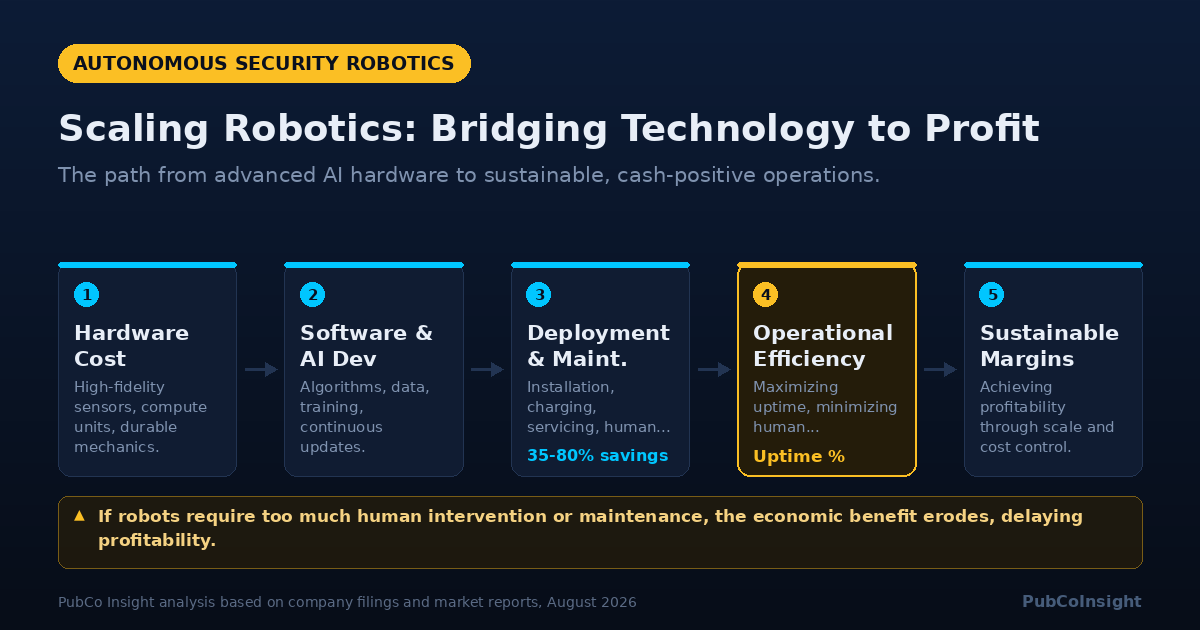
The Mechanism of Robotics Profitability
The core challenge for autonomous security and delivery robotics lies in bridging the gap between advanced technology and scalable, cost-effective deployment. The mechanism involves several critical stages, each with its own bottlenecks. First, there is the initial hardware cost. Building a robust, intelligent robot requires specialized components: high-fidelity sensors like LiDAR and radar, powerful onboard compute units for real-time AI processing, and durable mechanical systems for navigation and operation in varied environments. These components, particularly high-performance chips and custom-fabricated parts, often come with significant upfront expenses. Second, software development and AI training are continuous, resource-intensive processes. Developing the algorithms for autonomous navigation, object recognition, threat detection, and human interaction demands substantial investment in engineering talent and data collection. Training these AI models requires vast datasets and powerful computational resources, often leading to high cloud computing costs. The software must be robust enough to handle unexpected scenarios, adapt to new environments, and integrate seamlessly with existing security or logistics infrastructure. This iterative development cycle, with constant updates and improvements, is not a one-time cost but an ongoing operational expenditure. Third, deployment and maintenance present their own set of hurdles. Robots require charging infrastructure, regular servicing, and often human oversight for complex tasks or interventions. The cost of deploying a fleet includes not just the robots themselves, but also the logistics of installation, network connectivity, and the personnel needed for monitoring and rapid response. Maintenance involves replacing worn parts, updating software, and troubleshooting issues, all of which contribute to the total cost of ownership. The value proposition for customers often hinges on significant cost savings compared to human labor, typically in the range of 35% to 80% for security services. Achieving these savings requires maximizing robot uptime and minimizing operational overhead. If a robot spends too much time offline for maintenance or requires frequent human intervention, the economic benefit erodes rapidly. This is the stage where the true financial viability of a robotics solution is tested.Companies in the Sector
Several companies are navigating these dynamics, each with a distinct approach to the autonomous security and delivery market. Arbe Robotics Ltd. (ARBE), with its stock at $0.768, focuses on high-resolution 4D imaging radar solutions. This technology is crucial for autonomous systems, providing precise environmental perception in challenging conditions like fog, rain, or darkness, where optical sensors may struggle. Their radar chipsets and modules are designed to enhance the safety and performance of autonomous vehicles and robots, acting as a foundational technology layer. BigBear.ai Holdings, Inc. (BBAI), trading at $3.27, develops AI-powered analytics and decision intelligence solutions. While not directly building physical robots, their technology underpins the intelligence that drives many autonomous systems. Their focus on data fusion, machine learning, and predictive analytics provides insights that can optimize robot deployment strategies and improve response capabilities for security and defense applications. Kopin Corporation (KOPN), currently at $4.27, specializes in micro-displays and optical modules. These components are vital for augmented reality (AR) and virtual reality (VR) systems, which can be integrated into robot interfaces for remote operation or into wearable devices for human security personnel working alongside robots. Kopin's technology contributes to the human-machine interface aspect of advanced robotics. Lantronix, Inc. (LTRX), at $5.97, provides secure data access and management solutions for the Internet of Things (IoT). Their offerings enable secure connectivity for autonomous robots, ensuring reliable communication between devices, cloud platforms, and control centers. This infrastructure is critical for remote monitoring, data transfer, and over-the-air software updates for deployed robot fleets. MicroVision, Inc. (MVIS), with its stock at $3.39, is known for its LiDAR beam-scanning technology. LiDAR is a key sensor for autonomous navigation, providing precise 3D mapping of environments. Their solutions aim to offer high-resolution perception for a variety of applications, including industrial automation and autonomous vehicles, which can extend to security robots operating in complex indoor or outdoor spaces. Ondas Inc. (ONDS), trading at $9.11, operates in the industrial drone and autonomous data solutions space. Their Ondas Networks subsidiary provides private wireless networks for critical industrial applications, which can support robust communication for autonomous robots. The company's recent activity includes securing over $50 million in U.S. Army orders and a contract to provide counter-drone protection for Jacksonville Jaguars NFL home games, demonstrating their capabilities in defense and large-scale event security. Ondas also announced a new Air Force Research Laboratory (AFRL) contract award to advance its long-range Grasshopper autonomous aerial delivery system, indicating a focus on aerial robotics and logistics. Red Cat Holdings, Inc. (RCAT), at $9.21, focuses on drone technology, including hardware and software for defense, enterprise, and consumer markets. Their specialized drones can be integrated into broader autonomous security systems, providing aerial surveillance and reconnaissance capabilities that complement ground-based robots. Serve Robotics Inc. (SERV), currently at $5.085, designs and operates autonomous sidewalk delivery robots. Their Q2 2026 report, showing increased revenue but wider losses, underscores the challenges of scaling autonomous delivery services. The company's focus is on last-mile logistics, deploying robots for food and grocery delivery in urban environments. Unusual Machines, Inc. (UMAC), trading at $26.11, is another player in the robotics space, though specific details of their autonomous security offerings are less prominent in recent news. Their Q2 report noted losses but a first-half turn to profit, suggesting a different financial trajectory than some peers.Artificial Intelligence Technology Solutions, Inc.
Artificial Intelligence Technology Solutions, Inc. (AITX), trading at $0.0069, develops and leases AI-driven security robots and remote monitoring systems. The company operates through a Solutions-as-a-Service model, focusing on recurring monthly subscriptions rather than one-off hardware sales. This strategy aims to generate predictable revenue streams within the estimated $50 billion U.S. security and guarding services market. AITX structures its operations through several subsidiaries. Robotic Assistance Devices, Inc. (RAD-I) handles stationary security devices, offering solutions designed to deliver significant cost savings, between 35% and 80%, compared to traditional manned security. Robotic Assistance Devices Mobile (RAD-M) focuses on mobile autonomous platforms, including the ROAMEO mobile security unit, which began early commercial deployment in May 2026. The company views RAD-M as having a higher revenue ceiling than its stationary counterparts. Robotic Assistance Devices Group (RAD-G) is developing the SARA agentic artificial intelligence platform, which the company intends to license for substantial revenue. RAD Lanka, a wholly owned subsidiary in Sri Lanka operating under Port City Colombo status, supports software development, AI initiatives, and technical operations across the company's subsidiaries. AITX’s long-term vision, internally termed "RAD Town," involves integrated autonomous security deployments across campuses, communities, or jurisdictions. For the fiscal year ended February 28, 2026, AITX reported revenue of $7,745,336, a 26% increase over the prior fiscal year. Gross profit rose 48% to $5,533,700, with gross margin expanding to approximately 71% from 61%. Operating expenses remained largely flat at about $17,477,097, and the loss from operations improved by approximately $2.0 million to $(11,943,397). The company reported a net loss of approximately $14.5 million for the fiscal year and an accumulated deficit of approximately $171 million as of that date. As of February 28, 2026, AITX had negative cash flow from operating activities of $9,344,534 and negative working capital of $17,017,745. The public record does not yet establish the specific number of active subscriptions or units deployed for RAD-I or RAD-M products, which are key to understanding the current scale of their recurring revenue model. The company's filings indicate that management does not anticipate having positive cash flow from operations in the near term.What to watch
Investors in autonomous security robotics should monitor several upcoming developments. Serve Robotics' next earnings call will provide further details on their strategy to address the wider-than-expected losses and lower outlook reported in Q2. Specific guidance on cost control measures and scaling efficiency will be critical. For Ondas Inc., watch for updates on the deployment of their U.S. Army order and the progress of the counter-drone protection systems for the Jacksonville Jaguars NFL games. Details on the Air Force Research Laboratory (AFRL) contract for the Grasshopper autonomous aerial delivery system, including milestones and timelines, will also be important. Kopin Corporation's Q2 2026 earnings call on Monday, August 10, 2026, at 5:00 PM Eastern Time, will offer insights into their micro-display and optical module business, which can inform the broader component supply chain for robotics. Unusual Machines (UMAC) will likely provide more clarity on the drivers behind their first-half turn to profit and how they plan to sustain that trajectory in future reports. For Artificial Intelligence Technology Solutions, Inc. (AITX), continued monitoring of their 8-K filings is essential for updates on the commercial deployment of ROAMEO mobile security units and any licensing agreements for the SARA platform. Specific announcements regarding the expansion of their subscription base and progress towards positive cash flow from operations will be key indicators., { "label": "Software & AI Dev", "note": "Algorithms, data, training, continuous updates." }, { "label": "Deployment & Maint.", "note": "Installation, charging, servicing, human oversight.", "metric": "35-80% savings" }, { "label": "Operational Efficiency", "note": "Maximizing uptime, minimizing human intervention.", "metric": "Uptime %" }, { "label": "Sustainable Margins", "note": "Achieving profitability through scale and cost control." } ], "highlight": 3, "highlight_note": "If robots require too much human intervention or maintenance, the economic benefit erodes, delaying profitability.", "footnote": "PubCo Insight analysis based on company filings and market reports, August 2026" }Companies mentioned
| Ticker | Company | Price |
|---|---|---|
| AITX client | Artificial Intelligence Technology Solutions Inc | $0.0069 |
| ARBE | Arbe Robotics Ltd. | $0.768 |
| BBAI | BigBear.ai Holdings, Inc. | $3.27 |
| KOPN | Kopin Corporation | $4.27 |
| LTRX | Lantronix, Inc. | $5.97 |
| MVIS | MicroVision, Inc. | $3.39 |
| ONDS | Ondas Inc. | $9.11 |
| RCAT | Red Cat Holdings, Inc. | $9.21 |
| SERV | Serve Robotics Inc. | $5.085 |
| UMAC | Unusual Machines, Inc. | $26.11 |
Listed alphabetically, not ranked. Prices as of 2026-08-08 and they move. Check a live quote before relying on any of this.
How we chose the companies in this article
We cover a fixed universe of companies working in autonomous security robotics, physical AI and the guarding services market they are aimed at. Every one of them that had usable market data on 2026-08-08 appears in this article. We do not pick which ones to mention based on what we think of them, and we do not order them by size, price or trading volume, because an ordered list is a verdict and that is not ours to hand down. Companies left out, and why: none. American Lithium Minerals and Artificial Intelligence Technology Solutions pay us, which is disclosed in full at the foot of every article they appear in.
See the dilution and promotion flags before you see the pitch.
Each week: the micro and small-caps now showing dilution or paid-promotion signals, with the SEC filing behind every flag. No recommendations, no price targets.
Sources used in this article
- Situational Awareness invested $500 million in chip startup Source Foundry Investing.com · 2026-08-08
- Alphabet Just Posted a Jaw-Dropping $112 Billion Profit. Here's the Catch. Motley Fool · 2026-08-08
- NVDL’s 2x Promise Delivered Only 17.21% While NVIDIA Soared 22.21% in One Year 24/7 Wall St. · 2026-08-08
- Airbnb Just Hit a Four-Year High. Is It a Buy? Motley Fool · 2026-08-08
- Nvidia to invest up to $3 billion in Stargate data center developer Lancium, the Information reports Reuters · 2026-08-08
- Osisko Metals (TSX:OM) Is Up 20.8% After Reporting Deepening 2026 Losses Has The Bull Case Changed? Simply Wall St. · 2026-08-08
- Why Genius Sports Popped by Almost 10% This Week Motley Fool · 2026-08-08
- Axon Enterprise vs. Chewy: Do Customers of Police or Pets Make One Stock a Better Buy in 2026? Motley Fool · 2026-08-07
- Stock Market News for Aug 7, 2026 Zacks · 2026-08-07
- APP Vs CELH Vs BROS Vs AXON: Retail Traders Are Most Interested In Buying Post-Earnings Dips Of These 2 Stocks Stocktwits · 2026-08-07
- Why QuinStreet Stock Crushed it on Friday Motley Fool · 2026-08-07
- Dow Jones Futures: What To Do As Stock Market Revs Up; Warren Buffett, Cisco, Lumentum Due Investor's Business Daily · 2026-08-07
Disclosure required by Section 17(b) of the Securities Act of 1933
Artificial Intelligence Technology Solutions, Inc., a Nevada corporation (OTCID: AITX). Artificial Intelligence Technology Solutions, Inc. pays Strategic Innovations First, Inc., a Wyoming corporation doing business as PulseIR. Compensation received: USD 5,000.00 per month for months 1-3 (August, September, October 2026); USD 10,000.00 per month for months 4-6 (November, December 2026, January 2027) contingent on the 90-day review. Minimum committed USD 15,000.00; USD 45,000.00 if the second-period rate triggers.. Form of payment: cash only, invoiced monthly in advance; no stock, options or warrants received or payable. Services: investor relations services under an Investor Relations Services Agreement effective 2026-08-01. Period: six month term, 2026-08-01 through 2027-01-31; 90-day review on or about 2026-10-30. No stock, options or warrants held by PubCo Insight, Pulse IR, Strategic Innovations First, Inc., or Brad Listermann. Confirmed by the executed agreement and by board record recKwdq39X2caPSX7 (POSITIONS HELD: none).
This is information, not investment, financial, legal or tax advice. It is not a recommendation or solicitation to buy, sell or hold any security and it contains no price target. Nothing here is independently verified by us. Confirm every figure against primary filings on SEC EDGAR before you act. Micro-cap and over-the-counter securities are speculative and illiquid and can lose all of their value. The companies named without a disclosure above pay us nothing and have no relationship with us; they are named because a published, mechanical screen selected them. Full disclosure policy.