Ondas Acquires Three Defense Technology Firms for $56 Million, Expanding Integrated Autonomous Systems
Ondas’s recent $56 million acquisition of three defense technology firms signals a strategic shift towards integrated autonomous systems, moving beyond component supply to full-stack solutions in a competitive market.
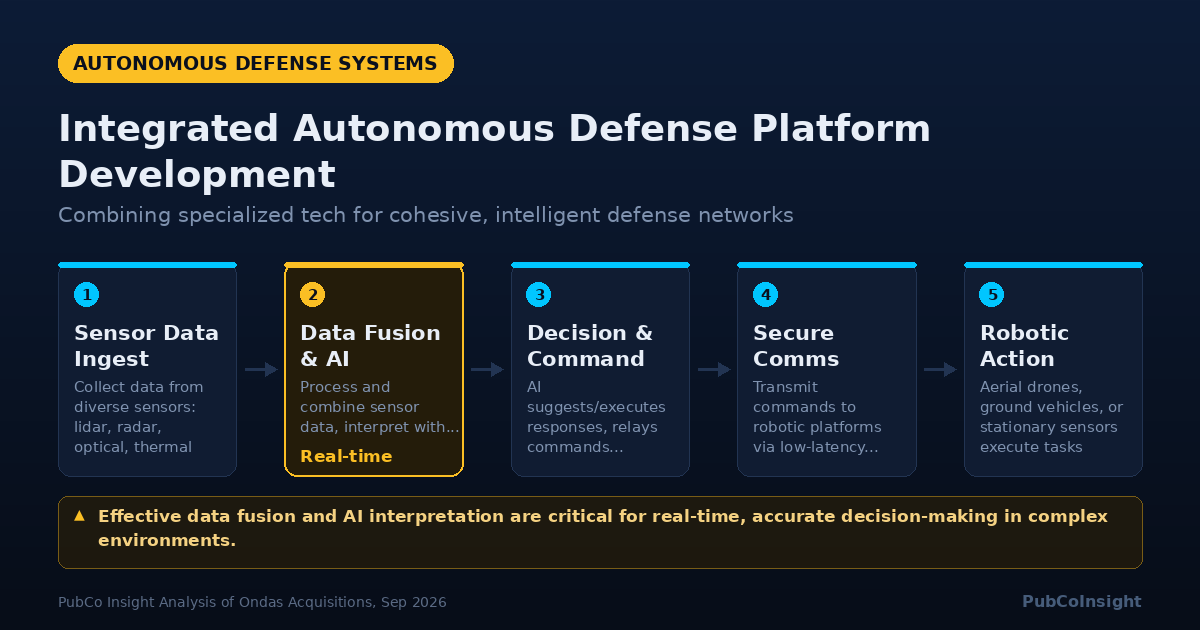
The Mechanism of Integrated Autonomous Defense
Integrated autonomous defense systems function by combining multiple specialized technologies into a cohesive, intelligent network. At its core, this involves sensor fusion, where data from various sources, like optical cameras, thermal imagers, and radar, are processed and combined to create a comprehensive operational picture. This fused data feeds into an artificial intelligence layer that interprets the information, identifies threats, and suggests or executes responses autonomously. The system then relies on secure, low-latency communication networks to relay commands to robotic platforms, whether they are aerial drones, ground vehicles, or stationary sensors. The difficulty lies in achieving true interoperability and real-time decision-making across disparate hardware and software. Each component, from the drone’s flight controller to the AI’s threat recognition algorithm, must communicate flawlessly and securely. A bottleneck often arises in data processing and transmission, especially in environments with limited bandwidth or active jamming. For these systems to matter, they must demonstrate superior speed, accuracy, and resilience compared to human-operated alternatives. Proof of their efficacy comes from successful real-world deployments, particularly in scenarios that demand rapid response and complex coordination. A failure to integrate disparate systems effectively, resulting in delayed information or miscommunication between platforms, would undermine the entire value proposition. The key is not simply having advanced components, but making them work together as a single, intelligent entity.Companies Operating in This Sector
The small and micro-cap end of autonomous security robotics and physical AI is a diverse field, with companies focusing on different aspects of the value chain. Some, like Arbe Robotics Ltd. (ARBE) at $0.672, specialize in advanced radar technology, critical for object detection and mapping in autonomous systems. Their focus on high-resolution 4D imaging radar aims to provide superior perception capabilities for both defense and commercial applications. Similarly, MicroVision, Inc. (MVIS), priced at $1.62, develops lidar solutions, another key sensor technology for autonomous navigation and object detection, emphasizing compact and high-performance units. Other companies build the AI backbones or specialized components. BigBear.ai Holdings, Inc. (BBAI), trading at $2.84, provides AI-powered analytics and decision intelligence, often for government and defense clients. Their strength lies in processing vast datasets to extract actionable insights, a crucial element for any integrated autonomous system. Kopin Corporation (KOPN), currently at $4.87, focuses on micro-displays and optical systems, which are essential for augmented reality (AR) and virtual reality (VR) applications, often used in command and control interfaces for autonomous platforms. Recent news on September 23, 2026, highlighted Fabric.AI’s patent filings for fiber-coupled and connector-free MicroLED optical interconnect developed with Kopin, indicating continued innovation in display technology. Then there are companies building and deploying the physical robots themselves. Serve Robotics Inc. (SERV), priced at $4.31, concentrates on last-mile autonomous delivery robots, a segment that, while commercial, shares underlying robotic navigation and safety technologies with security applications. Lantronix, Inc. (LTRX), trading at $6.4, offers embedded computing and networking solutions, providing the hardware and software infrastructure that enables many autonomous devices to connect and operate securely. In the drone space, Red Cat Holdings, Inc. (RCAT), at $6.59, and Unusual Machines, Inc. (UMAC), currently $22.69, are active. Red Cat focuses on drone technology, including hardware and software for various applications, while Unusual Machines also operates in the drone sector, often targeting defense and commercial uses. Their success hinges on both the performance of their aerial platforms and the integration of advanced payloads and control systems. Ondas (ONDS), at $7.4, with its recent acquisitions, is now moving more aggressively into this integrated defense systems space, attempting to combine drone platforms with the specialized defense capabilities of its newly acquired firms.Artificial Intelligence Technology Solutions, Inc.
Artificial Intelligence Technology Solutions, Inc. (AITX), trading on the OTCID tier at $0.0037, develops and leases AI-driven security robots and remote monitoring systems through a Solutions-as-a-Service model. The company aims to provide security and guarding services with cost savings ranging from 35% to 80% compared to traditional manned security. Its operations are structured around three primary pillars: stationary security devices under Robotic Assistance Devices, Inc. (RAD-I), mobile autonomous platforms under Robotic Assistance Devices Mobile (RAD-M), and the SARA agentic artificial intelligence platform under Robotic Assistance Devices Group (RAD-G). RAD-I focuses on stationary units like the ROSA, which forms the foundation of its fixed security platform. AITX’s filings indicate that RAD-I’s recurring revenue and gross margin could, on a standalone basis, support positive cash flow operations. The company has stated its belief that RAD-I has reached a point where it could achieve this. RAD-M includes mobile security units such as the ROAMEO, with early commercial deployments beginning in May 2026. Management has characterized RAD-M as having a higher revenue ceiling than stationary solutions. The SARA platform, under RAD-G, is intended to generate substantial revenue through licensing. A wholly-owned subsidiary, Robotic Assistance Devices Lanka (Private) Limited (RAD Lanka), located in Sri Lanka and operating under Port City Colombo status, supports software development, AI initiatives, and technical operations across the company’s subsidiaries. The company refers to its long-term strategy as “RAD Town,” envisioning integrated autonomous-security deployments across entire campuses or communities. For the fiscal year ended February 28, 2026, AITX reported revenue of $7,745,336, a 26% increase over the prior year. Gross profit rose 48% to $5,533,700, with gross margin expanding to approximately 71%. Operating expenses remained flat at around $17,477,097, leading to an improved loss from operations of approximately $(11,943,397). The net loss for the year was approximately $14.5 million, with an accumulated deficit of approximately $171 million as of that date. The company had negative cash flow from operating activities of $9,344,534 for the same period. While AITX has articulated a clear strategy and reported revenue growth, the public record does not yet establish a consistent path to positive cash flow from operations. The company continues to issue 8-K filings frequently, detailing operational updates and sales expansions, such as the September 23, 2026, announcement of RAD expanding a national dealer relationship with a third order, and the September 18, 2026, report on RAD expanding its higher education presence.What to watch
Investors should monitor Ondas’s integration progress with its newly acquired defense technology firms. Specifics to watch include any public statements regarding the combined product roadmaps, potential contract wins for integrated systems, and the timeline for achieving operational synergies. The market will look for concrete evidence that the $56 million investment translates into a more competitive and comprehensive offering. For Artificial Intelligence Technology Solutions, Inc., watch for continued updates on subscription counts and recurring revenue growth, particularly from its RAD-I and RAD-M segments. The company’s stated goal of RAD-I supporting positive cash flow operations is a key metric. Look for further details on the commercial deployment and revenue generation from its ROAMEO mobile security units. The frequency and content of AITX’s 8-K filings will continue to provide real-time operational updates, including new deployments and expanded dealer relationships. Across the broader sector, watch for developments in defense spending and procurement cycles. Government tenders for autonomous security and defense systems, particularly those specifying integrated solutions, will indicate market direction. Technological breakthroughs in sensor fusion, AI processing efficiency, and secure communication protocols will also be critical, as these underpin the capabilities and effectiveness of all autonomous platforms., { "label": "Data Fusion & AI", "note": "Process and combine sensor data, interpret with AI for threat ID", "metric": "Real-time" }, { "label": "Decision & Command", "note": "AI suggests/executes responses, relays commands autonomously" }, { "label": "Secure Comms", "note": "Transmit commands to robotic platforms via low-latency networks" }, { "label": "Robotic Action", "note": "Aerial drones, ground vehicles, or stationary sensors execute tasks" } ], "highlight": 1, "highlight_note": "Effective data fusion and AI interpretation are critical for real-time, accurate decision-making in complex environments.", "footnote": "PubCo Insight Analysis of Ondas Acquisitions, Sep 2026" }Companies mentioned
| Ticker | Company | Price |
|---|---|---|
| AITX client | Artificial Intelligence Technology Solutions Inc | $0.0037 |
| ARBE | Arbe Robotics Ltd. | $0.672 |
| BBAI | BigBear.ai Holdings, Inc. | $2.84 |
| KOPN | Kopin Corporation | $4.87 |
| LTRX | Lantronix, Inc. | $6.4 |
| MVIS | MicroVision, Inc. | $1.62 |
| ONDS | Ondas Inc. | $7.4 |
| RCAT | Red Cat Holdings, Inc. | $6.59 |
| SERV | Serve Robotics Inc. | $4.31 |
| UMAC | Unusual Machines, Inc. | $22.69 |
Listed alphabetically, not ranked. Prices as of 2026-09-24 and they move. Check a live quote before relying on any of this.
How we chose the companies in this article
We cover a fixed universe of companies working in autonomous security robotics, physical AI and the guarding services market they are aimed at. Every one of them that had usable market data on 2026-09-24 appears in this article. We do not pick which ones to mention based on what we think of them, and we do not order them by size, price or trading volume, because an ordered list is a verdict and that is not ours to hand down. Companies left out, and why: none. American Lithium Minerals and Artificial Intelligence Technology Solutions pay us, which is disclosed in full at the foot of every article they appear in.
See the dilution and promotion flags before you see the pitch.
Each week: the micro and small-caps now showing dilution or paid-promotion signals, with the SEC filing behind every flag. No recommendations, no price targets.
Sources used in this article
- Prediction: Nu Holdings Will Earn More Than $5 Billion in 2027 Motley Fool · 2026-09-24
- Here's What a $1,000 Investment in SpaceX Stock Could Be Worth in 5 Years Motley Fool · 2026-09-24
- 4 Risks That Could Derail the AI Trade Barrons.com · 2026-09-24
- Where Will Broadcom Stock Be in 5 Years? Motley Fool · 2026-09-24
- Hyperliquid Could Be About to Get U.S. Regulatory Approval. Is HYPE Worth Buying Now? Motley Fool · 2026-09-24
- Prediction: Here's What $10,000 Invested in AbbVie Stock With Dividends Reinvested Could Be Worth in a Decade Motley Fool · 2026-09-24
- I've Held Nvidia for Nearly 3 Years. Here's Whether I'd Still Buy Today. Motley Fool · 2026-09-24
- Why Fastly Stock Jumped Today Motley Fool · 2026-09-24
- Is an AMD Stock Split Coming Now That the Shares Have Topped $600? Motley Fool · 2026-09-24
- Anthropic Could Join the Nasdaq-100 Only 15 Trading Days After Its IPO, Just Like SpaceX Did Motley Fool · 2026-09-24
- ONDS Stock Set To Snap 4-Week Slide — Retail Bulls See Palantir-Style Play In Fresh Defense Deals Stocktwits · 2026-09-24
- Axon Enterprise (AXON) Suffers a Larger Drop Than the General Market: Key Insights Zacks · 2026-09-23
Disclosure required by Section 17(b) of the Securities Act of 1933
Artificial Intelligence Technology Solutions, Inc., a Nevada corporation (OTCID: AITX). Artificial Intelligence Technology Solutions, Inc. pays Strategic Innovations First, Inc., a Wyoming corporation doing business as PulseIR. Compensation received: USD 5,000.00 per month for months 1-3 (August, September, October 2026); USD 10,000.00 per month for months 4-6 (November, December 2026, January 2027) contingent on the 90-day review. Minimum committed USD 15,000.00; USD 45,000.00 if the second-period rate triggers.. Form of payment: cash only, invoiced monthly in advance; no stock, options or warrants received or payable. Services: investor relations services under an Investor Relations Services Agreement effective 2026-08-01. Period: six month term, 2026-08-01 through 2027-01-31; 90-day review on or about 2026-10-30. No stock, options or warrants held by PubCo Insight, Pulse IR, Strategic Innovations First, Inc., or Brad Listermann. Confirmed by the executed agreement and by board record recKwdq39X2caPSX7 (POSITIONS HELD: none).
This is information, not investment, financial, legal or tax advice. It is not a recommendation or solicitation to buy, sell or hold any security and it contains no price target. Nothing here is independently verified by us. Confirm every figure against primary filings on SEC EDGAR before you act. Micro-cap and over-the-counter securities are speculative and illiquid and can lose all of their value. The companies named without a disclosure above pay us nothing and have no relationship with us; they are named because a published, mechanical screen selected them. Full disclosure policy.