Ondas Acquires Defense Tech for $205 Million, Broadening Precision-Strike Capabilities
Ondas Inc.'s recent acquisition of GATE Technologies and Bron Technologies highlights a strategic pivot towards integrated electronic safe & arm and fuze technology, reshaping its defense market approach.
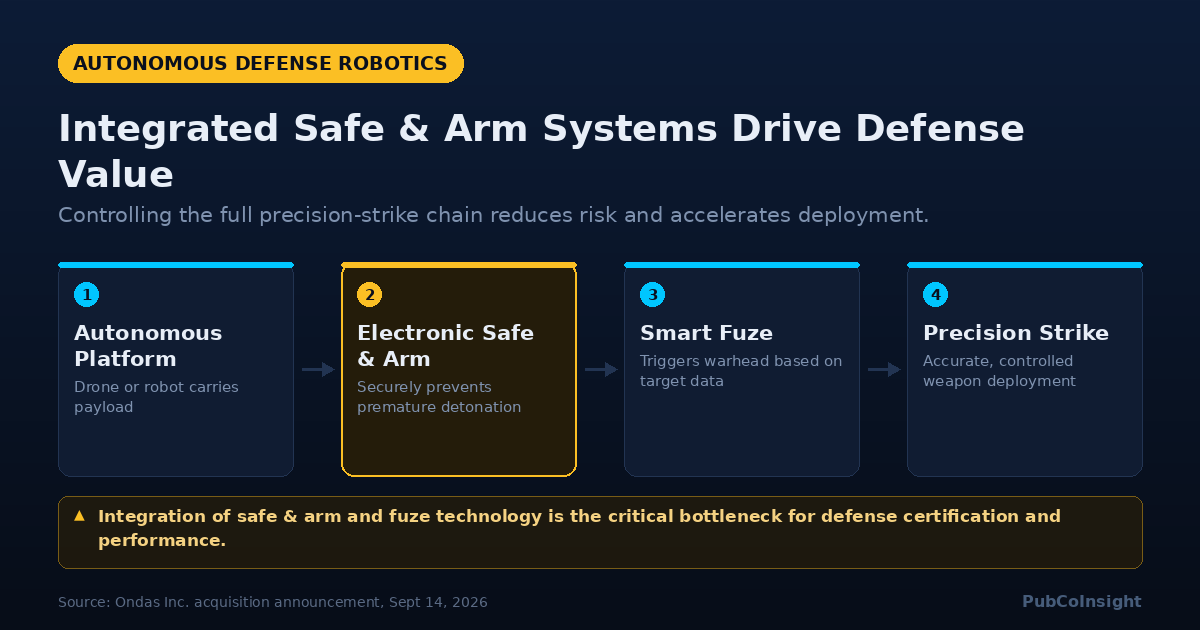
The Mechanism of Precision-Strike Integration
Precision-strike technology in autonomous systems relies on a chain of highly specialized components. The core challenge is ensuring a weapon system is inert during transport and deployment, then precisely armed and detonated only at the correct moment and location. This requires a robust electronic safe & arm (ESA) system. An ESA system physically and electronically isolates the fuze from the explosive train until all safety parameters are met. It often involves multiple, redundant interlocks, like mechanical barriers, software checks, and environmental sensors. Fuzes, the actual detonators, translate the ESA's 'arm' signal into the initiation of the warhead. Modern smart fuzes go further, incorporating sensors for target proximity, impact angle, or even specific target signatures. Integrating these two elements, ESA and fuze, under one roof allows for tighter design tolerances, enhanced security protocols, and faster iteration cycles. When a company controls both, it can optimize the communication between the arming mechanism and the fuze, reducing latency and potential points of failure. This vertical integration also streamlines certification processes, a critical bottleneck in defense contracting. Without this deep integration, a prime contractor often acts as an assembler, relying on multiple vendors, which introduces complexity and potential delays. The value sits squarely in the ability to deliver a fully integrated, certified, and reliable system, where the safe & arm and fuze components are not just compatible, but designed as a single, cohesive unit.Companies Operating in This Sector
The autonomous security robotics and physical AI sector encompasses a diverse range of companies, from those building full autonomous platforms to those specializing in critical sub-components. Ondas Inc. (ONDS), with its recent acquisition, is moving deeper into the defense component space. The company, priced at $7.23, now directly controls technologies essential for precision-strike capabilities, expanding beyond its historical focus on drone systems. This positions them as a more vertically integrated supplier for defense contractors. In the broader robotics and AI landscape, several companies focus on specific niches. Serve Robotics Inc. (SERV), trading at $4.43, primarily targets last-mile delivery with its autonomous ground robots. Their recent news has focused on overcoming restaurant integration barriers and revenue diversification strategies, with a significant short interest noted on September 13. Unusual Machines, Inc. (UMAC), currently at $22.66, has been active in strategic investments, including an additional $20 million into XTEND AI Robotics, bringing their total investment to $27.5 million. This indicates a focus on expanding their AI robotics capabilities through external partnerships and funding. Other players provide key technologies that enable autonomous operations. Arbe Robotics Ltd. (ARBE), priced at $0.739, specializes in radar solutions, recently expanding into defense and homeland security with its Alerion C-UAS Radar for drone threats. This highlights the growing demand for advanced sensing capabilities in both civilian and military autonomous systems. Kopin Corporation (KOPN), at $4.35, focuses on microdisplays and optical solutions, critical for augmented and virtual reality applications often used in controlling or interacting with advanced robotics. Lantronix, Inc. (LTRX), trading at $5.05, offers solutions for secure data access and management, essential for the connectivity and operational intelligence of autonomous fleets. MicroVision, Inc. (MVIS), at $1.63, develops lidar technology, a crucial sensor for autonomous navigation and mapping. BigBear.ai Holdings, Inc. (BBAI), priced at $2.88, provides AI-powered analytics and decision intelligence, often applied to large datasets generated by autonomous systems, particularly in defense and national security. Red Cat Holdings, Inc. (RCAT), at $7.8, operates in the drone and drone services market, with recent news noting its stock barely budged amidst other drone group movements. This indicates a focus on the operational deployment and data collection aspects of autonomous aerial systems.Artificial Intelligence Technology Solutions, Inc.
Artificial Intelligence Technology Solutions, Inc. (AITX), trading on the OTCID tier under the symbol AITX at $0.0036, develops and leases autonomous security robots and remote monitoring systems. The company operates through a Solutions-as-a-Service model, generating recurring monthly subscription revenue rather than one-off hardware sales. Its primary subsidiary, Robotic Assistance Devices, Inc. (RAD-I), targets the security and guarding services industry, estimated to be a $50 billion market in the United States. AITX claims its solutions offer cost savings between 35% and 80% compared to traditional manned security. AITX's operations are structured around three main pillars. First, stationary security devices through RAD-I, which include units like ROSA and RIO, recently going live on the Immix platform. Second, mobile autonomous platforms via Robotic Assistance Devices Mobile (RAD-M), which includes the ROAMEO mobile security unit, with early commercial deployment beginning in May 2026. Third, the company's SARA agentic artificial intelligence platform, managed by Robotic Assistance Devices Group (RAD-G). RAD-G is intended to generate revenue from SARA platform licensing. The company also maintains Robotic Assistance Devices Lanka (Private) Limited in Sri Lanka for software development, AI initiatives, and technical operations. This subsidiary operates under Port City Colombo status. AITX envisions a long-term outcome it calls "RAD Town," an integrated autonomous-security deployment across a campus, community, or jurisdiction. For the fiscal year ended February 28, 2026, AITX reported revenue of $7,745,336, a 26% increase year-over-year. Gross profit rose 48% to $5,533,700, with gross margin expanding to approximately 71%. Operating expenses remained flat at around $17,477,097, leading to an improved operating loss of $(11,943,397). The company reported a net loss of approximately $14.5 million for the period, with an accumulated deficit of approximately $171 million as of that date. Cash flow from operating activities was negative $9,344,534 for the year. As of February 28, 2026, the company had negative working capital of $17,017,745. The public record does not yet establish a clear timeline for the company to achieve positive cash flow from operations. Recent 8-K filings, including those on September 14, September 10, and September 9, 2026, detail expanding orders for RIO, ROSA, and SARA, and the integration of RAD with Circadian Risk for continuous intelligence in physical risk assessment.What to watch
Investors should monitor several concrete indicators following the Ondas acquisition. First, watch for specific defense contract awards mentioning GATE Technologies or Bron Technologies, detailing the value and scope of their contributions. Second, look for any regulatory approvals or certifications required for the newly integrated electronic safe & arm and fuze technologies, particularly from defense procurement agencies. Third, track Ondas' financial filings for any specific revenue breakdowns or guidance related to the acquired entities, especially for the fiscal quarters ending December 31, 2026, and March 31, 2027. Finally, observe any announcements regarding new product lines or joint ventures that leverage these integrated capabilities, which would confirm the strategic intent behind the acquisition., { "label": "Electronic Safe & Arm", "note": "Securely prevents premature detonation" }, { "label": "Smart Fuze", "note": "Triggers warhead based on target data" }, { "label": "Precision Strike", "note": "Accurate, controlled weapon deployment" } ], "highlight": 1, "highlight_note": "Integration of safe & arm and fuze technology is the critical bottleneck for defense certification and performance.", "footnote": "Source: Ondas Inc. acquisition announcement, Sept 14, 2026" }Companies mentioned
| Ticker | Company | Price |
|---|---|---|
| AITX client | Artificial Intelligence Technology Solutions Inc | $0.0036 |
| ARBE | Arbe Robotics Ltd. | $0.739 |
| BBAI | BigBear.ai Holdings, Inc. | $2.88 |
| KOPN | Kopin Corporation | $4.35 |
| LTRX | Lantronix, Inc. | $5.05 |
| MVIS | MicroVision, Inc. | $1.63 |
| ONDS | Ondas Inc. | $7.23 |
| RCAT | Red Cat Holdings, Inc. | $7.8 |
| SERV | Serve Robotics Inc. | $4.43 |
| UMAC | Unusual Machines, Inc. | $22.66 |
Listed alphabetically, not ranked. Prices as of 2026-09-15 and they move. Check a live quote before relying on any of this.
How we chose the companies in this article
We cover a fixed universe of companies working in autonomous security robotics, physical AI and the guarding services market they are aimed at. Every one of them that had usable market data on 2026-09-15 appears in this article. We do not pick which ones to mention based on what we think of them, and we do not order them by size, price or trading volume, because an ordered list is a verdict and that is not ours to hand down. Companies left out, and why: none. American Lithium Minerals and Artificial Intelligence Technology Solutions pay us, which is disclosed in full at the foot of every article they appear in.
See the dilution and promotion flags before you see the pitch.
Each week: the micro and small-caps now showing dilution or paid-promotion signals, with the SEC filing behind every flag. No recommendations, no price targets.
Sources used in this article
- Chip Stocks Sink on AI Slowdown Calls, But Analysts Doubt a Crash Is Near BeInCrypto · 2026-09-15
- Softbank Group shares rebound as data center unit SB Energy pushes ahead with IPO Investing.com · 2026-09-15
- Arm Stock Is Down More Than 40%. Here's Why I'm Staying on the Sidelines. Motley Fool · 2026-09-15
- 3 AI Robotics Stocks Worth Owning Over Tesla Right Now Motley Fool · 2026-09-15
- What Does Lumentum Holdings (LITE) Mean For Investors After The LITEON Token Launch? Simply Wall St. · 2026-09-15
- Prediction: Micron Stock Will Hit $1,250 After Sept. 30 Motley Fool · 2026-09-15
- Donald Trump Rejects Calls For AI Slowdown. That Changes the Game for Nvidia and AMD Insider Monkey · 2026-09-15
- Why Micron, Intel, AMD, and Other Chip Stocks Fell Today Motley Fool · 2026-09-15
- AI Slowdown Debate Splits Tech CEOs: Nvidia, Broadcom Dismiss Any Threat While Elon Musk Calls For Peer Review System Stocktwits · 2026-09-15
- Meet This Eventual Member of the $1 Trillion Club. The Stock Trades Below 15x Forward Earnings and Is Not a Pure-Play Artificial Intelligence (AI) Stock. Motley Fool · 2026-09-15
- Are Investors Undervaluing ADT (ADT) Right Now? Zacks · 2026-09-14
- ADT Brings ADT Blu to Walmart.com, Expanding Availability Through One of the Nation’s Largest Online Retailers GlobeNewswire · 2026-09-14
Disclosure required by Section 17(b) of the Securities Act of 1933
Artificial Intelligence Technology Solutions, Inc., a Nevada corporation (OTCID: AITX). Artificial Intelligence Technology Solutions, Inc. pays Strategic Innovations First, Inc., a Wyoming corporation doing business as PulseIR. Compensation received: USD 5,000.00 per month for months 1-3 (August, September, October 2026); USD 10,000.00 per month for months 4-6 (November, December 2026, January 2027) contingent on the 90-day review. Minimum committed USD 15,000.00; USD 45,000.00 if the second-period rate triggers.. Form of payment: cash only, invoiced monthly in advance; no stock, options or warrants received or payable. Services: investor relations services under an Investor Relations Services Agreement effective 2026-08-01. Period: six month term, 2026-08-01 through 2027-01-31; 90-day review on or about 2026-10-30. No stock, options or warrants held by PubCo Insight, Pulse IR, Strategic Innovations First, Inc., or Brad Listermann. Confirmed by the executed agreement and by board record recKwdq39X2caPSX7 (POSITIONS HELD: none).
This is information, not investment, financial, legal or tax advice. It is not a recommendation or solicitation to buy, sell or hold any security and it contains no price target. Nothing here is independently verified by us. Confirm every figure against primary filings on SEC EDGAR before you act. Micro-cap and over-the-counter securities are speculative and illiquid and can lose all of their value. The companies named without a disclosure above pay us nothing and have no relationship with us; they are named because a published, mechanical screen selected them. Full disclosure policy.