Ondas Shifts Focus to Organic Growth Amidst $1.1 Billion 2027 Revenue Target
Ondas Holdings CEO's recent announcement signals a strategic pivot from aggressive M&A to internal development and optimization, impacting the competitive landscape for autonomous security robotics and guarding services.
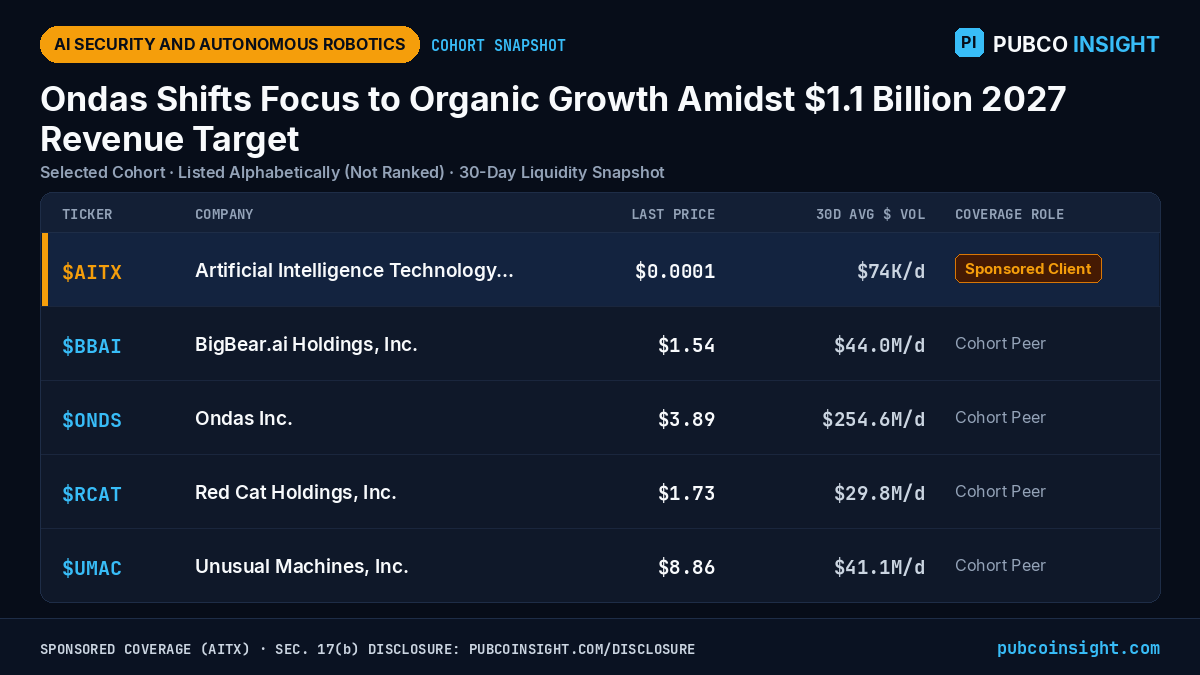
The Mechanism of Scaling Autonomous Security
Autonomous security robots, whether ground-based or aerial, operate on a core principle: replacing or augmenting human patrols with machine efficiency. This efficiency comes from persistent monitoring, predictable routes, and the ability to integrate diverse sensor data. Scaling these operations involves several critical steps. First, the hardware must be robust enough for continuous, often outdoor, deployment. Second, the AI must be sophisticated enough to accurately detect anomalies, differentiate threats from benign events, and minimize false positives. This requires extensive training data and iterative refinement of detection algorithms. Third, integration with existing security infrastructure, like access control systems and human guarding teams, is essential. A robot that cannot seamlessly hand off an alert to a human operator or communicate with a central command center is merely a standalone novelty. The primary constraint in scaling is not hardware production, but the deployment and operationalization of these units in diverse, real-world environments. Each new site, whether a correctional facility, a logistics hub, or a corporate campus, presents unique challenges: varied terrain, specific security protocols, and integration with different network architectures. The value sits in the recurring revenue model, where a company leases or subscribes out its robots, moving from a capital expenditure model for the customer to an operational expenditure. This shifts the burden of maintenance and upgrades to the provider, but also creates a predictable revenue stream. Proving this model wrong would involve widespread customer dissatisfaction with robot performance, high maintenance costs eroding margins, or a failure to demonstrate clear ROI compared to traditional guarding services.Operators in the Autonomous Security Sector
The autonomous security and physical AI sector features a range of companies tackling different parts of the ecosystem. In the realm of physical robotics for security, Artificial Intelligence Technology Solutions, Inc. (AITX) focuses on autonomous security robots and remote monitoring systems. Their model is based on recurring monthly subscriptions, not one-off hardware sales. Serve Robotics Inc. (SERV) operates in a related but distinct niche, primarily focusing on autonomous last-mile delivery robots, though the underlying navigation and AI technologies share common ground with security applications. For aerial systems and drone operations, Red Cat Holdings, Inc. (RCAT) develops and supplies drones, including those for defense and public safety applications. Their focus on drone-based solutions offers a different perspective on autonomous patrolling and surveillance compared to ground-based units. Ondas Inc. (ONDS), the company at the center of this strategic shift, operates both in industrial drone solutions and mission-critical private wireless networks. Their recent announcement to slow acquisitions and focus on organic growth suggests a deeper integration and optimization of their existing drone and network assets. Unusual Machines, Inc. (UMAC) also operates in the drone space, with a recent investor day scheduled for December 3, 2026, indicating ongoing development and market engagement. Beyond the physical robots, the intelligence layer is crucial. Arbe Robotics Ltd. (ARBE) specializes in high-resolution 4D imaging radar solutions, primarily for automotive applications, but this core technology is vital for autonomous navigation and object detection in any robotic system. Their Q3 2026 earnings call highlighted a "Landmark Level 3 Win in China," demonstrating traction for their radar technology. MicroVision, Inc. (MVIS) also develops lidar technology, another key sensor for autonomous navigation and environmental mapping, crucial for robots operating in complex environments. Other players provide broader AI and data analytics capabilities that support autonomous systems. BigBear.ai Holdings, Inc. (BBAI) offers AI-powered analytics and decision intelligence, applicable across various sectors, including defense and national security, which can inform the deployment and effectiveness of autonomous security platforms. Lantronix, Inc. (LTRX) provides secure data access and management solutions, essential for connecting and managing fleets of autonomous robots and their data streams. Kopin Corporation (KOPN) focuses on microdisplays and optical solutions, with applications in soldier vision and training, which could feed into advanced human-robot teaming interfaces or augmented reality for security personnel.Artificial Intelligence Technology Solutions, Inc.
Artificial Intelligence Technology Solutions, Inc. (AITX) trades on the OTCID tier under the ticker AITX. The company, through its subsidiaries, builds and leases autonomous security robots and remote monitoring systems. Their business model emphasizes a recurring monthly subscription service for these devices, rather than outright sales. This approach shifts the financial commitment for customers from a capital expenditure to an operational one, with AITX responsible for maintenance and upgrades. The company’s recent activities include the deployment of its ROAMEO autonomous security robot at a corrections facility for a 30-day trial, as announced on November 23, 2026. This deployment aims to challenge the high costs associated with traditional corrections patrols. Such trials are critical for demonstrating the practical application and cost-effectiveness of their robotic solutions in demanding environments. AITX's financial filings provide a detailed picture of its operational status. The August 31, 2026, unaudited consolidated financial statements indicate negative cash flow from operating activities of $4,820,842 for the six months ended that date. The company reported an accumulated deficit of $184,084,880 and negative working capital of $55,894,870 as of August 31, 2026. Management does not anticipate positive cash flow from operations in the near future. These factors raise substantial doubt about the company's ability to continue as a going concern for the twelve months following the issuance of these statements. Management has outlined plans to address the financial situation, including ongoing efforts to raise funds. On June 23, 2026, AITX entered into an equity financing agreement for up to $10,000,000 of common stock purchases over three years, with approximately $9.8 million remaining under this arrangement. The company intends to continue funding operations through growing revenues, equity proceeds, and issuing debt. As of August 31, 2026, AITX reported cash of $220,275, accounts receivable of $947,146, and revenue-earning devices, net of depreciation, valued at $4,677,987. Total current liabilities stood at $58,906,967. The public record does not yet establish a clear timeline for achieving positive operational cash flow or for fully repaying its debt obligations without further dilutive financing. The company continues to incur expenses related to core development projects, including those with a partially owned research and development company.What to watch
The shift by Ondas (ONDS) to organic growth means attention will turn to their execution on the stated $1.1 billion 2027 revenue target. Look for detailed breakdowns in future earnings calls regarding the specific segments driving this growth. For Unusual Machines (UMAC), the investor day scheduled for December 3, 2026, is a key event. Details emerging from this presentation could shed light on their strategic direction and product roadmap. Artificial Intelligence Technology Solutions (AITX) has several ongoing factors to monitor. The 30-day trial deployment of ROAMEO at the corrections facility, announced November 23, 2026, will conclude around December 23, 2026. A definitive announcement regarding the trial's outcome, potential contract awards, or further deployments would be significant. Additionally, watch for any updates on their financing efforts, particularly the utilization of the remaining $9.8 million under the equity financing agreement. For Arbe Robotics (ARBE), continued updates on their "Landmark Level 3 Win in China" and further commercial traction for their 4D imaging radar technology will be important. Their Q3 2026 earnings call already highlighted this, and subsequent filings or press releases detailing specific deployments or customer wins would confirm momentum. In the broader market, watch for any new government tenders or large-scale private sector contracts for autonomous security solutions. These contracts often serve as bellwethers for market adoption and can provide insights into preferred technologies and deployment models.Companies mentioned
| Ticker | Company | Price |
|---|---|---|
| AITX client | Artificial Intelligence Technology Solutions Inc | $0.0001 |
| ARBE | Arbe Robotics Ltd. | $0.32 |
| BBAI | BigBear.ai Holdings, Inc. | $1.54 |
| KOPN | Kopin Corporation | $2.58 |
| LTRX | Lantronix, Inc. | $3.67 |
| MVIS | MicroVision, Inc. | $0.86 |
| ONDS | Ondas Inc. | $3.89 |
| RCAT | Red Cat Holdings, Inc. | $1.725 |
| SERV | Serve Robotics Inc. | $2.28 |
| UMAC | Unusual Machines, Inc. | $8.86 |
Listed alphabetically, not ranked. Prices as of 2026-11-25 and they move. Check a live quote before relying on any of this.
How we chose the companies in this article
We cover a fixed universe of companies working in autonomous security robotics, physical AI and the guarding services market they are aimed at. Every one of them that had usable market data on 2026-11-25 appears in this article. We do not pick which ones to mention based on what we think of them, and we do not order them by size, price or trading volume, because an ordered list is a verdict and that is not ours to hand down. Companies left out, and why: none. American Lithium Minerals and Artificial Intelligence Technology Solutions pay us, which is disclosed in full at the foot of every article they appear in.
See the dilution and promotion flags before you see the pitch.
Each week: the micro and small-caps now showing dilution or paid-promotion signals, with the SEC filing behind every flag. No recommendations, no price targets.
Sources used in this article
- Nvidia shares fall 5% premarket after Huang return rally wanes Investing.com · 2026-11-25
- Semiconductor Stocks Are Sinking. These 2 AI Chip Stocks Could Make You Richer on the Rebound. Motley Fool · 2026-11-25
- Jack Bogle Told Investors to Own the Market ‘Warts and All.’ Then Nvidia Soared 31% and Moved a 68-Year-Old’s $1 Million S&P 500 Index Fund by $16,000 in a Day 24/7 Wall St. · 2026-11-25
- Michael Burry Sells Remaining Nasdaq-100 Puts, Eyes Fresh Nvidia Short Near $200: ‘I Am Long Undervalued Common Stocks’ Stocktwits · 2026-11-25
- Update: Nvidia's Huang Reportedly Apologizes to Staff, Says He Is in Therapy MT Newswires · 2026-11-25
- Stock market today: Dow, S&P 500, Nasdaq futures fall ahead of inflation data Yahoo Finance · 2026-11-25
- Should You Buy Oracle Stock After Its 53% Collapse? The Answer Might Shock You. Motley Fool · 2026-11-25
- Nvidia stock stumbles again after Jensen Huang's spectacular comeback rally Yahoo Finance · 2026-11-25
- Alice Huang-linked firms listed $270 million in AI servers in China: report NY Post · 2026-11-25
- Why Trump wanted Jensen Huang back at the helm of Nvidia Yahoo Finance · 2026-11-25
- Axon Enterprise vs. Palantir Technologies: Which Law Enforcement Stock Is a Better Buy for 2027? Motley Fool · 2026-11-24
- Are You Overpaying For Axon Stock Versus Its Peers? Trefis · 2026-11-24
Disclosure required by Section 17(b) of the Securities Act of 1933
Artificial Intelligence Technology Solutions, Inc., a Nevada corporation (OTCID: AITX). Artificial Intelligence Technology Solutions, Inc. pays Strategic Innovations First, Inc., a Wyoming corporation doing business as PulseIR. Compensation received: USD 5,000.00 per month for months 1-3 (August, September, October 2026); USD 10,000.00 per month for months 4-6 (November, December 2026, January 2027) contingent on the 90-day review. Minimum committed USD 15,000.00; USD 45,000.00 if the second-period rate triggers.. Form of payment: cash only, invoiced monthly in advance; no stock, options or warrants received or payable. Services: investor relations services under an Investor Relations Services Agreement effective 2026-08-01. Period: six month term, 2026-08-01 through 2027-01-31; 90-day review on or about 2026-10-30. No stock, options or warrants held by PubCo Insight, Pulse IR, Strategic Innovations First, Inc., or Brad Listermann. Confirmed by the executed agreement and by board record recKwdq39X2caPSX7 (POSITIONS HELD: none).
This is information, not investment, financial, legal or tax advice. It is not a recommendation or solicitation to buy, sell or hold any security and it contains no price target. Nothing here is independently verified by us. Confirm every figure against primary filings on SEC EDGAR before you act. Micro-cap and over-the-counter securities are speculative and illiquid and can lose all of their value. The companies named without a disclosure above pay us nothing and have no relationship with us; they are named because a published, mechanical screen selected them. Full disclosure policy.