Ondas and Palantir Launch Regna AI for Sovereign Defense Missions
The partnership between Ondas and Palantir to create Regna AI signals a focused push into defense-specific AI, potentially reshaping the competitive landscape for autonomous security and physical AI in military applications.
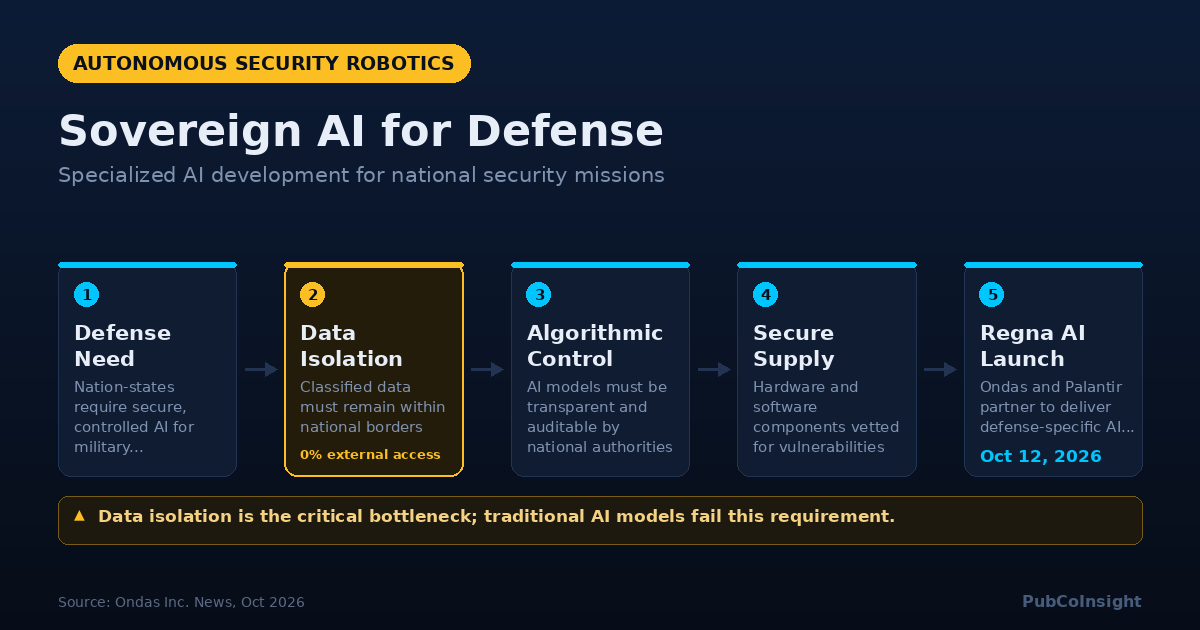
The Mechanism of Sovereign AI in Defense
Sovereign AI, in the context of defense, means an artificial intelligence system designed and operated under the direct control and jurisdiction of a specific nation-state. Its data, algorithms, and infrastructure are isolated from foreign influence or access. This isolation is critical for national security. It prevents espionage, sabotage, or the unauthorized use of sensitive intelligence. The core challenge lies in data provenance and algorithmic transparency. Defense applications generate vast amounts of classified data. This data must be processed and analyzed without leaving national borders or being exposed to external entities. Traditional cloud-based AI solutions, often relying on global infrastructure, are unsuitable for this. Sovereign AI requires dedicated, on-premise or nationally controlled cloud environments. The algorithms themselves must be auditable. Military commands need to understand how an AI system arrives at its decisions, especially in critical applications like target identification or threat assessment. Black-box AI models, common in commercial applications, are generally unacceptable. Furthermore, the supply chain for hardware and software components must be secure. This means vetting every chip, sensor, and line of code for potential backdoors or vulnerabilities. Building such a system demands deep integration between hardware, software, and national security protocols. It is not just about building a powerful AI, but building a powerful AI that is demonstrably trustworthy and controllable within a specific national context. A failure in data isolation, algorithmic transparency, or supply chain integrity would render the entire system unusable for defense.Companies Operating in This Sector
The autonomous security and physical AI sector sees a range of companies developing solutions for various applications, from commercial guarding to specialized defense. Ondas Inc. (ONDS), for example, has focused on drone and autonomous system solutions. Its partnership with Palantir to create Regna AI specifically targets sovereign AI capabilities for defense. This marks a clear expansion into a more secure, government-centric AI market. Ondas also recently secured EASA certification for an advanced missile protection system on the Bombardier Global 7500, indicating its work in airborne defense technologies. Other companies are building the foundational technologies that underpin these autonomous systems. Kopin Corporation (KOPN) develops microdisplays and optical systems, critical components for augmented and virtual reality devices often used in advanced robotics and soldier systems. Kopin recently secured an $18.6 million US Army contract for its color MicroLED technology, showing direct involvement in military hardware. MicroVision, Inc. (MVIS) focuses on lidar technology, essential for autonomous navigation and object detection in robotics, providing the "eyes" for many of these systems. Arbe Robotics Ltd. (ARBE) also specializes in imaging radar, another key sensor technology for autonomous vehicles and robots, offering high-resolution perception in challenging conditions. In the broader AI and data analytics space, BigBear.ai Holdings, Inc. (BBAI) provides AI-powered analytics and decision intelligence, often for government and defense clients. Their work involves processing complex data sets to provide actionable insights, which complements the development of autonomous platforms. Lantronix, Inc. (LTRX) offers secure data access and management solutions, crucial for connecting and controlling distributed autonomous assets while maintaining data integrity. Companies like Red Cat Holdings, Inc. (RCAT) are engaged in drone technology, including defense applications. Red Cat's FPV (First Person View) drones are used for training and reconnaissance, a segment that could integrate advanced AI for enhanced mission capabilities. Serve Robotics Inc. (SERV) operates in the autonomous delivery robot market, a different facet of physical AI focused on commercial logistics, but its core robotics and navigation technologies share common ground with security applications. Unusual Machines, Inc. (UMAC) is also active in AI robotics, with its CEO recently appointed as Chairman of XTI Aerospace, suggesting a focus on integrating AI into advanced aerial platforms.Artificial Intelligence Technology Solutions, Inc.
Artificial Intelligence Technology Solutions, Inc. (AITX) operates through its subsidiaries, developing and leasing autonomous security robots and remote monitoring systems. The company generates revenue primarily through a recurring monthly subscription model for its "Solutions-as-a-Service." This model contrasts with one-off hardware sales. AITX’s operations are structured around three main pillars. Robotic Assistance Devices, Inc. (RAD-I) focuses on stationary security devices. This subsidiary markets its AI-driven solutions to the security and guarding services industry, a market estimated at $50 billion in the United States. AITX states its solutions aim for cost savings between 35% and 80% compared to traditional manned security. Robotic Assistance Devices Mobile (RAD-M) develops mobile autonomous platforms, including the ROAMEO unit, which began early commercial deployment in May 2026. The third pillar, Robotic Assistance Devices Group (RAD-G), handles the SARA agentic artificial intelligence platform, which AITX intends to license. The company also maintains Robotic Assistance Devices Lanka (Private) Limited (RAD Lanka) in Sri Lanka, which supports software development, AI initiatives, and technical operations. AITX's filings indicate a long-term vision they term "RAD Town," aiming for integrated autonomous security deployments across campuses, communities, or larger jurisdictions. For the fiscal year ended February 28, 2026, AITX reported revenue of $7,745,336, a 26% increase year-over-year. Gross profit rose 48% to $5,533,700, with gross margin expanding to approximately 71%. Operating expenses remained flat at around $17,477,097, leading to an improved loss from operations of $(11,943,397). The company reported a net loss of approximately $14.5 million for the fiscal year. As of February 28, 2026, AITX had an accumulated deficit of approximately $171 million and negative working capital of $17,017,745. The company's independent registered public accounting firm included an explanatory paragraph in its report expressing substantial doubt about its ability to continue as a going concern. AITX recently announced another municipal customer, with a seven-unit ROSA order on October 14. The public record does not yet establish the long-term financial impact of the RAD-M mobile unit deployments or the SARA platform licensing model.What to watch
Investors should monitor several specific developments. The initial deployments and contract awards for Regna AI will show the immediate impact of the Ondas-Palantir partnership. Look for announcements on specific defense contracts or pilot programs, including the agencies involved and the scope of work. For Kopin Corporation (KOPN), the progress and follow-on orders related to its $18.6 million US Army contract for color MicroLED technology will indicate its continued penetration into military hardware supply chains. Any further federal contract wins for Axon Enterprise (AXON), as noted on October 17, are relevant for the broader defense and public safety robotics market. Regarding Artificial Intelligence Technology Solutions, Inc. (AITX), watch for updates on the commercial deployment of its ROAMEO mobile security units and any announced licensing agreements for its SARA agentic AI platform. These developments would provide concrete evidence of revenue generation from its newer initiatives. Also, observe any changes in its recurring monthly subscription revenue figures, as reported in future quarterly filings, to track the growth of its core Solutions-as-a-Service model., { "label": "Data Isolation", "note": "Classified data must remain within national borders", "metric": "0% external access" }, { "label": "Algorithmic Control", "note": "AI models must be transparent and auditable by national authorities" }, { "label": "Secure Supply Chain", "note": "Hardware and software components vetted for vulnerabilities" }, { "label": "Regna AI Launch", "note": "Ondas and Palantir partner to deliver defense-specific AI solutions", "metric": "Oct 12, 2026" } ], "highlight": 1, "highlight_note": "Data isolation is the critical bottleneck; traditional AI models fail this requirement.", "footnote": "Source: Ondas Inc. News, Oct 2026" }Companies mentioned
| Ticker | Company | Price |
|---|---|---|
| AITX client | Artificial Intelligence Technology Solutions Inc | $0.0016 |
| ARBE | Arbe Robotics Ltd. | $0.46 |
| BBAI | BigBear.ai Holdings, Inc. | $2.16 |
| KOPN | Kopin Corporation | $3.29 |
| LTRX | Lantronix, Inc. | $5.61 |
| MVIS | MicroVision, Inc. | $1.13 |
| ONDS | Ondas Inc. | $6.04 |
| RCAT | Red Cat Holdings, Inc. | $4.72 |
| SERV | Serve Robotics Inc. | $3.23 |
| UMAC | Unusual Machines, Inc. | $16.31 |
Listed alphabetically, not ranked. Prices as of 2026-10-17 and they move. Check a live quote before relying on any of this.
How we chose the companies in this article
We cover a fixed universe of companies working in autonomous security robotics, physical AI and the guarding services market they are aimed at. Every one of them that had usable market data on 2026-10-17 appears in this article. We do not pick which ones to mention based on what we think of them, and we do not order them by size, price or trading volume, because an ordered list is a verdict and that is not ours to hand down. Companies left out, and why: none. American Lithium Minerals and Artificial Intelligence Technology Solutions pay us, which is disclosed in full at the foot of every article they appear in.
See the dilution and promotion flags before you see the pitch.
Each week: the micro and small-caps now showing dilution or paid-promotion signals, with the SEC filing behind every flag. No recommendations, no price targets.
Sources used in this article
- Axon Stock In Focus After Federal Contract Wins Simply Wall St. · 2026-10-17
- Social Security's 2027 Cost-of-Living Adjustment (COLA) Is 3.6%. Here's How That Compares With Today's Best High-Yield Savings Rates. Motley Fool · 2026-10-17
- Missed Out On Micron and Sandisk? Make Sure You Don't Miss Out On This Memory Stock. Motley Fool · 2026-10-17
- 1 Stat That Makes Walt Disney (DIS) Hard to Ignore This October Motley Fool · 2026-10-17
- CoreWeave Stock Faces A Debt Funding Test Simply Wall St. · 2026-10-17
- Could Shopify Stock Repeat Amazon's Run Since 2007? Motley Fool · 2026-10-17
- As AI Supercharges Hackers, Cybersecurity Stocks Split Into Platforms and Point Solutions Motley Fool · 2026-10-17
- TSMC Says AI Chip Demand Is Still Far Above What It Can Supply. That's Why I'd Buy Nvidia Stock. Motley Fool · 2026-10-17
- Should You Buy Qualcomm Stock For Its Cash? Trefis · 2026-10-17
- Elon Musk’s Roadster, Nvidia’s Space AI Push, Nadella’s Security Warning: Mag 7 Voices This Week Stocktwits · 2026-10-17
- Tesla’s Flying Roadster Has Wall Street Talking About SpaceX, Not Cars Motley Fool · 2026-10-17
- Is Axon (AXON) a Buy as Wall Street Analysts Look Optimistic? Zacks · 2026-10-16
Disclosure required by Section 17(b) of the Securities Act of 1933
Artificial Intelligence Technology Solutions, Inc., a Nevada corporation (OTCID: AITX). Artificial Intelligence Technology Solutions, Inc. pays Strategic Innovations First, Inc., a Wyoming corporation doing business as PulseIR. Compensation received: USD 5,000.00 per month for months 1-3 (August, September, October 2026); USD 10,000.00 per month for months 4-6 (November, December 2026, January 2027) contingent on the 90-day review. Minimum committed USD 15,000.00; USD 45,000.00 if the second-period rate triggers.. Form of payment: cash only, invoiced monthly in advance; no stock, options or warrants received or payable. Services: investor relations services under an Investor Relations Services Agreement effective 2026-08-01. Period: six month term, 2026-08-01 through 2027-01-31; 90-day review on or about 2026-10-30. No stock, options or warrants held by PubCo Insight, Pulse IR, Strategic Innovations First, Inc., or Brad Listermann. Confirmed by the executed agreement and by board record recKwdq39X2caPSX7 (POSITIONS HELD: none).
This is information, not investment, financial, legal or tax advice. It is not a recommendation or solicitation to buy, sell or hold any security and it contains no price target. Nothing here is independently verified by us. Confirm every figure against primary filings on SEC EDGAR before you act. Micro-cap and over-the-counter securities are speculative and illiquid and can lose all of their value. The companies named without a disclosure above pay us nothing and have no relationship with us; they are named because a published, mechanical screen selected them. Full disclosure policy.