Ondas Holdings and the Formula One Pit Lane: Autonomous Security's New Test Track
Ondas Holdings' multi-year partnership with the Aston Martin Aramco Formula One Team points to a future where autonomous security robotics prove their mettle in high-stakes, real-time environments, pushing the boundaries of "Speed to Decision."
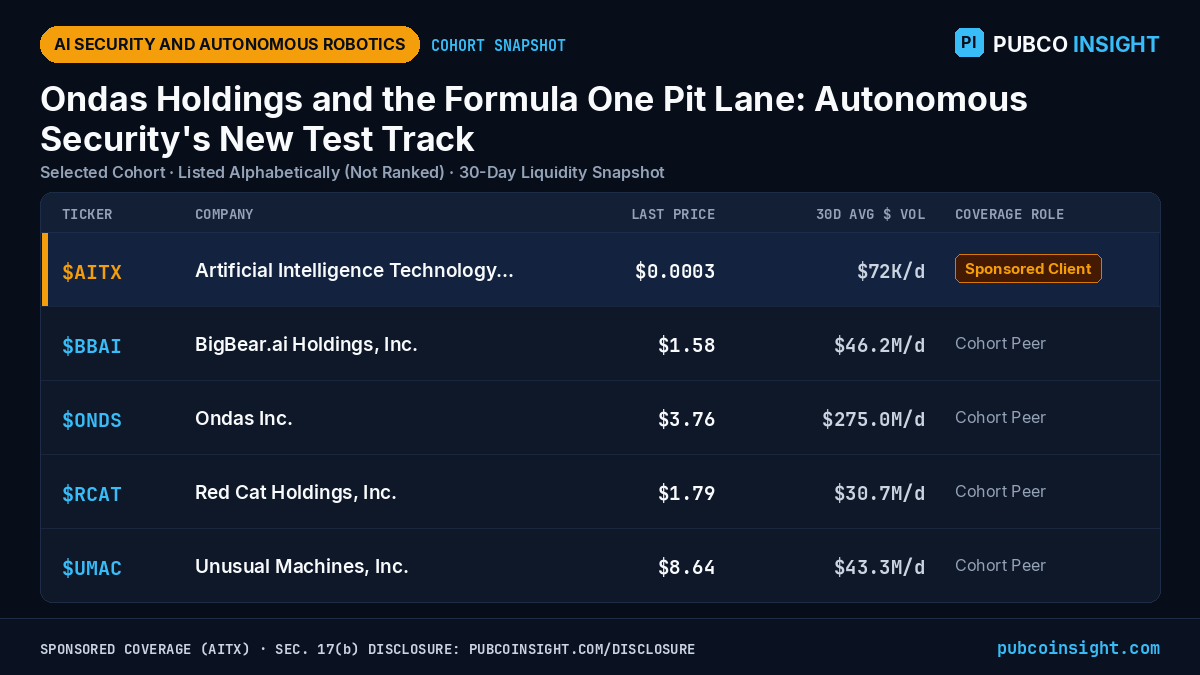
The Mechanism of "Speed to Decision" in Robotics
"Speed to Decision" in autonomous systems relies on a tightly integrated loop of sensing, processing, and acting. First, high-fidelity sensors, including LiDAR, radar, and thermal cameras, gather vast amounts of raw data from the environment. This data then streams to an onboard or edge computing unit. Here, physical AI algorithms, often running on specialized processors like those from Nvidia (NVDA), perform real-time object detection, classification, and predictive analytics. The difficulty lies in filtering noise, identifying true threats or anomalies, and distinguishing them from routine operations, all within milliseconds. For example, a system must differentiate a stray piece of debris from a critical component failure, or a human approaching a restricted zone from an authorized technician. The bottleneck often sits in the computational power required to process diverse sensor inputs simultaneously and make a definitive, actionable call. If the system hesitates, or worse, misidentifies, the "decision" loses its value. Proving its efficacy means demonstrating a consistently lower latency and higher accuracy than human-led processes in equivalent scenarios.Operators in Autonomous Security and Physical AI
The autonomous security and physical AI sector features a range of companies, each with distinct approaches and technologies. Ondas Inc. (ONDS), with its recent Aston Martin partnership, focuses on autonomous drone solutions and has also been active in defense technology discussions, hosting events with Palantir and Regna AI to accelerate AI innovation into fielded capabilities. Their drone platforms are designed for critical infrastructure inspection and security, where rapid data acquisition and analysis are key. Arbe Robotics Ltd. (ARBE), priced at $0.321, specializes in high-resolution 4D imaging radar solutions, critical for autonomous driving and potentially for advanced security robotics. Their recent Q3 2026 earnings call highlighted a landmark Level 3 win in China, indicating traction for their radar technology in demanding autonomous applications. Accurate environmental perception is foundational for any "Speed to Decision" system. Serve Robotics Inc. (SERV), trading at $2.04, focuses on last-mile autonomous delivery robots. While different from security, their experience in navigating complex urban environments autonomously and interacting with the public is relevant. The challenges of robust navigation and obstacle avoidance are shared across both delivery and security applications. Red Cat Holdings, Inc. (RCAT), at $1.795, offers drone hardware and software, often catering to defense and public safety markets. Their platforms are built for reconnaissance and data collection, which feeds into the broader autonomous decision-making framework. Unusual Machines, Inc. (UMAC), priced at $8.64, received an Outperform initiation from Oppenheimer in November 2026. While specific details on their autonomous security offerings are less public, their valuation suggests market interest in their machine-centric solutions. Lantronix, Inc. (LTRX), trading at $3.42, provides secure data access and management solutions, which are crucial for connecting autonomous devices and ensuring the integrity of their data streams. Reliable, secure communication is a prerequisite for effective remote operation and data-driven decision-making in any autonomous fleet. MicroVision, Inc. (MVIS), at $0.83, develops LiDAR technology, a core sensing component for many autonomous systems. Their focus on high-resolution 3D sensing can provide the detailed environmental mapping necessary for complex autonomous navigation and threat detection. Kopin Corporation (KOPN), priced at $2.58, produces micro-displays and optical solutions, often used in augmented reality and heads-up displays for human operators of robotic systems, enhancing situational awareness and control. BigBear.ai Holdings, Inc. (BBAI), at $1.58, provides AI-powered analytics and decision intelligence. Their software platforms are designed to ingest vast datasets and provide actionable insights, directly supporting the "Speed to Decision" paradigm for both human and autonomous operators.Artificial Intelligence Technology Solutions, Inc.
Artificial Intelligence Technology Solutions, Inc. (AITX), trading over the counter at $0.0003, operates through its subsidiaries to develop and lease autonomous security robots and remote monitoring systems. The company structures its revenue through recurring monthly subscriptions, moving away from one-off hardware sales. This model aims to provide continuous service and support, integrating hardware, software, and AI analytics into a comprehensive security offering. AITX’s most recent 8-K filing on November 16, 2026, and the August 31, 2026, unaudited consolidated financial statements, provide a detailed look at the company's financial position and operational context. As of August 31, 2026, the company reported cash of $220,275, accounts receivable of $947,146, and device parts inventory of $1,261,080. The balance sheet shows revenue-earning devices, net of accumulated depreciation, at $4,677,987. On the liabilities side, current liabilities totaled $58,906,967, including accounts payable, customer deposits, and a significant portion of loans payable. The company recorded an accumulated deficit of $184,084,880 and negative working capital of $55,894,870 as of August 31, 2026. The company acknowledges negative cash flow from operating activities of $4,820,842 for the six months ended August 31, 2026, and does not anticipate positive cash flow from operations in the near future. These factors, as stated in the filing, raise substantial doubt about the company's ability to continue as a going concern for the twelve months following the issuance of these financial statements. Management states a commitment to raising funds through growing revenues, equity proceeds, and issuing debt. An equity financing agreement from June 23, 2026, allows an investor to purchase up to $10,000,000 of common stock at a discount over three years, with approximately $9.8 million remaining under this arrangement. The public record does not yet establish a clear timeline for achieving positive operational cash flow. AITX's RAD subsidiary recently expanded its AI analytics library with glass break detection for its ROAMEO platform, announced on November 16, 2026. This specific feature adds to the robot's ability to detect and report security breaches, enhancing its value proposition for clients. The company's business plan centers on expanding its fleet of autonomous security robots, such as ROAMEO and other models, deploying them to customer sites for continuous monitoring and patrol. Their strategy involves a subscription model that includes maintenance, software updates, and remote support, aiming to provide a comprehensive security service rather than just hardware sales.What to Watch
Investors should monitor several concrete developments. For Ondas (ONDS), the specifics of the Aston Martin partnership, including the exact role of their technology and any performance metrics released, will be key. Any public demonstrations or detailed case studies from this collaboration would offer tangible evidence of their "Speed to Decision" capabilities. For Arbe Robotics (ARBE), watch for further details on their Level 3 win in China, including deployment timelines and revenue contributions. Continued progress in securing design wins with major automotive or robotics manufacturers will demonstrate the broader applicability of their 4D imaging radar. Regarding Artificial Intelligence Technology Solutions (AITX), the company's ability to execute on its stated funding plans and reduce its accumulated deficit will be critical. Watch for further equity financing announcements or debt restructuring efforts in upcoming filings. Any significant increase in revenue-earning device deployments or subscription counts, as detailed in their quarterly reports, would indicate progress on their business model. Across the sector, watch for new tenders being awarded for autonomous security solutions in critical infrastructure, logistics, or public safety. Regulatory decisions regarding autonomous operation, especially in complex environments, will also shape market opportunities. Finally, keep an eye on developments in AI chip technology from companies like Nvidia (NVDA), as advancements here directly impact the processing power and efficiency of all autonomous systems.Companies mentioned
| Ticker | Company | Price |
|---|---|---|
| AITX client | Artificial Intelligence Technology Solutions Inc | $0.0003 |
| ARBE | Arbe Robotics Ltd. | $0.321 |
| BBAI | BigBear.ai Holdings, Inc. | $1.58 |
| KOPN | Kopin Corporation | $2.58 |
| LTRX | Lantronix, Inc. | $3.42 |
| MVIS | MicroVision, Inc. | $0.83 |
| ONDS | Ondas Inc. | $3.76 |
| RCAT | Red Cat Holdings, Inc. | $1.795 |
| SERV | Serve Robotics Inc. | $2.04 |
| UMAC | Unusual Machines, Inc. | $8.64 |
Listed alphabetically, not ranked. Prices as of 2026-11-23 and they move. Check a live quote before relying on any of this.
How we chose the companies in this article
We cover a fixed universe of companies working in autonomous security robotics, physical AI and the guarding services market they are aimed at. Every one of them that had usable market data on 2026-11-23 appears in this article. We do not pick which ones to mention based on what we think of them, and we do not order them by size, price or trading volume, because an ordered list is a verdict and that is not ours to hand down. Companies left out, and why: none. American Lithium Minerals and Artificial Intelligence Technology Solutions pay us, which is disclosed in full at the foot of every article they appear in.
See the dilution and promotion flags before you see the pitch.
Each week: the micro and small-caps now showing dilution or paid-promotion signals, with the SEC filing behind every flag. No recommendations, no price targets.
Sources used in this article
- Axon Enterprise (AXON) Stock Gets Fair Value Trim After Analysts Turn More Cautious Simply Wall St. · 2026-11-23
- U.S. chip and neocloud stocks rally premarket after last week’s selloff Investing.com · 2026-11-23
- Stocks to Watch: Anthropic, Nvidia, Zscaler The Wall Street Journal · 2026-11-23
- Jensen and Lori Huang Have Amassed a Vast Fortune. We Break Down Their Wealth. The Wall Street Journal · 2026-11-23
- Amazon Nears $7.5 Billion Deal to Buy AI Startup Decart MT Newswires · 2026-11-23
- Could $1,000 a Month in Dividend Stocks Make You Rich by 2040? Motley Fool · 2026-11-23
- Nvidia Faces Fresh Scrutiny as US Probes Megaspeed, Alice Huang MT Newswires · 2026-11-23
- Stock market today: Dow, S&P 500, Nasdaq futures surge amid relief rally Yahoo Finance · 2026-11-23
- Market Chatter: Nvidia's Alice Huang Scandal Draws Fresh Scrutiny Over China Intelligence Links MT Newswires · 2026-11-23
- Stock Futures Rally as Dust Settles After AI-Driven Selloff The Wall Street Journal · 2026-11-23
- Stock Market Sell-Off: Here's My Honest Take On What Every Long-Term Investor Should Do Right Now Motley Fool · 2026-11-23
- Axon Enterprise (AXON) Ties Its Police Tech Into One $8.8 Million City Deal Simply Wall St. · 2026-11-22
Disclosure required by Section 17(b) of the Securities Act of 1933
Artificial Intelligence Technology Solutions, Inc., a Nevada corporation (OTCID: AITX). Artificial Intelligence Technology Solutions, Inc. pays Strategic Innovations First, Inc., a Wyoming corporation doing business as PulseIR. Compensation received: USD 5,000.00 per month for months 1-3 (August, September, October 2026); USD 10,000.00 per month for months 4-6 (November, December 2026, January 2027) contingent on the 90-day review. Minimum committed USD 15,000.00; USD 45,000.00 if the second-period rate triggers.. Form of payment: cash only, invoiced monthly in advance; no stock, options or warrants received or payable. Services: investor relations services under an Investor Relations Services Agreement effective 2026-08-01. Period: six month term, 2026-08-01 through 2027-01-31; 90-day review on or about 2026-10-30. No stock, options or warrants held by PubCo Insight, Pulse IR, Strategic Innovations First, Inc., or Brad Listermann. Confirmed by the executed agreement and by board record recKwdq39X2caPSX7 (POSITIONS HELD: none).
This is information, not investment, financial, legal or tax advice. It is not a recommendation or solicitation to buy, sell or hold any security and it contains no price target. Nothing here is independently verified by us. Confirm every figure against primary filings on SEC EDGAR before you act. Micro-cap and over-the-counter securities are speculative and illiquid and can lose all of their value. The companies named without a disclosure above pay us nothing and have no relationship with us; they are named because a published, mechanical screen selected them. Full disclosure policy.