Ondas Secures European, Asian Counter-UAS Contracts Amidst Expanding Drone Defense Market
Ondas Inc. announced multi-million-dollar counter-UAS contracts in Europe and Asia, positioning itself in a rapidly growing segment of the autonomous security robotics market, a shift that spotlights the increasing demand for drone defense capabilities.
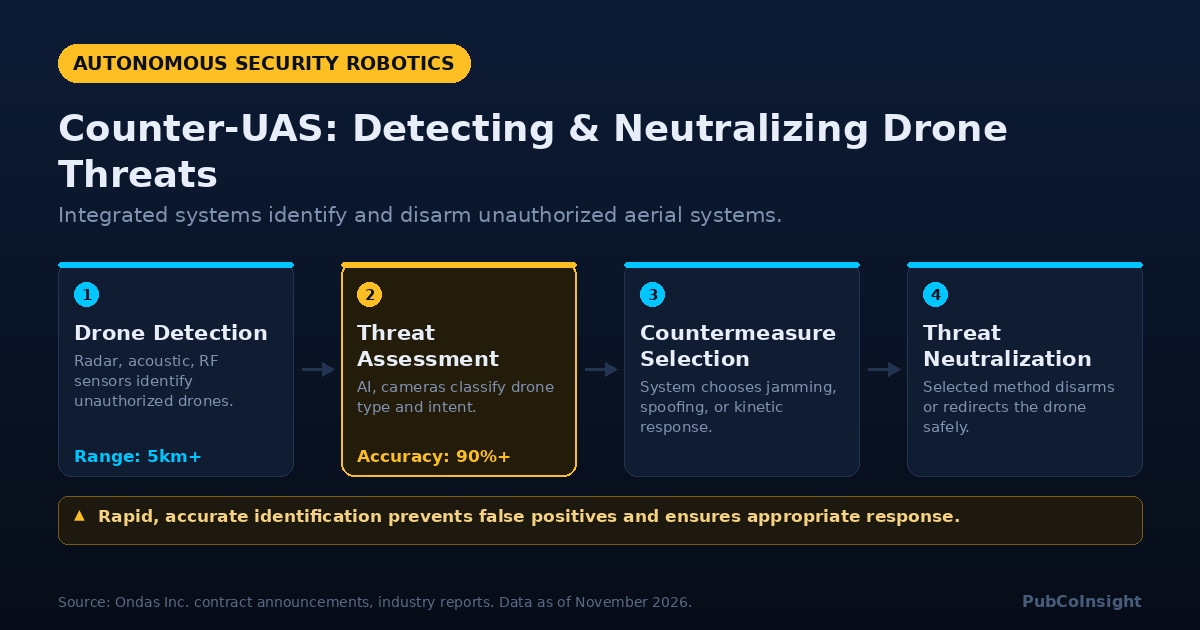
The Mechanism of Counter-UAS
Counter-UAS, or counter-unmanned aerial systems, involves a complex interplay of technologies designed to detect, track, identify, and neutralize unauthorized drones. The process typically begins with detection, often using radar, acoustic sensors, or radio frequency (RF) spectrum analysis. Radar systems, like those offered by Arbe Robotics (ARBE), can identify objects in the air by emitting radio waves and analyzing the reflections. Acoustic sensors listen for specific drone signatures, while RF analysis detects the unique communication signals between a drone and its operator. Once detected, the system tracks the drone's movement and attempts to identify its type and intent. This often involves electro-optical and infrared cameras, sometimes integrated with artificial intelligence for rapid classification. The neutralization phase employs various methods. Kinetic solutions involve interceptor drones or projectiles. Non-kinetic methods are more common in civilian contexts. These include jamming the drone's control signals or GPS, forcing it to land or return to its operator. Some systems use spoofing, sending false GPS signals to redirect the drone. The challenge lies in distinguishing legitimate drones from threats, minimizing collateral damage, and operating within diverse regulatory environments. The value sits in the speed and accuracy of threat assessment, and the ability to deploy appropriate, non-lethal countermeasures without disrupting legitimate air traffic or communications.Operators in the Autonomous Security Robotics Sector
Several companies operate in the broader autonomous security robotics and physical AI market, each with distinct focuses. Arbe Robotics (ARBE) specializes in 4D imaging radar solutions, primarily for automotive applications, but its high-resolution radar technology holds potential for enhanced drone detection in counter-UAS systems. Their radar can distinguish small objects at long ranges, critical for early threat identification. BigBear.ai Holdings, Inc. (BBAI) focuses on artificial intelligence and machine learning, offering predictive analytics and decision intelligence. While not directly manufacturing robotics, their AI platforms could be integrated into autonomous security systems for advanced threat assessment, pattern recognition, and optimizing response protocols. This could enhance the intelligence layer of counter-UAS operations, predicting drone trajectories or identifying operator locations. Kopin Corporation (KOPN) develops micro-displays and optical modules, which are crucial components for augmented reality (AR) and virtual reality (VR) systems. These technologies are vital for remote operation interfaces of advanced security robots and for providing operators with enhanced situational awareness in complex environments, including drone defense. Lantronix, Inc. (LTRX) provides secure data access and management solutions for the Internet of Things (IoT). Their technology enables secure communication between autonomous robots, sensors, and central command centers, a fundamental requirement for distributed security networks and real-time data processing in counter-UAS applications. MicroVision, Inc. (MVIS) develops lidar technology, a crucial component for autonomous navigation and object detection. Their lidar sensors provide high-resolution 3D mapping of environments, which could be used by ground-based security robots for patrol, obstacle avoidance, and potentially for tracking low-flying drones in complex urban landscapes. Red Cat Holdings, Inc. (RCAT) is involved in drone technology, including hardware and software for various applications. Their expertise in drone design and flight control could inform the development of interceptor drones for counter-UAS missions or provide insights into drone vulnerabilities for defense systems. Serve Robotics Inc. (SERV) focuses on autonomous sidewalk delivery robots. While a different application, their experience in deploying and managing fleets of autonomous ground vehicles in public spaces offers insights into the operational challenges and regulatory hurdles of physical AI deployment. Unusual Machines, Inc. (UMAC) designs and manufactures specialized machinery. Their precise engineering capabilities could be leveraged in the production of bespoke components for advanced robotics, including mechanisms for drone interception or sophisticated sensor housings for counter-UAS platforms.Artificial Intelligence Technology Solutions, Inc.
Artificial Intelligence Technology Solutions, Inc. (AITX) operates in the autonomous security robotics sector, primarily through its subsidiary Robotic Assistance Devices (RAD). The company focuses on building and leasing autonomous security robots and remote monitoring systems. These units are deployed under a recurring monthly subscription model, rather than as outright hardware sales. This strategy aims to provide continuous revenue streams tied to service delivery. AITX's product line includes stationary and mobile autonomous security robots designed for applications such as perimeter security, access control, and remote surveillance. The company's SARA AI security platform is central to its offerings, positioning an "agentic AI security professional" for various deployments. On November 2nd, AITX's RAD subsidiary highlighted SARA's qualifications, promoting its capabilities. On November 3rd, AITX announced a Balance Sheet Stability Program, with a stated target of achieving its first breakeven milestone by January 2027. The company's most recent substantive filing, a 10-Q for the six months ended August 31, 2026, indicates negative cash flow from operating activities of $4,820,842. As of August 31, 2026, AITX reported an accumulated deficit of $184,084,880 and negative working capital of $55,894,870. The filing acknowledges that management does not anticipate positive cash flow from operations in the near future. These factors raise substantial doubt about the company's ability to continue as a going concern for the twelve months following the issuance of these financial statements. The public record does not yet establish a clear path to sustained profitability or positive operational cash flow for AITX. Management has outlined plans to address its financial situation, including raising funds through growing revenues, equity proceeds, and issuing debt. An equity financing agreement dated June 23, 2026, allows an investor to purchase up to $10,000,000 of common stock at a discount over three years, with approximately $9.8 million remaining under this arrangement. The company's balance sheet for August 31, 2026, shows cash of $220,275, accounts receivable of $947,146, and revenue-earning devices, net of depreciation, valued at $4,677,987. Total current liabilities stood at $58,906,967, including significant current portions of loans payable and accrued interest. The company's strategy hinges on expanding its subscription base and managing its substantial debt obligations.What to watch
Investors should monitor several specific developments. For Ondas (ONDS), watch for further details on the European and Asian government contracts, including specific deployment timelines and revenue recognition schedules. Also, track any official announcements or pilot programs related to FEMA's counter-drone funding expansion, which could indicate future domestic opportunities. For Artificial Intelligence Technology Solutions (AITX), the January 2027 target for its first breakeven milestone is a key metric. Investors should look for specific updates in subsequent filings regarding progress toward this goal, particularly in terms of subscription growth, revenue acceleration, and improvements in operational cash flow. Any new equity or debt financing agreements, or extensions to existing debt maturities, will also be important to track in their 8-K filings. Across the sector, watch for broader regulatory shifts concerning drone usage and counter-UAS technologies, both domestically and internationally. New permit requirements for drone defense systems or changes in spectrum allocation could impact deployment strategies. Finally, observe any major tender awards for security robotics or counter-drone solutions from large government agencies or enterprise customers, as these can signal market direction and potential partnerships for smaller players., { "label": "Threat Assessment", "note": "AI, cameras classify drone type and intent.", "metric": "Accuracy: 90%+" }, { "label": "Countermeasure Selection", "note": "System chooses jamming, spoofing, or kinetic response." }, { "label": "Threat Neutralization", "note": "Selected method disarms or redirects the drone safely." } ], "highlight": 1, "highlight_note": "Rapid, accurate identification prevents false positives and ensures appropriate response.", "footnote": "Source: Ondas Inc. contract announcements, industry reports. Data as of November 2026." }Companies mentioned
| Ticker | Company | Price |
|---|---|---|
| AITX client | Artificial Intelligence Technology Solutions Inc | $0.0005 |
| ARBE | Arbe Robotics Ltd. | $0.42 |
| BBAI | BigBear.ai Holdings, Inc. | $2.56 |
| KOPN | Kopin Corporation | $3.35 |
| LTRX | Lantronix, Inc. | $5.65 |
| MVIS | MicroVision, Inc. | $1.24 |
| ONDS | Ondas Inc. | $5.27 |
| RCAT | Red Cat Holdings, Inc. | $4.0 |
| SERV | Serve Robotics Inc. | $2.65 |
| UMAC | Unusual Machines, Inc. | $13.03 |
Listed alphabetically, not ranked. Prices as of 2026-11-05 and they move. Check a live quote before relying on any of this.
How we chose the companies in this article
We cover a fixed universe of companies working in autonomous security robotics, physical AI and the guarding services market they are aimed at. Every one of them that had usable market data on 2026-11-05 appears in this article. We do not pick which ones to mention based on what we think of them, and we do not order them by size, price or trading volume, because an ordered list is a verdict and that is not ours to hand down. Companies left out, and why: none. American Lithium Minerals and Artificial Intelligence Technology Solutions pay us, which is disclosed in full at the foot of every article they appear in.
See the dilution and promotion flags before you see the pitch.
Each week: the micro and small-caps now showing dilution or paid-promotion signals, with the SEC filing behind every flag. No recommendations, no price targets.
Sources used in this article
- 1 Reason to Hold Coca-Cola Stock for 10 Years Motley Fool · 2026-11-05
- Why Rocket Lab Stock Plunged 15% in October and Why Its Decline Might Be Short-Lived Motley Fool · 2026-11-05
- Berkshire Hathaway's Stock Portfolio Is Worth About 3 Times What It Paid. The Gains Alone Equal About 19% of the Company. Motley Fool · 2026-11-05
- Should Investors Buy Into the Chipotle Turnaround? Motley Fool · 2026-11-05
- Zacks Earnings Trends Highlights: Nvidia, Micron and Alphabet Zacks · 2026-11-05
- Nucor and Prudential Financial have been highlighted as Zacks Bull and Bear of the Day Zacks · 2026-11-05
- The Zacks Analyst Blog Highlights Analog Devices, Taiwan Semiconductor Manufacturing, Texas Instruments and NVIDIA Zacks · 2026-11-05
- The Midterms Are Over. Here's What Chip Stocks Did in the Year After Each of the Last 8. Motley Fool · 2026-11-05
- Amazon Trades at a Fraction of Costco's Valuation. Is the Discount Deserved? Motley Fool · 2026-11-05
- The Election Day Revolt That Threatens America’s AI Boom The Wall Street Journal · 2026-11-05
- Ondas (ONDS) Wins Counter UAS Deals Following A Narrative That Says It Looks Undervalued Simply Wall St. · 2026-11-05
- Axon Trades on Its 2027 Growth. Here’s What the November 5 Report Has to Prove TIKR · 2026-11-04
Disclosure required by Section 17(b) of the Securities Act of 1933
Artificial Intelligence Technology Solutions, Inc., a Nevada corporation (OTCID: AITX). Artificial Intelligence Technology Solutions, Inc. pays Strategic Innovations First, Inc., a Wyoming corporation doing business as PulseIR. Compensation received: USD 5,000.00 per month for months 1-3 (August, September, October 2026); USD 10,000.00 per month for months 4-6 (November, December 2026, January 2027) contingent on the 90-day review. Minimum committed USD 15,000.00; USD 45,000.00 if the second-period rate triggers.. Form of payment: cash only, invoiced monthly in advance; no stock, options or warrants received or payable. Services: investor relations services under an Investor Relations Services Agreement effective 2026-08-01. Period: six month term, 2026-08-01 through 2027-01-31; 90-day review on or about 2026-10-30. No stock, options or warrants held by PubCo Insight, Pulse IR, Strategic Innovations First, Inc., or Brad Listermann. Confirmed by the executed agreement and by board record recKwdq39X2caPSX7 (POSITIONS HELD: none).
This is information, not investment, financial, legal or tax advice. It is not a recommendation or solicitation to buy, sell or hold any security and it contains no price target. Nothing here is independently verified by us. Confirm every figure against primary filings on SEC EDGAR before you act. Micro-cap and over-the-counter securities are speculative and illiquid and can lose all of their value. The companies named without a disclosure above pay us nothing and have no relationship with us; they are named because a published, mechanical screen selected them. Full disclosure policy.