Ondas Acquires GATE and Bron, Deepening Defense Robotics Vertical Integration
Ondas' recent $205 million acquisition of defense technology companies GATE and Bron signals a strategic shift towards owning more of the precision-strike supply chain, aiming to capture greater value from defense contracts.
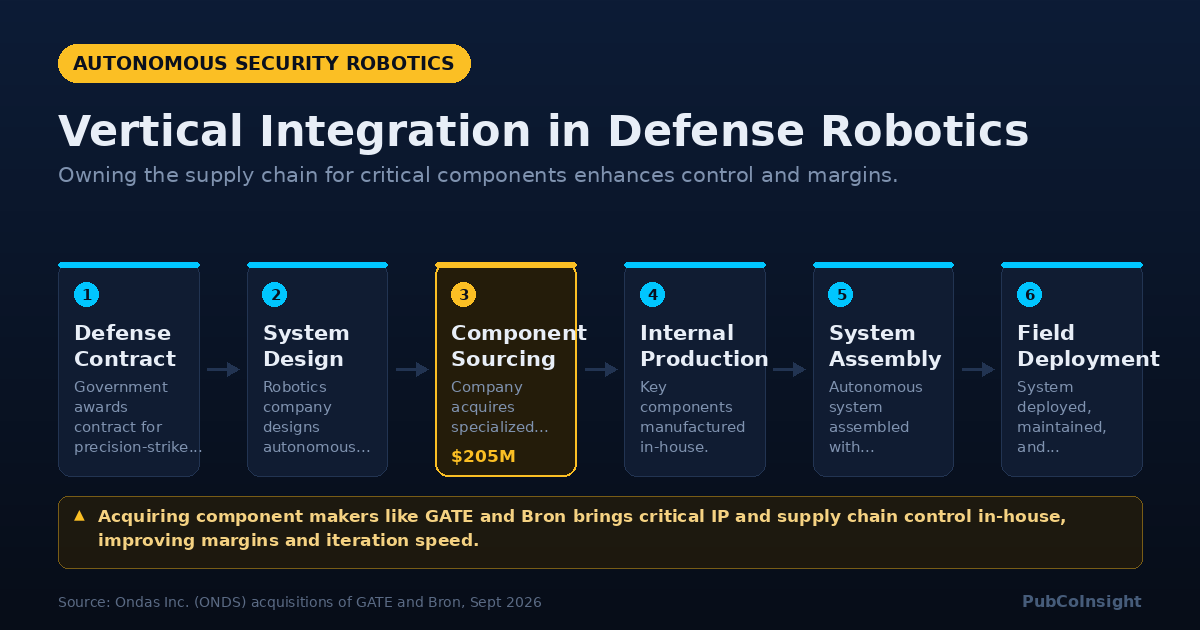
The Mechanism of Vertical Integration in Defense Robotics
Vertical integration in defense robotics is not simply about owning more parts of the manufacturing process. It is about controlling critical intellectual property, securing supply chains for specialized components, and improving the feedback loop between design, manufacturing, and field deployment. For precision-strike systems, this means bringing in-house the development and production of elements like guidance systems, warhead integration, and even specialized sensor arrays. These components often rely on proprietary algorithms and tightly controlled manufacturing processes. When a company acquires a supplier of such critical parts, it gains direct control over quality, intellectual property, and production timelines. This reduces reliance on external vendors, which can be particularly volatile in the defense sector due to geopolitical shifts, export controls, and the specialized nature of the technology. The value sits in the ability to iterate faster and more securely. If a system needs a software update for a guidance algorithm, owning the software developer means faster deployment and fewer third-party dependencies. If a specific material for a warhead casing becomes scarce, an integrated company has more levers to pull, from internal development to direct raw material sourcing. This strategy is proven wrong if the acquired entities fail to integrate effectively, leading to increased overhead without corresponding gains in efficiency or capability. It is also challenged if the acquired technologies become obsolete quickly, or if the cost of internal production outweighs the benefits of specialized external suppliers.Companies Operating in Autonomous Security and Robotics
The broader autonomous security and robotics sector sees a range of approaches, from specialized component manufacturing to comprehensive service offerings. Ondas Inc. (ONDS), trading at $7.39, has now made a definitive move into defense vertical integration with its GATE and Bron acquisitions. This positions Ondas to control more of the componentry for its drone and precision-strike systems, a clear shift from relying on external suppliers for critical defense technologies. Other companies focus on different aspects of the robotics and AI ecosystem. Arbe Robotics Ltd. (ARBE), priced at $0.67, specializes in high-resolution 4D imaging radar solutions, primarily for the automotive industry, but with clear applications in autonomous security for object detection and mapping. Its technology provides a detailed environmental picture beyond optical sensors, crucial for robust autonomous operation in various conditions. BigBear.ai Holdings, Inc. (BBAI), at $2.80, focuses on artificial intelligence and machine learning for decision intelligence, serving both defense and commercial sectors. Their work involves processing vast datasets to provide predictive analytics, which informs strategic decisions for security operations and logistics. In the vision systems and displays space, Kopin Corporation (KOPN), trading at $4.74, develops micro-displays and optical modules. These components are critical for augmented reality and virtual reality systems, which have applications in remote operation of security robots and enhanced situational awareness for human operators. Kopin's shares rose after Oppenheimer initiated coverage with an Outperform rating on September 17th. On the same day, Fabric.AI appointed Haynes Boone as counsel to support joint intellectual property with Kopin, highlighting the importance of their core technology. Lantronix, Inc. (LTRX), at $5.85, provides secure data access and management solutions for the Internet of Things (IoT). Their embedded computing and networking products are foundational for connecting and managing fleets of autonomous security devices, ensuring reliable communication and data transfer. MicroVision, Inc. (MVIS), priced at $1.66, develops lidar technology for automotive safety and autonomous driving. Lidar, which uses pulsed laser light to measure distances, is another critical sensor technology for autonomous security robots, enabling precise navigation and obstacle avoidance. Red Cat Holdings, Inc. (RCAT), at $6.75, operates in the drone sector, providing hardware and software for various applications, including defense. The company experienced a decline on September 18th as part of a broader drone sector selloff, highlighting market sensitivity to speculative drone names. Serve Robotics Inc. (SERV), trading at $4.41, focuses on sidewalk delivery robots. While not directly in security, their experience in deploying autonomous ground vehicles in public spaces offers insights into navigation, safety protocols, and regulatory challenges that are relevant to mobile security robots. On September 14th, Zacks questioned if Serve Robotics' Beacon could overcome restaurant integration barriers, pointing to the real-world challenges of deploying autonomous systems. Unusual Machines, Inc. (UMAC), at $23.18, also operates in the drone and robotics space. Like Red Cat, Unusual Machines saw its shares drop on September 18th, facing similar market pressures in the drone sector. Zacks noted on September 18th that Unusual Machines is one of three wireless stocks set to benefit from industry tailwinds.Artificial Intelligence Technology Solutions, Inc.
Artificial Intelligence Technology Solutions, Inc. (AITX), trading at $0.0039, operates through its subsidiaries, focusing on AI-driven security and productivity solutions. The company's primary subsidiary, Robotic Assistance Devices, Inc. (RAD-I), markets a "Solutions-as-a-Service" model to the security and guarding services industry, a market estimated at $50 billion in the United States. AITX aims to deliver cost savings between 35% and 80% compared to traditional manned security, using a suite of stationary and mobile devices integrated with its software and monitoring platforms. AITX describes its operations across three main pillars: stationary security devices through RAD-I, mobile autonomous platforms through Robotic Assistance Devices Mobile (RAD-M), and its SARA agentic artificial intelligence platform through Robotic Assistance Devices Group (RAD-G). Early commercial deployment of the ROAMEO mobile security unit, a RAD-M product, began in May 2026. RAD Lanka, a wholly owned subsidiary in Sri Lanka, handles software development, AI initiatives, and technical operations. The company envisions an integrated autonomous security deployment across campuses or communities, which it refers to as "RAD Town." For the fiscal year ended February 28, 2026, AITX reported revenue of $7,745,336, a 26% increase over the prior fiscal year. Gross profit rose 48% to $5,533,700, with gross margin expanding to approximately 71% from 61%. Operating expenses remained flat at around $17,477,097, and the loss from operations improved by $2.0 million to $(11,943,397). The company reported a net loss of approximately $14.5 million for the fiscal year and an accumulated deficit of approximately $171 million as of that date. The public record does not yet establish a clear path to sustained positive cash flow from operations, which management does not anticipate having. The independent registered public accounting firm has included an explanatory paragraph in its report on consolidated financial statements expressing substantial doubt about the company's ability to continue as a going concern. Recent 8-K filings on September 18th, 16th, and 15th, indicate that AITX's RAD is expanding its presence in higher education and reinforcing the role of its ROSA units as the foundation of its stationary security platform. The company also called for clear boundaries in the age of AI-powered security, as reported on September 15th. AITX's filings indicate management's characterization that RAD-I has "achieved a point" where it could support positive cash flow operations today, and that RAD-M will eventually surpass RAD-I's monthly recurring revenue contribution. They project subscription gross margin to exceed 75% and outright-sale gross margin to exceed 50%, based on average bill of materials costs and market-accepted pricing.What to watch
Investors in the autonomous security and robotics sector should monitor several key developments. For Ondas (ONDS), the integration of GATE and Bron will be critical. Watch for specific defense contract announcements that leverage these new capabilities, and look for disclosures on how these acquisitions impact their gross margins in upcoming quarterly filings. The ability to demonstrate improved profitability from these vertical moves will be a key indicator. For Artificial Intelligence Technology Solutions (AITX), the continued expansion of their "Solutions-as-a-Service" model, particularly the adoption of ROAMEO mobile security units, will be important. Look for updates on subscription counts and revenue growth in subsequent filings, especially regarding the stated goal of RAD-M surpassing RAD-I's monthly recurring revenue contribution. The company's ability to reduce its accumulated deficit and negative working capital will be a significant data point. Across the sector, watch for broader trends in defense spending and procurement, as these directly impact companies like Ondas and Red Cat (RCAT). For companies focused on specific technologies, such as Arbe Robotics (ARBE) with 4D radar or MicroVision (MVIS) with lidar, look for new OEM design wins or significant partnerships that validate their technology in large-scale deployments. Regulatory developments around autonomous vehicle deployment, particularly for companies like Serve Robotics (SERV), will also shape market opportunities., { "label": "System Design", "note": "Robotics company designs autonomous defense system." }, { "label": "Component Sourcing", "note": "Company acquires specialized guidance and sensor firms.", "metric": "$205M" }, { "label": "Internal Production", "note": "Key components manufactured in-house." }, { "label": "System Assembly", "note": "Autonomous system assembled with integrated parts." }, { "label": "Field Deployment", "note": "System deployed, maintained, and upgraded." } ], "highlight": 2, "highlight_note": "Acquiring component makers like GATE and Bron brings critical IP and supply chain control in-house, improving margins and iteration speed.", "footnote": "Source: Ondas Inc. (ONDS) acquisitions of GATE and Bron, Sept 2026" }Companies mentioned
| Ticker | Company | Price |
|---|---|---|
| AITX client | Artificial Intelligence Technology Solutions Inc | $0.0039 |
| ARBE | Arbe Robotics Ltd. | $0.67 |
| BBAI | BigBear.ai Holdings, Inc. | $2.8 |
| KOPN | Kopin Corporation | $4.74 |
| LTRX | Lantronix, Inc. | $5.85 |
| MVIS | MicroVision, Inc. | $1.66 |
| ONDS | Ondas Inc. | $7.39 |
| RCAT | Red Cat Holdings, Inc. | $6.75 |
| SERV | Serve Robotics Inc. | $4.41 |
| UMAC | Unusual Machines, Inc. | $23.18 |
Listed alphabetically, not ranked. Prices as of 2026-09-21 and they move. Check a live quote before relying on any of this.
How we chose the companies in this article
We cover a fixed universe of companies working in autonomous security robotics, physical AI and the guarding services market they are aimed at. Every one of them that had usable market data on 2026-09-21 appears in this article. We do not pick which ones to mention based on what we think of them, and we do not order them by size, price or trading volume, because an ordered list is a verdict and that is not ours to hand down. Companies left out, and why: none. American Lithium Minerals and Artificial Intelligence Technology Solutions pay us, which is disclosed in full at the foot of every article they appear in.
See the dilution and promotion flags before you see the pitch.
Each week: the micro and small-caps now showing dilution or paid-promotion signals, with the SEC filing behind every flag. No recommendations, no price targets.
Sources used in this article
- Goldman Sachs Adjusts PT on Axon Enterprise to $675 From $715, Maintains Buy Rating MT Newswires · 2026-09-21
- 2 Unstoppable Growth Stocks to Buy and Hold for the Next Decade Motley Fool · 2026-09-21
- Monster Beverage and Coca-Cola Beat the S&P 500 Over the Last 5 Years. Here's Whether the Next 5 Years Will Look the Same. Motley Fool · 2026-09-21
- What Is Driving Bitcoin Higher Right Now Motley Fool · 2026-09-21
- Nvidia Has Been the King of AI. This ETF Bets the Next Winners Will Be Somewhere Else. Motley Fool · 2026-09-21
- Warren Buffett's $187 Billion Warning to Wall Street Echoes Louder Than Ever, Thanks to His Favorite Valuation Measure Motley Fool · 2026-09-21
- Social Security at 62 vs. 70: The Decision That Changes Everything Motley Fool · 2026-09-21
- 2 Profitable Stocks to Target This Week and 1 We Ignore StockStory · 2026-09-21
- Better Buy Right Now: Bitcoin vs. Dogecoin Motley Fool · 2026-09-21
- Market Chatter: Microsoft CEO Planning to Join Sept. 24 White House State Dinner With China's Xi Jinping MT Newswires · 2026-09-21
- Warren Buffett Just Released a Farewell Letter. It Contains the Most Devastating 4-Word Piece of Investment Advice I've Ever Heard. Motley Fool · 2026-09-21
- Axon Enterprise (AXON) Prices $1B of Zero-Coupon Notes. What is the Real Cost? Insider Monkey · 2026-09-20
Disclosure required by Section 17(b) of the Securities Act of 1933
Artificial Intelligence Technology Solutions, Inc., a Nevada corporation (OTCID: AITX). Artificial Intelligence Technology Solutions, Inc. pays Strategic Innovations First, Inc., a Wyoming corporation doing business as PulseIR. Compensation received: USD 5,000.00 per month for months 1-3 (August, September, October 2026); USD 10,000.00 per month for months 4-6 (November, December 2026, January 2027) contingent on the 90-day review. Minimum committed USD 15,000.00; USD 45,000.00 if the second-period rate triggers.. Form of payment: cash only, invoiced monthly in advance; no stock, options or warrants received or payable. Services: investor relations services under an Investor Relations Services Agreement effective 2026-08-01. Period: six month term, 2026-08-01 through 2027-01-31; 90-day review on or about 2026-10-30. No stock, options or warrants held by PubCo Insight, Pulse IR, Strategic Innovations First, Inc., or Brad Listermann. Confirmed by the executed agreement and by board record recKwdq39X2caPSX7 (POSITIONS HELD: none).
This is information, not investment, financial, legal or tax advice. It is not a recommendation or solicitation to buy, sell or hold any security and it contains no price target. Nothing here is independently verified by us. Confirm every figure against primary filings on SEC EDGAR before you act. Micro-cap and over-the-counter securities are speculative and illiquid and can lose all of their value. The companies named without a disclosure above pay us nothing and have no relationship with us; they are named because a published, mechanical screen selected them. Full disclosure policy.