Ondas Expands Defense Robotics Vertical Integration with GATE and Bron Acquisitions
Ondas' recent acquisitions of GATE and Bron aim to deepen its control over defense robotics manufacturing, targeting a significant increase in pro forma revenue by consolidating key component production.
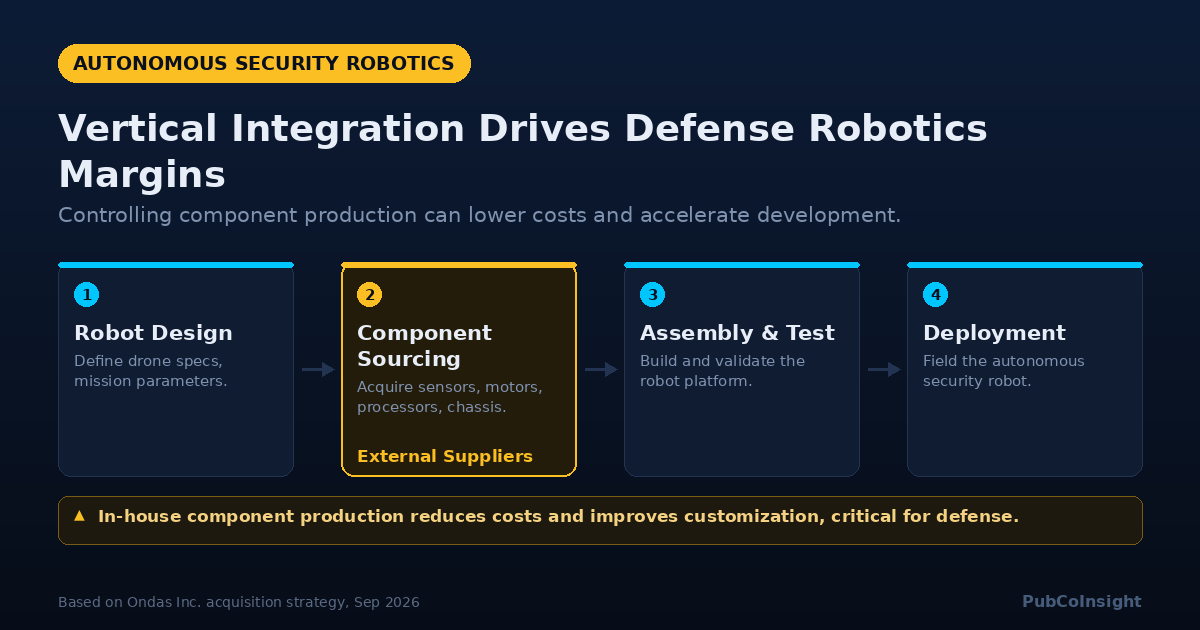
The Mechanism of Vertical Integration in Robotics
Vertical integration in robotics manufacturing means a company owns more stages of its production process. Instead of buying a camera module from one vendor, a motor from another, and software from a third, an integrated company designs and builds these components itself. This matters because each external interface is a potential point of failure, a cost adder, or a bottleneck. When a company controls the design and fabrication of, for example, a custom motor controller board, it can optimize it precisely for its robotic platform's power draw, weight, and communication protocols. This optimization is difficult to achieve with general-purpose components. Consider the development cycle for a new defense drone. If a critical sensor is sourced externally, any design change or performance upgrade requires negotiation, lead times, and potential re-engineering of the entire system to accommodate the new part. If the sensor is designed and built in-house, the robotics team can iterate on both the sensor and the drone platform simultaneously. This parallel development accelerates time to market and allows for deeper integration of hardware and software, leading to superior performance characteristics like lower latency in data processing or enhanced power efficiency. The constraint often sits at the intersection of custom hardware and proprietary software, where external sourcing introduces friction. Owning these interfaces directly removes that friction. This approach would be proven wrong if the acquired entities fail to deliver cost savings or performance improvements that outweigh the overhead of managing additional manufacturing operations.Companies Operating in Autonomous Security and Robotics
The broader autonomous security and robotics sector sees a range of approaches to manufacturing and deployment. Ondas Inc. (ONDS), trading at $7.38, has explicitly moved towards deeper vertical integration with its GATE and Bron acquisitions. This positions Ondas to control more aspects of its defense drone production, aiming for greater efficiency and proprietary advantage. The company's focus on defense applications means stringent requirements for reliability and performance, which integration can support. Other players focus on specific niches within the technology stack. Arbe Robotics Ltd. (ARBE), at $0.687, specializes in high-resolution 4D imaging radar solutions, a critical sensor technology for autonomous systems. Their focus is on providing a core component rather than building entire robotic platforms. Similarly, MicroVision, Inc. (MVIS), priced at $1.67, develops lidar technology, another key sensor for spatial awareness in autonomous navigation. These companies operate as specialized suppliers, offering advanced components to a wider market. In the AI and software layer, BigBear.ai Holdings, Inc. (BBAI), at $2.90, provides AI-powered analytics and decision intelligence, often for government and defense clients. Their value lies in processing data and generating insights, rather than in the physical robotics themselves. Kopin Corporation (KOPN), trading at $4.85, develops micro-displays and optical systems, components crucial for augmented and virtual reality applications, which can extend to human-robot interfaces and remote operation systems. On the operational side, companies like Lantronix, Inc. (LTRX), at $6.18, offer secure data access and management solutions for the Internet of Things (IoT), which is foundational for connecting and managing fleets of autonomous robots. Red Cat Holdings, Inc. (RCAT), priced at $6.95, and Unusual Machines, Inc. (UMAC), at $24.25, are both involved in drone technology, with Red Cat focusing on drone hardware and software, and Unusual Machines also in the drone space. Their strategies vary in terms of integration, but all aim to capture market share in the rapidly expanding drone and robotics sector. Serve Robotics Inc. (SERV), at $4.44, focuses on last-mile delivery robots, operating a fleet of autonomous vehicles for specific commercial applications.Artificial Intelligence Technology Solutions, Inc.
Artificial Intelligence Technology Solutions, Inc. (AITX) trades on the OTCID tier at $0.0037. The company, through its subsidiaries, builds and leases autonomous security robots and remote monitoring systems. Its business model centers on a recurring monthly subscription service for its hardware and software, rather than one-off sales. The company's primary subsidiary, Robotic Assistance Devices, Inc. (RAD-I), markets an AI-driven "Solutions-as-a-Service" model to the security and guarding services industry. AITX estimates this market to be approximately $50 billion in the United States. The stated goal is to deliver cost savings of between 35% and 80% compared with traditional manned security. AITX operates across three principal pillars. First, stationary security devices, under RAD-I, which include units like ROSA, a stationary security platform that forms the foundation of its offerings. Second, mobile autonomous platforms, under Robotic Assistance Devices Mobile (RAD-M), which includes the ROAMEO mobile security unit. Early commercial deployment of ROAMEO began in May 2026. Third, the company's SARA agentic artificial intelligence platform, under Robotic Assistance Devices Group (RAD-G). This platform is intended to generate substantial revenue through licensing. A wholly owned subsidiary, RAD Lanka, located in Sri Lanka, supports software development, AI initiatives, and technical operations. The company refers to the long-term outcome of this integrated strategy as "RAD Town," envisioning autonomous security deployments across campuses, communities, or jurisdictions. For the fiscal year ended February 28, 2026, AITX reported revenue of $7,745,336, a 26% increase over the prior fiscal year. Gross profit increased 48% to $5,533,700, and gross margin expanded to approximately 71% from 61%. Operating expenses remained flat at approximately $17,477,097. The company's loss from operations improved by approximately $2.0 million to $(11,943,397). AITX reported a net loss of approximately $14.5 million for the fiscal year ended February 28, 2026, with an accumulated deficit of approximately $171 million as of that date. The company had negative cash flow from operating activities of $9,344,534 for the year ended February 28, 2026. As of February 28, 2026, the company had an accumulated deficit of $171,121,742 and negative working capital of $17,017,745. Management does not anticipate having positive cash flow from operations in the immediate future. While the company outlines a comprehensive strategy, the public record does not yet establish consistent positive cash flow from operations. The company's filings indicate expectations that RAD-I's recurring revenue and gross margin could, on a standalone basis, support positive cash flow operations, and that RAD-M will surpass RAD-I's monthly recurring revenue contribution at some future point. It also projects subscription gross margin to exceed 75% and outright-sale gross margin to exceed 50%, based on average bill of materials costs and pricing that the market "has appeared to accept." These projections depend on continued pricing acceptance, stable input costs, and manufacturing scale.What to watch
Investors should monitor Ondas' next quarterly filings for detailed financial impacts of the GATE and Bron acquisitions. Specific line items related to cost of goods sold and gross margins for their defense segment will indicate whether the vertical integration strategy is yielding the targeted improvements. Look for any updates on the reported $200 million pro forma revenue target, particularly how it breaks down between the acquired entities and existing operations. For Artificial Intelligence Technology Solutions, Inc., watch for updates on the commercial deployment of its ROAMEO mobile security units, which began in May 2026. Further 8-K filings detailing new customer wins or expanded deployments for RAD-I's stationary solutions, especially in higher education as mentioned on September 18th, will provide insight into revenue growth. Pay attention to any statements regarding progress towards positive cash flow from operations, as indicated as a management expectation for RAD-I on a standalone basis., { "label": "Component Sourcing", "note": "Acquire sensors, motors, processors, chassis.", "metric": "External Suppliers" }, { "label": "Assembly & Test", "note": "Build and validate the robot platform." }, { "label": "Deployment", "note": "Field the autonomous security robot." } ], "highlight": 1, "highlight_note": "In-house component production reduces costs and improves customization, critical for defense.", "footnote": "Based on Ondas Inc. acquisition strategy, Sep 2026" }Companies mentioned
| Ticker | Company | Price |
|---|---|---|
| AITX client | Artificial Intelligence Technology Solutions Inc | $0.0037 |
| ARBE | Arbe Robotics Ltd. | $0.687 |
| BBAI | BigBear.ai Holdings, Inc. | $2.9 |
| KOPN | Kopin Corporation | $4.85 |
| LTRX | Lantronix, Inc. | $6.18 |
| MVIS | MicroVision, Inc. | $1.67 |
| ONDS | Ondas Inc. | $7.38 |
| RCAT | Red Cat Holdings, Inc. | $6.95 |
| SERV | Serve Robotics Inc. | $4.44 |
| UMAC | Unusual Machines, Inc. | $24.25 |
Listed alphabetically, not ranked. Prices as of 2026-09-23 and they move. Check a live quote before relying on any of this.
How we chose the companies in this article
We cover a fixed universe of companies working in autonomous security robotics, physical AI and the guarding services market they are aimed at. Every one of them that had usable market data on 2026-09-23 appears in this article. We do not pick which ones to mention based on what we think of them, and we do not order them by size, price or trading volume, because an ordered list is a verdict and that is not ours to hand down. Companies left out, and why: none. American Lithium Minerals and Artificial Intelligence Technology Solutions pay us, which is disclosed in full at the foot of every article they appear in.
See the dilution and promotion flags before you see the pitch.
Each week: the micro and small-caps now showing dilution or paid-promotion signals, with the SEC filing behind every flag. No recommendations, no price targets.
Sources used in this article
- Is SpaceX Actually Worth $10 Trillion? Motley Fool · 2026-09-23
- S&P 500 Profits Are on Track for a Third Straight Quarter of 25%+ Growth. The Index Hasn't Kept Up. Motley Fool · 2026-09-23
- 3 Stocks to Buy and Hold Even if There's a Stock Market Sell-Off This Fall Motley Fool · 2026-09-23
- Is D-Wave Quantum’s (QBTS) Cybersecurity Board Hire a Signal on Its Enterprise Readiness? Simply Wall St. · 2026-09-23
- Nvidia (NVDA) Targets 22,000 GPUs For New Southeast Asia AI Factory Hubs Simply Wall St. · 2026-09-23
- Why AutoZone Stock Rallied Today Motley Fool · 2026-09-23
- May Mobility's SPAC Merger: Is This a Road to Nowhere for Investors? Motley Fool · 2026-09-23
- If You Buy Monster Beverage With $10,000 Today, Could You Become a Millionaire in 25 Years? Motley Fool · 2026-09-23
- Why This Top Automaker's Gamble on V-8 Engines During a Hybrid Boom Actually Makes Sense Motley Fool · 2026-09-23
- Why Marathon Petroleum Stock Slipped Today Motley Fool · 2026-09-23
- Axon Stock Just Fell 22% in a Month. Here’s the Number That Explains Why TIKR · 2026-09-22
- Goldman Sachs Adjusts PT on Axon Enterprise to $675 From $715, Maintains Buy Rating MT Newswires · 2026-09-21
Disclosure required by Section 17(b) of the Securities Act of 1933
Artificial Intelligence Technology Solutions, Inc., a Nevada corporation (OTCID: AITX). Artificial Intelligence Technology Solutions, Inc. pays Strategic Innovations First, Inc., a Wyoming corporation doing business as PulseIR. Compensation received: USD 5,000.00 per month for months 1-3 (August, September, October 2026); USD 10,000.00 per month for months 4-6 (November, December 2026, January 2027) contingent on the 90-day review. Minimum committed USD 15,000.00; USD 45,000.00 if the second-period rate triggers.. Form of payment: cash only, invoiced monthly in advance; no stock, options or warrants received or payable. Services: investor relations services under an Investor Relations Services Agreement effective 2026-08-01. Period: six month term, 2026-08-01 through 2027-01-31; 90-day review on or about 2026-10-30. No stock, options or warrants held by PubCo Insight, Pulse IR, Strategic Innovations First, Inc., or Brad Listermann. Confirmed by the executed agreement and by board record recKwdq39X2caPSX7 (POSITIONS HELD: none).
This is information, not investment, financial, legal or tax advice. It is not a recommendation or solicitation to buy, sell or hold any security and it contains no price target. Nothing here is independently verified by us. Confirm every figure against primary filings on SEC EDGAR before you act. Micro-cap and over-the-counter securities are speculative and illiquid and can lose all of their value. The companies named without a disclosure above pay us nothing and have no relationship with us; they are named because a published, mechanical screen selected them. Full disclosure policy.