Autonomous Security: The Infrastructure Question for Physical AI
The debate between robotic hardware and underlying infrastructure is intensifying, as companies navigate the complexities of deployment, data processing, and scaling in the physical AI sector.
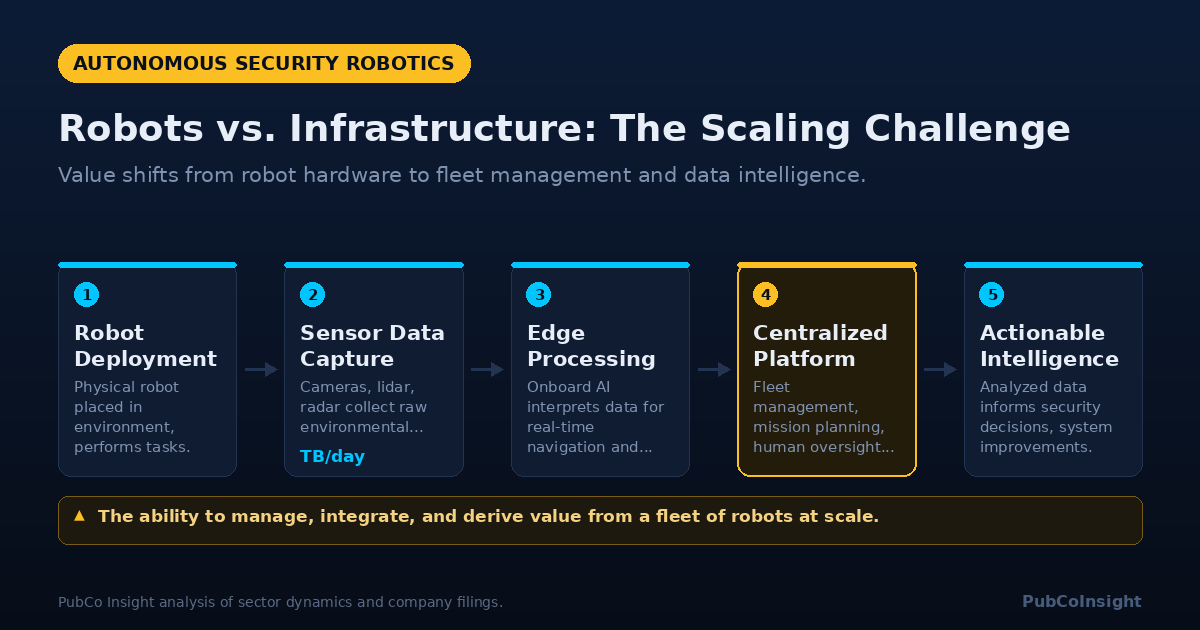
The Mechanism of Physical AI Deployment
Deploying an autonomous security robot involves several distinct stages, each presenting its own challenges and opportunities. First, the robot needs to perceive its environment. This relies on a suite of sensors: cameras, lidar, radar, and ultrasonic detectors. These sensors generate massive amounts of raw data. The quality and redundancy of this sensor array directly impact the robot's ability to operate safely and effectively in varied conditions, from bright daylight to total darkness, and through adverse weather. Next, this raw sensor data must be processed in real-time. This is where edge computing, often on the robot itself, plays a crucial role. The robot's onboard AI must interpret the data to build a dynamic map of its surroundings, identify objects, track movement, and detect anomalies. This processing requires specialized hardware, like high-performance GPUs, and sophisticated algorithms. The challenge lies in performing these complex computations with low latency and minimal power consumption, often in environments without reliable external connectivity. After processing, the robot needs to make decisions and execute actions. This involves navigation planning, obstacle avoidance, and task execution, such as patrolling a specific route or investigating an alert. These actions are guided by high-level instructions from a central command platform, which also receives filtered data and alerts from the robot. This command platform, the "infrastructure" component, acts as the brain for a fleet of robots. It manages missions, handles exceptions, provides remote human oversight when necessary, and aggregates data for post-event analysis and system improvement. The bottleneck often sits here: the ability to efficiently manage a growing fleet, integrate with existing security systems, and provide actionable intelligence from disparate data sources. A robot can be mechanically perfect, but if its data cannot be processed, understood, and acted upon, it remains a sophisticated paperweight.Companies in the Sector
Several companies are navigating this complex landscape. Serve Robotics Inc. (SERV), at $5.03, focuses on autonomous sidewalk delivery robots. Their model emphasizes the last-mile logistics challenge, where the robot's physical navigation through urban environments is paramount. Their success hinges on robust, localized autonomy and efficient fleet management in dense areas. In the broader drone sector, Ondas Inc. (ONDS), priced at $7.90, and Red Cat Holdings, Inc. (RCAT), at $8.49, are developing drone solutions. Ondas has a focus on critical infrastructure inspection and data collection, while Red Cat focuses on drone technology for defense and public safety. Their work with drones highlights the importance of precise navigation and data capture from aerial platforms, often requiring specialized communication infrastructure. Unusual Machines, Inc. (UMAC), trading at $23.98, has recently focused on NDAA-compliant expansion and manufacturing, indicating a push towards defense and government contracts for its drone technology. Companies like Arbe Robotics Ltd. (ARBE), at $0.656, and MicroVision, Inc. (MVIS), at $1.84, are developing core sensor technologies. Arbe specializes in high-resolution 4D imaging radar, crucial for all-weather autonomous perception. MicroVision focuses on lidar solutions, providing precise depth mapping. These companies are foundational to the "robot" side of the equation, providing the eyes and ears for autonomous systems. Kopin Corporation (KOPN), priced at $4.48, develops micro-displays and optical modules, which are critical components for augmented reality and virtual reality systems, as well as for some advanced robotic interfaces. Lantronix, Inc. (LTRX), at $5.37, provides secure data access and management solutions, essential for connecting and managing distributed IoT and robotic assets. BigBear.ai Holdings, Inc. (BBAI), at $3.05, offers AI-powered analytics and data processing, which fits squarely into the infrastructure side, turning raw data into actionable intelligence for various applications, including defense and intelligence.Artificial Intelligence Technology Solutions, Inc.
Artificial Intelligence Technology Solutions, Inc. (AITX), trading over the counter at $0.0044, operates through several subsidiaries to build and lease AI-driven security robots and remote monitoring systems. The company structures its offerings on a recurring monthly subscription model. Its primary subsidiary, Robotic Assistance Devices, Inc. (RAD-I), markets an AI-driven "Solutions-as-a-Service" model to the security and guarding services industry. The company estimates this market to be approximately $50 billion in the United States. AITX states its solutions aim to deliver cost savings between 35% and 80% compared with traditional manned security. AITX describes its operations across three main pillars: stationary security devices (RAD-I), mobile autonomous platforms (RAD-M), and its SARA agentic artificial intelligence platform (RAD-G). The company’s mobile autonomous platforms include the ROAMEO mobile security unit, with early commercial deployment beginning in May 2026. AITX recently announced a 14-unit order intake across five customer relationships on August 27, 2026, describing it as the most diverse 24-hour order intake in company history. On August 25, 2026, the company reported a growing ROAMEO deployment pipeline and expanded production readiness, aiming for 50 units by August 2027. The RAD-M segment was rebranded to PURSUON on August 24, 2026, advancing the company's autonomous mobile security strategy. AITX also maintains Robotic Assistance Devices Lanka (Private) Limited (RAD Lanka) in Sri Lanka, operating under Port City Colombo status. This subsidiary supports software development, artificial intelligence initiatives, and technical operations. The company refers to the long-term outcome of its integrated strategy as "RAD Town," envisioning autonomous-security deployments across campuses, communities, or jurisdictions. In the fiscal year ended February 28, 2026, AITX reported revenue of $7,745,336, a 26% increase over the prior fiscal year. Gross profit rose 48% to $5,533,700, with gross margin expanding to approximately 71% from 61%. Operating expenses remained flat at about $17,477,097, and the loss from operations improved by approximately $2.0 million to $(11,943,397). The company reported a net loss of approximately $14.5 million for the fiscal year ended February 28, 2026. As of February 28, 2026, AITX had an accumulated deficit of approximately $171 million and negative working capital of $17,017,745. The public record does not yet establish a clear path to sustained positive cash flow from operations.What to watch
Investors should monitor the reported deployment numbers for mobile autonomous platforms like AITX’s ROAMEO units. The company has stated a goal of 50 units by August 2027. Tracking these figures against stated targets will indicate progress in scaling mobile deployments. The integration of new orders, such as the 14-unit intake reported on August 27, 2026, will also show market acceptance and expansion of their customer base. Further filings from companies like Unusual Machines (UMAC) regarding their NDAA-compliant expansion, as noted on August 22, 2026, will shed light on their strategic direction in the defense sector. For Serve Robotics (SERV), quarterly earnings reports will detail the expansion of their delivery network and the economic viability of their last-mile robotic services. The broader market will continue to watch for concrete examples of physical AI deployments moving beyond pilot phases to large-scale, profitable operations across the sector., { "label": "Sensor Data Capture", "note": "Cameras, lidar, radar collect raw environmental data.", "metric": "TB/day" }, { "label": "Edge Processing", "note": "Onboard AI interprets data for real-time navigation and anomaly detection." }, { "label": "Centralized Platform", "note": "Fleet management, mission planning, human oversight, data aggregation." }, { "label": "Actionable Intelligence", "note": "Analyzed data informs security decisions, system improvements." } ], "highlight": 3, "highlight_note": "The ability to manage, integrate, and derive value from a fleet of robots at scale.", "footnote": "PubCo Insight analysis of sector dynamics and company filings." }Companies mentioned
| Ticker | Company | Price |
|---|---|---|
| AITX client | Artificial Intelligence Technology Solutions Inc | $0.0044 |
| ARBE | Arbe Robotics Ltd. | $0.656 |
| BBAI | BigBear.ai Holdings, Inc. | $3.05 |
| KOPN | Kopin Corporation | $4.48 |
| LTRX | Lantronix, Inc. | $5.37 |
| MVIS | MicroVision, Inc. | $1.84 |
| ONDS | Ondas Inc. | $7.9 |
| RCAT | Red Cat Holdings, Inc. | $8.49 |
| SERV | Serve Robotics Inc. | $5.03 |
| UMAC | Unusual Machines, Inc. | $23.98 |
Listed alphabetically, not ranked. Prices as of 2026-08-31 and they move. Check a live quote before relying on any of this.
How we chose the companies in this article
We cover a fixed universe of companies working in autonomous security robotics, physical AI and the guarding services market they are aimed at. Every one of them that had usable market data on 2026-08-31 appears in this article. We do not pick which ones to mention based on what we think of them, and we do not order them by size, price or trading volume, because an ordered list is a verdict and that is not ours to hand down. Companies left out, and why: none. American Lithium Minerals and Artificial Intelligence Technology Solutions pay us, which is disclosed in full at the foot of every article they appear in.
See the dilution and promotion flags before you see the pitch.
Each week: the micro and small-caps now showing dilution or paid-promotion signals, with the SEC filing behind every flag. No recommendations, no price targets.
Sources used in this article
- As the Stock Market Sounds an Alarm, Warren Buffett Just Offered a Blunt Warning for Investors Motley Fool · 2026-08-31
- Warren Buffett Has Recommended This 1 Investment for Decades. History Says It Could Turn $100 per Month Into $225,000. Motley Fool · 2026-08-31
- Just Starting Out With $5,000? 3 Magnificent ETFs to Buy in 2026. Motley Fool · 2026-08-31
- 1 Top Cryptocurrency to Buy Before It Hits $1 Million per Token by 2033, According to This Wall Street Analyst Motley Fool · 2026-08-31
- Micron Will Report Its Fiscal Q4 Earnings During the Market's Worst Month. History Says This Is What Happens Next. Motley Fool · 2026-08-31
- Circle Your Calendars: Sept. 9 May Be a Huge Day for SpaceX and Its Shareholders Motley Fool · 2026-08-31
- Both Hedge Funds and Mutual Funds Are Buying These Fantastic Fintech Stocks, and That's a Great Signal for Investors to Buy Motley Fool · 2026-08-31
- Phillip Securities Adjusts Price Target on Nvidia to $300 From $285, Keeps Buy Rating MT Newswires · 2026-08-31
- China Renaissance Adjusts Price Target on Nvidia to $330 From $319, Keeps Buy Rating MT Newswires · 2026-08-31
- What Does the S&P 500’s August Gain Say About the Rest of the Year? History’s Answer Is Strikingly Clear. Motley Fool · 2026-08-31
- Will Strength in Dedrone Platform Continue to Drive AXON's Growth? Zacks · 2026-08-28
- Drone Stocks Drop While Broad Market Rises: Unusual Machines Sinks 9%, Ondas Falls 6%, Red Cat Slides 5% 24/7 Wall St. · 2026-08-28
Disclosure required by Section 17(b) of the Securities Act of 1933
Artificial Intelligence Technology Solutions, Inc., a Nevada corporation (OTCID: AITX). Artificial Intelligence Technology Solutions, Inc. pays Strategic Innovations First, Inc., a Wyoming corporation doing business as PulseIR. Compensation received: USD 5,000.00 per month for months 1-3 (August, September, October 2026); USD 10,000.00 per month for months 4-6 (November, December 2026, January 2027) contingent on the 90-day review. Minimum committed USD 15,000.00; USD 45,000.00 if the second-period rate triggers.. Form of payment: cash only, invoiced monthly in advance; no stock, options or warrants received or payable. Services: investor relations services under an Investor Relations Services Agreement effective 2026-08-01. Period: six month term, 2026-08-01 through 2027-01-31; 90-day review on or about 2026-10-30. No stock, options or warrants held by PubCo Insight, Pulse IR, Strategic Innovations First, Inc., or Brad Listermann. Confirmed by the executed agreement and by board record recKwdq39X2caPSX7 (POSITIONS HELD: none).
This is information, not investment, financial, legal or tax advice. It is not a recommendation or solicitation to buy, sell or hold any security and it contains no price target. Nothing here is independently verified by us. Confirm every figure against primary filings on SEC EDGAR before you act. Micro-cap and over-the-counter securities are speculative and illiquid and can lose all of their value. The companies named without a disclosure above pay us nothing and have no relationship with us; they are named because a published, mechanical screen selected them. Full disclosure policy.