The Compute Corridor: Physical AI's Emerging Infrastructure Bottleneck
The autonomous security robotics sector faces a critical infrastructure question, as the physical AI models driving these systems demand unprecedented compute resources, creating a new layer of essential, specialized data center capacity.
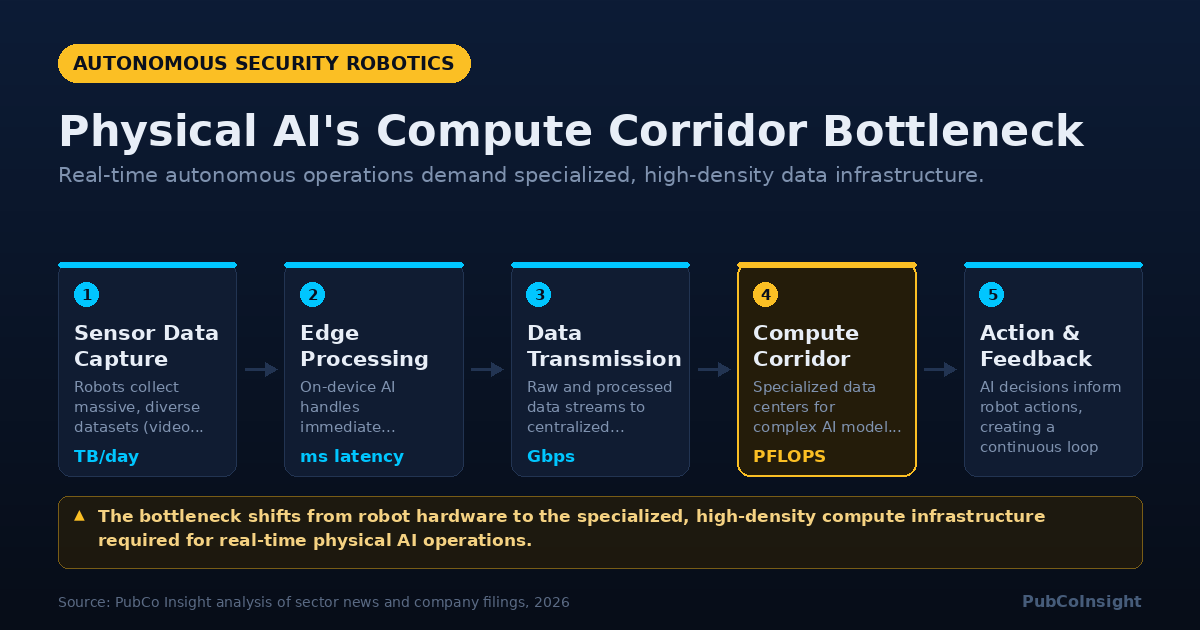
The Mechanism of Physical AI Infrastructure
Physical AI, unlike its cloud-based counterparts, operates in a constant feedback loop with the real world. An autonomous security robot, for example, processes live video feeds, lidar scans, thermal imaging, and acoustic data simultaneously. It must identify anomalies, classify threats, navigate complex environments, and communicate with human operators or other robots, all in milliseconds. This requires local edge processing for immediate reactions, but also significant backend compute for model training, complex situational awareness, and long-term pattern recognition. The mechanism involves a tiered compute architecture. On-device processors handle immediate, low-latency tasks like object detection and obstacle avoidance. This data then streams to regional compute corridors, specialized data centers optimized for high-throughput, low-latency processing of massive sensor datasets. Here, more complex AI models, often trained on vast proprietary datasets, perform tasks like behavioral analysis, predictive threat assessment, and coordinated multi-robot operations. The challenge lies in the sheer volume and velocity of data, coupled with the need for near-instantaneous inference. Traditional data centers, designed for general-purpose cloud computing, often lack the power density, specialized cooling, and network architecture to handle these demands efficiently. The bottleneck is not just raw processing power, but the entire physical environment housing that power: power delivery, cooling, network fabric, and security protocols tailored for sensitive, real-time physical AI workloads. If these corridors cannot scale efficiently, the operational reach and intelligence of autonomous security fleets will hit a hard ceiling.Companies Operating in This Sector
The infrastructure question touches every player in autonomous security robotics, though their approaches differ. Some focus on the physical hardware, others on the AI models, and a new class on the compute infrastructure itself. Ondas Inc. (ONDS, $7.62) and Red Cat Holdings, Inc. (RCAT, $8.37) are primarily known for their drone and unmanned system platforms. Ondas, through its Ondas Networks subsidiary, develops wireless and drone solutions. Red Cat focuses on enterprise drone solutions and software, including its 'Teal Drones' for defense and public safety. Their systems generate vast amounts of data, highlighting the need for robust backend processing. The efficiency of their data offload and processing capabilities directly impacts their operational utility. Companies like Arbe Robotics Ltd. (ARBE, $0.636) and MicroVision, Inc. (MVIS, $1.65) are focused on the sensor layer, providing advanced radar and lidar solutions, respectively. Arbe's 4D Imaging Radar is critical for autonomous perception, while MicroVision develops MEMS-based lidar. The precision and volume of data from these sensors demand significant real-time processing, often pushing the limits of on-device compute and requiring seamless integration with backend infrastructure. Lantronix, Inc. (LTRX, $5.22) and Kopin Corporation (KOPN, $4.28) provide components and solutions that enable the physical AI ecosystem. Lantronix offers secure data access and management solutions, essential for connecting autonomous devices to their compute backends. Kopin develops microdisplays and optical modules, critical for advanced vision systems in robotics. Their role is foundational, ensuring the data integrity and display capabilities that make physical AI actionable. BigBear.ai Holdings, Inc. (BBAI, $2.92) operates in the realm of decision intelligence, providing AI-powered analytics and data fusion. While not directly building robots, their platforms are precisely the kind of backend intelligence systems that would consume and process the data streams from autonomous security fleets, turning raw sensor input into actionable insights. Unusual Machines, Inc. (UMAC, $23.76) has been active in the drone space, recently strengthening its supply chain intelligence through a partnership with Altana to improve drone component manufacturing. Their focus on supply chain resilience for drone components underscores the growing industrialization of the sector, where reliable access to parts directly impacts deployment and scalability of physical AI systems. Serve Robotics Inc. (SERV, $4.945) focuses on last-mile delivery robots. Their operational model, involving fleets of autonomous ground vehicles, requires constant connectivity and real-time path planning, highlighting the edge-to-cloud compute demands for widespread physical AI deployment.Artificial Intelligence Technology Solutions, Inc.
Artificial Intelligence Technology Solutions, Inc. (AITX, $0.0044) operates in the autonomous security robotics sector through its subsidiary, Robotic Assistance Devices (RAD). The company specializes in building and leasing autonomous security robots and remote monitoring systems. AITX's business model centers on recurring monthly subscriptions for its solutions, rather than one-off hardware sales, positioning it as a service provider in the physical AI space. AITX's product line includes stationary and mobile autonomous security robots designed for perimeter protection, access control, and remote guarding. These devices integrate various sensors, including cameras, thermal imagers, and audio analytics, to detect and deter threats. The company’s filings indicate a focus on expanding its deployment footprint and increasing its recurring revenue streams. For instance, recent 8-K filings on August 31 and August 27, 2026, disclosed order intakes of 32 units and 14 units respectively, across various solutions and customer relationships. These orders demonstrate continued market penetration for their autonomous security offerings. The company also announced on September 1, 2026, that its RAD solutions would be showcased at GSX 2026 from three points on the show floor, indicating an active marketing and sales strategy. While AITX regularly reports unit orders, the public record does not yet consistently detail the average contract value or the long-term revenue impact of these deployments. The company's strategy emphasizes the scalable nature of its subscription model, aiming to build a substantial installed base that generates predictable revenue. AITX's investor 'Ask Me Anything' session on September 3, 2026, with CEO Reinharz, suggests an ongoing effort to engage with its shareholder base and provide updates on its operational progress and strategic direction for both AITX and PURSUON, another brand under its umbrella. The company’s consistent filing of 8-Ks, as seen through August and early September 2026, reflects active disclosure of its operational developments.What to watch
The compute corridor thesis will play out through several observable developments. Watch for announcements from major cloud providers or specialized data center operators detailing new facilities explicitly designed for physical AI workloads. Forkast News reported on September 7, 2026, that Anthropic’s Ninth Compute Corridor deepened Nvidia’s grip as supplier and landlord, and Nscale Pre-IPO $3.5B targets NYSE as Compute Landlord Thesis Reaches Public Markets. These suggest a market recognizing the demand for specialized compute infrastructure. Observe the capital expenditure reports from companies like Nvidia (NVDA), particularly any line items dedicated to "AI infrastructure partnerships" or "compute corridor development." Any significant increase here would signal a direct investment in this new class of facilities. Monitor the technical specifications of new autonomous security robot models. Increased processing demands or expanded sensor arrays will directly translate into higher backend compute requirements. Look for announcements regarding partnerships between robotics companies and infrastructure providers, or internal investments by robotics firms in their own specialized data centers. Finally, keep an eye on regulatory filings related to new data center construction or expansion in regions with high concentrations of autonomous vehicle or robotics testing. Permits issued for high-density compute facilities in areas like Arizona, California, or Texas, specifically mentioning AI or robotics applications, would be a strong indicator of this trend materializing., { "label": "Edge Processing", "note": "On-device AI handles immediate, low-latency tasks", "metric": "ms latency" }, { "label": "Data Transmission", "note": "Raw and processed data streams to centralized infrastructure", "metric": "Gbps" }, { "label": "Compute Corridor", "note": "Specialized data centers for complex AI model inference & training", "metric": "PFLOPS" }, { "label": "Action & Feedback", "note": "AI decisions inform robot actions, creating a continuous loop" } ], "highlight": 3, "highlight_note": "The bottleneck shifts from robot hardware to the specialized, high-density compute infrastructure required for real-time physical AI operations.", "footnote": "Source: PubCo Insight analysis of sector news and company filings, 2026" }Companies mentioned
| Ticker | Company | Price |
|---|---|---|
| AITX client | Artificial Intelligence Technology Solutions Inc | $0.0044 |
| ARBE | Arbe Robotics Ltd. | $0.636 |
| BBAI | BigBear.ai Holdings, Inc. | $2.92 |
| KOPN | Kopin Corporation | $4.28 |
| LTRX | Lantronix, Inc. | $5.22 |
| MVIS | MicroVision, Inc. | $1.65 |
| ONDS | Ondas Inc. | $7.62 |
| RCAT | Red Cat Holdings, Inc. | $8.37 |
| SERV | Serve Robotics Inc. | $4.945 |
| UMAC | Unusual Machines, Inc. | $23.76 |
Listed alphabetically, not ranked. Prices as of 2026-09-07 and they move. Check a live quote before relying on any of this.
How we chose the companies in this article
We cover a fixed universe of companies working in autonomous security robotics, physical AI and the guarding services market they are aimed at. Every one of them that had usable market data on 2026-09-07 appears in this article. We do not pick which ones to mention based on what we think of them, and we do not order them by size, price or trading volume, because an ordered list is a verdict and that is not ours to hand down. Companies left out, and why: none. American Lithium Minerals and Artificial Intelligence Technology Solutions pay us, which is disclosed in full at the foot of every article they appear in.
See the dilution and promotion flags before you see the pitch.
Each week: the micro and small-caps now showing dilution or paid-promotion signals, with the SEC filing behind every flag. No recommendations, no price targets.
Sources used in this article
- The Stock Market Is Flashing a Warning Seen Only 6 Times Since 1871, and History Is Crystal Clear That a Disaster Could Be Heading Toward Wall Street Motley Fool · 2026-09-07
- Anthropic’s Ninth Compute Corridor Deepens Nvidia’s Grip as Supplier and Landlord Forkast News · 2026-09-07
- Not a Crash, Not a Correction: What the September Effect Really Means for Artificial Intelligence (AI) Chip Stocks Motley Fool · 2026-09-07
- OpenAI Scientist Sounds the Alarm on AI, Warns ‘No One Is Prepared’ for What Comes Next — Hopes for ‘Voluntary Slowdowns’ in AI Development Benzinga Private Markets · 2026-09-07
- The Stock Market Just Did Something For the 3rd Time in Over 100 Years. If History Is Any Guide, Prepare For This to Come Next. Motley Fool · 2026-09-07
- Nscale Pre-IPO $3.5B Targets NYSE as Compute Landlord Thesis Reaches Public Markets Forkast News · 2026-09-07
- How Much Would You Need in Realty Income (O) Stock to Collect $500 a Month in Dividends? Motley Fool · 2026-09-07
- Where Will Tesla Be in 5 Years? Motley Fool · 2026-09-07
- A Once-in-a-Decade Opportunity: 1 Magnificent S&P 500 Stock Down 41% to Buy Right Now Motley Fool · 2026-09-07
- Rocket Lab's Neutron Just Slipped Again. Here's the Only Date That Still Matters for Shareholders. Motley Fool · 2026-09-07
- Unusual Machines CFO Brian Hoff Sells 11,413 Shares Motley Fool · 2026-09-05
- Why Is Axon (AXON) Up 3% Since Last Earnings Report? Zacks · 2026-09-04
Disclosure required by Section 17(b) of the Securities Act of 1933
Artificial Intelligence Technology Solutions, Inc., a Nevada corporation (OTCID: AITX). Artificial Intelligence Technology Solutions, Inc. pays Strategic Innovations First, Inc., a Wyoming corporation doing business as PulseIR. Compensation received: USD 5,000.00 per month for months 1-3 (August, September, October 2026); USD 10,000.00 per month for months 4-6 (November, December 2026, January 2027) contingent on the 90-day review. Minimum committed USD 15,000.00; USD 45,000.00 if the second-period rate triggers.. Form of payment: cash only, invoiced monthly in advance; no stock, options or warrants received or payable. Services: investor relations services under an Investor Relations Services Agreement effective 2026-08-01. Period: six month term, 2026-08-01 through 2027-01-31; 90-day review on or about 2026-10-30. No stock, options or warrants held by PubCo Insight, Pulse IR, Strategic Innovations First, Inc., or Brad Listermann. Confirmed by the executed agreement and by board record recKwdq39X2caPSX7 (POSITIONS HELD: none).
This is information, not investment, financial, legal or tax advice. It is not a recommendation or solicitation to buy, sell or hold any security and it contains no price target. Nothing here is independently verified by us. Confirm every figure against primary filings on SEC EDGAR before you act. Micro-cap and over-the-counter securities are speculative and illiquid and can lose all of their value. The companies named without a disclosure above pay us nothing and have no relationship with us; they are named because a published, mechanical screen selected them. Full disclosure policy.