Autonomous Security Robotics Market Set for $3.26 Trillion Expansion by 2040
A recent report projects the global physical AI market to reach $3.26 trillion by 2040, driven by the scaling of robotics and autonomous systems, creating a significant runway for growth in the security and guarding services sector.
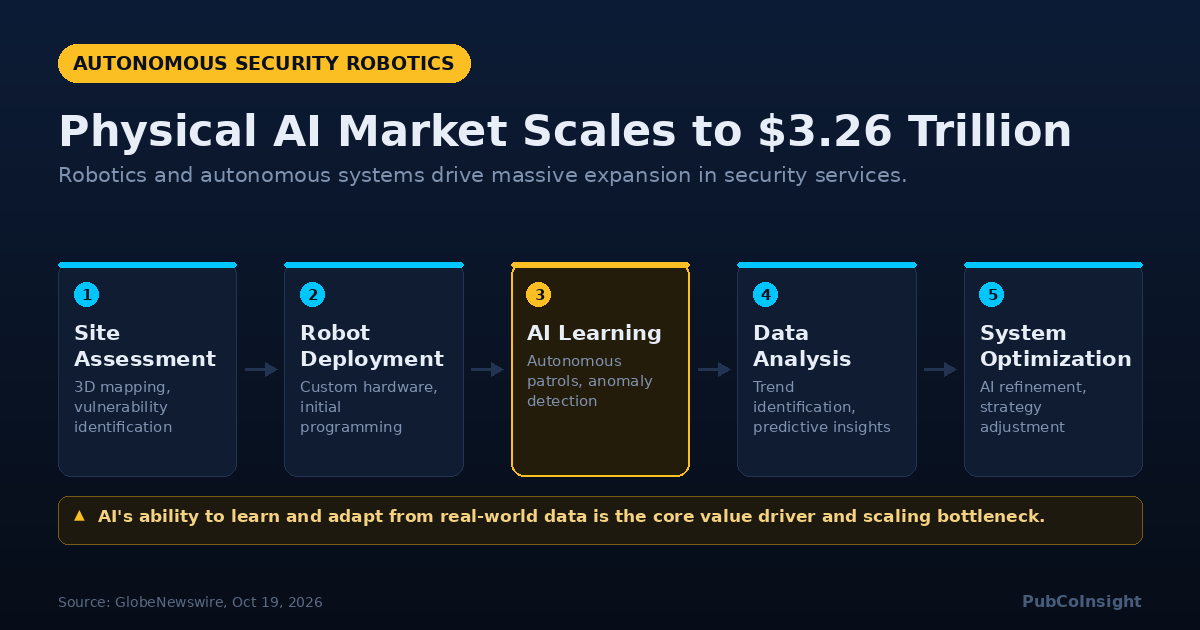
Mechanism of Autonomous Security Deployment
The transition to autonomous security robotics involves a multi-stage deployment process, moving from initial site assessment to continuous operational integration. First, a detailed site survey identifies critical areas, existing infrastructure, and specific security vulnerabilities. This phase often involves drone mapping or 3D laser scanning to create a precise digital twin of the environment. Next, robot selection and customization occur, matching specific device capabilities, like thermal imaging or advanced analytics, to the identified needs. This is where the physical AI component truly begins to manifest, with robots learning the layout and patrol routes. The third stage involves programming and initial deployment. This includes setting up patrol paths, defining alert protocols, and integrating with existing security command centers. Crucially, the AI systems learn from initial patrols, refining their understanding of normal operations versus anomalies. This machine learning loop is what differentiates autonomous systems from simple automation. A robot that merely follows a pre-programmed path is not physical AI; a robot that adapts its patrol based on real-time data, identifies new patterns, and flags unusual activity for human review, is. The fourth stage focuses on data aggregation and analysis. Autonomous units collect vast amounts of environmental data, from video feeds to sensor readings. This data is then processed by central AI platforms to identify trends, predict potential incidents, and optimize patrol efficiency. The real value unlocks when this data informs not just immediate alerts, but also long-term security strategy, allowing for predictive rather than reactive measures. This continuous feedback loop, where data from deployed robots improves the central AI, is the critical bottleneck for scaling. If the AI cannot effectively learn and adapt, the system remains a collection of expensive cameras on wheels.Companies Driving the Sector's Evolution
Several companies are actively developing and deploying solutions in this expanding market. Axon Enterprise, Inc. (AXON), though a larger player, continues to show significant momentum in the federal sector, securing new contracts for its integrated body camera and evidence management systems. While not purely autonomous robotics, Axon's focus on data capture and secure evidence management forms a critical backbone for any future autonomous security deployment, especially where accountability and post-incident analysis are paramount. Their recent federal contract wins, reported on October 17 and October 15, highlight continued government spending on advanced security technologies. In the pure-play autonomous robotics space, Serve Robotics Inc. (SERV) focuses on last-mile delivery robots. While currently centered on food delivery, the underlying autonomous navigation and obstacle avoidance technology has direct applicability to security patrols in defined urban or campus environments. The company's stock experienced a plunge this week, as reported on October 17, but the core technology remains relevant to broader physical AI applications. Ondas Inc. (ONDS), with its focus on drone technology, is expanding into sovereign AI capabilities through its Regna AI launch with Palantir, announced on October 16. This partnership aims to leverage AI for defense missions, pushing the boundaries of autonomous aerial surveillance and response. Their recent EASA certification for an advanced missile protection system on the Bombardier Global 7500, reported on October 13, demonstrates their commitment to high-stakes autonomous applications. Unusual Machines, Inc. (UMAC), at $16.31, is exploring "Swarm Economics" with its XTEND AI robotics, as highlighted on October 15. The concept of swarm robotics, where multiple smaller, autonomous units coordinate to achieve a larger objective, is a significant leap in physical AI. This approach could offer redundancy and scalability in security deployments, distributing risk and coverage across numerous smaller, more agile units. The appointment of Unusual Machines CEO Dr. Allan Evans to XTI Aerospace's board on October 14 suggests a broader strategic vision for autonomous systems. Other companies contribute critical components or adjacent technologies. Arbe Robotics Ltd. (ARBE), at $0.46, develops high-resolution 4D imaging radar solutions, essential for robust autonomous navigation and object detection in varying environmental conditions. MicroVision, Inc. (MVIS), trading at $1.13, focuses on lidar technology for advanced driver-assistance systems (ADAS) and autonomous vehicles, another foundational sensing technology for mobile security robots. Kopin Corporation (KOPN), at $3.29, is involved in display technologies for augmented reality and virtual reality, which could play a role in human-robot interfaces for monitoring and control. Kopin's participation in a live YouTube "Ask Me Anything" panel on AI infrastructure on October 16 indicates their continued engagement with the broader AI ecosystem. Lantronix, Inc. (LTRX), at $5.61, provides secure data access and management solutions, critical for the reliable operation and data transfer from autonomous security units. Red Cat Holdings, Inc. (RCAT), at $4.72, focuses on drone technology, including hardware and software for military and commercial applications, aligning with the aerial surveillance needs of physical AI security. BigBear.ai Holdings, Inc. (BBAI), at $2.16, specializes in AI-powered analytics and decision intelligence, which can process the vast datasets generated by autonomous security robots to provide actionable insights.Artificial Intelligence Technology Solutions, Inc.
Artificial Intelligence Technology Solutions, Inc. (AITX), trading on the OTCID tier under AITX at $0.0016, operates through subsidiaries like Robotic Assistance Devices, Inc. (RAD-I) and Robotic Assistance Devices Mobile (RAD-M). The company builds and leases autonomous security robots and remote monitoring systems, primarily under a recurring monthly subscription model. This "Solutions-as-a-Service" approach targets the security and guarding services industry, which AITX estimates to be an approximately $50 billion market in the United States. AITX's solutions are designed to deliver significant cost savings, ranging from 35% to 80%, compared with traditional manned security. Their portfolio includes both stationary and mobile devices, supported by proprietary software and monitoring platforms. RAD-I focuses on stationary security devices, while RAD-M develops mobile autonomous platforms, including the ROAMEO mobile security unit, which began early commercial deployment in May 2026. The company also operates Robotic Assistance Devices Group (RAD-G), responsible for the SARA agentic artificial intelligence platform, which AITX projects will generate substantial revenue through licensing. Robotic Assistance Devices Lanka (Private) Limited, a wholly owned subsidiary in Sri Lanka, provides software development, AI initiatives, and technical operations support. AITX describes its long-term strategy as "RAD Town," aiming for integrated autonomous security deployments across entire campuses, communities, or jurisdictions. For the fiscal year ended February 28, 2026, AITX reported revenue of $7,745,336, a 26% increase year-over-year. Gross profit rose 48% to $5,533,700, with gross margin expanding to approximately 71%. Operating expenses remained flat at around $17,477,097, and the loss from operations improved by approximately $2.0 million to $(11,943,397). The company reported a net loss of approximately $14.5 million for the fiscal year. As of February 28, 2026, AITX had an accumulated deficit of approximately $171 million and negative working capital of $17,017,745. The company's independent registered public accounting firm has included an explanatory paragraph in its report expressing substantial doubt about AITX's ability to continue as a going concern. Management does not anticipate having positive cash flow from operations in the near term. The public record does not yet establish the full scale of RAD-M's commercial deployments or the widespread adoption of the SARA platform licensing model. On October 14, 2026, AITX's RAD division added another municipal customer with a seven-unit ROSA order, indicating continued traction for its stationary solutions.What to watch
Investors should monitor the ongoing commercial deployment of mobile autonomous platforms like AITX's ROAMEO unit, specifically looking for detailed customer contracts and deployment numbers beyond early pilot programs. The adoption rate of AI platform licensing, such as AITX's SARA, will be a key indicator of broader market acceptance for physical AI software solutions. Watch for further federal contract announcements from companies like Axon, which can signal increasing government investment in advanced security technologies. The progress of Ondas's Regna AI partnership with Palantir, particularly in securing defense-related contracts, will provide insight into high-value autonomous system deployments. For Unusual Machines, Inc., any further developments in "Swarm Economics" and multi-unit deployments will be important to track for scalability. Finally, look for filings related to capital raises or strategic partnerships from smaller players, as these can provide the necessary funding for accelerated product development and market penetration in a rapidly expanding sector., { "label": "Robot Deployment", "note": "Custom hardware, initial programming" }, { "label": "AI Learning", "note": "Autonomous patrols, anomaly detection" }, { "label": "Data Analysis", "note": "Trend identification, predictive insights" }, { "label": "System Optimization", "note": "AI refinement, strategy adjustment" } ], "highlight": 2, "highlight_note": "AI's ability to learn and adapt from real-world data is the core value driver and scaling bottleneck.", "footnote": "Source: GlobeNewswire, Oct 19, 2026" }Companies mentioned
| Ticker | Company | Price |
|---|---|---|
| AITX client | Artificial Intelligence Technology Solutions Inc | $0.0016 |
| ARBE | Arbe Robotics Ltd. | $0.46 |
| BBAI | BigBear.ai Holdings, Inc. | $2.16 |
| KOPN | Kopin Corporation | $3.29 |
| LTRX | Lantronix, Inc. | $5.61 |
| MVIS | MicroVision, Inc. | $1.13 |
| ONDS | Ondas Inc. | $6.04 |
| RCAT | Red Cat Holdings, Inc. | $4.72 |
| SERV | Serve Robotics Inc. | $3.23 |
| UMAC | Unusual Machines, Inc. | $16.31 |
Listed alphabetically, not ranked. Prices as of 2026-10-19 and they move. Check a live quote before relying on any of this.
How we chose the companies in this article
We cover a fixed universe of companies working in autonomous security robotics, physical AI and the guarding services market they are aimed at. Every one of them that had usable market data on 2026-10-19 appears in this article. We do not pick which ones to mention based on what we think of them, and we do not order them by size, price or trading volume, because an ordered list is a verdict and that is not ours to hand down. Companies left out, and why: none. American Lithium Minerals and Artificial Intelligence Technology Solutions pay us, which is disclosed in full at the foot of every article they appear in.
See the dilution and promotion flags before you see the pitch.
Each week: the micro and small-caps now showing dilution or paid-promotion signals, with the SEC filing behind every flag. No recommendations, no price targets.
Sources used in this article
- Hyperliquid CEO Jeff Yan Says Perpetual Futures Markets Can Democratize Access to Pre-IPO Companies. Here's Why He's Right. Motley Fool · 2026-10-19
- Prediction: This Will Be SpaceX's Stock Price By the End of 2027 Motley Fool · 2026-10-19
- If I Only Had $500 to Invest Right Now, This Is the ETF I'd Buy Without Any Hesitation Motley Fool · 2026-10-19
- Prediction: Microsoft Stock Is Going to Soar After Oct. 28 Motley Fool · 2026-10-19
- Is Visa Stock Still a Buy After Gaining 14% This Year? Motley Fool · 2026-10-19
- Stocks to Watch: Intel, CXMT, French Banks The Wall Street Journal · 2026-10-19
- Update: Market Chatter: Nvidia Leaning Towards Using Taiwan Semiconductor Process in New Memory Chips MT Newswires · 2026-10-19
- Global Physical Artificial Intelligence (AI) Market Report 2026-2040 | Market to Reach $3.26 Trillion as Robotics, Autonomous Systems, and Wearables Scale GlobeNewswire · 2026-10-19
- Not So Fast! One Warren Buffett's Core Positions at Berkshire Hathaway May Not Get the Heave-Ho by Successor Greg Abel After All. Motley Fool · 2026-10-19
- If You Invested $100 a Month in This High-Yield Dividend Stock, Here's the Dividend Income It Produced Over 10 Years Motley Fool · 2026-10-19
- Axon Stock Fell 6% in a Day and Is Down 31% in 2026. Time to Sell or Load Up? TIKR · 2026-10-17
- Axon Stock In Focus After Federal Contract Wins Simply Wall St. · 2026-10-17
Disclosure required by Section 17(b) of the Securities Act of 1933
Artificial Intelligence Technology Solutions, Inc., a Nevada corporation (OTCID: AITX). Artificial Intelligence Technology Solutions, Inc. pays Strategic Innovations First, Inc., a Wyoming corporation doing business as PulseIR. Compensation received: USD 5,000.00 per month for months 1-3 (August, September, October 2026); USD 10,000.00 per month for months 4-6 (November, December 2026, January 2027) contingent on the 90-day review. Minimum committed USD 15,000.00; USD 45,000.00 if the second-period rate triggers.. Form of payment: cash only, invoiced monthly in advance; no stock, options or warrants received or payable. Services: investor relations services under an Investor Relations Services Agreement effective 2026-08-01. Period: six month term, 2026-08-01 through 2027-01-31; 90-day review on or about 2026-10-30. No stock, options or warrants held by PubCo Insight, Pulse IR, Strategic Innovations First, Inc., or Brad Listermann. Confirmed by the executed agreement and by board record recKwdq39X2caPSX7 (POSITIONS HELD: none).
This is information, not investment, financial, legal or tax advice. It is not a recommendation or solicitation to buy, sell or hold any security and it contains no price target. Nothing here is independently verified by us. Confirm every figure against primary filings on SEC EDGAR before you act. Micro-cap and over-the-counter securities are speculative and illiquid and can lose all of their value. The companies named without a disclosure above pay us nothing and have no relationship with us; they are named because a published, mechanical screen selected them. Full disclosure policy.