Serve Robotics Explores New Markets as Uber Exits Stake
Serve Robotics is looking to expand its autonomous delivery capabilities beyond food, a strategic shift signaled by Uber's recent sale of its entire stake in the company.
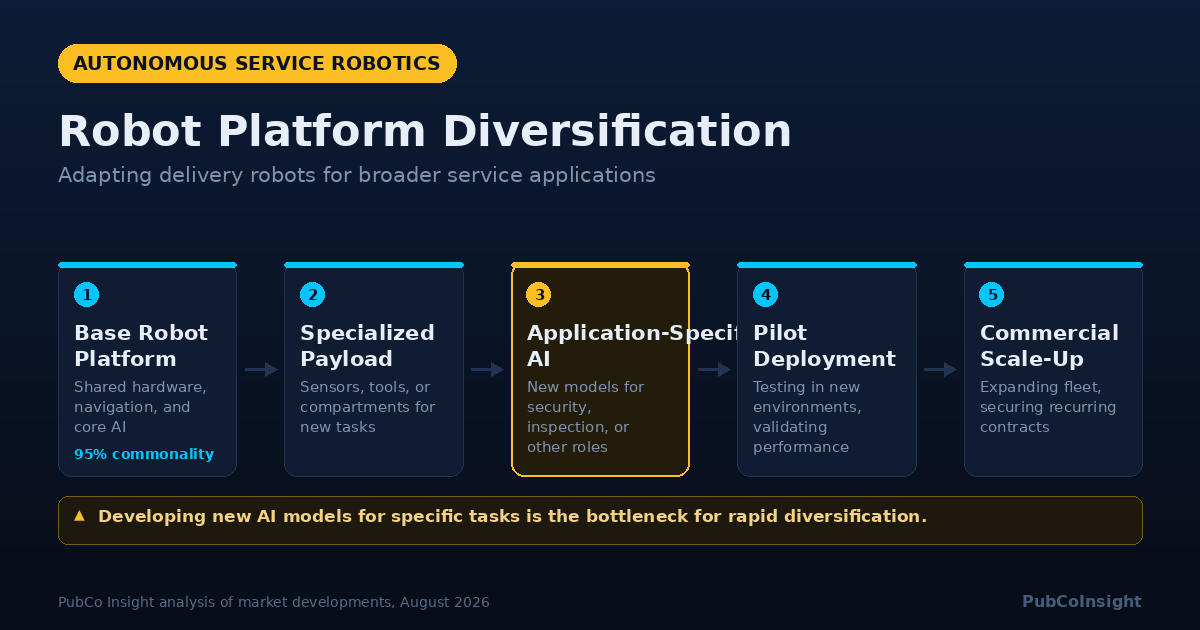
The Mechanism of Autonomous Service Expansion
Scaling physical AI beyond a single application like food delivery requires a modular approach to robot design and software architecture. A robot built for delivering burritos must navigate sidewalks, cross streets, and interact with pedestrians and customers. These core capabilities, including precise GPS localization, obstacle avoidance using lidar and cameras, and robust communication protocols, are directly transferable to other service roles. The critical difference lies in the end-effector, the specific tool or payload the robot carries, and the specialized software layer that dictates its mission. For instance, a delivery robot carries a temperature-controlled compartment. A security robot, however, might carry an array of high-resolution cameras, thermal imaging sensors, microphones, and two-way communication systems. The base chassis, power management, and fundamental navigation algorithms remain largely the same. The challenge then becomes integrating new sensor packages, developing specialized AI models for threat detection or anomaly identification, and ensuring the robot can operate autonomously for extended periods in diverse environments without human intervention. This requires robust battery technology, efficient charging infrastructure, and a sophisticated fleet management system that can handle varied mission profiles. Proving this adaptability in new operational contexts, like patrolling a corporate campus versus delivering a meal, is the key hurdle.Companies Operating in the Sector
The autonomous security and physical AI space features a range of companies, each with distinct approaches to hardware, software, and market penetration. Ondas Inc. (ONDS), trading at $9.24, focuses on proprietary wireless and drone technology. Its subsidiary, American Robotics, develops autonomous drone systems for industrial inspection and data collection. The company saw its stock rise on August 14, 2026, following news of new tariffs on drone imports, suggesting a potential benefit for domestic manufacturers. Ondas's strength lies in its ability to integrate advanced communication with aerial robotics, a different but related segment of physical AI. Unusual Machines, Inc. (UMAC), priced at $34.06, also experienced significant movement on August 14, 2026, with its stock soaring on the same tariff news. Unusual Machines concentrates on drone manufacturing and related services, positioning itself as a beneficiary of policies favoring domestic production. Its focus on the hardware aspect of unmanned aerial vehicles provides a contrast to companies building ground-based autonomous platforms. Red Cat Holdings, Inc. (RCAT), at $11.13, is another player in the drone sector, providing hardware and software solutions for defense, enterprise, and consumer markets. Red Cat's recent performance, alongside Unusual Machines and Ondas, highlights the impact of geopolitical and trade policy on the drone segment of physical AI. In the sensor and perception technology space, companies like MicroVision, Inc. (MVIS), at $2.24, and Arbe Robotics Ltd. (ARBE), at $0.797, are critical enablers. MicroVision develops lidar technology for automotive safety and advanced driver-assistance systems. Arbe Robotics specializes in 4D imaging radar solutions, offering high-resolution perception for autonomous vehicles. These technologies are foundational for any autonomous robot requiring precise environmental understanding, whether for delivery, security, or industrial applications. Kopin Corporation (KOPN), priced at $5.5, contributes to this ecosystem through its microdisplay and optical solutions, essential for augmented reality and heads-up displays that might interface with autonomous systems. Lantronix, Inc. (LTRX), trading at $6.47, provides secure data access and management solutions for the Internet of Things (IoT) and remote environment management. Its technology enables the secure communication and control necessary for large fleets of autonomous robots, ensuring data integrity and operational reliability. BigBear.ai Holdings, Inc. (BBAI), at $3.27, operates in the artificial intelligence and machine learning domain, primarily serving government and defense clients. While not directly building physical robots, BigBear.ai's expertise in predictive analytics and decision intelligence could play a role in optimizing autonomous fleet operations or enhancing the intelligence of security platforms. Axon Enterprise (AXON), though not directly in the micro-cap autonomous robotics space, is worth noting due to its August 14, 2026, revenue outlook increase driven by connected devices. Axon's focus on public safety technology, including body cameras and TASER devices, shows a pathway for integrating physical AI with existing security infrastructure.Artificial Intelligence Technology Solutions, Inc.
Artificial Intelligence Technology Solutions, Inc. (AITX) trades over the counter under the symbol AITX. The company develops and leases autonomous security robots and remote monitoring systems. Its business model centers on recurring monthly subscriptions rather than one-off hardware sales. AITX’s operations are structured around several subsidiaries: Robotic Assistance Devices, Inc. (RAD-I) for stationary security devices, Robotic Assistance Devices Mobile (RAD-M) for mobile autonomous platforms, and Robotic Assistance Devices Group (RAD-G) for its SARA agentic artificial intelligence platform. RAD Lanka, a wholly owned subsidiary in Sri Lanka, handles software development and AI initiatives. AITX describes its primary subsidiary, RAD-I, as targeting the security and guarding services industry, which it estimates as a $50 billion market in the United States. The company states its solutions aim to deliver cost savings between 35% and 80% compared to traditional manned security. AITX's product suite includes both stationary and mobile devices, integrated with its proprietary software and monitoring platforms. The ROAMEO mobile security unit, a product of RAD-M, began early commercial deployment in May 2026. The company’s long-term vision, referred to internally as "RAD Town," involves integrated autonomous security deployments across campuses, communities, or jurisdictions. AITX reported revenue of $7,745,336 for the fiscal year ended February 28, 2026, a 26% increase over the prior year. Gross profit increased by 48% to $5,533,700, with gross margin expanding to approximately 71% from 61%. Operating expenses remained flat at around $17,477,097, and the loss from operations improved by approximately $2.0 million to $(11,943,397). The company reported a net loss of approximately $14.5 million for the fiscal year ended February 28, 2026, with an accumulated deficit of approximately $171 million as of that date. The company’s independent registered public accounting firm has expressed substantial doubt about its ability to continue as a going concern. For the year ended February 28, 2026, AITX had negative cash flow from operating activities of $9,344,534. As of February 28, 2026, the company had negative working capital of $17,017,745. The public record does not yet establish a clear path to sustained positive cash flow from operations. The company’s filings indicate management does not anticipate having positive cash flow from operations in the near term.What to watch
Investors should monitor Serve Robotics' upcoming announcements regarding specific new market verticals. Any pilot programs or commercial agreements outside of food delivery will be key indicators. Pay attention to the types of environments or industries Serve targets, such as corporate campuses, logistics hubs, or retail security. For Ondas (ONDS) and Unusual Machines (UMAC), the impact of the recently imposed drone tariffs on their order books and revenue growth will be important. Specific contract wins or expansions in their domestic markets, particularly in Q3 and Q4 2026 earnings reports, will show if the tariffs are translating into tangible benefits. Watch for any new filings from Artificial Intelligence Technology Solutions (AITX) detailing progress on ROAMEO deployments or new SARA platform licensing agreements. The company's ability to demonstrate a reduction in its accumulated deficit and a move towards positive cash flow from operations in its subsequent filings will be a critical metric., {"label": "Specialized Payload", "note": "Sensors, tools, or compartments for new tasks"}, {"label": "Application-Specific AI", "note": "New models for security, inspection, or other roles"}, {"label": "Pilot Deployment", "note": "Testing in new environments, validating performance"}, {"label": "Commercial Scale-Up", "note": "Expanding fleet, securing recurring contracts"}], "highlight": 2, "highlight_note": "Developing new AI models for specific tasks is the bottleneck for rapid diversification.", "footnote": "PubCo Insight analysis of market developments, August 2026"}Companies mentioned
| Ticker | Company | Price |
|---|---|---|
| AITX client | Artificial Intelligence Technology Solutions Inc | $0.007 |
| ARBE | Arbe Robotics Ltd. | $0.797 |
| BBAI | BigBear.ai Holdings, Inc. | $3.27 |
| KOPN | Kopin Corporation | $5.5 |
| LTRX | Lantronix, Inc. | $6.47 |
| MVIS | MicroVision, Inc. | $2.24 |
| ONDS | Ondas Inc. | $9.24 |
| RCAT | Red Cat Holdings, Inc. | $11.13 |
| SERV | Serve Robotics Inc. | $4.99 |
| UMAC | Unusual Machines, Inc. | $34.06 |
Listed alphabetically, not ranked. Prices as of 2026-08-17 and they move. Check a live quote before relying on any of this.
How we chose the companies in this article
We cover a fixed universe of companies working in autonomous security robotics, physical AI and the guarding services market they are aimed at. Every one of them that had usable market data on 2026-08-17 appears in this article. We do not pick which ones to mention based on what we think of them, and we do not order them by size, price or trading volume, because an ordered list is a verdict and that is not ours to hand down. Companies left out, and why: none. American Lithium Minerals and Artificial Intelligence Technology Solutions pay us, which is disclosed in full at the foot of every article they appear in.
See the dilution and promotion flags before you see the pitch.
Each week: the micro and small-caps now showing dilution or paid-promotion signals, with the SEC filing behind every flag. No recommendations, no price targets.
Sources used in this article
- 2 Stocks Down 15% and 30% to Buy Right Now and Hold for the Next Decade Motley Fool · 2026-08-17
- AM Applications Analysis: Parts Produced 2025-2034 Delivers 10-Year Additive Manufacturing Market Forecast GlobeNewswire · 2026-08-17
- Where Will Workday Stock Be in 5 Years If Silver Lake Doesn't Buy It? Motley Fool · 2026-08-17
- Billionaire Stanley Druckenmiller Dumped Micron and Intel, and More Than 11X'd Duquesne Family Office's Stake in an AI Pioneer Motley Fool · 2026-08-17
- Salesforce Borrowed $25 Billion to Buy Its Own Stock and Cut Its Cash Flow Growth Guidance in Half Motley Fool · 2026-08-17
- Nebius Group (NBIS) Emerges As A Key Bidder In Decart AI Talks Simply Wall St. · 2026-08-17
- Wall Street Says the Stock Market's Return Will Crush the Long-Term Average in the Next Year Motley Fool · 2026-08-17
- Nvidia Discloses Multi-Billion-Dollar Stakes in Intel, SpaceX in Filing MT Newswires · 2026-08-17
- Fed Chair Kevin Warsh's Job Just Got Much Easier. Here's What's Likely Next for the Stock Market As a Result. Motley Fool · 2026-08-17
- EMCOR and Thor Industries have been highlighted as Zacks Bull and Bear of the Day Zacks · 2026-08-17
- Why Are Nasdaq, S&P 500 Futures Rising Premarket? SPCX, NVDA, SNDK, MU, NLST, BABA, SLS, RKLB Stocks In Focus Stocktwits · 2026-08-17
- Uber Sells Serve Robotics Stake, Catches Company Off Guard: ‘Differing Views’ Sour Partnership Benzinga · 2026-08-17
Disclosure required by Section 17(b) of the Securities Act of 1933
Artificial Intelligence Technology Solutions, Inc., a Nevada corporation (OTCID: AITX). Artificial Intelligence Technology Solutions, Inc. pays Strategic Innovations First, Inc., a Wyoming corporation doing business as PulseIR. Compensation received: USD 5,000.00 per month for months 1-3 (August, September, October 2026); USD 10,000.00 per month for months 4-6 (November, December 2026, January 2027) contingent on the 90-day review. Minimum committed USD 15,000.00; USD 45,000.00 if the second-period rate triggers.. Form of payment: cash only, invoiced monthly in advance; no stock, options or warrants received or payable. Services: investor relations services under an Investor Relations Services Agreement effective 2026-08-01. Period: six month term, 2026-08-01 through 2027-01-31; 90-day review on or about 2026-10-30. No stock, options or warrants held by PubCo Insight, Pulse IR, Strategic Innovations First, Inc., or Brad Listermann. Confirmed by the executed agreement and by board record recKwdq39X2caPSX7 (POSITIONS HELD: none).
This is information, not investment, financial, legal or tax advice. It is not a recommendation or solicitation to buy, sell or hold any security and it contains no price target. Nothing here is independently verified by us. Confirm every figure against primary filings on SEC EDGAR before you act. Micro-cap and over-the-counter securities are speculative and illiquid and can lose all of their value. The companies named without a disclosure above pay us nothing and have no relationship with us; they are named because a published, mechanical screen selected them. Full disclosure policy.