Portable AI Security Towers Target Broad Market Access
Artificial Intelligence Technology Solutions, Inc. introduced its RAIA Portable AI Security Tower, a development that could reshape how autonomous security solutions reach a wider range of customers.
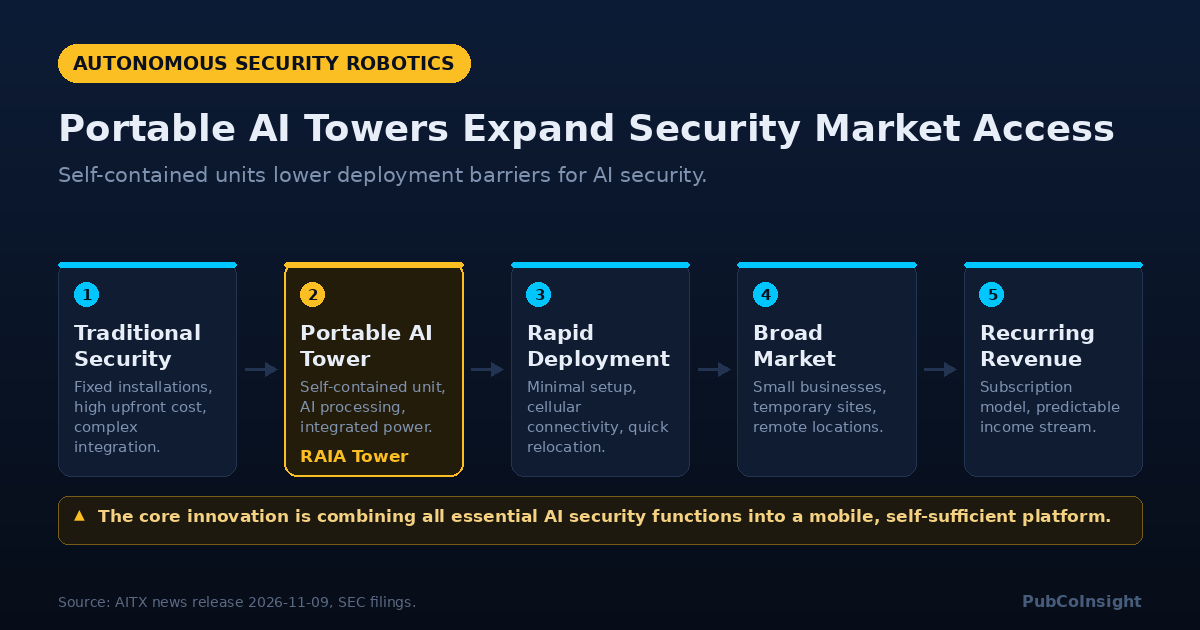
The Mechanism of Rapid Deployment
Portable AI security towers condense the essential components of an autonomous security system into a single, mobile platform. This typically includes a mast-mounted camera array, often with thermal and optical sensors, onboard AI processing units for real-time threat detection, and a power source, usually a combination of battery storage and solar panels. The critical innovation is the integration of these elements into a unit that requires minimal setup. A user simply positions the tower, powers it on, and connects it to a network, often via cellular data. For this to be effective, three conditions must hold. First, the AI models must be robust enough to perform accurately in varied, un-optimized environments, detecting anomalies without extensive site-specific training. Second, the power management system must deliver sufficient uptime, especially in remote locations or during extended periods without direct sunlight. Third, the communication infrastructure needs to be resilient, allowing for reliable remote monitoring and incident response without relying on existing client-side networks. If the AI struggles with false positives in new settings, if the batteries drain too quickly, or if connectivity drops, the value proposition erodes. Success hinges on these towers being truly "set up yourself" and "always on" in diverse conditions, not just in controlled demonstrations.Companies Operating in Autonomous Security Robotics
The autonomous security robotics market features a range of companies developing different facets of the technology. Arbe Robotics Ltd. (ARBE) focuses on high-resolution 4D imaging radar solutions, which are critical for precision navigation and object detection in autonomous systems, including those used in security. Their technology offers enhanced perception capabilities beyond traditional cameras, particularly in adverse weather conditions. BigBear.ai Holdings, Inc. (BBAI) develops AI-powered analytics and decision intelligence software, which can be integrated into security platforms for predictive threat assessment and operational efficiency. Their strength lies in processing vast datasets to provide actionable insights, a capability increasingly vital for sophisticated autonomous security operations. Kopin Corporation (KOPN) specializes in microdisplays and optical solutions, components that could find application in advanced sensor arrays for security robots or in augmented reality interfaces for human operators managing these systems. Their expansion of Massachusetts capacity for MicroLED manufacturing suggests a push for higher volume production of these components. Lantronix, Inc. (LTRX) provides secure data access and management solutions, essential for connecting and controlling remote autonomous devices. Their embedded solutions and software platforms are crucial for ensuring reliable and secure communication between security robots and command centers, a key enabler for widespread deployment. MicroVision, Inc. (MVIS) develops lidar technology, another critical sensor type for autonomous navigation and mapping. High-resolution lidar systems provide precise 3D environmental data, allowing security robots to understand their surroundings and detect intruders with accuracy, even in complex environments. Ondas Inc. (ONDS), through its American Robotics subsidiary, offers autonomous drone solutions for industrial and security applications. Their "drone-in-a-box" systems provide automated aerial surveillance, complementing ground-based autonomous robots by offering an overhead perspective for monitoring large areas. Recent news on Ondas ahead of earnings and a $315 million award for AeroVironment (not in this list but a peer) highlight the growing drone market. Red Cat Holdings, Inc. (RCAT) focuses on drone technology and related software, including solutions for defense and public safety. Their offerings could extend to security applications, providing adaptable aerial platforms for surveillance and reconnaissance, particularly in situations requiring rapid deployment or covering expansive terrains. Serve Robotics Inc. (SERV) develops autonomous sidewalk delivery robots. While their primary focus is logistics, the underlying autonomous navigation and obstacle avoidance technologies share common ground with security robotics. Their Q3 2026 earnings call highlighted revenue surges over 300%, demonstrating traction in autonomous service deployments. Unusual Machines, Inc. (UMAC) designs and manufactures specialized machinery, which could include components or platforms for advanced robotics. Their Q3 earnings call highlighted expansion and demand outlook, suggesting growth in their manufacturing capabilities relevant to the broader robotics sector.Artificial Intelligence Technology Solutions, Inc.
Artificial Intelligence Technology Solutions, Inc. (AITX), trading under the ticker AITX on the OTCID tier, operates through subsidiaries focused on building and leasing autonomous security robots and remote monitoring systems. The company structures its revenue through recurring monthly subscriptions for these services, rather than one-time hardware sales. This model aligns with the growing trend of "Robotics-as-a-Service" (RaaS), aiming to provide a predictable revenue stream and lower upfront costs for customers. AITX's recent unveiling of the RAIA Portable AI Security Tower exemplifies its strategy to expand market reach. This product is designed for rapid deployment, allowing customers to set up an AI-powered security presence without extensive infrastructure. This contrasts with their larger, fixed-site units like the Stationary Autonomous Guarding (RAD) models. The RAIA tower integrates AI for threat detection, a camera array, and a self-contained power source, making it suitable for temporary events, construction sites, or remote locations where traditional security infrastructure is lacking or too costly. The company's filings, including the 8-K from November 9, 2026, detail this product launch and anticipated Q1 2027 deliveries. The company's most recent substantive filing, a 10-Q for the period ending August 31, 2026, shows total current assets of $3,012,097 and total current liabilities of $58,906,967, resulting in negative working capital of $55,894,870. The filing also reports negative cash flow from operating activities of $4,820,842 for the six months ended August 31, 2026, and an accumulated deficit of $184,084,880. Management acknowledges these factors raise substantial doubt about the company's ability to continue as a going concern, while also stating their commitment to raising funds through growing revenues, equity proceeds, and issuing debt. They have an equity financing agreement from June 23, 2026, to purchase up to $10,000,000 of common stock over three years, with approximately $9.8 million remaining under this arrangement. The public record does not yet establish the rate at which this remaining equity financing will be drawn down or its impact on future cash flow. The company's revenue-earning devices, net of depreciation, were valued at $4,677,987 as of August 31, 2026. This portfolio of deployed units forms the basis for their recurring subscription revenue model.What to watch
Investors should monitor specific, checkable developments. Look for AITX's Q1 2027 financial filings to confirm initial deliveries and revenue generation from the RAIA Portable AI Security Tower. Pay attention to any subsequent 8-K filings detailing order volumes or customer agreements for the new towers. For Ondas, their upcoming earnings report, anticipated after November 9, 2026, will shed light on their drone segment's performance and any new contract wins. Axon Enterprise (AXON), a larger player in public safety technology, recently made a $1.2 billion commitment to a public safety drone deal, as reported on November 7, 2026. While not directly competing with AITX's ground-based towers, this highlights the broader market's appetite for advanced, autonomous security solutions. Keep an eye on Kopin Corporation's progress in expanding its Massachusetts MicroLED manufacturing capacity, as announced on November 9, 2026, which could signal future supply chain dynamics for advanced display components used in robotics. Finally, watch for any announcements from Serve Robotics Inc. regarding further expansion of their autonomous delivery footprint, as their Q3 2026 earnings showed significant revenue growth, indicating increasing market acceptance for autonomous service robots., { "label": "Portable AI Tower", "note": "Self-contained unit, AI processing, integrated power.", "metric": "RAIA Tower" }, { "label": "Rapid Deployment", "note": "Minimal setup, cellular connectivity, quick relocation." }, { "label": "Broad Market Access", "note": "Small businesses, temporary sites, remote locations." }, { "label": "Recurring Revenue", "note": "Subscription model, predictable income stream." } ], "highlight": 1, "highlight_note": "The core innovation is combining all essential AI security functions into a mobile, self-sufficient platform.", "footnote": "Source: AITX news release 2026-11-09, SEC filings." }Companies mentioned
| Ticker | Company | Price |
|---|---|---|
| AITX client | Artificial Intelligence Technology Solutions Inc | $0.0004 |
| ARBE | Arbe Robotics Ltd. | $0.47 |
| BBAI | BigBear.ai Holdings, Inc. | $2.45 |
| KOPN | Kopin Corporation | $3.38 |
| LTRX | Lantronix, Inc. | $5.45 |
| MVIS | MicroVision, Inc. | $1.24 |
| ONDS | Ondas Inc. | $5.97 |
| RCAT | Red Cat Holdings, Inc. | $4.5 |
| SERV | Serve Robotics Inc. | $3.39 |
| UMAC | Unusual Machines, Inc. | $13.48 |
Listed alphabetically, not ranked. Prices as of 2026-11-10 and they move. Check a live quote before relying on any of this.
How we chose the companies in this article
We cover a fixed universe of companies working in autonomous security robotics, physical AI and the guarding services market they are aimed at. Every one of them that had usable market data on 2026-11-10 appears in this article. We do not pick which ones to mention based on what we think of them, and we do not order them by size, price or trading volume, because an ordered list is a verdict and that is not ours to hand down. Companies left out, and why: none. American Lithium Minerals and Artificial Intelligence Technology Solutions pay us, which is disclosed in full at the foot of every article they appear in.
See the dilution and promotion flags before you see the pitch.
Each week: the micro and small-caps now showing dilution or paid-promotion signals, with the SEC filing behind every flag. No recommendations, no price targets.
Sources used in this article
- Axon Enterprise: 3 Key Takeaways for Long-Term Investors Motley Fool · 2026-11-10
- AMD Stock Clocks Best Day In 6 Months — But Michael Burry Won’t Touch The Nvidia Headline Trade Stocktwits · 2026-11-10
- Moonshot AI rents Nvidia’s top chips in China, Bloomberg reports Investing.com · 2026-11-10
- Warren Buffett's Instructions for His Wife's Inheritance Are 90% Stocks and 10% Bonds. Here's How That Mix Has Done Since 2000. Motley Fool · 2026-11-10
- AP Top Extended Financial Headlines at 1:24 a.m. EST Associated Press · 2026-11-10
- AP Top Financial News at 1:24 a.m. EST Associated Press · 2026-11-10
- 3 US AI Chip Stocks Beyond Nvidia Stock Key Person Risk Simply Wall St. · 2026-11-10
- Why Firefly Stock Soared Today Motley Fool · 2026-11-10
- Asia stocks rally as Korean chips surge and oil retreat lifts sentiment Investing.com · 2026-11-10
- Warren Buffett's Successor, Greg Abel, Just Added Another Tech Stock to Berkshire's Portfolio. Here's What He Sees. Motley Fool · 2026-11-10
- How Jensen Huang’s Affair Spiraled Into a National Security Nightmare The Wall Street Journal · 2026-11-10
- Axon's Connected Devices Unit Gains Momentum: Can It Sustain? Zacks · 2026-11-09
Disclosure required by Section 17(b) of the Securities Act of 1933
Artificial Intelligence Technology Solutions, Inc., a Nevada corporation (OTCID: AITX). Artificial Intelligence Technology Solutions, Inc. pays Strategic Innovations First, Inc., a Wyoming corporation doing business as PulseIR. Compensation received: USD 5,000.00 per month for months 1-3 (August, September, October 2026); USD 10,000.00 per month for months 4-6 (November, December 2026, January 2027) contingent on the 90-day review. Minimum committed USD 15,000.00; USD 45,000.00 if the second-period rate triggers.. Form of payment: cash only, invoiced monthly in advance; no stock, options or warrants received or payable. Services: investor relations services under an Investor Relations Services Agreement effective 2026-08-01. Period: six month term, 2026-08-01 through 2027-01-31; 90-day review on or about 2026-10-30. No stock, options or warrants held by PubCo Insight, Pulse IR, Strategic Innovations First, Inc., or Brad Listermann. Confirmed by the executed agreement and by board record recKwdq39X2caPSX7 (POSITIONS HELD: none).
This is information, not investment, financial, legal or tax advice. It is not a recommendation or solicitation to buy, sell or hold any security and it contains no price target. Nothing here is independently verified by us. Confirm every figure against primary filings on SEC EDGAR before you act. Micro-cap and over-the-counter securities are speculative and illiquid and can lose all of their value. The companies named without a disclosure above pay us nothing and have no relationship with us; they are named because a published, mechanical screen selected them. Full disclosure policy.