Market Pulse: AI Power, Grid & Robotics
Power Grid Strain and Autonomous Defense: How Big Tech's AI Appetite Fuels Small Cap Robotics and Edge Hardware
Vistra's record earnings and Axon's drone commitments signal a direct pipeline from data center power demand to small cap defense and edge AI suppliers.
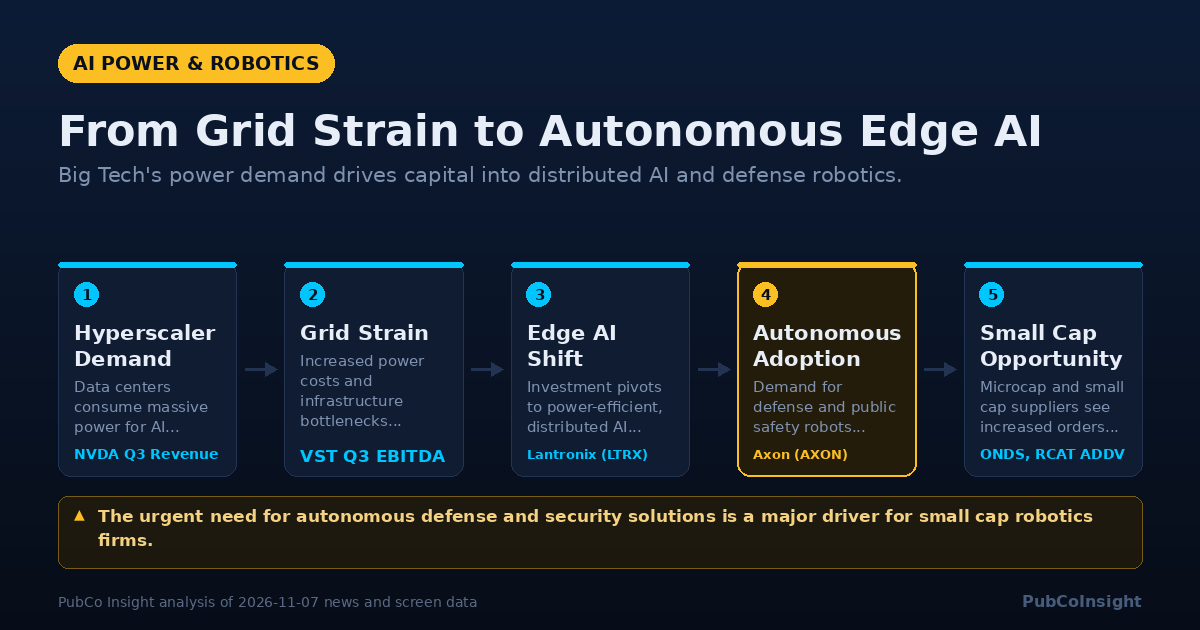
Vistra (VST) just posted record Q3 2026 earnings, reporting an adjusted EBITDA of $2 billion, a clear indicator of the immense power demands driven by the artificial intelligence boom. This isn't just about utility stock performance; it's a flashing red light for anyone tracking capital flows into the physical infrastructure supporting AI. When a major power generator like Vistra sees this kind of surge, it means the hyperscalers, the NVDA's of the world, are burning through megawatts at an unprecedented rate. This power bottleneck isn't just a cost center for big tech; it's a forcing function, pushing investment into more efficient edge AI hardware and, critically, into autonomous systems that can operate with less centralized power, including defense and security robotics.
Meanwhile, Axon Enterprise (AXON) announced a $1.2 billion commitment to a public safety drone deal, highlighting the accelerating adoption of autonomous robotics in critical infrastructure and defense. This isn't a speculative play; it's a massive, concrete investment by a public safety giant. The intersection of surging power demand for data centers and the urgent need for robust, decentralized autonomous solutions creates a unique transmission mechanism for capital and operational opportunities for small cap and microcap companies. The market isn't just chasing AI software; it's chasing the physical manifestation of AI, from the power plants that run it to the robots that execute its directives.
The Market Transmission Mechanism: From Megawatts to Microchips and Drones
The core transmission mechanism here is a dual-pronged effect: the intense pressure on power grids from data center expansion and the strategic pivot towards distributed, edge-based AI and autonomous systems. When Vistra (VST) reports record EBITDA, it's not just selling electricity; it's selling the lifeblood of the modern digital economy. This demand surge translates directly into higher energy costs for hyperscalers and, by extension, for any company relying on cloud infrastructure. This cost pressure forces innovation in power efficiency, pushing capital towards edge AI solutions that can process data closer to the source, reducing latency and energy consumption associated with transmitting data to centralized data centers. This shift creates a direct pipeline for small cap hardware and software providers. Companies developing low-power AI chips, ruggedized edge computing devices, and autonomous platforms that can operate independently of constant cloud connectivity become essential. The Axon (AXON) deal for public safety drones underscores the second part of this mechanism: the increasing reliance on autonomous robotics for security, logistics, and defense. These systems require specialized hardware, advanced sensor fusion, and robust communication protocols that are often developed by smaller, agile firms. The capital expenditure from big tech and government contracts for these solutions doesn't just stay with the prime contractors; it cascades down through the supply chain, creating opportunities for small cap component manufacturers, software developers, and integration specialists. Retail order flow also rotates into these niche plays as traders recognize the fundamental shift in infrastructure spending and defense priorities.
The weekly Flags Watchlist: small-caps now showing dilution or promotion signals, each linked to the SEC filing behind the flag.
How the Small-Cap and Microcap Cohort Positions Around This Trend
Several small cap and microcap companies are directly positioned to capitalize on these macro shifts in power demand and autonomous systems. Ondas Inc. (ONDS), with a 30-day average daily dollar volume (ADDV) of $314.8 million, is a significant player in the industrial drone and autonomous systems space. Ondas's focus on mission-critical wireless networks for industrial and government applications, including counter-UAS systems, aligns directly with the increased demand for robust, secure autonomous platforms. Their operational milestones often involve securing contracts for critical infrastructure protection, a segment increasingly impacted by the need for decentralized intelligence and security. Unusual Machines, Inc. (UMAC), showing a 30-day ADDV of $53.2 million, operates in the niche of advanced manufacturing for specialized robotics components. As the demand for autonomous defense and public safety drones escalates, companies like Unusual Machines become crucial suppliers for precision parts and assemblies. Their balance sheet realities often revolve around scaling production to meet contract demands, making their liquidity and operational efficiency key watch points. BigBear.ai Holdings, Inc. (BBAI), with a 30-day ADDV of $47.5 million, provides AI-powered analytics and decision intelligence solutions, often for government and defense clients. The push for autonomous systems generates vast amounts of data, and BigBear.ai's ability to process and derive actionable insights from this data is directly relevant. Their growth trajectory is tied to the increasing complexity of data generated by edge AI devices and autonomous fleets. Red Cat Holdings, Inc. (RCAT), with a 30-day ADDV of $33.5 million, is a drone technology company focused on defense and public safety. Their solutions, including small tactical drones and drone software, are direct beneficiaries of the Axon-style commitments and the broader shift towards autonomous defense. Red Cat's operational execution in securing government contracts and expanding its product line will be critical. Kopin Corporation (KOPN), trading with a 30-day ADDV of $13.3 million, specializes in microdisplays and optical solutions, essential components for augmented reality (AR) and virtual reality (VR) systems often integrated into advanced robotics and heads-up displays for autonomous operators. As autonomous systems become more sophisticated, the human-machine interface becomes paramount, creating demand for Kopin's specialized hardware. Serve Robotics Inc. (SERV), with a 30-day ADDV of $11.7 million, focuses on autonomous sidewalk delivery robots. While seemingly distinct, Serve Robotics represents the broader trend of deploying autonomous systems for practical, everyday applications, reducing reliance on human labor and optimizing logistics. Their success hinges on scaling their fleet and expanding service areas, demonstrating the viability of edge AI in real-world scenarios. Finally, Lantronix, Inc. (LTRX), with a 30-day ADDV of $4.3 million, provides secure data access and management solutions for the Internet of Things (IoT) and edge computing. As more autonomous devices come online, the need for secure, reliable connectivity and data management becomes critical. Lantronix's offerings are foundational to enabling the distributed intelligence required by these systems, from industrial IoT to defense applications. Their balance sheet strength and ability to integrate with diverse hardware platforms are key differentiators.What Active Traders and Desks Are Watching Next
* Q4 2026 Earnings Calls for Utilities: Monitor Vistra (VST) and other major power generators for updated guidance on data center demand and capital expenditure plans for grid upgrades. Any acceleration here signals continued pressure on power resources. * Hyperscaler Capex Announcements: Watch for Q4 2026 and Q1 2027 capital expenditure reports from major cloud providers and AI chip developers like NVDA. Specific allocations towards edge computing infrastructure or AI-optimized data centers will be key. * Defense Contract Awards: Track announcements from the Department of Defense and other government agencies for new contracts related to autonomous systems, counter-UAS technologies, and secure communications. These often provide direct revenue streams for small cap defense contractors. * FDA and Regulatory Updates for Robotics: For companies like Serve Robotics (SERV) and others in commercial autonomous applications, regulatory clarity or new standards for public deployment will be crucial catalysts. * Industry Conferences and Product Launches: Upcoming events like CES or specialized robotics and AI conferences often feature new product unveilings or partnership announcements from companies like Ondas (ONDS), Red Cat (RCAT), and Kopin (KOPN). * Retail Order Flow Trends: Observe shifts in average daily dollar volume and short interest across the small cap AI and robotics cohort. Sustained increases in liquidity for names like Unusual Machines (UMAC) or BigBear.ai (BBAI) could indicate growing retail and institutional interest.Companies mentioned
| Ticker | Company | Price |
|---|---|---|
| BBAI | BigBear.ai Holdings, Inc. | $2.22 |
| KOPN | Kopin Corporation | $3.04 |
| LTRX | Lantronix, Inc. | $5.17 |
| ONDS | Ondas Inc. | $5.335 |
| RCAT | Red Cat Holdings, Inc. | $4.04 |
| SERV | Serve Robotics Inc. | $3.22 |
| UMAC | Unusual Machines, Inc. | $11.9 |
Listed alphabetically, not ranked. Prices as of 2026-11-07 and they move. Check a live quote before relying on any of this.
How we chose the companies in this article
Candidate pool of 10 small-cap, microcap, and OTC names in Market Pulse: AI Power, Grid & Robotics; ranked by 30-day average daily dollar volume (Yahoo Finance) as of 2026-11-07. All compensated IR clients are excluded from this editorial lane.
PubCo Insight
See the dilution and promotion flags before you see the pitch.
Each week: the micro and small-caps now showing dilution or paid-promotion signals, with the SEC filing behind every flag. No recommendations, no price targets.
Every flag links to its EDGAR filing so you can check it yourself. Sponsored coverage disclosed under SEC 17(b). One-click unsubscribe.
Sources used in this article
- Better IPO to Buy: Anthropic vs. SpaceX Motley Fool · 2026-11-07
- Airbnb Just Popped After a Blowout Quarter. Is the Stock Still a Buy? Motley Fool · 2026-11-07
- Warren Buffett's Top Advice for Investors Bracing for a Market Crash Motley Fool · 2026-11-07
- What Is Behind The Rebound In Qualcomm Stock? Trefis · 2026-11-07
- In 5 Years, One of These Cryptocurrencies Could Be Worth More Than Bitcoin Motley Fool · 2026-11-07
- George Kurtz Just Announced Incredible News for CrowdStrike Investors and the Artificial Intelligence (AI) Industry Motley Fool · 2026-11-07
- Rocket Lab Just Built a Space Robot Motley Fool · 2026-11-07
- Here's the Yearly Dividend Income $10,000 Provides Across 3 Very Different Yields Motley Fool · 2026-11-07
- Archer Aviation Said It Has More Than $6 Billion in Orders. What Does That Actually Mean for Investors? Motley Fool · 2026-11-07
- Social Security's Trump Bump-Led 2027 COLA Is a Double-Edged Sword for Tens of Millions of Retirees Motley Fool · 2026-11-07
- What Just Happened To Vistra Stock? Trefis · 2026-11-07
- GE Vernova vs. Vistra: Which Industrials Stock Is a Better Buy for 2027? Motley Fool · 2026-11-07
PubCo Insight publishes research on small and micro-cap companies. Nothing here is investment advice, we make no buy or sell recommendations, and we publish no price targets. Small and micro-cap shares are speculative and illiquid and you can lose everything you put into them. Check every figure against primary filings on SEC EDGAR before you act on it.